Integrative Biomedical Research

Integrative Biomedical Research (Journal of Angiotherapy) | Online ISSN  3068-6326
463
Citations
1.9m
Views
801
Articles
Your new experience awaits. Try the new design now and help us make it even better
Switch to the new experience
Figures and Tables
REVIEWS   (Open Access)

Engineering the Trojan Horse: Programming Bacterial Vectors for Targeted Payload Delivery

Nur E Ahad1, Mahmud Hasan Khan1, MD Yasin Sharker1, Md. Asaduzzaman Shishir2, Kazi Fahmida Rahman1, Kazi Samia Pial1, Md. Murshed Hasan Sarkar1, Kazi Md. Mostafizur Rahman1, SM Bakhtiar Ul Islam1, Nayeema Bulbul1, Jinath Sultana Jime1, Ashrafus Safa3, Md. Fakruddin1*

+ Author Affiliations

Integrative Biomedical Research 10 (2) 1-8 https://doi.org/10.25163/biomedical.10210950

Submitted: 11 August 2026 Revised: 29 September 2026  Published: 08 October 2026 


Abstract

It is often challenging to implement precision medicine in practice because accessing diseased tissues through complex physiological barriers is difficult. Solid tumors and chronically inflamed tissues, as seen in IBD, create hostile microenvironments marked by hypoxia, acidosis, and increased pressure that preclude conventional macromolecular therapies. This review examines the advancement of bacterial vectors developed as living Trojan Horses via synthetic biology, intended to colonize and transport potent payloads to pathological locations. It examines chassis options, such as Escherichia coli Nissle 1917, and weakened pathogens, including Salmonella typhimurium and Listeria monocytogenes. We talk about genetic control devices like the Synchronized Lysis Circuit (SLC) and secretion systems (T1SS–T6SS). We also discuss how engineered bacteria utilise biochemical signals to release cytokines, nanobodies, or enzymes that convert prodrugs into active drugs. The creation of biocontainment switches and "nanoarmors" has made things safer and more effective. Although improvements are being made, issues persist with the stability of genetic circuits and the variability of bacterial engraftment. To find a balance between virulence attenuation and colonization, we need to use a variety of fields. For clinical success, it is crucial to continue developing autonomous biocontainment and regulatory pathways for live biotherapeutic products (LBPs).

Keywords: Engineered bacterial vectors; synthetic biology; targeted payload delivery; living therapeutics; tumor microenvironment; biocontainment; live biotherapeutic products.

1. Introduction

The development of drug carriers reached a turning point, and now the passive delivery of therapeutic agents is being replaced by self-contained biological vehicles (Charbonneau et al., 2020). Conventional delivery carriers, such as liposomes, polymeric nanoparticles, and viral vectors, have greatly modified the pharmacokinetic characteristics of many drug molecules. However, such platforms often lack the intelligence necessary to navigate the diverse and compartmentalised environments characteristic of human disease (Alshawwa et al., 2022). In contrast, bacterial vectors uniquely provide a “living” delivery system that exploits billions of years of evolutionary perfecting in motility, environmental perception and host colonisation (Zong et al., 2023). This Trojan Horse approach consists in programming bacteria to infiltrate disease settings without being recognised, and locally produce and deliver therapeutic cargo upon local cues, thus achieving the best of both worlds: high activity in disease sites but less toxicity systemically (Figure 1).

Figure 1: The Trojan Horse Workflow. Schematic of the bacterial delivery pipeline. (A) Engineered vectors are administered via systemic injection or oral routes. (B) Bacteria utilize flagellar-mediated motility to navigate against interstitial pressure gradients and innate chemotaxis to home in on pathological signals. (C) The vectors colonize the target niche, such as the necrotic core of a solid tumor or inflamed gut mucosa, replicating locally to maintain a therapeutic dose. (D) Upon sensing local triggers, the bacteria synthesize and release high-potency payloads, maximizing efficacy while minimizing systemic toxicity.

Synthetic biology has evolved from a theoretical field to an applied engineering discipline, that currently enables rational design of these microbial vectors. The field grows in tandem with the whole-genome sequencing of diverse bacteria, which made available the requisite blueprints for genetic committal (König et al., 2013). Nowadays, an engineered bacterial-based drug delivery system contains three necessary modules: a sensing module for detecting biomarkers in vitro, a processing module comprising heterogeneous genetic circuits (GCs) that integrate the detected signals, and an actuator module that generates a therapeutic compound to accomplish the release function (Omer et al., 2022). Such an elegant design enables bacteria to function like a single micro-machine, even performing complex and programmed tasks in vivo (Abedi et al., 2022). Especially in oncology and gastroenterology, the need for such systems is particularly high. Solid tumors are always characterized by abnormal vasculature, which results in hypoxic and necrotic areas that can hardly be reached by systemic chemotherapy (Schmidt et al., 2020). Similarly, in IBD patients, mucosal barriers and a rival microbiome protect chronically inflamed mucosa from effective drug penetration (Duan et al., 2021). Bacterial vectors can be engineered to specifically dwell in such sites, take advantage of their natural chemotaxis and target the necrotic core of tumors or inflammatory lesions in the gut (Harimoto et al., 2022).

The direction of microbial therapeutics has its origins in empirical reports of tumor shrinkage and elimination after bacterial infection, also known as Coley’s Toxins, almost a century ago (Chien et al., 2017). Nevertheless, the absence of genetic control and systemic toxicity restricted earlier uses (Chien et al., 2017). The early modification was via recombinant DNA technology during the 1970s and 1980s, and synthetic biology formalized with a toolbox of modular components in the early 2000s for precisely engineerable organisms (Pfeifer et al., 2023). The development of standardized assembly approaches such as BioBrick and later more efficient natural cloning methods as Gibson Assembly and Golden Gate Assembly enabled construction of multi-gene circuits on a short time scale (Kelwick et al., 2014). These developments changed the paradigm from mere gene over-expression to controllable, self-regulated systems that are well-behaved in the host.

The unique capabilities of engineered bacterial therapeutics offer on-demand production of intricate biopharmaceuticals directly at the required body site, thereby mitigating issues related to stability during storage, transportation, and administration (Dey et al., 2024).

The benefit of using live bacteria as opposed to abiotic nanoparticles is their active transport and sensing capabilities (van 't Hof, 2022). Bacteria exploit flagellar-mediated motility to migrate against the interstitial pressure gradients of tumors in a manner that passive diffusion-based systems cannot (Zoaby et al., 2016). They are also capable of local multiplication, such that the therapeutic dose at the site of disease is preserved even in the face of low initial systemic doses (St. Jean et al., 2008). This focal proliferation significantly increases the therapeutic index of highly active agents, such as cytokines or pore-forming toxins, which would otherwise cause severe systemic toxicity (St. Jean et al., 2008).

2. Selection and Engineering of Microbial Chassis

The design process for a bacterial Trojan Horse begins with selecting the ideal ‘chassis’ in which to implement the biocontainment (Fig. Such an ideal chassis should have high tolerance or be biocompatible, predictable colonisation of propagating elements and must be easily modified for safety and functionality.

2.1. Commensal and Probiotic Platforms

Escherichia coli Nissle 1917 (EcN), which is the most common and only Gram-negative probiotic chassis for use in humans to date. EcN has remained in medical use as a gastrointestinal therapeutic agent for over 100 years and serves as the active ingredient in the commercially available drug Mutaflor® (Reister et al., 2014). One of its significant advantages is its ability to grow as a facultative anaerobe that can accommodate the fluctuating O2 tensions in the gut and solid tumors (Chen, Lei, et al., 2023). EcN is also extremely versatile in metabolism, able to metabolize atypical nutrients from pathological tissues such as nitrate in hypoxic tumors or lactate and formate in inflamed lesions (Wang et al., 2025; Winter et al., 2013). More recent engineering approaches have involved curing EcN of its native plasmids (pM1 and pM2) to subsequently reintroduce chromosome-shredding CRISPR-Cas12 systems, thereby developing “non-proliferative” therapeutic platforms. By doing so, these organisms are left metabolically active to generate payloads, but may not replicate or escape into the environment – a significant concern for biocontainment (Chowdhury et al., 2019; Isabella et al., 2018).

Other non-pathogenic commensals, including Lactobacillus and Bifidobacterium species, are preferred because they are GRAS (Generally Recognised as Safe). Bifidobacterium species are obligate anaerobes, specifically suited for reaching the deepest anoxic avascular necrotic areas of solid tumours, which facultative anaerobes might have difficulty penetrating (Van Dessel et al., 2015). B. longum and B. infantis have been demonstrated to augment the efficacy of checkpoint inhibitors by altering the systemic immune milieu (Kong et al., 2025; Shang et al., 2024).  Lactococcus lactis is generally an aerotolerant anaerobe, and its widespread use for localized delivery in the small intestine includes engineering auxotrophy in these strains (eg, ΔthyA) to enable environmental containment (Cook et al., 2018).

2.2. Attenuated Pathogenic Vectors

Pathogenic bacteria, such as Salmonella typhimurium and Listeria monocytogenes, are chosen because of their high motility and special ability to enter host cells (Husseiny & Hensel, 2006). Salmonella is a very effective coloniser of tumours. It will accumulate in areas such as tissue, reaching concentrations three orders of magnitude higher than those in healthy tissues, such as the liver or spleen (Kocijancic et al., 2017). For attenuation of virulence, clinical-grade strains such as VNP20009 have been constructed by multiple rounds of genetic deletions,  including purI (resulting in purine auxotrophy), and msbB (which alters lipopolysaccharide structure for decreasing TNF-α-mediated sepsis) (Broadway et al., 2017). Another strain, Salmonella A1-R, has been shown in vitro and in vivo to induce cancer cell death through rapid proliferation with a burst effect (Mi et al., 2019).

Listeria monocytogenes has an interesting advantage in that it is intracellular (Fotopoulou et al., 2024). It exploits internalins (InlA and InlB) to induce receptor-mediated endocytosis, before breaking the phagosome to reach the cytosol, following the release of Listeriolysin O (LLO) and phospholipases (Flickinger et al., 2018; Theisen & Sauer, 2016). In the cytosol, it polymerises host actin using the ActA protein and disseminates between cells (Li et al., 2024). For therapeutic applications, Listeria is commonly attenuated by the deletion of actA, which prevents spread, and inlB to reduce liver toxicity. These "double-deleted" (LADD) strains are highly efficient in delivering antigens to both the MHC I and MHC II pathways,  and therefore, they represent prime candidates for cancer vaccines (Ding et al., 2023).

The physiological and metabolic differences between these species dictate their clinical application, as summarized in Table 1.

Table 1. Attributes and Applications of Microbial Chassis. Comparative summary of the principal bacterial chassis currently used as living vectors for targeted payload delivery. For each organism the table reports the motility rate measured in semisolid medium, the primary anatomical or microenvironmental niche that the strain colonises, the key genetic modifications introduced to attenuate virulence or to enforce biocontainment, and the oxygen tolerance of the strain. Read together, these attributes determine whether a given chassis is best suited to gut-mucosal, intracellular or hypoxic tumour applications.

Chassis Organism

Motility Rate (semisolid medium)

Primary Target Niche

Key Safety Modifications

Oxygen Tolerance

Reference

E. coli Nissle 1917

1.31 cm/hr

Gut mucosa, Solid tumors

Plasmid curing, CRISPR shredding

Facultative Anaerobe

(Isabella et al., 2018)

Salmonella typhimurium

1.49 cm/hr

Necrotic tumor core

ΔpurI, ΔmsbB (VNP20009)

Facultative Anaerobe

(Broadway et al., 2017; Toso et al., 2002)

Listeria monocytogenes

Intracellular propagation

Cytosol of APCs

ΔactA, ΔinlB, Δdal/dat

Facultative Anaerobe

(Zeng et al., 2020)

Bifidobacterium longum

Low/Passive

Colon, Necrotic tumor core

Natural probiotic status

Strict Anaerobe

(Sarkar & Mandal, 2016)

Lactococcus lactis

Non-motile

Small intestine

ΔthyA (Auxotrophy)

Aerotolerant Anaerobe

(Cook et al., 2018)

 3. Genetic Circuitry: Programming the Trojan Horse

The "Trojan Horse" metaphor is most apt when describing the genetic circuits that allow bacteria to remain dormant until they reach their destination. These circuits process environmental inputs and execute complex logic to control the production and release of payloads (Figure 2).   

Figure 2: Modular genetic circuitry for programmable therapeutics. The engineered architecture consists of three integrated components: a Sensing Module that detects environmental biomarkers like lactate or hypoxia; a Processing Module that utilizes Boolean logic gates (e.g., AND, NOT) to compute inputs and prevent off-target activation; and an Actuator Module responsible for the production and secretion of the therapeutic compound.

3.1. Sensing Modules and Synthetic Promoters

Engineering starts with the choice of promoters, which recognise distinct chemical signals(Green & Paget, 2004). Many hypoxia-inducible systems are based on the oxygen-responsive Fumarate and Nitrate Reduction regulator (FNR) (Kiley & Beinert, 2003; Unden & Schirawski, 1997). Under hypoxic conditions, FNR also binds a 2+ cluster to form the active homodimer, which initiates transcription at promoters such as pPepT, pflE, or synthetic FF+20 (Kelly et al., 2018; Kiley & Beinert, 2003). In the intestine, engineered EcN is engineered to detect markers of IBD (Riglar et al., 2016; Riglar et al., 2017). For instance, thiosulfate-sensitive promoters (through the ThsS/R system) enable bacteria to detect a gut inflammation marker, which can then induce the secretion of anti-inflammatory cytokines (Daeffler et al., 2017; Winter et al., 2010). Likewise, sensors of lactate and pH (LldR, pCadC) can be exploited to preferentially target cells residing within the acidic, lactate-rich niche typical of several cancers (Wang et al., 2025; Zúñiga et al., 2021).

3.2. Boolean Logic and Signal Processing

A combination of various sensors, controlled by Boolean logic gates (AND, OR, NOT, and NOR) , dramatically enhances the specificity of the delivery (Moon et al., 2012; Nielsen et al., 2016; Tamsir et al., 2010). A prime example is the AND gate, which only in the presence of hypoxia and high lactate together fulfils the conditions for a defined release of payload, thus avoiding nonspecific therapeutic effects in healthy, oxygenated tissues (Anderson et al., 2007; Chowdhury et al., 2019; Danino et al., 2015). These gates are implemented using strongly insulated TetR-family transcriptional repressors (Nielsen et al., 2016; Stanton et al., 2013). These circuits are standardized by the use of Relative Promoter Units (RPU) that quantify RNA polymerase flow, resulting in models predicting circuit behavior across strains (Kelly et al., 2009; Nielsen et al., 2016). Since a library of genetic NOT gates has been well characterized in EcN, complex multi-input NOR gates and sequential logic circuits have been constructed (Nielsen et al., 2016; Roquet et al., 2016; Stanton et al., 2013).   

3.3. Memory and Sequential Logic

For diagnostic purposes, bacteria need to “remember” their surroundings. Bacteria can be engineered to "remember" the presence of a biomarker even if they are no longer in that environment, using S/R (Set-Reset) latches as sequential logic circuits (Tanniche & Behkam, 2023). One approach to monitor and report the diverse signals produced by these communities is the engineering of EcN with concentration-recording circuits, which sense, record, and report distinct levels of biochemical signals as "analogue-to-digital" converters for the microbiome (Daniel et al., 2013; Farzadfard & Lu, 2014) (Table 2).

Table 2. Synthetic Logic Gates and Memory Circuits Implemented in Bacterial Vectors. Overview of the genetic computation modules that allow engineered bacteria to restrict payload production to the intended pathological niche. Each entry identifies the component repressors or sensor proteins from which the gate is assembled, the input criteria that the circuit evaluates, and the functional result obtained in engineered cells. The collection spans simple signal inversion (NOT gate), layered multi-input logic (NOR and AND gates), bi-stable memory elements that record transient exposures (SR latch), and population-level oscillators that drive periodic release (synchronized lysis).

Logic Gate/Circuit

Component Repressors/Sensors

Input Criteria

Functional Result

Reference

NOT Gate

SrpR, PhlF, IcaRA

Single promoter input

Signal inversion: foundational for layering

(Nielsen et al., 2016; Stanton et al., 2013)

NOR Gate

Layered repressor gates

Multiple promoter inputs

Output is 'ON' only if all inputs are 'OFF'

(Moon et al., 2012; Tamsir et al., 2010)

AND Gate

pPepT + LldR

Hypoxia + Lactate

Specificity for necrotic tumor microenvironments

(Anderson et al., 2007; Danino et al., 2015)

SR Latch

SrpR S3 / PhlF P2 pair

Transient signal pulse

Bi-stable memory; records exposures

(Ajo‐Franklin et al., 2007; Gardner et al., 2000)

Synchronized Lysis

pLuxI/LuxR + AHL

Quorum density

Oscillatory, periodic drug release

(Danino et al., 2010; Din et al., 2016)

4. Therapeutic Payloads and the Trojan Mechanism

The payloads delivered by bacterial Trojan Horses range from small molecules to complex proteins and nucleic acids. The strategy often involves conjugating these payloads to bacterial machinery, facilitating translocation across membranes.   

4.1. Siderophore-Mediated Delivery

A related Trojan-horse approach exploits the host iron transport machinery of pathogens. Gram-negative bacteria produce siderophores in order to obtain iron. Modification of drugs for delivery to bacteria through the attachment of artificial siderophores and synthetic siderophores covalently linked to antibiotics/antibacterial antisense oligomers (ASOs) represents a novel approach to transport large macromolecules across the bacterial cell membrane, thereby circumventing the increasing growth in antibiotic resistance (Graff & Barry, 2024; Rayner et al., 2023; Zscherp et al., 2021). In this way, the bacteria are "deceived" into uploading their own demise.

4.2. Immunomodulatory Payloads

The focus in cancer immunotherapy is on shaping the tumor microenvironment (TME). Synthetic bacteria have been crafted to deliver:

  • Nanobodies: The local delivery of anti-CD47, anti-PD-L1 or anti-CTLA-4 nanobodies aids immune checkpoint blockade, resulting in CD8+ T cell infiltration without systemic side effects (Nguyen et al., 2023).
  • Cytokines: Prolonged exposure to IL-12, TNF-α, or IFN-γ converts “cold” tumors into “hot” lesions that are inflamed and more responsive to immune attack (Yan et al., 2025).
  • Pro-apoptotic Proteins: Hemolysin E (HlyE) is a channel-forming toxin that can be targeted to tumours specifically and used for direct lysis of the cancer cells (Swofford et al., 2014).   

4.3. Payloads for Inflammatory and Metabolic Disorders

For IBD, vectors are designed to produce anti-inflammatory molecules such as IL-10, TGF-β1 or elafin (an antiprotease) (Liu et al., 2022). In metabolic disorders, such as Phenylketonuria (PKU), bacteria are engineered to break down toxic metabolites. For example, the engineered strain SYNB1618 produces enzymes in the gut that degrade phenylalanine (Phe) before it can accumulate to toxic concentrations in the systemic circulation (Kim et al., 2023).   

5. Release Mechanisms: Delivering the Cargo

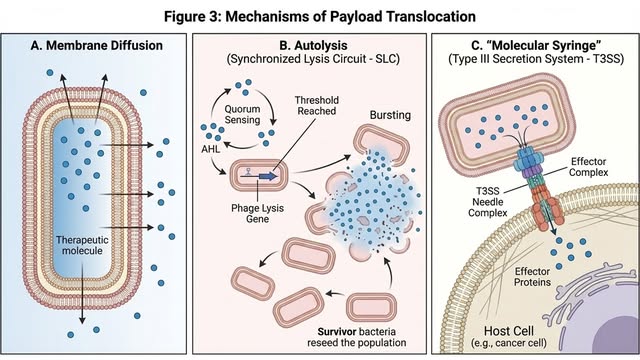
The Trojan Horse method depends on what and when it does what. Two main subtypes of release exist: heterologous secretion systems and programmed cell lysis (Figure 3).

Figure 3: Schematic representation of bacterial delivery and release strategies. Engineered vectors utilize diverse mechanisms to ensure the delivery of high-potency payloads to pathological niches. (A) Programmed and Synchronized Lysis (SLC): A synthetic quorum-sensing circuit monitors population density and triggers a phage lysis gene (e.g., $\phi X174 E$) to cause a rhythmic, extracellular burst of therapeutic cargo. (B) Specialized Secretion Systems: Pathogen-derived structures like the Type III Secretion System (T3SS) function as "molecular syringes" to inject proteins directly into the host cell cytoplasm. The Type VI Secretion System (T6SS) utilizes a contractile tail to mechanically spear effectors across membranes. (C) Vesicular Delivery: Outer Membrane Vesicles (OMVs) are natural nanostructures that can be engineered to carry drugs through mucosal barriers and intestinal epithelial layers more efficiently than whole bacteria. (D) Universal Secretion: The Sec and Tat pathways facilitate the transport of payloads into the periplasmic or extracellular space via translocases.

5.1. Programmed and Synchronized Lysis

One of the most novel release mechanisms is Synchronized Lysis Circuit (SLC). It reads the bacterial population density inside the tumor through a quorum-sensing loop (commonly used luxI/luxR)(Chien et al., 2017). Once a threshold concentration of AIs (AHLs) is reached and lysis gene under the control of it is induced (for example using ϕX174 element E), the mass population explodes in an event known as “lysis” releasing its content (Din et al., 2016). However, antigen is delivered in a pulsatile temporal manner, and with only a small number of survivors reseeding the population, leading to periodic tonic delivery of the virus. Such an "integrate and fire" mechanism is exploited to prevent systemic toxicity by controlling the total bacterial load, while maintaining a pulsatile administration of therapy (Din et al., 2016). 

5.2. Bacterial Secretion Systems

Modification of bacterial secretion systems (T1SS–T6SS) may also be possible to re-engineer for payload delivery (Table 3):

  • Type III (T3SS): This sophisticated apparatus enables Gram-negative pathogens to deliver effector proteins into the cytoplasm of the host cell, all without extracellular exposure (Green & Mecsas, 2016).   
  • Type VI (T6SS): A molecular spring-loaded nanomachine that ejects effectors into membranes of adjacent cells (Basler, 2015). 
  • Outer Membrane Vesicles (OMVs): These naturally occurring nanostructures can also be designed to contain high payload of drugs and or decorated with targeting ligands for better penetration through mucosal layers as compared to whole bacteria (Lieberman, 2022).

Table 3. Mechanisms of Therapeutic Payload Release from Engineered Bacterial Vectors. Comparison of the natural and synthetic routes through which engineered bacteria externalise their therapeutic cargo. For each mechanism the table gives the biological origin of the machinery, the type of delivery that it achieves, and the key structural proteins required for its assembly and function. The routes range from direct cytoplasmic injection by pathogen-derived secretion systems, through quorum-triggered extracellular burst and vesicular transfer, to universal periplasmic and extracellular export. The choice among them determines whether a payload reaches the host cytosol, the extracellular matrix or the mucosal surface.

Release Mechanism

Biological Origin

Delivery Type

Key Structural Proteins

Reference

T3SS

Salmonella, Yersinia

Direct cytoplasmic injection

~20 proteins forming a "needle"

(Green & Mecsas, 2016)

T6SS

Vibrio, Pseudomonas

Mechanical spear injection

TssJLM complex, contractile tail

(Basler, 2015)

SLC

Synthetic (Phage E gene)

Extracellular burst

LuxI, LuxR, Phage E

(Din et al., 2016)

OMV

Natural (Gram-negative)

Vesicular delivery

Outer membrane lipid bilayer

(Lieberman, 2022)

Sec/Tat

Universal

Periplasmic/Extracellular

SecYEG translocase

(Oswald et al., 2021)

6. Overcoming Host Defenses and Barriers

In order to be effective, a Trojan Horse must not be eliminated by the host's defenses. This is accomplished by modifying the surface and through the application of hybrid systems.

6.1. Surface Modification: "Nano armor" and Bio-hybrids

These surface physicochemical coatings, or "nano armor," act like a shield against the attack by gastric acid and the host immunity. One approach includes that of "therapeutic nano-coatings" or the administration of "responsively degradable nano armor" to render high resistance and stable gut colonisation. Furthermore, “biomimetic cloaking” by encapsulating bacteria with host cellular membranes (e.g., red blood cell membrane) helps to protect bacterial from immune surveillance and increase intra-tumoral interstitial penetration (Cao & Liu, 2024).

6.2. Navigating the Microbiome and Mucosal Barriers

By enabling the engineered probiotics to self-coat themselves with biofilms, they can be presented in this competitive gut-growing environment and protected from mechanical clearance (Armetta, 2022). Several vectors also follow competitive colonisation mechanisms, which produce bacteriocins to suppress the pathogenic bacteria population and occupy the special niches in the ileum or colon (Pickard et al., 2017). Therapeutically, OMVs are particularly useful for IBD, as they can cross the gut epithelial barrier more readily than parent bacteria to deliver anti-inflammatory molecules directly into the submucosa (Chen et al., 2025).   

7. Biocontainment and Safety Switches

When even bacteria are engineered to enter the body, one really needs to have control over their survival and movement within. To prevent these scenarios, synthetic biologists have created a number of “kill switches.  

7.1. The Deadman and Passcode Switches

Here, inside the Deadman Switch: a system that only works as long as something else is actively in place to suppress it. If the signal is lost (e.g., bacteria leave the site, are excreted), that switch is flipped to a “death” state in which high levels of toxins are expressed and the organism dies quickly. The Passcode Switch is a little more complicated, acting like a biological logic gate that needs particular amounts of chemicals to survive(Aggarwal et al., 2022).   

7.2. "Demon and Angel" Systems

A new strategy used for genetic stability is the "demon and angel" system. This system combines high expression of a toxic essential gene (the "demon") with low-level expression required for survival (the "angel"). By knocking out the endogenous essential gene and putting it only on the circuit, bacteria are pressured to stay within this kill switch in order to survive (to avoid emergence of loss-of-function mutants over hundreds of generations)(Kato & Mori, 2024).   

8. Clinical Status and Translational Landscape

The transition of bacterial vectors from the laboratory to the clinic is an ongoing process marked by several milestone trials.

8.1. Trials in Oncology

  • Bacillus Calmette-Guérin (BCG): An attenuated strain of Mycobacterium bovis, is the first and unique FDA-approved bacterial therapy for superficial bladder cancer. It has a local immunostimulation that decreases the recurrence of tumors(Kramer et al., 2018).   
  • VNP20009 (S. typhimurium): Tested in Phase I studies for metastatic melanoma. Although it was safe, with tumor targeting as judged by dose-limiting and suboptimal colonization levels, further genetic optimization is required (Toso et al., 2002).   
  • Clostridium novyi-NT: When delivered in spore form, this obligate anaerobe has demonstrated potent antitumor effects in Phase I studies, with intra-tumoral injections resulting in regression of >1/3 of treated patients (Jankú et al., 2020).   

8.2. Trials in Metabolic and Inflammatory Disease

  • AG019 (L. lactis): A pill for the oral treatment of Type 1 Diabetes, proinsulin and IL-10. Three-phase 1b/2a trials (Mathieu et al., 2023) demonstrated the safety and tolerability of the treatment, with stabilisation of metabolic variables and induction of antigen-specific tolerance.   
  • SYNB1618 and SYNB1934 (E. coli Nissle): These were Synthetic Biotics created for PKU. Dose-dependent trials revealed a significant effect of phenylalanine provision on consumption. Similarly, the Phase 3 Synpheny-3 trial of SYNB1934 was stopped in February 2024 after an internal review concluded it will not likely achieve its primary efficacy endpoint, despite being safe and having a tolerable side effect profile (Chen, Pan, et al., 2023; Vockley et al., 2023) (Table 4).   

Table 4. Clinical Status and Translational Landscape of Live Biotherapeutic Programmes. Summary of registered clinical studies relevant to engineered live biotherapeutic products and their comparators. Each row records the ClinicalTrials.gov identifier, the sponsoring organisation, the vector or chassis under investigation, the indication being targeted, and the reported status or principal outcome of the study. The set covers completed early-phase safety and proof-of-mechanism trials in type 1 diabetes and phenylketonuria, together with ongoing oncology programmes and observational registry and biomarker studies in inflammatory bowel disease.

Clinical Trial ID (NCT)

Sponsor/Company

Vector/Chassis

Indication

Status/Outcome

Reference

NCT03751007

ActoBio

Lactococcus lactis

Type 1 Diabetes

Phase 1b/2a Completed; safe/stabilized C-peptide

(Mathieu et al., 2023)

NCT04534842

Synlogic

E. coli Nissle

Phenylketonuria

Phase 2 Completed; reduced plasma Phe by 40%

(Vockley et al., 2023)

NCT03516487

Synlogic

E. coli Nissle

Phenylketonuria

Phase 1/2a Completed; proof-of-mechanism

(Puurunen et al., 2021)

NCT03860272

Agenus Inc.

Fc-engineered Ab

Advanced Cancer

Phase 1; dose escalation ongoing

(Chand et al., 2024)

NCT03162549

CorEvitas

Registry Study

IBD

Ongoing; effectiveness of IBD biologics

ClinicalTrials.gov (NCT03162549)

NCT03462875

CUHK

Microbiota Study

Eastern IBD

Completed; mapping microbial profiles in Asia

ClinicalTrials.gov (NCT03462875);(Qiu et al., 2022)

NCT05640583

HyGIeaCare

Biomarker Study

IBD Biomarkers

Completed; assessing colonic biomarkers vs stool

ClinicalTrials.gov (NCT05640583)


9. Regulatory Perspectives and Future Directions

The regulatory environment on LBP products is complicated and ever-changing. Regulators [such as, the U.S. Food and Drug Administration (FDA) and European Medicines Agency (EMA)] have defined criteria that differentiate LBPs from normal probiotics in foods.

9.1. EU SoHO Regulation 2024

The new EU Regulation 2024/1938 on quality and safety standards for substances of human origin (SoHO): Published July 17, 2024. This legislation broadens the application of current regulations to intestinal microbiota and mandates that entities collecting or manipulating them register and adhere to rigorous quality controls by August 2027 (Rodriguez et al., 2025). This change takes a harder line with human-derived microbial products, recognising their one-of-a-kind biology and potential impact on patient safety (Mikkelsen et al., 2020).   

9.2. FDA 2025 Updates

In 2025, the FDA published multiple draft guidance to update how it regulates biological products. This features new guidelines to show biosimilarity and new testing procedures for bacterial and viral pathogens in donors of human cells and tissues. For LBPs, chemistry, manufacturing and control information is emphasised, still requiring extensive strain characterisation and stability to guarantee a uniform therapeutic output (Min et al., 2025).

10. Nuanced Conclusions on the Microbial Trojan Horse

The Trojan AhM Theta Horse: Engineering Bacterial Vectors to Cleave Coding DNA within a Patient Bioreactor. The construction of bacterial vectors as Trojan Horses is the quality class in biological redirection. By turning pathogens into protectors and commensals into drug factories, researchers are getting around the constraints of bacteria as drugs. A second-order insight imputed from recent clinical failures — one example of course being the SYNB1934 trial read-out — is that survival and persistence in the complex human gut ecosystem are as important as sensitive sensing. Future Investigation Future studies will need to focus on "engraftment engineering," so that the Trojan Horses not only are able to reach their destination but also last long enough to have a therapeutic effect. Furthermore, self-contained biocontainment is no longer an elective safety element, but a requirement for clinical translation. The transition of these systems to the phase II or III stage will be associated with a shift from basic “ON/OFF” switches as dose controllers to complex control systems, capable of managing drugs in response to disease severity at any given time. The journey from food-borne pathogen to precision cancer vaccine is a long one, but with the landmarks reached in PKU and oncology, the era of living drugs as clinical fact is very much an emerging destination.

11. Conclusion

Engineered bacterial vectors have moved from empirical observation to rational design, offering a delivery modality that no passive carrier can match: a self-propelled, sensing, computing agent capable of persisting within hypoxic tumour cores and chronically inflamed mucosa and manufacturing its payload in situ. The convergence of defined chassis such as E. coli Nissle 1917 and attenuated Salmonella, inducible promoters wired into Boolean and memory circuits, tunable release through synchronised lysis or type I–VI secretion, and surface "nanoarmor" has produced systems that are measurably safer and more potent than their predecessors. Yet translation remains constrained by the same three problems: genetic circuits that drift or are lost under in vivo selection, engraftment that varies unpredictably between hosts, and the unresolved trade-off between attenuating virulence and preserving colonisation. Progress will therefore depend less on new parts than on circuit evolutionary stability, autonomous biocontainment, and regulatory frameworks for live biotherapeutic products that are still taking shape.

References


Abedi, M. H., Yao, M. S., Mittelstein, D. R., Bar-Zion, A., Swift, M., Lee-Gosselin, A., et al. (2022). Ultrasound-controllable engineered bacteria for cancer immunotherapy. Nature Communications, 13(1), 1585. https://doi.org/10.1038/s41467-022-29065-2

Aggarwal, N., Kitano, S., Puah, G. R. Y., Kittelmann, S., Hwang, I. Y., & Chang, M. W. (2022). Microbiome and Human Health: Current Understanding, Engineering, and Enabling Technologies. Chemical Reviews, 123(1), 31. https://doi.org/10.1021/acs.chemrev.2c00431

Ajo-Franklin, C. M., Drubin, D. A., Eskin, J. A., Gee, E. P. S., Landgraf, D., Phillips, I., et al. (2007). Rational design of memory in eukaryotic cells. Genes & Development, 21(18), 2271. https://doi.org/10.1101/gad.1586107

Alshawwa, S. Z., Kassem, A. A., Farid, R. M., Mostafa, S. K., & Labib, G. S. (2022). Nanocarrier Drug Delivery Systems: Characterization, Limitations, Future Perspectives and Implementation of Artificial Intelligence. Pharmaceutics, 14(4), 883. https://doi.org/10.3390/pharmaceutics14040883

Anderson, J. C., Voigt, C. A., & Arkin, A. P. (2007). Environmental signal integration by a modular AND gate. Molecular Systems Biology, 3(1), 133. https://doi.org/10.1038/msb4100173

Armetta, J. (2022). Sequence-guided approaches for the cultivation and engineering of the gut microbiome [Doctoral dissertation, Technical University of Denmark]. Research Portal Denmark. https://local.forskningsportal.dk/local/dki-cgi/ws/cris-link?src=dtu&id=dtu-43733bed-f266-45e2-8f92-80b372a3c15d

Basler, M. (2015). Type VI secretion system: secretion by a contractile nanomachine. Philosophical Transactions of the Royal Society B Biological Sciences, 370(1679), 20150021. https://doi.org/10.1098/rstb.2015.0021

Broadway, K. M., Suh, S., Behkam, B., & Scharf, B. E. (2017). Optimizing the restored chemotactic behavior of anticancer agent Salmonella enterica serovar Typhimurium VNP20009. Journal of Biotechnology, 251, 76. https://doi.org/10.1016/j.jbiotec.2017.04.006

Cao, Z., & Liu, J. (2024). Surface nanocoating of bacteria as a versatile platform to develop living therapeutics. Nature Protocols, 19(11), 3162. https://doi.org/10.1038/s41596-024-01019-6

Chand, D., Savitsky, D. A., Krishnan, S., Mednick, G., Delépine, C., García-Broncano, P., et al. (2024). Botensilimab, an Fc-Enhanced Anti–CTLA-4 Antibody, Is Effective against Tumors Poorly Responsive to Conventional Immunotherapy. Cancer Discovery, 14(12), 2407. https://doi.org/10.1158/2159-8290.cd-24-0190

Charbonneau, M. R., Isabella, V. M., Li, N., & Kurtz, C. (2020). Developing a new class of engineered live bacterial therapeutics to treat human diseases. Nature Communications, 11(1). https://doi.org/10.1038/s41467-020-15508-1

Chen, A., Pan, Y., & Chen, J. (2023). Clinical, genetic, and experimental research of hyperphenylalaninemia. Frontiers in Genetics, 13. https://doi.org/10.3389/fgene.2022.1051153

Chen, H., Lei, P., Ji, H., Yang, Q., Peng, B., Ma, J., et al. (2023). Advances in Escherichia coli Nissle 1917 as a customizable drug delivery system for disease treatment and diagnosis strategies. Materials Today Bio, 18, 100543. https://doi.org/10.1016/j.mtbio.2023.100543

Chen, K., Huang, L., Yang, M., Yue, N., Luo, D. W., Zhang, Y., et al. (2025). Microbiome engineering: unlocking therapeutic potential in inflammatory bowel disease. Frontiers in Microbiology, 16. https://doi.org/10.3389/fmicb.2025.1610029

Chien, T., Doshi, A., & Danino, T. (2017). Advances in bacterial cancer therapies using synthetic biology. Current Opinion in Systems Biology, 5, 1. https://doi.org/10.1016/j.coisb.2017.05.009

Chowdhury, S., Castro, S., Coker, C., Hinchliffe, T. E., Arpaia, N., & Danino, T. (2019). Programmable bacteria induce durable tumor regression and systemic antitumor immunity. Nature Medicine, 25(7), 1057. https://doi.org/10.1038/s41591-019-0498-z

Cook, D. P., Gysemans, C., & Mathieu, C. (2018). Lactococcus lactis As a Versatile Vehicle for Tolerogenic Immunotherapy. Frontiers in Immunology, 8, 1961. https://doi.org/10.3389/fimmu.2017.01961

Daeffler, K. N. M., Galley, J. D., Sheth, R. U., Ortiz-Velez, L., Bibb, C. O., Shroyer, N. F., et al. (2017). Engineering bacterial thiosulfate and tetrathionate sensors for detecting gut inflammation. Molecular Systems Biology, 13(4), 923. https://doi.org/10.15252/msb.20167416

Daniel, R., Rubens, J. R., Sarpeshkar, R., & Lu, T. K. (2013). Synthetic analog computation in living cells. Nature, 497(7451), 619. https://doi.org/10.1038/nature12148

Danino, T., Mondragón-Palomino, O., Tsimring, L. S., & Hasty, J. (2010). A synchronized quorum of genetic clocks. Nature, 463(7279), 326. https://doi.org/10.1038/nature08753

Danino, T., Prindle, A., Kwong, G. A., Skalak, M., Li, H., Allen, K., et al. (2015). Programmable probiotics for detection of cancer in urine. Science Translational Medicine, 7(289). https://doi.org/10.1126/scitranslmed.aaa3519

Dey, S., Seyfert, C. E., Fink-Straube, C., Kany, A. M., Müller, R., & Sankaran, S. (2024). Thermo-amplifier circuit in probiotic E. coli for stringently temperature-controlled release of a novel antibiotic. Journal of Biological Engineering, 18(1). https://doi.org/10.1186/s13036-024-00463-y

Din, M. O., Danino, T., Prindle, A., Skalak, M., Selimkhanov, J., Allen, K., et al. (2016). Synchronized cycles of bacterial lysis for in vivo delivery. Nature, 536(7614), 81. https://doi.org/10.1038/nature18930

Ding, Y. D., Shu, L. Z., He, R. S., Chen, K., Deng, Y. J., Zhou, Z., et al. (2023). Listeria monocytogenes: a promising vector for tumor immunotherapy. Frontiers in Immunology, 14. https://doi.org/10.3389/fimmu.2023.1278011

Duan, L., Zheng, F., Merlin, D., Wang, H., Xiao, Z., & Xiao, B. (2021). Editorial: Oral Nanotherapeutics for Colon Diseases. Frontiers in Bioengineering and Biotechnology, 9. https://doi.org/10.3389/fbioe.2021.816304

Farzadfard, F., & Lu, T. K. (2014). Genomically encoded analog memory with precise in vivo DNA writing in living cell populations. Science, 346(6211), 1256272. https://doi.org/10.1126/science.1256272

Flickinger, J. C., Rodeck, U., & Snook, A. E. (2018). Listeria monocytogenes as a Vector for Cancer Immunotherapy: Current Understanding and Progress. Vaccines, 6(3), 48. https://doi.org/10.3390/vaccines6030048

Fotopoulou, E. T., Jenkins, C., Painset, A., & Amar, C. (2024). Listeria monocytogenes: the silent assassin. Journal of Medical Microbiology, 73(3). https://doi.org/10.1099/jmm.0.001800

Gardner, T. S., Cantor, C. R., & Collins, J. J. (2000). Construction of a genetic toggle switch in Escherichia coli. Nature, 403(6767), 339. https://doi.org/10.1038/35002131

Graff, A. M., & Barry, S. M. (2024). Siderophores as tools and treatments. npj Antimicrobials and Resistance, 2(1). https://doi.org/10.1038/s44259-024-00053-4

Green, E. R., & Mecsas, J. (2016). Bacterial Secretion Systems: An Overview. Microbiology Spectrum, 4(1). https://doi.org/10.1128/microbiolspec.vmbf-0012-2015

Green, J., & Paget, M. S. B. (2004). Bacterial redox sensors. Nature Reviews Microbiology, 2(12), 954. https://doi.org/10.1038/nrmicro1022

Harimoto, T., Hahn, J., Chen, Y., Im, J., Zhang, J., Hou, N., et al. (2022). A programmable encapsulation system improves delivery of therapeutic bacteria in mice. Nature Biotechnology, 40(8), 1259. https://doi.org/10.1038/s41587-022-01244-y

Husseiny, M. I., & Hensel, M. (2006). Construction of highly attenuated Salmonella enterica serovar Typhimurium live vectors for delivering heterologous antigens by chromosomal integration. Microbiological Research, 163(6), 605. https://doi.org/10.1016/j.micres.2006.10.003

Isabella, V. M., Ha, B., Castillo, M. J., Lubkowicz, D., Rowe, S. E., Millet, Y., et al. (2018). Development of a synthetic live bacterial therapeutic for the human metabolic disease phenylketonuria. Nature Biotechnology, 36(9), 857. https://doi.org/10.1038/nbt.4222

Jankú, F., Zhang, H. H., Pezeshki, A., Goel, S., Murthy, R., Wang-Gillam, A., et al. (2020). Intratumoral Injection of Clostridium novyi -NT Spores in Patients with Treatment-refractory Advanced Solid Tumors. Clinical Cancer Research, 27(1), 96. https://doi.org/10.1158/1078-0432.ccr-20-2065

Kato, Y., & Mori, H. (2024). Genetically stable kill-switch using “demon and angel” expression construct of essential genes. Frontiers in Bioengineering and Biotechnology, 12. https://doi.org/10.3389/fbioe.2024.1365870

Kelly, C. L., Harris, A. W. K., Steel, H., Hancock, E. J., Heap, J., & Papachristodoulou, A. (2018). Synthetic negative feedback circuits using engineered small RNAs. Nucleic Acids Research, 46(18), 9875. https://doi.org/10.1093/nar/gky828

Kelly, J., Rubin, A. J., Davis, J. H., Ajo-Franklin, C. M., Cumbers, J., Czar, M. J., et al. (2009). Measuring the activity of BioBrick promoters using an in vivo reference standard. Journal of Biological Engineering, 3(1), 4. https://doi.org/10.1186/1754-1611-3-4

Kelwick, R., MacDonald, J. T., Webb, A. J., & Freemont, P. S. (2014). Developments in the Tools and Methodologies of Synthetic Biology. Frontiers in Bioengineering and Biotechnology, 2. https://doi.org/10.3389/fbioe.2014.00060

Kiley, P. J., & Beinert, H. (2003). The role of Fe–S proteins in sensing and regulation in bacteria. Current Opinion in Microbiology, 6(2), 181. https://doi.org/10.1016/s1369-5274(03)00039-0

Kim, K., Kang, M., & Cho, B. (2023). Systems and synthetic biology-driven engineering of live bacterial therapeutics. Frontiers in Bioengineering and Biotechnology, 11. https://doi.org/10.3389/fbioe.2023.1267378

Kocijancic, D., Felgner, S., Schauer, T., Frahm, M., Heise, U., Zimmermann, K., et al. (2017). Local application of bacteria improves safety ofSalmonella-mediated tumor therapy and retains advantages of systemic infection. Oncotarget, 8(30), 49988. https://doi.org/10.18632/oncotarget.18392

Kong, Y., Bai, H., Deng, F., Zhao, Y., Li, Q., & Chang, L. (2025). Application of bifidobacterium in tumor therapy. Frontiers in Oncology, 15, 1551924. https://doi.org/10.3389/fonc.2025.1551924

König, H., Frank, D. N., Heil, R., & Coenen, C. (2013). Synthetic Genomics and Synthetic Biology Applications Between Hopes and Concerns. Current Genomics, 14(1), 11. https://doi.org/10.2174/138920213804999147

Kramer, M. G., Masner, M., Ferreira, F., & Hoffman, R. M. (2018). Bacterial Therapy of Cancer: Promises, Limitations, and Insights for Future Directions. Frontiers in Microbiology, 9. https://doi.org/10.3389/fmicb.2018.00016

Li, S., Yao, Q., Li, J., Yang, H., Qian, R., Zheng, M., et al. (2024). Inhibition of neutrophil swarming by type I interferon promotes intracellular bacterial evasion. Nature Communications, 15(1). https://doi.org/10.1038/s41467-024-53060-4

Lieberman, L. A. (2022). Outer membrane vesicles: A bacterial-derived vaccination system. Frontiers in Microbiology, 13, 1029146. https://doi.org/10.3389/fmicb.2022.1029146

Liu, Y., Feng, J., Pan, H., Zhang, X., & Zhang, Y. (2022). Genetically engineered bacterium: Principles, practices, and prospects. Frontiers in Microbiology, 13. https://doi.org/10.3389/fmicb.2022.997587

Mathieu, C., Wiedeman, A., Cerosaletti, K., Long, S. A., Serti, E., Cooney, L. G., et al. (2023). A first-in-human, open-label Phase 1b and a randomised, double-blind Phase 2a clinical trial in recent-onset type 1 diabetes with AG019 as monotherapy and in combination with teplizumab. Diabetologia, 67(1), 27. https://doi.org/10.1007/s00125-023-06014-2

Mi, Z., Feng, Z., Li, C., Yang, X., Ma, M., & Rong, P. (2019). Salmonella-Mediated Cancer Therapy: An Innovative Therapeutic Strategy. Journal of Cancer, 10(20), 4765. https://doi.org/10.7150/jca.32650

Mikkelsen, T. A., McIlroy, J. R., Mimiague, M., Rouanet, A., & Sterkman, L. (2020). Towards an EU-wide suitable regulatory framework for faecally derived, industrially manufactured medicinal products. United European Gastroenterology Journal, 8, 351. https://doi.org/10.1177/2050640620910313

Min, H. J., Choi, K., Yun, S., & Jang, S. (2025). Live Biotherapeutic Products for Metabolic Diseases: Development Strategies, Challenges, and Future Directions. Journal of Microbiology and Biotechnology, 35. https://doi.org/10.4014/jmb.2410.10054

Moon, T. S., Lou, C., Tamsir, A., Stanton, B. C., & Voigt, C. A. (2012). Genetic programs constructed from layered logic gates in single cells. Nature, 491(7423), 249. https://doi.org/10.1038/nature11516

Nguyen, D. H., Chong, A., Hong, Y., & Min, J. (2023). Bioengineering of bacteria for cancer immunotherapy. Nature Communications, 14(1). https://doi.org/10.1038/s41467-023-39224-8

Nielsen, A. A. K., Der, B. S., Shin, J., Vaidyanathan, P., Paralanov, V., Strychalski, E. A., et al. (2016). Genetic circuit design automation. Science, 352(6281). https://doi.org/10.1126/science.aac7341

Omer, R., Mohsin, M., Mohsin, A., Mushtaq, B. S., Huang, X., Guo, M., et al. (2022). Engineered Bacteria-Based Living Materials for Biotherapeutic Applications. Frontiers in Bioengineering and Biotechnology, 10. https://doi.org/10.3389/fbioe.2022.870675

Oswald, J., Njenga, R., Natriashvili, A., Sarmah, P., & Koch, H. (2021). The Dynamic SecYEG Translocon. Frontiers in Molecular Biosciences, 8, 664241. https://doi.org/10.3389/fmolb.2021.664241

Pfeifer, B. A., Beitelshees, M., Hill, A., Bassett, J., & Jones, C. H. (2023). Harnessing synthetic biology for advancing RNA therapeutics and vaccine design. npj Systems Biology and Applications, 9(1). https://doi.org/10.1038/s41540-023-00323-3

Pickard, J. M., Zeng, M. Y., Caruso, R., & Núñez, G. (2017). Gut microbiota: Role in pathogen colonization, immune responses, and inflammatory disease. Immunological Reviews, 279(1), 70. https://doi.org/10.1111/imr.12567

Puurunen, M., Vockley, J., Searle, S., Sacharow, S., Phillips, J. A., Denney, W. S., et al. (2021). Safety and pharmacodynamics of an engineered E. coli Nissle for the treatment of phenylketonuria: a first-in-human phase 1/2a study. Nature Metabolism, 3(8), 1125. https://doi.org/10.1038/s42255-021-00430-7

Qiu, P., Ishimoto, T., Fu, L., Zhang, J., Zhang, Z., & Liu, Y. (2022). The Gut Microbiota in Inflammatory Bowel Disease. Frontiers in Cellular and Infection Microbiology, 12, 733992. https://doi.org/10.3389/fcimb.2022.733992

Rayner, B., Verderosa, A. D., Ferro, V., & Blaskovich, M. A. T. (2023). Siderophore conjugates to combat antibiotic-resistant bacteria. RSC Medicinal Chemistry, 14(5), 800. https://doi.org/10.1039/d2md00465h

Reister, M., Hoffmeier, K., Krezdorn, N., Rotter, B., Liang, C., Rund, S. A., et al. (2014). Complete genome sequence of the Gram-negative probiotic Escherichia coli strain Nissle 1917. Journal of Biotechnology, 187, 106. https://doi.org/10.1016/j.jbiotec.2014.07.442

Riglar, D. T., Baym, M., Kerns, S. J., Niederhuber, M. J., Bronson, R. T., Kotula, J. W., et al. (2016). Long-term monitoring of inflammation in the mammalian gut using programmable commensal bacteria. bioRxiv (Cold Spring Harbor Laboratory). https://doi.org/10.1101/075051

Riglar, D. T., Giessen, T. W., Baym, M., Kerns, S. J., Niederhuber, M. J., Bronson, R. T., et al. (2017). Engineered bacteria can function in the mammalian gut long-term as live diagnostics of inflammation. Nature Biotechnology, 35(7), 653. https://doi.org/10.1038/nbt.3879

Rodriguez, J., Cordaillat-Simmons, M., Pot, B., & Druart, C. (2025). The regulatory framework for microbiome-based therapies: insights into European regulatory developments. npj Biofilms and Microbiomes, 11(1), 53. https://doi.org/10.1038/s41522-025-00683-0

Roquet, N., Soleimany, A. P., Ferris, A. C., Aaronson, S., & Lu, T. K. (2016). Synthetic recombinase-based state machines in living cells. Science, 353(6297). https://doi.org/10.1126/science.aad8559

Sarkar, A., & Mandal, S. (2016). Bifidobacteria—Insight into clinical outcomes and mechanisms of its probiotic action. Microbiological Research, 192, 159. https://doi.org/10.1016/j.micres.2016.07.001

Schmidt, C. K., Medina-Sánchez, M., Edmondson, R. J., & Schmidt, O. G. (2020). Engineering microrobots for targeted cancer therapies from a medical perspective. Nature Communications, 11(1). https://doi.org/10.1038/s41467-020-19322-7

Shang, F., Jiang, X., Wang, H., Guo, S., Kang, S., Xu, B., et al. (2024). Bifidobacterium longum suppresses colorectal cancer through the modulation of intestinal microbes and immune function. Frontiers in Microbiology, 15, 1327464. https://doi.org/10.3389/fmicb.2024.1327464

St. Jean, A., Zhang, M., & Forbes, N. S. (2008). Bacterial therapies: completing the cancer treatment toolbox. Current Opinion in Biotechnology, 19(5), 511. https://doi.org/10.1016/j.copbio.2008.08.004

Stanton, B. C., Nielsen, A. A. K., Tamsir, A., Clancy, K., Peterson, T. C., & Voigt, C. A. (2013). Genomic mining of prokaryotic repressors for orthogonal logic gates. Nature Chemical Biology, 10(2), 99. https://doi.org/10.1038/nchembio.1411

Swofford, C. A., St. Jean, A., Panteli, J. T., Brentzel, Z. J., & Forbes, N. S. (2014). Identification of Staphylococcus aureus α-hemolysin as a protein drug that is secreted by anticancer bacteria and rapidly kills cancer cells. Biotechnology and Bioengineering, 111(6), 1233. https://doi.org/10.1002/bit.25184

Tamsir, A., Tabor, J. J., & Voigt, C. A. (2010). Robust multicellular computing using genetically encoded NOR gates and chemical ‘wires.’ Nature, 469(7329), 212. https://doi.org/10.1038/nature09565

Tanniche, I., & Behkam, B. (2023). Engineered live bacteria as disease detection and diagnosis tools. Journal of Biological Engineering, 17(1). https://doi.org/10.1186/s13036-023-00379-z

Theisen, E., & Sauer, J. (2016). Listeria monocytogenes and the Inflammasome: From Cytosolic Bacteriolysis to Tumor Immunotherapy. Current topics in microbiology and immunology, 133. https://doi.org/10.1007/978-3-319-41171-2_7

Toso, J., Gill, V. J., Hwu, P., Marincola, F. M., Restifo, N. P., Schwartzentruber, D. J., et al. (2002). Phase I Study of the Intravenous Administration of AttenuatedSalmonella typhimuriumto Patients With Metastatic Melanoma. Journal of Clinical Oncology, 20(1), 142. https://doi.org/10.1200/jco.2002.20.1.142

Unden, G., & Schirawski, J. (1997). The oxygen-responsive transcriptional regulator FNR of Escherichia coli : the search for signals and reactions. Molecular Microbiology, 25(2), 205. https://doi.org/10.1046/j.1365-2958.1997.4731841.x

van ‘t Hof, M. (2022). Prediction, precision, and safety in advanced microbial therapeutics [Doctoral dissertation, Technical University of Denmark]. Research Portal Denmark. https://local.forskningsportal.dk/local/dki-cgi/ws/cris-link?src=dtu&id=dtu-88d5d0a9-2e43-42a9-98f8-36d9052ba5a9

Van Dessel, N., Swofford, C. A., & Forbes, N. S. (2015). Potent and Tumor specific: Arming Bacteria With Therapeutic Proteins. Therapeutic Delivery, 6(3), 385. https://doi.org/10.4155/tde.14.113

Vockley, J., Sondheimer, N., Puurunen, M., Díaz, G. A., Ginevic, I., Grange, D. K., et al. (2023). Efficacy and safety of a synthetic biotic for treatment of phenylketonuria: a phase 2 clinical trial. Nature Metabolism, 5(10), 1685. https://doi.org/10.1038/s42255-023-00897-6

Wang, M. G., Liu, M., Wang, D., Yang, D., Yiwei, Z., Lan, Y., et al. (2025). Engineered bacteria for cancer therapy: Advancements, challenges, and future directions. Chinese Medical Journal, 138(24), 3224. https://doi.org/10.1097/cm9.0000000000003807

Winter, S., Thiennimitr, P., Winter, M. G., Butler, B. P., Huseby, D. L., Crawford, R. W., et al. (2010). Gut inflammation provides a respiratory electron acceptor for Salmonella. Nature, 467(7314), 426. https://doi.org/10.1038/nature09415

Winter, S., Winter, M. G., Xavier, M. N., Thiennimitr, P., Poon, V., Keestra, A. M., et al. (2013). Host-Derived Nitrate Boosts Growth of E. coli in the Inflamed Gut. Science, 339(6120), 708. https://doi.org/10.1126/science.1232467

Yan, S., Sun, X., & Wang, K. (2025). From cold to hot tumors: feasibility of applying therapeutic insights to TNBC. Discover Oncology, 16(1). https://doi.org/10.1007/s12672-025-03745-z

Zeng, H., Xie, M., Ding, C., Ma, J., Xu, D., Wang, X., et al. (2020). Attenuated Listeria monocytogenes as a Vaccine Vector for the Delivery of OMPW, the Outer Membrane Protein of Aeromonas hydrophila. Frontiers in Microbiology, 11, 70. https://doi.org/10.3389/fmicb.2020.00070

Zoaby, N., Shainsky-Roitman, J., Badarneh, S., Abumanhal, H., Leshansky, A. M., Yaron, S., et al. (2016). Autonomous bacterial nanoswimmers target cancer. Journal of Controlled Release, 257, 68. https://doi.org/10.1016/j.jconrel.2016.10.006

Zong, R., Ruan, H., Liu, C., Fan, S., & Li, J. (2023). Bacteria and Bacterial Components as Natural Bio-Nanocarriers for Drug and Gene Delivery Systems in Cancer Therapy. Pharmaceutics, 15(10), 2490. https://doi.org/10.3390/pharmaceutics15102490

Zscherp, R., Coetzee, J., Vornweg, J. R., Grunenberg, J., Herrmann, J., Müller, R., et al. (2021). Biomimetic enterobactin analogue mediates iron-uptake and cargo transport into E. coli and P. aeruginosa. Chemical Science, 12(30), 10179. https://doi.org/10.1039/d1sc02084f

Zúñiga, A., Rufino, M. C., Chang, H., Fristot, E., Mayonove, P., Hani, E. H., et al. (2021). Engineered l-Lactate Responding Promoter System Operating in Glucose-Rich and Anoxic Environments. ACS Synthetic Biology, 10(12), 3527. https://doi.org/10.1021/acssynbio.1c00456


Article metrics
View details
0
Downloads
0
Citations
25
Views

View Dimensions


View Plumx


View Altmetric


0
Save
0
Citation
25
View
0
Share