Integrative Biomedical Research

Integrative Biomedical Research (Journal of Angiotherapy) | Online ISSN  3068-6326
463
Citations
1.9m
Views
801
Articles
Your new experience awaits. Try the new design now and help us make it even better
Switch to the new experience
Figures and Tables
REVIEWS   (Open Access)

Targeted Protein Degraders (PROTACs) Overcome KRAS Inhibitor Resistance and Remodel Antitumor Immunity in Lung Cancer

Nurhuda Mohamad Ansor1* Fan Xu1, Nozlena Abdul Samad1,  Marjanu Hikmah Elias 2, Kaynat Khimani 2

+ Author Affiliations

Integrative Biomedical Research 10 (2) 1-22 https://doi.org/10.25163/biomedical.10210954

Submitted: 04 October 2026 Revised: 20 November 2026  Published: 01 December 2026 


Abstract

For nearly forty years, KRAS sat on oncology's list of targets everyone wanted and no one could reach — a smooth, pocket-less GTPase whose picomolar affinity for GTP made conventional occupancy-driven chemistry a poor fit. Discovery of a cryptic switch-II pocket changed that calculus, delivering covalent G12C inhibitors such as sotorasib and adagrasib, yet clinical benefit has proven frustratingly transient: secondary pocket mutations, KRAS amplification, and adaptive feedback through wild-type RAS and upstream receptor tyrosine kinases routinely restore signaling within months. This review asks why that keeps happening and traces a different strategy built to answer it directly — targeted protein degradation, particularly proteolysis-targeting chimeras (PROTACs), which hijack the ubiquitin–proteasome system to eliminate the target physically rather than merely block it. We synthesize the mechanistic logic separating heterobifunctional PROTACs from monovalent molecular glues and non-proteasomal chimeras (LYTACs, AUTACs, ATTECs), then trace the KRAS-specific degrader lineage from the failed reporter-only compound XY-4-88 through the first endogenous degrader LC-2, to clinically advanced agents such as ASP3082 and compact FBXO28-recruiting degraders including DJX-A-KM. Because degradation depends on ternary-complex cooperativity rather than sustained occupancy, these molecules retain activity against resistant alleles and remodel the tumor immune microenvironment in ways that synergize with checkpoint blockade. We close by weighing unresolved translational obstacles — beyond-rule-of-five physicochemistry, emerging E3 ligase-specific resistance, and the delivery and computational innovations now being deployed against them. Taken together, the evidence positions degrader chemistry as a distinct, resistance-resilient complement to KRAS inhibition in lung adenocarcinoma, though clinical confirmation remains, for now, incomplete.

Keywords: KRAS; targeted protein degradation; PROTAC; molecular glue degrader; E3 ubiquitin ligase; non-small cell lung cancer; drug resistance; tumor microenvironment.

1. Introduction

Lung cancer keeps its unwelcome place at the top of cancer mortality tables, and non-small cell lung cancer (NSCLC) — lung adenocarcinoma (LUAD) especially — accounts for most of that burden (Cordani et al., 2024; Faryal et al., 2026). A good deal of that burden traces back to a single, deceptively small gene product: KRAS, the Kirsten rat sarcoma viral oncogene homolog, a membrane-anchored guanosine triphosphatase (GTPase) that functions as one of the cell's central signaling switches (Huang et al., 2021; Ming et al., 2023). In healthy cells this switch is not stuck in one position; KRAS toggles between an inactive, GDP-bound conformation and an active, GTP-bound one, and it does so continuously (Lee et al., 2026; Ming et al., 2023). The toggle itself is set in motion upstream, when receptor tyrosine kinases (RTKs) promote the exchange of GDP for GTP, after which active KRAS recruits its downstream effectors — chiefly the RAF–MEK–ERK (mitogen-activated protein kinase) cascade and the PI3K–AKT–mTOR axis — to coordinate growth, survival, and metabolic decisions inside the cell (Feng et al., 2025; Karki et al., 2025; Lee et al., 2026).

That switch breaks, often, and when it does the consequences are considerable. Single-nucleotide missense mutations in KRAS turn up in somewhere between 23% and 30% of all human cancers, though the distribution is far from even: pancreatic ductal adenocarcinoma carries a mutation burden near 90%, colorectal cancer sits around 40–50%, and NSCLC comes in at roughly 30–35% (Faryal et al., 2026; Huang et al., 2021; Karki et al., 2025). Within lung adenocarcinoma specifically, one allele dominates the landscape — G12C is thought to account for 41% to 50% of KRAS-mutated cases, with G12V and G12D trailing behind (Deng et al., 2026; Lu et al., 2026; Zeng et al., 2020). Nearly all of these lesions cluster at codons 12, 13, or 61, and what they share mechanistically is a disruption of GTPase-activating protein (GAP)-stimulated GTP hydrolysis — the mutant protein essentially gets stuck mid-cycle, locked in its GTP-bound, hyperactive state, and proliferation follows (Deng et al., 2026; Ming et al., 2023).

For the better part of four decades, this made KRAS something oncology quietly gave up on — not for lack of trying, but because the protein itself seemed to offer nothing to grab onto (Huang et al., 2021; Lu et al., 2026; Santarpia et al., 2023). Three structural features conspired against drug developers: an almost absurdly tight, picomolar-range affinity for GTP; intracellular GTP concentrations in the millimolar range, which made competing off the nucleotide a non-starter; and a surface so smooth and featureless that none of the usual hydrophobic pockets or allosteric grooves were available for a small molecule to exploit (Arenas-Moreira et al., 2026; Tewari et al., 2026; Zeng et al., 2020).

The narrative shifted, and it shifted because someone found a pocket that was not supposed to exist. A shallow, cryptic allosteric site adjacent to the switch-II region — now generally called the switch-II pocket, or S-IIP — turned out to be accessible, but only when KRAS G12C sits in its GDP-bound conformation (Deng et al., 2026; Santarpia et al., 2023). That discovery is arguably the single most consequential event in KRAS drug discovery to date; it opened the door to covalent, allele-specific G12C inhibitors, sotorasib (AMG510) and adagrasib (MRTX849) among them, both of which went on to earn regulatory approval (Huang et al., 2021; Santarpia et al., 2023). The chemistry did not stop there. Non-covalent inhibitors targeting the G12D allele followed, MRTX1133 being the best known (Feng et al., 2025; Isermann et al., 2025), and so did compounds designed to hit KRAS regardless of which mutation was present — direct pan-KRAS inhibitors such as BI-2865 and MCB-294, plus the tri-complex RAS(ON) multi-selective inhibitor RMC-6236, also known as daraxonrasib (Feng et al., 2025; Isermann et al., 2025; Kim et al., 2023).

And yet — this is where the story gets complicated — small-molecule inhibitors, for all their conceptual elegance, run into a wall that is more pharmacological than chemical (Cordani et al., 2024; Deng et al., 2026; Martín-Acosta et al., 2026). They work by occupancy: the drug has to stay bound to keep the target quiet, which in practice means sustaining high systemic exposure, and high systemic exposure tends to bring off-target toxicity along with it (Faryal et al., 2026; Lu et al., 2026; Mathur et al., 2025). Clinical responses, when they come, often do not last. Resistance sets in early and takes several forms at once — primary, adaptive, acquired — and the acquired variety is frequently traced to secondary mutations within the switch-II pocket itself (Y96D/C, R68S, H95D/Q/R among them), mutations that simply abolish the inhibitor's ability to bind (Feng et al., 2025; Karki et al., 2025; Tewari et al., 2026). KRAS gene amplification contributes as well (Karki et al., 2025), and so does something more insidious: adaptive feedback that reactivates wild-type RAS isoforms and upstream RTKs — EGFR, MET, HER3 — effectively rerouting signal flow around the blocked node and restoring MAPK output (Feng et al., 2025; Santarpia et al., 2023). Underlying all of this is a more basic limitation worth stating plainly: an inhibitor blocks catalysis, but it does not remove the protein. The scaffold stays put, and whatever non-enzymatic, protein-protein interactions that scaffold was supporting can carry on largely undisturbed (Cordani et al., 2024; Lu et al., 2026).

It is against that backdrop that targeted protein degradation (TPD) has gained traction as something other than an incremental fix — more a change in strategy altogether (Li et al., 2023; Zhou et al., 2026). Rather than occupying a site, TPD borrows a mechanism the cell already has on hand: the ubiquitin–proteasome system (UPS), co-opted by heterobifunctional small molecules known as proteolysis-targeting chimeras, or PROTACs, to mark a target protein for outright destruction (Arenas-Moreira et al., 2026; Faryal et al., 2026; Pravin & Jóźwiak, 2024). Architecturally, a PROTAC is built from three parts stitched together: a warhead that recognizes the protein of interest, a ligand that recruits an E3 ubiquitin ligase — von Hippel–Lindau (VHL), cereblon (CRBN), and FBXO28 are the ones that recur most often in the KRAS literature — and a linker holding the two ends in place (Deng et al., 2026; Faryal et al., 2026; Zhou et al., 2026).

Mechanistically, the sequence unfolds in a fairly predictable way, though the details matter. The bifunctional molecule first brings the target protein and an E3 ligase together into a transient POI–PROTAC–E3 ternary complex (Faryal et al., 2026; Mathur et al., 2025; Zhou et al., 2026). That induced proximity is really the whole trick: it lets the E3 ligase, working alongside E1-activating and E2-conjugating enzymes, deposit ubiquitin onto lysine residues exposed on the target's surface, building up a polyubiquitin tag (Arenas-Moreira et al., 2026; Faryal et al., 2026; Zhou et al., 2026). The 26S proteasome then reads that tag as a signal to shred the protein into peptide fragments (Arenas-Moreira et al., 2026; Mathur et al., 2025). What happens next is arguably what makes PROTACs pharmacologically distinct from almost everything that came before them — the degrader itself comes out the other side intact, free to diffuse away and repeat the cycle on a fresh copy of the target, which is why a single molecule can drive several rounds of destruction at concentrations well below stoichiometric (Arenas-Moreira et al., 2026; Faryal et al., 2026; Mathur et al., 2025; Tewari et al., 2026).

Set beside conventional inhibitors, this catalytic, event-driven logic confers a cluster of advantages that matter a great deal in KRAS-mutant oncology specifically. Because degradation removes the entire protein, both its enzymatic GTPase activity and its non-catalytic scaffolding roles disappear together (Cordani et al., 2024; Lu et al., 2026). Because the mechanism is catalytic rather than occupancy-based, meaningful knockdown can be sustained at low nanomolar concentrations without demanding constant target saturation (Faryal et al., 2026; Lu et al., 2026; Mathur et al., 2025). Because degradation efficiency depends on ternary-complex cooperativity and geometric fit rather than raw binding affinity to an active site, PROTACs often retain activity against target variants that would otherwise render an inhibitor useless (Cordani et al., 2024; Faryal et al., 2026; Tewari et al., 2026). And because no deep, high-affinity pocket is strictly required, degraders can, in principle, reach the transcription factors, GTPases, and other "undruggable" effectors that classical medicinal chemistry has mostly had to leave alone (Arenas-Moreira et al., 2026; Faryal et al., 2026; Zhou et al., 2026).

The translation of that logic into actual KRAS-directed chemical matter has been uneven but genuinely instructive. Early attempts were sobering: XY-4-88, a CRBN-recruiting derivative of the inhibitor ARS-1620, degraded an overexpressed GFP-KRAS G12C reporter construct without ever managing to touch the endogenous protein, apparently because the geometry of the ternary complex did not permit productive ubiquitination (Deng et al., 2026; Zeng et al., 2020). The breakthrough, when it came, was LC-2 — a VHL-recruiting PROTAC built around adagrasib (MRTX849) that achieved genuine endogenous KRAS G12C degradation and durable suppression of phosphorylated ERK (Cordani et al., 2024; Deng et al., 2026; Huang et al., 2021). From there the chemistry diversified quickly: reversible-covalent degraders such as YF135, more potent successors like YN14 (Lu et al., 2026), and, for the G12D allele, clinical-stage candidates ASP3082 and ARV-806 (Lu et al., 2026; Martín-Acosta et al., 2026). To escape the constraint of targeting one allele at a time, pan-KRAS degraders — ACBI3 and MCB-36 among them — have been engineered to clear a broad spread of mutant forms (G12D, G12C, G12V, G13D, Q61H) while leaving wild-type HRAS and NRAS untouched (Feng et al., 2025; Karki et al., 2025; Lu et al., 2026). A separate design line, motivated by the size and permeability problems that dog classical PROTACs, has produced compact dual-covalent small-molecule degraders — DJX-A-KM and DS-01 — that recruit the comparatively underused E3 ligase FBXO28 through electrophilic acrylamide chemistry (Deng et al., 2026). Perhaps most striking of all, KRAS degradation does not appear to be an isolated, tumor-cell-autonomous event: it reshapes the surrounding tumor microenvironment, drawing in CD8+ T cells and producing measurable synergy when paired with immune checkpoint blockade (anti-PD-1/PD-L1) (Feng et al., 2025; Martín-Acosta et al., 2026).

Taken together, these developments make the case for a focused synthesis. This review sets out to trace that arc — from the molecular pathology that made KRAS a target worth pursuing, through the structural and mechanistic logic of PROTAC-based degradation, to the resistance-defeating and immunomodulatory consequences that degrader chemistry appears to unlock — while also being honest about where the field still falls short. More specifically, the discussion that follows examines why occupancy-driven small-molecule inhibitors are structurally predisposed to intrinsic, adaptive, and acquired resistance in KRAS-mutant NSCLC; lays out the event-driven pharmacology that separates PROTACs and molecular glues from conventional inhibitors; surveys the allele-specific and pan-KRAS degraders that have emerged in recent years, with attention to warhead choice, linker design, and E3 ligase selection (VHL, CRBN, FBXO28); evaluates how degrader chemistry intersects with resistance biology and tumor-immune remodeling; and closes by considering the translational obstacles — beyond-rule-of-five physicochemistry, E3 ligase-specific resistance, and emerging solutions spanning AI-guided design, dual-target degraders, and nanocarrier delivery — that will likely determine whether this approach reaches the clinic at scale.

2. Targeted Protein Degradation and KRAS-Directed PROTACs Overcoming Oncogenic Drug Resistance

2.1. From Site Occupancy to Event-Driven Pharmacology: A Conceptual Shift

It is worth pausing, before getting into KRAS specifically, to ask why targeted protein degradation exists as a field at all — what problem it was actually trying to solve. Precision oncology has spent the better part of two decades built almost entirely on one pharmacological premise: find a pocket, design a molecule that sits in it, and keep the molecule there long enough to shut the protein down (Nussinov et al., 2025; Tewari et al., 2026). That premise carried the field a long way, and small-molecule inhibitors (SMIs) transformed treatment across a wide range of cancers, but the occupancy-driven logic underneath them carries structural baggage that becomes harder to ignore the longer a drug stays on the market (Faryal et al., 2026; Lu et al., 2026). Sustained target engagement, by definition, requires sustained drug exposure, and sustained exposure is more or less synonymous with dose-limiting, off-target toxicity in a meaningful fraction of patients (Arenas-Moreira et al., 2026; Barghout & Eldeeb, 2025).

There is a second, subtler problem, and it may matter more than the toxicity issue in the long run. An inhibitor, however potent, blocks what a protein does — its catalytic output — without touching what the protein is. The physical scaffold remains fully intact, along with whatever protein–protein interactions and transcriptional partnerships that scaffold was mediating before the drug arrived (Cordani et al., 2024; Lu et al., 2026). Those interactions do not politely stand down; more often they persist, quietly sustaining oncogenic signaling and, over time, seeding the adaptive resistance that eventually undoes the drug's initial benefit (Cordani et al., 2024; Lee et al., 2026). Compounding all of this is a simple structural reality: roughly 80% of the human proteome — transcription factors, small GTPases, scaffolding proteins, and intrinsically disordered regions among them — has never offered the kind of deep hydrophobic pocket that small-molecule chemistry depends on, which is precisely why so much of the proteome has spent decades labeled "undruggable" (Arenas-Moreira et al., 2026; Mathur et al., 2025; Tewari et al., 2026).

Targeted protein degradation reframes the problem rather than solving the old one more cleverly. Instead of asking a molecule to out-compete an endogenous ligand for a binding site, TPD borrows the cell's own disposal machinery and asks it to physically remove the offending protein (Li et al., 2023; Zhou et al., 2026). The molecule does not need to occupy anything persistently; it needs only to bring a target protein of interest (POI) into transient physical proximity with the relevant proteolytic apparatus, after which the cell does the rest (Faryal et al., 2026; Pravin & Jóźwiak, 2024). That single conceptual pivot — from occupancy to event, from blocking to removing — turns out to carry several practical advantages that recur throughout this review, so it is worth naming them once, clearly, before moving into the mechanistic detail. Because a degrader dissociates intact once ubiquitination (or an equivalent tagging event) has occurred, it can recycle and drive further rounds of destruction, meaning that meaningful target knockdown is achievable at low nanomolar, sometimes picomolar, concentrations rather than requiring constant saturating exposure (Faryal et al., 2026; Mathur et al., 2025; Tewari et al., 2026). Because the whole protein is eliminated rather than merely inhibited, both catalytic function and non-catalytic scaffolding are lost together (Cordani et al., 2024; Lu et al., 2026). Because potency depends on cooperative ternary-complex formation rather than exclusively on active-site affinity, degraders often tolerate secondary point mutations that would otherwise abolish inhibitor binding outright (Barghout & Eldeeb, 2025; Faryal et al., 2026; Ming et al., 2023). And because no deep binding pocket is strictly necessary, degradation extends the druggable proteome to flat, featureless surfaces and to the transcription factors and structural proteins that classical chemistry has largely had to set aside (Arenas-Moreira et al., 2026; Faryal et al., 2026; Zhou et al., 2026). Figure 3 maps out how the resulting family of technologies — PROTACs, molecular glues, and the various non-proteasomal chimeras discussed in Section 2.4 — divides along the clearance pathway each one exploits, which is a useful map to keep in mind as the individual modalities are introduced below.

2.2. Anatomy and Mechanics of Heterobifunctional PROTACs

Of the various TPD platforms now in development, proteolysis-targeting chimeras remain the most thoroughly validated and, not coincidentally, the most structurally standardized (Nussinov et al., 2025; Zhou et al., 2026). A classical PROTAC is, at its core, a three-part molecule: a warhead that binds the target, a linker, and a ligand that recruits an E3 ubiquitin ligase (Arenas-Moreira et al., 2026; Faryal et al., 2026; Pravin & Jóźwiak, 2024). What these three pieces do together is more interesting than any one of them alone. The degrader first draws the target protein and the E3 ligase into a dynamic, non-covalent POI–PROTAC–E3 ternary complex (Faryal et al., 2026; Mathur et al., 2025; Zhou et al., 2026); that induced proximity is the entire mechanistic point, since it allows the E3 ligase — working with E1-activating and E2-conjugating enzymes upstream in the cascade — to deposit ubiquitin onto lysine residues exposed on the target's surface (Arenas-Moreira et al., 2026; Barghout & Eldeeb, 2025; Pravin & Jóźwiak, 2024). Once the polyubiquitin chain has built up sufficiently, the 26S proteasome recognizes it and degrades the target into short peptide fragments, at which point the PROTAC itself is released, unmodified, free to re-engage a fresh molecule of target protein (Arenas-Moreira et al., 2026; Faryal et al., 2026; Mathur et al., 2025). Figure 1 lays this cascade out step by step, and it is probably the single most useful reference point for understanding why PROTAC pharmacology behaves so differently from conventional inhibition — the catalytic recycling depicted there is what makes sub-stoichiometric dosing possible in the first place.

None of this happens automatically, however, and the linker deserves more attention than it typically gets in summary accounts, because it is often the determinant of whether a given PROTAC works at all. Linker length, rigidity, chemical composition — alkyl chains versus polyethylene glycol (PEG) spacers being the most common contrast — and the vector along which the linker attaches to each recruiting moiety all shape the spatial geometry of the resulting ternary complex and, by extension, which protein–protein interaction surfaces become available between the POI and the E3 ligase (Cordani et al., 2024; Faryal et al., 2026; Sobierajski et al., 2024). Get the linker wrong and the consequences are not subtle: steric clashes or excessive conformational floppiness can prevent productive ubiquitination even when both recruiting arms bind their respective targets perfectly well on their own (Tewari et al., 2026; Zhou et al., 2026). There is also a pharmacodynamic quirk worth flagging early, because it recurs throughout the KRAS degrader literature discussed later — the so-called "hook effect." At sufficiently high drug concentrations, individual PROTAC molecules begin to saturate the POI and the E3 ligase independently, forming unproductive binary complexes that compete with, and ultimately suppress, ternary complex assembly; the net effect is a bell-shaped, rather than monotonic, dose-response curve (Barghout & Eldeeb, 2025; Mathur et al., 2025; Zhou et al., 2026).

The field has not stood still with the classical three-part architecture, and several variations have emerged specifically to work around its limitations (Faryal et al., 2026; Yang et al., 2025). Reversible-covalent and fully covalent PROTACs incorporate electrophilic warheads — acrylamides being typical — to sharpen target engagement and selectivity while still preserving enough catalytic turnover, or extending pharmacodynamic duration, depending on the design goal (Deng et al., 2026; Faryal et al., 2026; Lu et al., 2026). Multivalent and trivalent constructs (sometimes called TriTACs) use branched linker geometries to engage more than one domain on the target simultaneously, or to recruit two
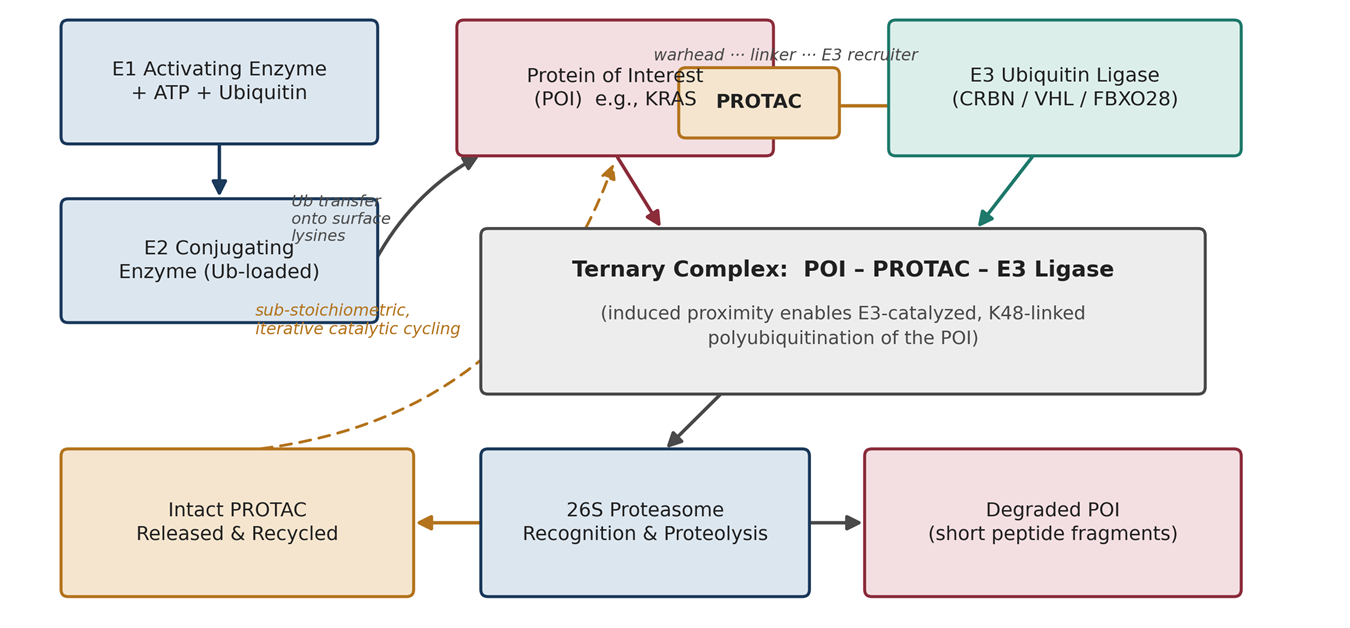
Figure 1. Event-driven mechanism of PROTAC-mediated target degradation. Schematic depiction of the catalytic degradation cycle: a heterobifunctional PROTAC simultaneously engages the protein of interest (POI) and an E3 ubiquitin ligase (e.g., CRBN, VHL, or FBXO28) to nucleate a ternary complex, within which E1- and E2-enzyme-supported transfer of ubiquitin onto surface lysine residues marks the POI for recognition and proteolysis by the 26S proteasome. Because the intact PROTAC dissociates after each catalytic cycle rather than being consumed, a single molecule can drive iterative rounds of substrate destruction, which is the structural basis for sub-stoichiometric degrader pharmacology discussed in Section 2.2.
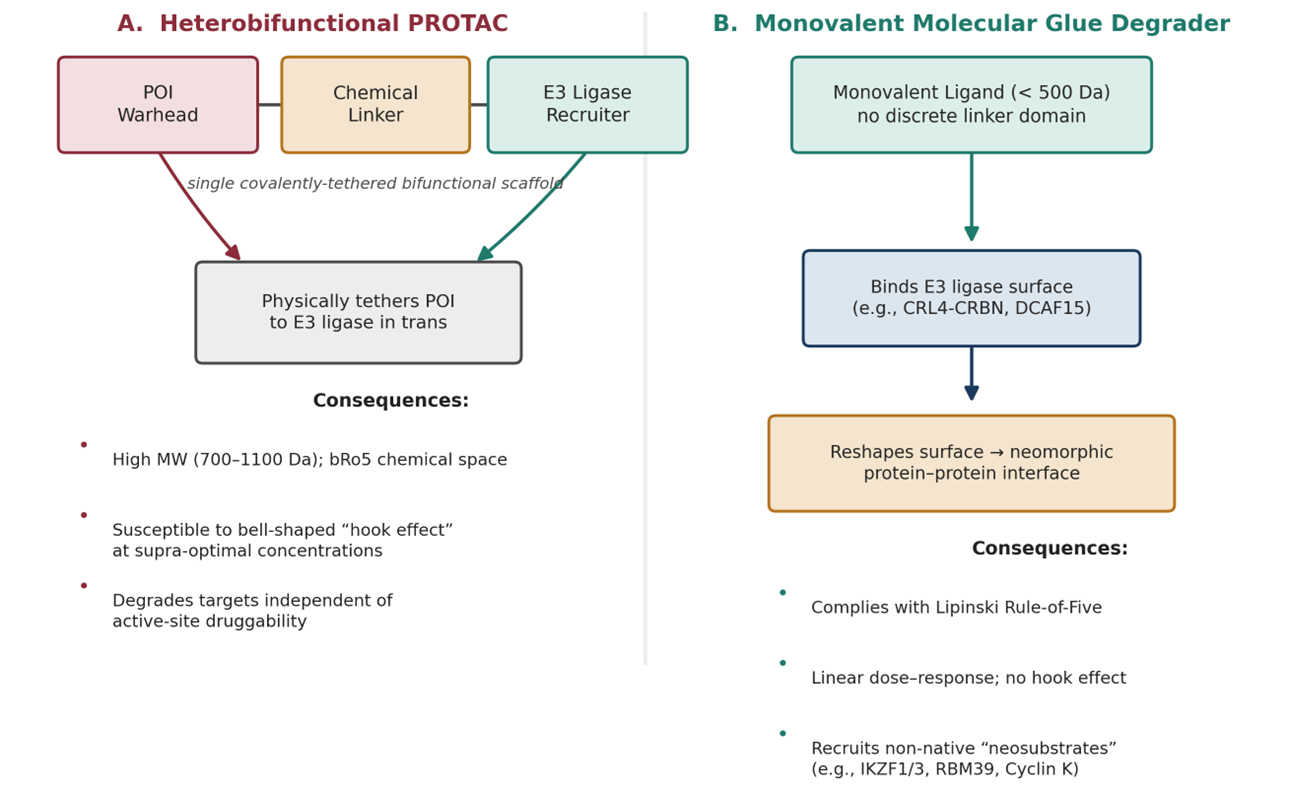
Figure 2. Structural and pharmacological contrast between heterobifunctional PROTACs and monovalent molecular glue degraders. Panel A depicts the tripartite PROTAC architecture — a POI-binding warhead, a chemical linker, and an E3 ligase recruiter — and its associated physicochemical and pharmacodynamic consequences, including high molecular weight and susceptibility to the hook effect. Panel B depicts the monovalent molecular glue mechanism, whereby a single low-molecular-weight ligand reshapes an E3 ligase surface to create a neomorphic protein–protein interface capable of recruiting non-native neosubstrates, conferring more favorable drug-like properties, as discussed in Section 2.3.

distinct E3 ligases at once, which tends to improve avidity and ternary-complex stability, and with it degradation kinetics (Barghout & Eldeeb, 2025; Faryal et al., 2026; Yang et al., 2025). Dual-target PROTACs go a step further, pairing hybrid warheads within a single heterobifunctional scaffold so that two distinct oncogenic drivers — dual EGFR/PARP, CDK4/6–IKZF1/3, or BTK/GSPT1 combinations are among those reported — are degraded concurrently, an approach explicitly aimed at closing off compensatory signaling escape routes before they open (Barghout & Eldeeb, 2025; Faryal et al., 2026; Yang et al., 2025). And because more than 90% of published PROTACs still rely on just two E3 ligases, cereblon (CRBN) and von Hippel–Lindau (VHL) (Faryal et al., 2026; Pravin & Jóźwiak, 2024; Sobierajski et al., 2024), there has been a deliberate push toward chemoproteomic discovery of alternative recruiters — KEAP1, DCAF15, DCAF16, RNF114, SKP2, and FBXO28 among the candidates now being explored — partly to sidestep CRBN-specific resistance mechanisms such as genomic loss or aberrant splicing, and partly to achieve degradation that is restricted to particular tissues (Deng et al., 2026; Faryal et al., 2026; Ma et al., 2026).

2.3. Molecular Glue Degraders: Monovalent Reprogramming of E3 Ligase Surfaces

Molecular glue degraders (MGDs) approach the same destructive endpoint from a structurally opposite direction. Where a PROTAC is bivalent and tethered, a molecular glue is a single, low-molecular-weight molecule — under roughly 500 Da — with no discrete linker domain connecting two separable pharmacophores (Barghout & Eldeeb, 2025; Ma et al., 2026; Tewari et al., 2026). Instead of physically bridging two proteins, an MGD binds either the E3 ligase or the target directly and, in doing so, reshapes the local surface topology enough to create an entirely new, neomorphic protein–protein interaction interface — one that did not exist before the drug arrived (Banerjee et al., 2026; Barghout & Eldeeb, 2025; Ma et al., 2026). That induced interface is what recruits the "neosubstrate": a protein that would never normally associate with the E3 ligase in question, now captured for ubiquitination and proteasomal clearance simply because the glue rewired the local geometry (Nussinov et al., 2025; Pravin & Jóźwiak, 2024). Figure 2 sets the two architectures side by side, and the contrast is instructive — because MGDs dispense with the bulky linker chemistry that PROTACs require, they tend to sit much more comfortably within Lipinski's Rule of Five, which in practical terms translates into better cell permeability, more reliable oral bioavailability, a conventional linear dose-response relationship, and — notably — freedom from the hook effect that complicates PROTAC dosing (Barghout & Eldeeb, 2025; Ma et al., 2026; Tewari et al., 2026).

The clinical precedent for this mechanism is older than the "molecular glue" terminology itself, and it is worth tracing briefly because it lends real credibility to the concept. Immunomodulatory imide drugs and their CELMoD successors — thalidomide, lenalidomide, pomalidomide, avadomide, and iberdomide — bind the thalidomide-binding domain of CRBN within the CRL4–CRBN E3 ligase complex, reprogramming its substrate specificity so that it now recruits the zinc-finger transcription factors IKZF1 (Ikaros) and IKZF3 (Aiolos), along with GSPT1 and CK1α, for degradation (Barghout & Eldeeb, 2025; Ma et al., 2026; Nussinov et al., 2025). A structurally distinct class, the aryl sulfonamides — indisulam, E7820, and tasisulam — instead engages the DCAF15 substrate receptor, driving degradation of the RNA-binding splicing factors RBM39 (CAPERα) and RBM23 and, in doing so, provoking lethal splicing aberrations in tumor cells (Avolio et al., 2026; Barghout & Eldeeb, 2025; Ma et al., 2026). A third example worth noting involves cyclin K: compounds such as CR8 and the dCEMM series, along with HQ461, engage the DDB1–CUL4 complex or CDK12/13 directly, stabilizing a neomorphic interface between DDB1 and the CDK12/13–cyclin K complex that results in selective cyclin K destruction (Barghout & Eldeeb, 2025; Ma et al., 2026).

For a long time, these compounds were found rather than designed — serendipitous phenotypic screening hits whose mechanism was worked out only after the fact. That is changing. Rational MGD discovery increasingly starts with an inert, non-degrading inhibitor scaffold and appends an electrophilic covalent handle — fumarate derivatives or vinylsulfonyl piperazines, for instance — engineered to engage E3 ligases such as DCAF16 or RNF126 covalently, effectively converting an ordinary inhibitor into a purpose-built degrader (Ma et al., 2026). A related strategy, hydrophobic tagging, takes a somewhat different route: monovalent or bivalent ligands are conjugated to bulky, lipophilic groups such as adamantane, which disrupt the target's native surface hydrophobicity in a way that mimics partial unfolding, thereby recruiting Hsp70/Hsp90 chaperone-mediated clearance or direct proteasomal degradation (Barghout & Eldeeb, 2025; Li et al., 2023; Pliatsika et al., 2024).

2.4. Beyond the Proteasome: Lysosomal, Autophagic, and Next-Generation Proximity Modalities

PROTACs and molecular glues both exploit the cytosolic ubiquitin–proteasome system, which is a considerable strength but also, inevitably, a ceiling. Something on the order of 40% of the human proteome consists of membrane-embedded receptors, secreted cytokines, extracellular matrix components, and aggregation-prone material sequestered in organelles — none of which the proteasome can physically reach (Pliatsika et al., 2024; Pravin & Jóźwiak, 2024). To get at that fraction of the proteome, a newer generation of proximity-inducing platforms has been built around the endosomal, lysosomal, and autophagic clearance systems instead (Banerjee et al., 2026; Barghout & Eldeeb, 2025; Zhou et al., 2026), and Table 1 and Figure 3 together summarize how this expanding toolkit now divides along that basic proteasome-versus-lysosome/autophagy axis.

Lysosome-targeting chimeras, or LYTACs, illustrate the principle well: these are bifunctional molecules that pair a POI-binding element with a ligand for a lysosome-shuttling cell-surface receptor, most often the cation-independent mannose-6-phosphate receptor (CI-M6PR) or the liver-restricted asialoglycoprotein receptor (ASGPR) (Pliatsika et al., 2024; Pravin & Jóźwiak, 2024; Zhou et al., 2026). Binding triggers receptor-mediated endocytosis, and whatever extracellular or cell-surface target was attached — EGFR, PD-L1, and ApoE4 have all been reported — is carried along into the lysosome for hydrolytic breakdown (Arenas-Moreira et al., 2026; Faryal et al., 2026; Pliatsika et al., 2024).

A parallel set of platforms exploits autophagy rather than receptor-mediated endocytosis. AUTACs (autophagy-targeting chimeras) carry a guanine-derived degradation tag that induces K63-linked polyubiquitination, which the autophagy machinery reads as a signal to sequester the tagged cargo — intracellular proteins and damaged mitochondria alike — for lysosomal clearance (Barghout & Eldeeb, 2025; Pliatsika et al., 2024). ATTECs (autophagosome-tethering compounds) skip the ubiquitination step entirely, tethering the target directly to LC3 on the autophagosomal membrane, which allows them to clear proteins or even lipid droplets without needing a ubiquitin tag at all (Barghout & Eldeeb, 2025; Pliatsika et al., 2024; Zhou et al., 2026). AUTOTACs take a related but distinct route, bridging the target to the ZZ domain of the autophagy receptor p62/SQSTM1 and driving p62 oligomerization to trigger selective autophagic clearance (Pliatsika et al., 2024; Faryal et al., 2026).

A further set of platforms leans on antibody or aptamer engineering rather than small-molecule chemistry. AbTACs and PROTABs are bispecific antibody constructs that tether cell-surface E3 ligases — RNF43 and ZNRF3 have both been used — to transmembrane target receptors, inducing lysosomal degradation of the latter (Pliatsika et al., 2024; Pravin & Jóźwiak, 2024). Closely related antibody–PROTAC conjugates and molecular glue–antibody conjugates take the opposite structural approach, using a monoclonal antibody as a delivery vehicle to restrict a conventional degrader's activity to antigen-positive cancer cells specifically, which reduces the systemic off-target liability that has dogged some earlier degrader candidates (Banerjee et al., 2026; Ma et al., 2026). Finally, a handful of platforms extend proximity-induced pharmacology past proteins altogether. RIBOTACs and RNATACs recruit endogenous ribonuclease L to cleave oncogenic microRNAs or viral RNA selectively (Barghout & Eldeeb, 2025; Nussinov et al., 2025); TRAFTACs and O'PROTACs are chimeric oligonucleotides that hijack E3 ligases to clear transcription factors that have otherwise proven difficult to drug (Barghout & Eldeeb, 2025; Lu et al., 2026); and DUBTACs invert the whole logic, recruiting deubiquitinating enzymes such as OTUB1 or USP7 not to destroy a protein but to stabilize one — restoring, for instance, a tumor suppressor or a misfolded ion channel that would otherwise be prematurely cleared (Barghout & Eldeeb, 2025; Zhou et al., 2026).

2.5. KRAS as the Proving Ground: From Undruggable Target to Degradable Oncoprotein

If any single target has come to define what targeted protein degradation can offer oncology, it is probably KRAS, and it is worth returning to the biology once more before turning to the degrader chemistry built around it (Feng et al., 2025; Huang et al., 2021). KRAS is, by a considerable margin, the most frequently mutated oncogene across human cancers — roughly 23% overall, with striking enrichment in pancreatic ductal adenocarcinoma (about 90%), colorectal cancer (40–50%), and non-small cell lung cancer (30–35%) (Faryal et al., 2026; Huang et al., 2021; Karki et al., 2025).
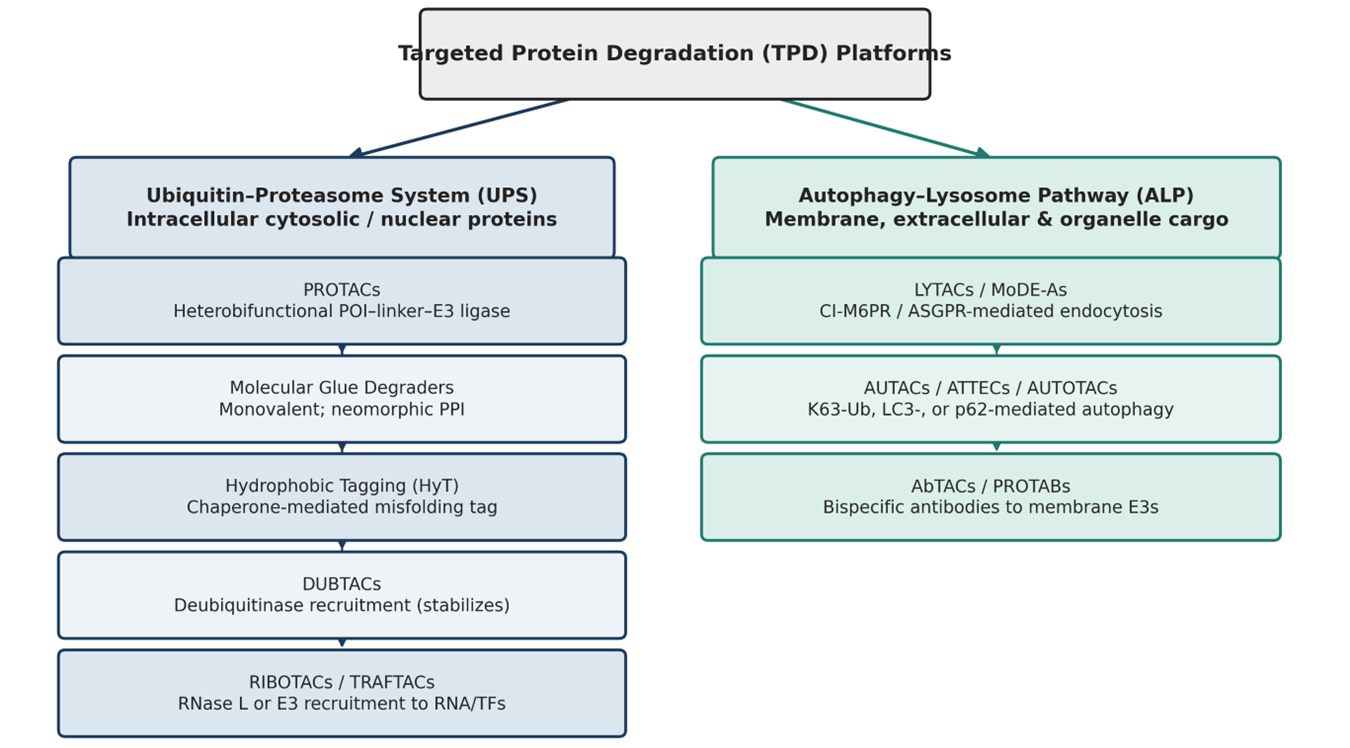
Figure 3. Taxonomy of targeted protein degradation modalities organized by subcellular clearance pathway and target compartment. Degrader platforms are divided into two principal branches: ubiquitin–proteasome system (UPS)-dependent modalities that clear intracellular cytosolic and nuclear proteins (PROTACs, molecular glue degraders, hydrophobic tagging compounds, DUBTACs, and oligonucleotide-based chimeras), and autophagy–lysosome pathway (ALP)-dependent modalities that extend proximity-induced pharmacology to membrane-bound, extracellular, and organelle-associated cargo (LYTACs, AUTACs/ATTECs/AUTOTACs, and antibody-based AbTACs/PROTABs), as detailed further in Table 1 and Section 2.4.
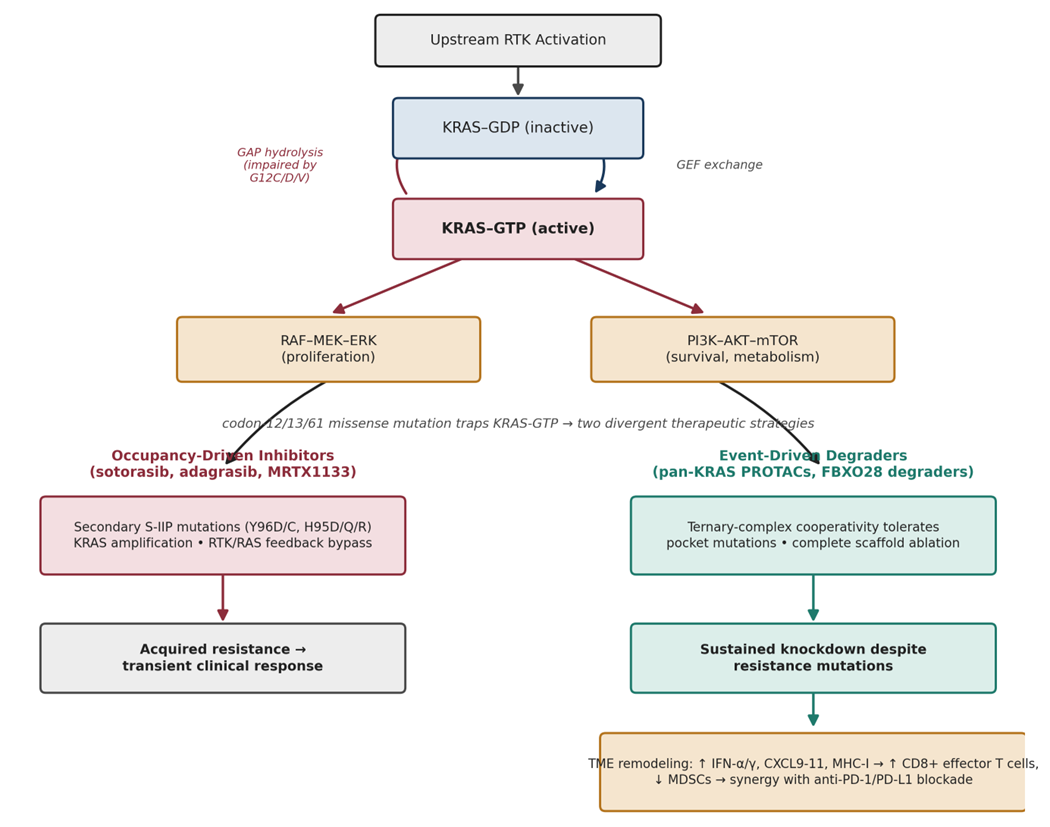
Figure 4. Oncogenic KRAS signaling, inhibitor resistance trajectories, and degrader-driven bypass with tumor microenvironment remodeling. The upper panel traces the physiological GDP–GTP cycling of KRAS and downstream RAF–MEK–ERK and PI3K–AKT–mTOR signaling, and how codon 12/13/61 mutations trap the protein in its active state. The lower panels contrast the two therapeutic strategies discussed throughout this review: occupancy-driven inhibitors, which remain vulnerable to secondary pocket mutations, KRAS amplification, and receptor tyrosine kinase feedback bypass (left), against event-driven degraders, which tolerate these same resistance mechanisms through ternary-complex cooperativity and additionally remodel the tumor immune microenvironment to synergize with checkpoint blockade (right), as detailed in Sections 4.3 and 5.5.

Its normal function, again, is that of a binary switch cycling between GDP-bound and GTP-bound states to gate RAF–MEK–ERK and PI3K–AKT–mTOR output (Lee et al., 2026; Ming et al., 2023), and the single-nucleotide missense mutations that recur at codons 12, 13, and 61 — G12C, G12D, and G12V chief among them — work by impairing GTP hydrolysis, which leaves the protein trapped in its active, signal-emitting conformation (Deng et al., 2026; Huang et al., 2021). Figure 4 walks through this cycle alongside the two divergent therapeutic strategies that have grown out of it, and reading the two branches of that figure side by side is, in a sense, the organizing logic of the rest of this review.

The undruggability narrative held for nearly forty years, undone finally by the same structural obstacles rehearsed earlier — picomolar GTP affinity, millimolar intracellular GTP concentration, and a smooth surface lacking any conventional deep pocket (Huang et al., 2021; Santarpia et al., 2023; Tewari et al., 2026) — until the switch-II pocket was identified and covalent, allele-specific G12C inhibitors (sotorasib, adagrasib) followed, joined subsequently by non-covalent G12D-directed MRTX1133 and by pan-KRAS agents such as BI-2865 and RMC-6236 (Feng et al., 2025; Huang et al., 2021; Karki et al., 2025; Santarpia et al., 2023). Clinical durability, however, has proven to be the weak link. Response duration is consistently constrained by primary, adaptive, and acquired resistance (Feng et al., 2025; Isermann et al., 2025; Lee et al., 2026), with acquired resistance most often traced to secondary binding-pocket mutations (Y96D/C, R68S, H95D/Q/R), to KRAS gene amplification, or to adaptive feedback reactivation of upstream RTKs (EGFR, MET, HER3) and of the wild-type RAS isoforms running in parallel (Feng et al., 2025; Karki et al., 2025; Santarpia et al., 2023).

This is precisely the resistance architecture that degrader chemistry appears built to circumvent, because it does not depend on sustained occupancy of a site that a secondary mutation can simply remodel (Feng et al., 2025; Lu et al., 2026; Martín-Acosta et al., 2026). The allele-specific degrader lineage began with LC-2, a VHL-recruiting derivative of adagrasib (Cordani et al., 2024; Deng et al., 2026), continued through the reversible-covalent degrader YF135 (Lu et al., 2026), and reached the clinic with ASP3082, a G12D-directed degrader (Feng et al., 2025; Lu et al., 2026). To move past the constraint of one allele at a time, non-covalent pan-KRAS degraders — ACBI3 and MCB-36 in particular — were engineered and have since demonstrated degradation of 13 of the 17 most common KRAS mutant alleles, spanning G12D, G12C, G12V, G13D, and Q61H, while sparing wild-type HRAS and NRAS (Feng et al., 2025; Karki et al., 2025). A separate line of dual-covalent small-molecule degraders, exemplified by DJX-A-KM (G12C-selective) and its pan-KRAS counterpart DS-01, sidesteps the molecular-weight penalty of classical PROTACs entirely by pairing an electrophilic acrylamide-prolinol warhead with recruitment of the E3 ligase FBXO28 (Deng et al., 2026).

The resistance-relevant payoff of this chemistry is fairly direct: because degraders rely on transient engagement and ternary-complex cooperativity rather than sustained site occupancy, pan-KRAS degraders continue to suppress proliferation in tumor cells carrying secondary mutations — Y96C and H95D among them — that render those same cells fully resistant to sotorasib and adagrasib (Feng et al., 2025; Karki et al., 2025; Tewari et al., 2026). There is a further layer to this story that goes beyond cell-autonomous signaling. Complete degradation of oncogenic KRAS appears to derepress type I and type II interferon (IFN-α/γ) signaling while simultaneously downregulating immunosuppressive cytokines such as IL-6, IL-10, TGF-β, and GM-CSF (Feng et al., 2025; Huang et al., 2021; Martín-Acosta et al., 2026). Single-cell transcriptomic and immunophenotypic profiling of degrader-treated tumors reports fewer exhausted CD8+ T cells, a reduction in myeloid-derived suppressor cells, and an increase in mature dendritic cells and cytotoxic effector CD8+ T-cell infiltration (Feng et al., 2025; Martín-Acosta et al., 2026) — a remodeling of the tumor immune landscape substantial enough that combining KRAS degraders with checkpoint blockade (anti-PD-1/PD-L1) has produced durable, synergistic tumor regression in the models reported to date (Feng et al., 2025; Martín-Acosta et al., 2026).

3. Methods

3.1. Review Design and Reporting Approach

This is, by design, a narrative review rather than a systematic one, and it seemed worth saying that plainly rather than dressing a narrative synthesis up in systematic-review language it does not fully earn. That said, "narrative" need not mean "unreproducible," and the search, screening, and synthesis steps below are reported in enough detail — search strings, database filters, date boundaries, inclusion logic — that another reviewer working from PubMed and the companion databases listed below should be able to reconstruct a substantially similar evidence base. Where the eligibility and extraction steps below borrow structure from the Preferred Reporting Items for Systematic Reviews and Meta-Analyses (PRISMA) framework, that borrowing is deliberate: even a narrative synthesis benefits from transparent, auditable selection criteria, and readers evaluating the strength of the claims made in Sections 4 and 5 should be able to trace each one back to a specific, identifiable body of primary and secondary literature.

3.2. Information Sources and Search Strategy

The primary bibliographic database was PubMed/MEDLINE (National Library of Medicine), supplemented by Scopus, Web of Science, and the Cochrane Library for cross-checking citation coverage and identifying reviews or primary reports that a single-database search might otherwise miss. Google Scholar was used in a limited, supplementary capacity, mainly to locate in-press or advance-access articles and conference abstracts (e.g., American Association for Cancer Research and American Society of Clinical Oncology annual meetings) not yet indexed in MEDLINE at the time of searching.

Searches were run using a combination of Medical Subject Headings (MeSH) terms and free-text keywords, connected with Boolean operators, structured around three conceptual blocks that were then combined with AND: (1) the disease/target block — ("KRAS" OR "Kirsten rat sarcoma") AND ("non-small cell lung cancer" OR "NSCLC" OR "lung adenocarcinoma"); (2) the modality block — ("PROTAC" OR "proteolysis targeting chimera" OR "targeted protein degradation" OR "molecular glue degrader" OR "E3 ubiquitin ligase" OR "LYTAC" OR "AUTAC" OR "ATTEC" OR "AUTOTAC" OR "hydrophobic tagging" OR "bifunctional degrader"); and (3), applied only where the intent was to capture resistance- or delivery-specific literature, a qualifier block — ("drug resistance" OR "tumor microenvironment" OR "nanoparticle" OR "drug delivery" OR "bioavailability"). A representative PubMed query took the form: (KRAS[MeSH] OR "KRAS mutation"[tiab]) AND ("PROTAC"[tiab] OR "proteolysis targeting chimera"[tiab] OR "targeted protein degradation"[tiab] OR "molecular glue"[tiab]) AND ("lung neoplasms"[MeSH] OR "non-small cell lung cancer"[tiab]). Field tags ([tiab] for title/abstract, [MeSH] for indexed subject headings) and truncation were applied consistently across databases, with syntax adapted to each platform's search grammar.

The search covered records indexed through late 2026, with no lower date boundary imposed on foundational mechanistic literature (e.g., early descriptions of the ubiquitin–proteasome system or of KRAS biochemistry), reflecting the reality that some of the conceptual groundwork this review relies on predates the PROTAC field itself. For degrader- and inhibitor-specific pharmacology, however, retrieval was intentionally weighted toward the past five years, since that window captures essentially the entire clinical-stage KRAS degrader literature. Records were restricted to English-language publications; no restriction was placed on article type at the retrieval stage (original research, secondary/systematic reviews, and narrative reviews were all retrieved), with filtering by type applied instead during screening, described next.

3.3. Eligibility Criteria and Study Selection

Records were screened in two passes, first by title and abstract and then, for anything not clearly excludable at that stage, by full text. Eligible records had to satisfy all of the following: (a) the study addressed KRAS biology, KRAS-directed small-molecule inhibition, or a targeted protein degradation modality (PROTAC, molecular glue, or a non-proteasomal chimera such as a LYTAC, AUTAC, ATTEC, or AUTOTAC) with direct or reasonably inferable relevance to oncology, and preferentially to lung cancer; (b) the report presented primary preclinical (biochemical, cell-based, or in vivo) data, clinical-trial data, or a structured secondary synthesis (systematic review, meta-analysis, or well-referenced narrative review) of such data; and (c) sufficient methodological detail was provided — compound structure or identifier, cell line or model system, and outcome measure — to allow the finding to be interpreted in context rather than taken at face value.

Records were excluded where they were: editorial commentary, conference abstracts lacking sufficient methodological detail to be independently interpretable, non-English-language reports without an available translation, or duplicate reports of the same dataset (in which case the most complete or most recent version was retained and earlier or partial versions were excluded). Reviews of the initial pool were conducted independently against these criteria, with disagreements resolved by discussion and, where necessary, by re-reading the source text in full; this dual-check step is standard practice for narrative syntheses of this scope and helps guard against the selective-citation bias that any single-reviewer search is otherwise prone to.

3.4. Data Extraction and Evidence Synthesis

From each eligible source, the following elements were extracted into a structured working table: compound or platform name, molecular target and mutant allele specificity where applicable, structural class (e.g., heterobifunctional PROTAC, monovalent molecular glue, dual-covalent small-molecule degrader), E3 ligase or clearance pathway engaged, reported potency or efficacy metrics (e.g., degradation concentration for 50% effect [DC50], maximal degradation [Dmax], half-maximal inhibitory concentration [IC50]) where available, developmental stage (preclinical versus a named clinical-trial phase), and the specific resistance mechanism or delivery barrier addressed, if any. This extraction table underlies the comparative summaries presented in Tables 1 through 4.

Because the eligible literature spans biochemical assays, cell-based degradation and viability studies, murine xenograft and syngeneic models, and early-phase clinical-trial reporting — study designs that are not statistically commensurable — no quantitative meta-analysis was attempted, and none would have been methodologically defensible given the heterogeneity involved. Synthesis instead proceeded narratively, organized thematically around mechanism of action, structural design principles, resistance biology, and translational/delivery considerations, consistent with the eligibility framework outlined above. Findings judged for the results synthesis were framed with explicit attention to their evidentiary basis — biochemical, cell-based, in vivo, or clinical — so that a reader can gauge the maturity of the underlying evidence for any given claim rather than treating preclinical and clinical findings as pharmacologically interchangeable. Where the same compound or mechanism was reported across multiple sources, the most recent and most methodologically complete report was generally cited as the primary reference, with earlier or corroborating reports retained as supporting citations rather than duplicated in full.

4. Mapping the Degrader Landscape — Comparative Pharmacology, Structural Evolution, and Translational Performance of KRAS-Directed Degraders

4.1. Comparative Performance and Proteomic Reach of Proximity-Induced Degradation Platforms

Pulling the modality-specific literature together into a single comparative frame, a fairly clean functional divide emerges between degraders that depend on the cytosolic proteasome and those that instead route their cargo through lysosomal or autophagic clearance (Barghout & Eldeeb, 2025; Pliatsika et al., 2024; Zhou et al., 2026). Conventional small-molecule inhibitors sit apart from both groups, of course, relying on occupancy-driven saturation that in practice demands sustained high drug concentrations and, with them, a recurring risk of off-target toxicity (Arenas-Moreira et al., 2026; Faryal et al., 2026). The proteasome-dependent degraders — PROTACs and molecular glue degraders chief among them — instead achieve sub-stoichiometric, catalytic destruction of the pathogenic protein through an event-driven mechanism that simply does not require the same exposure profile (Barghout & Eldeeb, 2025; Mathur et al., 2025; Pravin & Jóźwiak, 2024).

Table 1 lays out this comparison systematically across eight distinct platforms, and a few patterns stand out on inspection. Classical heterobifunctional PROTACs assemble a ternary POI–PROTAC–E3 complex that most often recruits Cullin-RING ligases — CRBN or VHL, overwhelmingly — to deposit K48-linked polyubiquitin chains destined for 26S proteasomal destruction (Barghout & Eldeeb, 2025; Faryal et al., 2026; Pravin & Jóźwiak, 2024), a mechanism depicted schematically in Figure 1. That mechanism is not without a pharmacodynamic cost, however: at supra-optimal drug concentrations, PROTACs run into the bell-shaped "hook effect" already introduced in Section 2, where uncomplexed degrader molecules saturate the E3 ligase and the target independently, forming unproductive binary complexes that actively compete against ternary-complex assembly (Barghout & Eldeeb, 2025; Mathur et al., 2025; Zhou et al., 2026). Molecular glue degraders sidestep that particular liability by design — lacking a physical linker altogether, they bind E3 ligases such as CRL4–CRBN or DCAF15 directly, reshaping the ligase surface into a neomorphic interface that recruits non-native neosubstrates (Barghout & Eldeeb, 2025; Ma et al., 2026; Pliatsika et al., 2024), the structural contrast Figure 2 was built specifically to illustrate. The practical upshot, evident consistently across the literature summarized in Table 1, is

Table 1. Comparative overview of major targeted protein degradation (TPD) technologies and proximity-inducing modalities. Eight distinct degrader classes are compared across five dimensions: structural and molecular composition, the primary cellular system exploited (ubiquitin–proteasome versus autophagy–lysosome pathways) and subcellular target localization, mechanism of action, and the pharmacological advantages each platform confers relative to conventional occupancy-driven inhibitors. The table is organized to move from the most clinically mature modality (PROTACs) toward emerging oligonucleotide-based chimeras, mirroring the taxonomy depicted in Figure 3, and each entry is supported by the primary and secondary literature cited in the final reference column.

Modality / Technology

Structural & Molecular Composition

Primary Cellular System & Target Localization

Mechanism of Action

Pharmacological Advantages & Key Features

References

Proteolysis-Targeting Chimeras (PROTACs)

Heterobifunctional molecule comprising a POI-binding warhead, an E3 ligase recruiter (e.g., VHL, CRBN, MDM2), and a chemical linker

Ubiquitin–Proteasome System (UPS); Intracellular (cytosolic and nuclear) proteins

Induces ternary complex formation (POI–PROTAC–E3), driving K48-linked polyubiquitination and 26S proteasomal destruction

Sub-stoichiometric catalytic turnover; removes catalytic and scaffolding functions; active against mutant forms

(Barghout & Eldeeb, 2025; Faryal et al., 2026; Pravin & Jóźwiak, 2024)

Molecular Glue Degraders (MGDs)

Monovalent, low-molecular-weight (<500 Da) small molecules lacking a chemical linker

Ubiquitin–Proteasome System (UPS); Intracellular proteins and transcription factors

Reshapes or stabilizes neomorphic protein–protein interaction (PPI) interfaces on E3 ligases (e.g., CRL4-CRBN, DCAF15) to recruit non-native neosubstrates

High cellular permeability; superior oral bioavailability; linear dose-response without the "hook effect"

(Barghout & Eldeeb, 2025; Ma et al., 2026; Pliatsika et al., 2024)

Hydrophobic Tagging (HyT)

Monovalent or bivalent ligands conjugated to bulky lipophilic groups (e.g., adamantane)

Ubiquitin–Proteasome System (UPS) & Cellular Quality Control; Cytosolic & membrane domains

Destabilizes target surface topology or exposes hydrophobic patches, mimicking misfolding to engage Hsp70/Hsp90 chaperones

Simplifies degrader chemistry; does not require high-affinity E3 ligase recruitment

(Barghout & Eldeeb, 2025; Pliatsika et al., 2024)

Lysosome-Targeting Chimeras (LYTACs)

Chimeric molecules tethering a POI-binding antibody/ligand to lysosomal receptor ligands (CI-M6PR or ASGPR)

Autophagy–Lysosome Pathway (ALP); Extracellular & cell-surface membrane proteins

Hijacks endosomal/lysosomal shuttling receptors to induce receptor-mediated endocytosis and lysosomal degradation

Degrades extracellular cytokines, matrix proteins, and cell-surface receptors inaccessible to the UPS

(Banerjee et al., 2026; Pliatsika et al., 2024; Pravin & Jóźwiak, 2024)

Autophagy-Driven Modalities (AUTACs, ATTECs, AUTOTACs)

Bifunctional molecules incorporating cGMP-based tags (AUTAC), LC3 binders (ATTEC), or p62/SQSTM1 recruiters (AUTOTAC)

Autophagy–Lysosome Pathway (ALP); Intracellular aggregates, organelles, & cytosolic proteins

AUTACs trigger K63 polyubiquitination; ATTECs directly tether targets to autophagosome membranes (LC3); AUTOTACs oligomerize p62

Clears protein aggregates (e.g., mutant HTT, α-synuclein) and whole damaged organelles (mitophagy)

(Barghout & Eldeeb, 2025; Pliatsika et al., 2024; Zhou et al., 2026)

Antibody- & Aptamer-Guided Modalities (AbTACs, KineTACs, GlueTACs)

Bispecific recombinant antibodies or aptamers engaging membrane E3 ligases (RNF43/ZNRF3) or cytokine receptors

Lysosomal Pathway; Transmembrane proteins & extracellular ligands

Forces spatial co-localization of cell-surface target proteins with transmembrane ligases or endocytic receptors

High tissue and cell-type specificity; restricts degradation activity strictly to target-expressing cells

(Pliatsika et al., 2024; Pravin & Jóźwiak, 2024)

DUBTACs & Deubiquitinase Modulators

Bifunctional chimeras recruiting deubiquitinating enzymes (DUBs like OTUB1 or USP7) to target proteins

Ubiquitin System; Intracellular proteins

Removals ubiquitin chains from target proteins, promoting targeted protein stabilization rather than destruction

Restores tumor suppressor proteins (e.g., PTEN, p53) or mutated functional channels (e.g., CFTR)

(Barghout & Eldeeb, 2025; Lee et al., 2026; Zhou et al., 2026)

Oligonucleotide-Based Modalities (RIBOTACs, TRAFTACs, ClickRNA-PROTACs)

Chimeric oligonucleotides recruiting endogenous ribonucleases (RNase L) or E3 ligases via nucleic acid warheads

UPS & Endogenous Nucleases; Oncogenic RNA transcripts & transcription factors

RIBOTACs selectively cleave pathogenic microRNAs/mRNAs; TRAFTACs degrade transcription factors via DNA/RNA binding

Directly targets non-enzymatic transcription factors and non-coding oncogenic RNA structures

(Barghout & Eldeeb, 2025; Lu et al., 2026; Pliatsika et al., 2024

Table 2. Profile of KRAS-targeted degraders, inhibitors, and emerging modalities evaluated in oncogenic lung and other solid tumors. Fourteen compounds are catalogued by target mutant subtype (G12C, G12D, or pan-KRAS), structural strategy (heterobifunctional PROTAC, dual-covalent small molecule, molecular glue, or allosteric inhibitor), the E3 ligase or covalent warhead scaffold recruited, and the key preclinical or clinical findings reported for each. Compounds are grouped to trace the field's developmental arc — from the reporter-only degrader XY-4-88 through clinically advanced candidates such as ASP3082 — allowing direct comparison between degrader and inhibitor pharmacology for the same mutant alleles.

Compound Name

Target Subtype / Mutation

Modality / Strategy

Recruited E3 Ligase / Warhead Scaffold

Key Preclinical & Clinical Findings

References

LC-2

KRAS G12C

Heterobifunctional PROTAC

VHL; MRTX849 (adagrasib) covalent warhead

First endogenous KRAS G12C degrader; rapidly degrades mutant KRAS in lung and pancreatic cancer cells, suppressing p-ERK

(Cordani et al., 2024; Deng et al., 2026; Huang et al., 2021)

YF135

KRAS G12C

Reversible-Covalent PROTAC

VHL; MRTX849 derivative

Reversibly engages KRAS G12C; induces continuous proteasomal degradation and bypasses irreversible warhead entrapment

(Lu et al., 2026)

XY-4-88

KRAS G12C

Covalent PROTAC

CRBN; ARS-1620 quinazoline derivative

Proof-of-concept degrader; degraded GFP-KRAS G12C in reporter cells but failed on endogenous KRAS due to ubiquitination geometry constraints

(Deng et al., 2026; Zeng et al., 2020)

DJX-A-KM

KRAS G12C

Dual-Covalent Small-Molecule Degrader

FBXO28; Acrylamide-prolinol warhead on MRTX849

Minimalist degrader recruiting FBXO28 via Cys98 modification; exhibits high cellular permeability and potent in vivo tumor regression

(Deng et al., 2026)

ASP3082

KRAS G12D

Heterobifunctional PROTAC

VHL; Non-covalent G12D warhead

First-in-class KRAS G12D degrader in Phase I clinical trials; drives marked tumor regression in PDAC and NSCLC models

(Lu et al., 2026; Pliatsika et al., 2024; Zhou et al., 2026)

ARV-806 (PT0253)

KRAS G12D

Selective PROTAC Degrader

VHL / Undisclosed E3 ligase

Highly potent G12D degrader in clinical development; exhibits 25-fold higher antiproliferative activity than G12D inhibitors

(Lu et al., 2026; Martín-Acosta et al., 2026)

ACBI3

Pan-KRAS (13/17 mutants)

Non-Covalent Pan-KRAS PROTAC

VHL; Non-covalent pan-KRAS binding warhead

Fishhook-shaped degrader eliminating 13 common KRAS mutants (G12D, G12C, G12V, Q61H) while sparing wild-type HRAS and NRAS

(Feng et al., 2025; Karki et al., 2025; Lu et al., 2026)

MCB-36

Pan-KRAS (Broad alleles)

VHL-Recruiting Pan-KRAS PROTAC

VHL; MCB-294 dual-state warhead

Derived from pan-KRAS inhibitor MCB-294; achieves sustained KRAS degradation, defeats G12Ci resistance, and remodels the TME

(Feng et al., 2025)

DS-01

Pan-KRAS (Broad alleles)

Dual-Covalent Pan-KRAS Degrader

FBXO28; Acrylamide-prolinol on pan-KRAS scaffold

Small-molecule pan-KRAS degrader using an electrophilic warhead to recruit FBXO28; eliminates G12C, G12D, G12V, G13D, and Q61H mutants

(Deng et al., 2026)

IPS-06061

KRAS G12D

Molecular Glue Degrader (MGD)

CRBN; De novo surface-template MGD

Rational PPI-driven molecular glue; stabilizes neomorphic interface between CRBN and KRAS G12D without a physical linker

(Ma et al., 2026)

Sotorasib (AMG510)

KRAS G12C

Covalent Allosteric Inhibitor

Switch-II Pocket (S-IIP) Cys12 covalent handle

FDA-approved inhibitor locking KRAS G12C in GDP-bound state; subject to acquired resistance via secondary pocket mutations and RTK bypass

(Huang et al., 2021; Santarpia et al., 2023)

Adagrasib (MRTX849)

KRAS G12C

Covalent Allosteric Inhibitor

Switch-II Pocket (S-IIP) Cys12 covalent handle

FDA-approved covalent G12C inhibitor; serves as the primary target-binding warhead for PROTACs LC-2, YF135, and DJX-A-KM

(Huang et al., 2021; Santarpia et al., 2023)

MCB-294

Pan-KRAS (GTP & GDP states)

Dual-State Pan-KRAS Inhibitor

Switch-II Pocket water-mediated H-bond network

Non-covalent inhibitor engaging active and inactive KRAS; demonstrates superior efficacy over BI-2865 and MRTX1133

(Feng et al., 2025)

RMC-6236

Multi-RAS (ON)

Tri-Complex RAS(ON) Inhibitor

Cyclophilin A (CYPA) chaperone recruitment

Forms a steric-blocking tri-complex with CYPA and active RAS-GTP; suppresses multi-allele KRAS, NRAS, and HRAS signaling

(Feng et al., 2025; Lee et al., 2026)

that MGDs tend to show superior cell permeability, higher oral bioavailability, a linear rather than bell-shaped dose-response, and — again — no hook effect (Barghout & Eldeeb, 2025; Ma et al., 2026; Tewari et al., 2026).

Beyond the proteasome-bound platforms, a separate family of technologies — summarized in the lower half of Table 1 and mapped taxonomically in Figure 3 — has been built specifically to reach the roughly 40% of the proteome that the ubiquitin–proteasome system simply cannot access: extracellular cytokines, transmembrane receptors, and aggregation-prone organelle content (Pliatsika et al., 2024; Pravin & Jóźwiak, 2024; Zhou et al., 2026). Lysosome-targeting chimeras exploit shuttling receptors — CI-M6PR and ASGPR most commonly — to drive endocytosis and lysosomal degradation of surface targets such as EGFR, PD-L1, and ApoE4 (Banerjee et al., 2026; Pliatsika et al., 2024; Pravin & Jóźwiak, 2024), while autophagy-driven platforms, ATTECs and AUTOTACs among them, tether intracellular targets directly to LC3 or to the p62/SQSTM1 receptor, achieving ubiquitin-independent clearance of protein aggregates and damaged mitochondria (Barghout & Eldeeb, 2025; Pliatsika et al., 2024; Zhou et al., 2026). A further, still-emerging tier of oligonucleotide-based platforms extends the same logic past proteins entirely: RIBOTACs recruit ribonuclease L for selective destruction of oncogenic microRNAs, TRAFTACs engage transcription factors through nucleic-acid warheads, and DUBTACs, working in the opposite direction, recruit deubiquitinating enzymes such as OTUB1 or USP7 to stabilize rather than destroy their targets (Barghout & Eldeeb, 2025; Lee et al., 2026; Lu et al., 2026).

4.2. Structural Chemistry, Efficacy, and Pharmacodynamics of KRAS-Targeted Modalities

Turning from the general TPD landscape to KRAS specifically, the compound-level record assembled in Table 2 traces a fairly coherent design trajectory, one that runs from early proof-of-concept failures through to compact, clinically advanced degraders. KRAS's forty-year "undruggable" reputation has been dismantled — not all at once, but in stages — by the parallel maturation of covalent allosteric inhibitors and, more recently, degrader chemistry built to complement or supersede them (Deng et al., 2026; Huang et al., 2021; Santarpia et al., 2023). The underlying biology, worth restating briefly, is that KRAS cycles between an inactive GDP-bound state and an active, signaling-competent GTP-bound conformation that drives RAF–MEK–ERK and PI3K–AKT–mTOR output (Lee et al., 2026; Ming et al., 2023), and that somatic mutations at codons 12, 13, or 61 — G12C, G12D, and G12V predominating in NSCLC — impair GAP-stimulated GTP hydrolysis and lock the protein in its oncogenic, GTP-bound state (Deng et al., 2026; Huang et al., 2021; Karki et al., 2025), a cycle Figure 4 revisits in the context of the resistance discussion that follows in Section 4.3.

The earliest attempt at KRAS G12C degradation, XY-4-88, is instructive mainly for how it failed. This CRBN-recruiting compound successfully engaged its E3 ligase and degraded an overexpressed GFP-KRAS G12C reporter construct in engineered cells, yet it could not clear the endogenous protein in pancreatic or lung cancer lines — the geometry of ternary-complex formation, apparently, simply did not permit productive polyubiquitination against the native target (Deng et al., 2026; Zeng et al., 2020). That bottleneck was resolved by LC-2, the first PROTAC to achieve genuine endogenous KRAS G12C degradation; built around a VHL-recruiting adagrasib (MRTX849) warhead, LC-2 produced rapid proteasomal clearance of mutant KRAS alongside sustained suppression of phosphorylated ERK (Cordani et al., 2024; Deng et al., 2026; Huang et al., 2021). Subsequent chemistry refined this scaffold further, yielding YF135, a reversible-covalent degrader designed to avoid the entrapment problems associated with irreversible warhead chemistry while still sustaining catalytic turnover (Lu et al., 2026).

A distinct and, in some respects, more consequential design line has centered on compact dual-covalent small-molecule degraders that bypass the molecular-weight burden inherent to classical PROTACs altogether (Deng et al., 2026). DJX-A-KM exemplifies this approach: it appends an acrylamide-prolinol warhead directly onto the MRTX849 scaffold, covalently engaging KRAS G12C at Cys12 while simultaneously modifying Cys98 on the E3 ligase FBXO28 (Deng et al., 2026). The reported potency is notable — a degradation concentration for half-maximal effect (DC50) near 2 nM and maximal degradation (Dmax) around 98%, achieved with rapid onset kinetics and high cellular permeability (Deng et al., 2026), details tabulated alongside comparator compounds in Table 2. Extending the same dual-covalent architecture to a pan-KRAS scaffold produced DS-01, which recruits FBXO28 to clear G12C, G12D, G12V, G13D, and Q61H variants across a range of cancer cell lines (Deng et al., 2026).

For non-G12C disease, allele-specific G12D degraders have progressed furthest — ASP3082, a VHL-recruiting compound now in Phase I evaluation, and ARV-806, which is reported to show roughly 25-fold greater antiproliferative potency than monovalent G12D inhibitors in head-to-head comparisons (Lu et al., 2026; Martín-Acosta et al., 2026; Pliatsika et al., 2024). At the broader end of the spectrum, non-covalent pan-KRAS degraders — ACBI3 and MCB-36, the latter derived from the dual-state pan-KRAS inhibitor MCB-294 — achieve degradation across 13 of the 17 most prevalent KRAS mutant alleles, including G12D, G12C, G12V, G13D, and Q61H, while sparing wild-type HRAS and NRAS (Feng et al., 2025; Karki et al., 2025; Lu et al., 2026). In comparative signaling assays, these pan-KRAS degraders produce more durable suppression of phosphorylated ERK than direct inhibitors such as sotorasib, adagrasib, or MCB-294 itself, with target suppression persisting well after drug washout — a pharmacodynamic signature that is, again, consistent with the catalytic, event-driven mechanism outlined in Section 2 rather than with conventional occupancy pharmacology (Feng et al., 2025).

4.3. Molecular Mechanisms of Resistance Bypass and Tumor Microenvironment Remodeling

Clinical benefit from direct KRAS G12C inhibitors is, unfortunately, often short-lived, undermined by primary, adaptive, and acquired resistance that emerges with some regularity (Feng et al., 2025; Isermann et al., 2025; Santarpia et al., 2023). Table 3 organizes the resistance literature into seven mechanistic categories, and three of these — on-target pocket mutations, KRAS copy-number amplification, and feedback-driven bypass signaling — account for the great majority of reported cases of acquired resistance to monovalent inhibitors. On-target resistance typically arises through secondary missense mutations within the switch-II pocket itself, Y96C/D, R68S, and H95D/Q/R being the most frequently reported, each of which introduces steric hindrance or disrupts hydrogen bonding sufficiently to abolish inhibitor binding outright (Feng et al., 2025; Isermann et al., 2025; Tewari et al., 2026). Separately, KRAS copy-number gain can simply overwhelm an occupancy-driven inhibitor by outproducing the drug's capacity to saturate every copy of the target (Barghout & Eldeeb, 2025; Karki et al., 2025), while adaptive feedback reactivation of upstream RTKs — EGFR, MET, HER3 — and of wild-type RAS isoforms restores downstream MAPK signaling through parallel routes that bypass the inhibited node entirely (Cordani et al., 2024; Feng et al., 2025; Lee et al., 2026), a bypass trajectory illustrated in the left-hand branch of Figure 4.

Degrader chemistry addresses these same resistance drivers, but through mechanisms that are biophysically and systemically distinct from anything an inhibitor can offer (Feng et al., 2025; Martín-Acosta et al., 2026), a contrast captured in the right-hand branch of Figure 4 and detailed further in Table 3. Because degradation efficiency hinges on ternary-complex cooperativity and geometric surface complementarity rather than on ultra-high active-site binding affinity, pan-KRAS PROTACs such as ACBI3 and MCB-36, together with the FBXO28-recruiting dual-covalent degrader DS-01, retain target knockdown and antiproliferative activity in cell models carrying the very Y96C or H95D pocket mutations that confer total resistance to sotorasib and adagrasib (Feng et al., 2025; Karki et al., 2025; Tewari et al., 2026). Complete elimination of the KRAS protein carries a further advantage over inhibition — because the scaffold itself is destroyed rather than merely blocked, degraders also remove the non-catalytic scaffolding interactions that would otherwise continue anchoring upstream RTK complexes and sustaining compensatory feedback (Cordani et al., 2024; Lu et al., 2026).

The tumor-immune consequences of KRAS degradation extend well past the cancer cell itself. In immunocompetent murine models of lung adenocarcinoma, chemical degradation of oncogenic KRAS derepresses type I and type II interferon signaling (IFN-α/γ), upregulates the chemokines CXCL9, CXCL10, and CXCL11, and increases cell-surface MHC-I antigen presentation (Martín-Acosta et al., 2026). Immunophenotypic profiling of these same models shows a marked increase in mature CD80+ dendritic cells and in macrophage-mediated phagocytosis of tumor cells, alongside a reduction in immunosuppressive myeloid-derived suppressor cells and a shift in tumor-infiltrating CD8+ T cells away from an exhausted phenotype and toward an actively cytotoxic effector state (Feng et al., 2025; Martín-Acosta et al., 2026). That remodeling appears to translate directly into therapeutic synergy: pairing KRAS degraders with anti-PD-1/PD-L1 checkpoint blockade produces durable, synergistic tumor regression in the models reported to date (Feng et al., 2025; Martín-Acosta et al., 2026), a finding summarized alongside the broader resistance-bypass mechanisms in Table 3.

It would be misleading, though, to present degraders as

Table 3. Mechanisms of resistance to direct KRAS inhibition and the counter-strategies enabled by targeted protein degradation. Seven resistance categories are presented, spanning on-target binding-pocket mutations, KRAS gene amplification, feedback reactivation of parallel signaling nodes, co-occurring tumor-suppressor alterations, degrader-specific proteostasis and E3 ligase dysregulation, transporter-mediated drug efflux, and immunosuppressive remodeling of the tumor microenvironment. For each mechanism, the table links the specific molecular alteration to its downstream biological consequence and to the TPD-based strategy reported to counteract it, providing the mechanistic basis for the resistance-bypass discussion in Sections 4.3 and 5.3.

Resistance Category

Specific Molecular Mechanism / Alteration

Biological Impact on Oncogenic Signaling

TPD-Based Counter-Strategy & Mechanistic Solution

References

On-Target Binding Pocket Mutations

Secondary missense mutations in Switch-II pocket (Y96D/C, R68S, H95D/Q/R)

Disrupts hydrogen bonding or creates steric hindrance, abolishing covalent/non-covalent inhibitor binding

Pan-KRAS PROTACs (ACBI3, MCB-36) and dual-covalent degraders (DS-01) rely on ternary cooperativity rather than high active-site affinity, maintaining target knockdown

(Feng et al., 2025; Karki et al., 2025; Tewari et al., 2026)

Target Gene Amplification

Genomic copy-number gain / amplification of KRAS alleles

Overwhelms occupancy-driven inhibitors by producing excessive target protein

Catalytic sub-stoichiometric degradation iteratively destroys overexpressed target proteins at low drug exposure levels

(Barghout & Eldeeb, 2025; Karki et al., 2025)

Feedback Reactivation & Bypass Signaling

Upstream RTK reactivation (EGFR, MET, HER3) & wild-type RAS isoform activation

Restores downstream RAF–MEK–ERK and PI3K–AKT signaling despite KRAS inhibition

Complete target elimination dismantles non-catalytic scaffolding interactions; combining degraders with RTK/SHP2 blockades prevents feedback loops

(Cordani et al., 2024; Feng et al., 2025; Lee et al., 2026)

Tumor Suppressor Alterations

Primary co-mutations in KEAP1, SMARCA4, CDKN2A, or STK11

Confers intrinsic resistance, promotes EMT transition, and shifts metabolic dependencies

Multitarget PROTACs or combining KRAS degraders with immunotherapies bypasses cell-autonomous survival programs

(Isermann et al., 2025; Karki et al., 2025)

Proteostasis & Ligase Dysregulation (TPD-Specific)

Genomic deletion, point mutation (e.g., CRBN H57/P352/F381), or silencing of E3 ligase machinery

Prevents ternary complex formation or polyubiquitination, driving degrader-specific acquired resistance

Switching recruited E3 ligase axes (e.g., VHL to CRBN or FBXO28), utilizing dual-ligase degraders, or combining with DUB inhibitors

(Banerjee et al., 2026; Deng et al., 2026; Martín-Acosta et al., 2026)

Transporter-Mediated Efflux

Upregulation of ATP-binding cassette drug efflux pumps (ABCB1/MDR1, ABCC1)

Lowers intracellular degrader accumulation below the threshold required for efficient degradation

Encapsulating degraders in nanocarriers (LNPs, micelles) or co-administering transporter inhibitors restores intracellular accumulation

(Banerjee et al., 2026)

Immunosuppressive TME Resistance

Secretion of immunosuppressive cytokines (IL-6, TGF-β, GM-CSF) and CD8+ T-cell exclusion

Impairs host antitumor immune surveillance and limits response durability

KRAS degradation derepresses type I IFNs, decreases MDSCs, increases dendritic cell maturation, and synergizes with anti-PD-1 therapy

(Feng et al., 2025; Martín-Acosta et al., 2026)

Table 4. Advanced drug-delivery systems (DDS) and nanotechnology platforms developed for targeted protein degraders. Seven delivery architectures are summarized according to the representative carrier or conjugate strategy employed, the physicochemical or biological barrier each was designed to overcome, and the resulting mechanistic and pharmacological benefit. Platforms range from systemic lipid nanoparticles and stimuli-responsive prodrugs to antibody-degrader conjugates, injectable depots, and bioorthogonal in-cell assembly systems, together illustrating the principal engineering strategies now being used to translate beyond-rule-of-five degrader chemistry into viable therapeutics.

Delivery Platform / Architecture

Representative Carrier / Conjugate Strategy

Biological / Physicochemical Barrier Addressed

Mechanistic Bypass & Pharmacological Benefits

References

Triggered Prodrug Strategies

Cleavable ester/amide linkers, GSH/ROS-responsive triggers, Folate-PROTACs (FA-S2-POMA)

Poor GI absorption, "beyond rule-of-five" molecular size, off-target toxicity

Temporarily masks polar groups; selectively uncages active degrader in the reductive, acidic, or enzymatic tumor microenvironment

(Banerjee et al., 2026; Ma et al., 2026)

Systemic Lipid Nanoparticles (LNPs)

Ionizable lipid formulations, ApoE-targeted lipid nanocarriers

Suboptimal PK, rapid systemic clearance, inefficient endosomal escape

Protects degraders from CYP metabolism, exploits natural liver tropism, and promotes endosomal escape into the cytosol

(Arenas-Moreira et al., 2026; Banerjee et al., 2026)

Polymeric Micelles & Nanocarriers

Amphiphilic block copolymer micelles, Cle-NP redox-sensitive platforms

Low aqueous solubility, high lipophilicity, erratic plasma exposure

Enhances drug encapsulation, prolongs systemic circulation time (AUC), and achieves GSH/H₂O₂-triggered payload release

(Arenas-Moreira et al., 2026; Banerjee et al., 2026; Ma et al., 2026)

Injectable Hydrogels & Local Depots

Physiologically or sono-responsive intratumoral hydrogel matrices

High systemic toxicity, short plasma half-life, post-surgical recurrence

Provides sustained, localized drug release; achieves high local AUC at tumor/resection sites while minimizing systemic exposure

(Banerjee et al., 2026)

Antibody–Drug/Degrader Conjugates (DACs & MACs)

Monoclonal antibodies conjugated to PROTACs or MGDs (e.g., ORM-5029 HER2-MAC)

Lack of tissue specificity, on-target/off-tumor toxicity in healthy organs

Restricts protein degradation strictly to antigen-positive tumor cells; extends plasma half-life up to 5 days

(Banerjee et al., 2026; Ma et al., 2026)

Polymer-Nanoparticle Sequential Systems

Ultra-pH and cathepsin B-responsive PSRNs (CDK4/6 polymer-PROTAC NPs)

Inadequate tissue penetration, dense tumor stroma barriers

Sequential pH/enzymatic disassembly allows deep penetration of sub-10 nm particles into solid tumor tissue

(Yang et al., 2025)

Bioorthogonal In-Cell Assembly (CLIPTACs)

Precursor tetrazine- and TCO-functionalized modules (e.g., JQ1-CLIPTAC)

Poor cell membrane permeability of large bRo5 heterobifunctional molecules

Compact precursor components easily permeate cell membranes and undergo bioorthogonal click cycloaddition in situ

(Barghout & Eldeeb, 2025; Pravin & Jóźwiak, 2024; Yang et al., 2025)


simply immune to resistance. Prolonged TPD exposure appears capable of selecting for a resistance phenotype that is mechanistically distinct from anything seen with inhibitors (Banerjee et al., 2026; Martín-Acosta et al., 2026; Ming et al., 2023). Preclinical evolutionary studies indicate that acquired degrader resistance arises predominantly from dysregulation of the ubiquitin–proteasome machinery itself rather than from secondary target mutations (Martín-Acosta et al., 2026), with genomic loss or epigenetic silencing of the recruited E3 ligase (CRBN or VHL), upregulation of ATP-dependent efflux transporters (ABCB1/MDR1), and functional hotspot mutations within CRBN (H57, P352, F381 have all been reported) among the specific liabilities identified — each capable of disrupting ternary-complex geometry without necessarily abolishing ligase expression altogether (Banerjee et al., 2026; Deng et al., 2026; Martín-Acosta et al., 2026). Encouragingly, at least in preclinical models, switching the recruited E3 ligase — moving from CRBN to VHL or to FBXO28, for instance — or co-administering an orthogonal pan-KRAS inhibitor has been sufficient to restore sensitivity in degrader-resistant tumors (Deng et al., 2026; Martín-Acosta et al., 2026), a finding with obvious implications for how future combination and sequencing strategies might be designed.

4.4. Advanced Nano-Delivery and Conjugation Platforms for Beyond-Rule-of-Five Therapeutics

Translation of classical PROTACs into viable clinical candidates is bottlenecked, more often than not, by "beyond Rule-of-Five" physicochemical liabilities — molecular weights in the 700–1100 Da range, excessive topological polar surface area, and rotatable-bond counts that together compromise oral absorption, membrane permeability, and tissue accumulation (Banerjee et al., 2026; Barghout & Eldeeb, 2025; Tewari et al., 2026). Table 4 catalogs seven distinct delivery architectures developed specifically to work around these constraints, and the underlying strategies cluster into a few recognizable categories.

Systemic nanocarriers and triggered prodrugs make up the first cluster. Lipid nanoparticles and polymeric micelles encapsulate hydrophobic degraders with reported efficiencies in the 60–80% range, shielding the payload from cytochrome P450-mediated clearance, extending plasma half-life, and — through ionizable lipid chemistries — promoting endosomal escape once the particle has been internalized (Arenas-Moreira et al., 2026; Banerjee et al., 2026). Stimuli-responsive variants add a further layer of tumor selectivity: the Cle-NP nanocarrier, for instance, releases fumarate-based molecular glues specifically upon encountering the elevated glutathione and hydrogen peroxide levels characteristic of the tumor microenvironment, while folate-conjugated prodrugs such as FA-S2-POMA mask polar functional groups until FOLR1-mediated endocytosis exposes the active degrader inside the target cell (Banerjee et al., 2026; Ma et al., 2026).

A second cluster relies on antibody conjugation rather than nanoparticle encapsulation. Degrader–antibody conjugates and molecular glue–antibody conjugates link a monovalent glue or a PROTAC to a monoclonal antibody through cathepsin-cleavable (valine-citrulline) or β-glucuronide linkers, restricting degradation activity to antigen-positive tumor cells specifically (Banerjee et al., 2026; Ma et al., 2026). Reported candidates in this category include ORM-5029, a HER2-targeted GSPT1-directed conjugate, and ORM-6151, targeted to CD33; both extend systemic elimination half-life to roughly five days while, at least in principle, sparing healthy tissue that does not express the target antigen (Banerjee et al., 2026; Ma et al., 2026).

A third strategy dispenses with systemic delivery altogether. Injectable, stimuli-responsive hydrogels deposit degraders directly into the tumor bed or a post-surgical resection site, sustaining high local drug exposure over a period of weeks while limiting systemic plasma concentrations and the toxicity that typically accompanies them (Banerjee et al., 2026). Finally, bioorthogonal in-cell assembly — CLIPTAC technology being the clearest example — sidesteps the cell-permeability problem from a different angle entirely, administering compact, individually cell-permeable precursor fragments (functionalized with tetrazine and trans-cyclooctene handles, respectively) that undergo click cycloaddition once inside the cytosol, assembling a fully functional heterobifunctional degrader only after both halves have already crossed the membrane (Barghout & Eldeeb, 2025; Pravin & Jóźwiak, 2024; Yang et al., 2025).

5. Translational Barriers, Emerging Solutions, and the Path Toward Clinical Realization of KRAS-Targeted Degraders

5.1. How Far the Field Has Actually Come

It is easy, reading the compound-by-compound record assembled in Table 2, to lose sight of how recent essentially all of this is. A protein that spent nearly four decades written off as pharmacologically intractable now has, by recent counts, more than 28 degrader candidates moving through Phase I–III clinical evaluation across the broader TPD field (Arenas-Moreira et al., 2026; Faryal et al., 2026; Tewari et al., 2026), and several of the KRAS-specific programs discussed in Section 4 — ASP3082 among them — are no longer purely preclinical curiosities. That is genuine progress, and it would be a mistake to understate it. At the same time, momentum is not the same thing as arrival, and the translational hurdles that remain are structural enough that they deserve to be discussed on their own terms rather than folded quietly into an otherwise optimistic narrative (Banerjee et al., 2026; Barghout & Eldeeb, 2025).

5.2. Physicochemistry Is Still the First Wall Most Degraders Hit

The most persistent obstacle is also the most basic: classical PROTACs are big molecules, typically 700–1100 Da, with polar surface areas and rotatable-bond counts that sit well outside the chemical space conventional medicinal chemistry was built around (Banerjee et al., 2026; Barghout & Eldeeb, 2025; Tewari et al., 2026). Table 4 catalogs the consequences fairly directly — poor gastrointestinal absorption, unpredictable cell permeability, limited systemic exposure, and, for any indication touching the central nervous system, essentially no blood–brain barrier penetration to speak of. None of this is a minor formulation inconvenience; it is a direct consequence of the bifunctional architecture that gives PROTACs their mechanistic advantages in the first place, which means solving it typically requires either abandoning some of that architecture (as the compact dual-covalent degraders discussed in Section 4.2 do) or wrapping the molecule in a delivery system sophisticated enough to compensate. Both paths are represented in the current literature, and it is not yet clear which will dominate, or whether the answer will simply differ by indication and target.

5.3. Degrader-Specific Resistance: A New Problem Layered on an Old One

A second, more sobering point deserves emphasis, if only because it complicates any narrative in which degraders simply "solve" the resistance problem that limited inhibitors. Sustained clinical exposure to degrader therapy appears capable of selecting for resistant sub-clones through mechanisms that have essentially nothing to do with the target gene itself, and everything to do with the E3 ligase machinery the degrader depends on (Banerjee et al., 2026; Martín-Acosta et al., 2026; Ming et al., 2023). The specific liabilities catalogued in Table 3 — CRBN gene silencing, loss-of-function mutations across the CUL4/DDB1/VHL ligase complex, functional hotspot substitutions within CRBN itself (H57, P352, and F381 recur across reports), and upregulation of ATP-dependent efflux transporters such as MDR1/ABCC1 — are not minor caveats. They amount to a genuinely new resistance axis, one that inhibitor pharmacology never had to contend with because inhibitors do not depend on hijacking a ligase in the first place. Framed this way, degrader-specific resistance is less a footnote to the resistance story told in Section 4.3 than a reminder that trading one pharmacological mechanism for another tends to trade one resistance liability for a different one, rather than eliminating the category of problem altogether. The encouraging counterpoint, again from the preclinical literature summarized in Table 3, is that this particular resistance axis seems more tractable than inhibitor resistance in at least one respect: switching the recruited E3 ligase, or combining a degrader with an orthogonal inhibitor, restores sensitivity in models where it has been tested (Deng et al., 2026; Martín-Acosta et al., 2026), which suggests a plausible clinical sequencing strategy even before the mechanism is fully worked out.

5.4. Delivery Engineering and Computational Design as Convergent Solutions

The delivery architectures summarized in Table 4 and the computational tools discussed here are best understood as two halves of the same response to the physicochemical problem outlined in Section 5.2, rather than as unrelated developments (Arenas-Moreira et al., 2026; Banerjee et al., 2026; Tewari et al., 2026). Stimuli-responsive lipid nanoparticles, polymeric micelles, folate-conjugated prodrugs, and antibody-degrader conjugates each optimize a different piece of the pharmacokinetic problem — biodistribution, endosomal escape, tumor-restricted release — without requiring the underlying degrader chemistry to shrink (Arenas-Moreira et al., 2026; Banerjee et al., 2026; Ma et al., 2026). CLIPTAC-style in-cell click assembly takes a genuinely different approach, splitting a large heterobifunctional molecule into two smaller, independently permeable precursors that only combine into the active degrader once both halves have crossed the membrane (Barghout & Eldeeb, 2025; Yang et al., 2025) — an elegant workaround, though one whose clinical validation still lags behind the nanoparticle and conjugate strategies.

On the computational side, machine learning pipelines and AlphaFold-based molecular dynamics approaches are increasingly used to predict ternary-complex cooperativity, linker flexibility, and expected degradation efficiency before a single analog is synthesized (Arenas-Moreira et al., 2026; Tewari et al., 2026; Zhou et al., 2026). It is worth being candid about where this technology currently stands: computational prediction has clearly begun to compress design-test-analyze cycles for the field broadly, but it has not, at least not yet, produced the kind of unambiguous head-to-head demonstration — AI-designed degrader versus conventionally optimized comparator, tested prospectively — that would settle how much of the historical trial-and-error linker optimization process it can actually replace. That is not a criticism of the approach so much as an honest statement of where the evidence currently sits.

5.5. What This Means for KRAS-Mutant Lung Cancer, Specifically

Bringing the discussion back to the disease context that motivated this review, the practical significance of everything above is that KRAS-mutant NSCLC sits at an unusually favorable intersection of several trends discussed throughout this manuscript. The target biology is well characterized (Figure 4), the resistance mechanisms that limit inhibitor durability are increasingly well mapped (Table 3), and — perhaps most consequentially for a disease where immunotherapy already plays a central role — degrader-driven tumor microenvironment remodeling appears to synergize directly with checkpoint blockade rather than simply coexisting with it (Feng et al., 2025; Martín-Acosta et al., 2026). None of that guarantees clinical success; early-phase data for agents such as ASP3082 will need to mature considerably before firm conclusions are warranted, and the degrader-specific resistance liabilities discussed in Section 5.3 have, to date, been characterized almost entirely in preclinical systems rather than in patients. But the convergence of mechanistic rationale, resistance biology, and immunologic synergy is unusual enough to justify the level of attention the field is currently receiving.

5.6. Limitations of this study

Finally, and in the interest of the same transparency urged in Section 3, this review's own limitations are worth stating rather than leaving implicit. As a narrative rather than systematic synthesis, it does not report a quantitative risk-of-bias assessment for each included study, and the underlying evidence base is heavily weighted toward preclinical biochemical, cellular, and murine data, with clinical-trial evidence for most KRAS-specific degraders still confined to early-phase, often unpublished or abstract-level reporting. Publication bias toward positive preclinical findings is an inherent risk in any synthesis of this kind, and readers should weigh the more striking claims — particularly around resistance-mutation tolerance and tumor microenvironment remodeling — with that caveat in mind until larger, ideally randomized, clinical datasets become available.

6. Conclusion

Targeted protein degradation reframes what "druggable" means for KRAS-mutant lung cancer. Rather than competing for an occupancy site that a single secondary mutation can neutralize, PROTACs and related degrader platforms eliminate the oncoprotein outright, removing its catalytic and scaffolding functions together and, in doing so, sidestepping much of the resistance architecture that limits sotorasib, adagrasib, and their successors. The preclinical evidence for durable target suppression, retained activity against pocket-mutant alleles, and favorable tumor-immune remodeling is genuinely encouraging, though it remains preclinical more often than not. Physicochemical liabilities, ligase-specific resistance, and delivery complexity are real and unresolved, not footnotes to be waved away. Even so, the trajectory from an "undruggable" GTPase to a growing roster of clinical-stage degraders marks one of precision oncology's more consequential pivots, and continued convergence of structural chemistry, computational design, and smart delivery seems likely to determine how much of that promise KRAS-mutant lung cancer patients ultimately see.

References


Arenas-Moreira, M., Ocaña, A., Bravo, I., & Alonso-Moreno, C. (2026). PROTAC delivery systems: Innovative approaches for cancer treatment. Biomedicine & Pharmacotherapy, 194, 118892. https://doi.org/10.1016/j.biopha.2025.118892

Avolio, R., De Lella, S., Esposito, F., & Matassa, D. S. (2026). Post-transcriptional regulation and RNA-binding protein targeting in chemoresistance. Biochimica et Biophysica Acta (BBA) – Reviews on Cancer, 1879(1), 189122. https://doi.org/10.1016/j.bbcan.2026.189122

Banerjee, M., Detappe, A., & Lammers, T. (2026). Targeted delivery of proteolysis-targeting chimeras (PROTAC) and molecular glue degraders (MGD). Advanced Drug Delivery Reviews, 236, 115922. https://doi.org/10.1016/j.addr.2026.115922

Barghout, S. H., & Eldeeb, M. A. (2025). Common organizing principles of the pharmacology of targeted protein degraders. The Journal of Pharmacology and Experimental Therapeutics, 392, 103694. https://doi.org/10.1124/jpet.124.002213

Cordani, N., Nova, D., Sala, L., Abbate, M. I., Colonese, F., Cortinovis, D. L., & Canova, S. (2024). Proteolysis targeting chimera agents (PROTACs): New hope for overcoming the resistance mechanisms in oncogene-addicted non-small cell lung cancer. International Journal of Molecular Sciences, 25(20), 11214. https://doi.org/10.3390/ijms252011214

Deng, J., Shen, S., Huang, L., Xu, F., Huang, W., Huang, C., Zhang, Z., Liu, T., Tan, Y., & Li, Z. (2026). Small-molecule degraders for oncogenic KRASG12C and pan-KRAS mutations. Nature Communications, 17, 2233. https://doi.org/10.1038/s41467-026-71093-9

Faryal, B., Ul Abideen, Z., Irfan, M., Ahmed, H., Jalilov, F., Abduraximova, L., & Ashraf, G. A. (2026). Targeted protein degradation in cancer: PROTACs, new targets, and clinical mechanisms. Biomolecules, 16(2), 325. https://doi.org/10.3390/biom16020325

Feng, J., Xiao, X., Xia, X., Min, J., Tang, W., Shi, X., Xu, K., Zhou, G., Li, K., Shen, P., Bao, R., Wu, S., Lin, M., Yuan, K., Lian, Z., Hu, L., Li, N., Wu, Z., Zhai, X., ... Pang, X. (2025). A pan-KRAS inhibitor and its derived degrader elicit multifaceted anti-tumor efficacy in KRAS-driven cancers. Cancer Cell, 43(10), 1866–1884. https://doi.org/10.1016/j.ccell.2025.09.012

Huang, L., Guo, Z., Wang, F., & Fu, L. (2021). KRAS mutation: From undruggable to druggable in cancer. Signal Transduction and Targeted Therapy, 6, 386. https://doi.org/10.1038/s41392-021-00780-4

Isermann, T., Sers, C., Der, C. J., & Papke, B. (2025). KRAS inhibitors: Resistance drivers and combinatorial strategies. Trends in Cancer, 11(2), 91–116. https://doi.org/10.1016/j.trecan.2024.11.009

Karki, R., Chen, R., & Pan, S. (2025). Proteomic perspectives on KRAS-driven cancers and emerging therapeutic approaches. Current Oncology, 32(11), 614. https://doi.org/10.3390/curroncol32110614

Kim, D., Herdeis, L., Rudolph, D., Zhao, Y., Böttcher, J., Vides, A., Ayala-Santos, C. I., Pourfarjam, Y., Cuevas-Navarro, A., Xue, J. Y., & Lito, P. (2023). Pan-KRAS inhibitor disables oncogenic signalling and tumour growth. Nature, 619, 160–166.

Lee, Y., Hwang, S., Shin, H., Choi, K., Seo, S., Kim, H., Yang, J. S., Kim, Y. J., Kim, Y.-M., & Song, E. J. (2026). Rewiring KRAS-driven cancers through the ubiquitin–proteasome system: Therapeutic opportunities with a focus on deubiquitinase. Experimental & Molecular Medicine, 58, 1–15. https://doi.org/10.1038/s12276-026-01837-6

Li, J., Chen, X., Lu, A., & Liang, C. (2023). Targeted protein degradation in cancers: Orthodox PROTACs and beyond. The Innovation, 4(3), 100413. https://doi.org/10.1016/j.xinn.2023.100413

Lu, X., Qin, J., Dong, S., Yuan, Y., Zhang, Z., Zhang, B., Chen, X., Gan, X., Liang, H., & Liu, F. (2026). Proteolysis-targeting chimera (PROTAC) in cancer: Design principles and applications on "undruggable" targets. Biomarker Research, 14, 69. https://doi.org/10.1186/s40364-026-00937-9

Ma, L., Wang, N., Zhu, J., He, S., Wu, L., & Zhang, B. (2026). Molecular glue degraders (MGDs): Emerging modalities in targeted protein degradation. Acta Pharmaceutica Sinica B, 16(7), 4261–4284. https://doi.org/10.1016/j.apsb.2026.02.020

Martín-Acosta, P., Fustero-Torre, C., Brehey, O., & Mayor-Ruiz, C. (2026). Targeted oncogenic KRAS degradation in lung adenocarcinoma models: Microenvironment remodeling and resistance mechanisms. Cancer Research, 86(12), 1500–1518. https://doi.org/10.1158/0008-5472.CAN-25-3911

Mathur, V., Jha, M., Zai, I., Mahajan, M., Nazar, S., Ali, S., Ilyas, A., Tanweer, S., Ali, J., & Alam, O. (2025). Design and development of PROTACs: A new paradigm in anticancer drug discovery. Medicine in Drug Discovery, 27, 100221. https://doi.org/10.1016/j.medidd.2025.100221

Ming, X., Zhang, Y., Wang, W., & Li, Z. (2023). Representative regulators of targeted protein degradation involved in drug resistance. Journal of Hematology & Oncology, 16, 6. https://doi.org/10.1186/s13045-023-01398-5

Nussinov, R., Yavuz, B. R., & Jang, H. (2025). Allostery in disease: Anticancer drugs, pockets, and the tumor heterogeneity. Journal of Molecular Biology, 437, 169050. https://doi.org/10.1016/j.jmb.2025.169050

Pliatsika, D., Blatter, C., & Riedl, R. (2024). Principal modes of action of targeted protein degradation strategies. Drug Discovery Today, 29(11), 103810. https://doi.org/10.1016/j.drudis.2024.103810

Pravin, N., & Józwiak, K. (2024). PROTAC unleashed: Unveiling the synthetic approaches and potential therapeutic applications. European Journal of Medicinal Chemistry, 279, 116837. https://doi.org/10.1016/j.ejmech.2024.116837

Santarpia, M., Ciappina, G., Spagnolo, C. C., Squeri, A., Passalacqua, M. I., Aguilar, A., Gonzalez-Cao, M., Giovannetti, E., Silvestris, N., & Rosell, R. (2023). Targeted therapies for KRAS-mutant non-small cell lung cancer: From preclinical studies to clinical development—a narrative review. Translational Lung Cancer Research, 12(2), 346–368. https://doi.org/10.21037/tlcr-22-639

Sobierajski, T., Malolepsza, J., Pichlak, M., Gendaszewska-Darmach, E., & Blazewska, K. M. (2024). The comparison of harnessing different E3 ligases and PROTAC effectiveness. Drug Discovery Today, 29(7), 103980. https://doi.org/10.1016/j.drudis.2024.103980

Tewari, A., Pawar, A., & Roy, S. (2026). Targeted protein degradation in the digital era: Computational challenges and opportunities for PROTACs. In Silico Research in Biomedicine, 2, 100372. https://doi.org/10.1016/j.insi.2026.100372

Yang, J., Zhang, Y., Zhang, M., Xing, D., & Wang, C. (2025). Dual/multi-target PROTACs: Design principles, mechanism insights, and therapeutic potential in precision medicine. Materials Today Advances, 28, 100644. https://doi.org/10.1016/j.mtadv.2025.100644

Zeng, M., Xiong, Y., Safaee, N., Nowak, R. P., Donovan, K. A., Yuan, C. J., Nabet, B., Gero, T. W., Feru, F., Li, L., Gondi, S., Ombelets, L. J., Quan, C., Jänne, P. A., Kostic, M., Scott, D. A., Westover, K. D., Fischer, E. S., & Gray, N. S. (2020). Exploring targeted degradation strategy for oncogenic KRASG12C. Cell Chemical Biology, 27(1), 19–31. https://doi.org/10.1016/j.chembiol.2019.12.006

Zhou, Z., Liu, P., Li, Y., Liu, X., & Li, J. (2026). Opportunities and challenges of PROTAC in the treatment of protein-driven diseases. Results in Chemistry, 24, 103234. https://doi.org/10.1016/j.rechem.2026.103234


Article metrics
View details
1
Downloads
0
Citations
334
Views
📖 Cite article

View Dimensions


View Plumx


View Altmetric


1
Save
0
Citation
334
View
0
Share