2.1 Setting the Scene: A Field Caught Mid-Transition
Conventional therapy for enteric dysbiosis and its most notorious opportunist, Clostridioides difficile, still leans heavily on broad-spectrum antibiotics. That reliance is understandable—antibiotics work, at least in the short term—but the collateral cost is by now well documented: depletion of protective commensals, sustained ecological damage, and a steady contribution to the broader antimicrobial resistance problem. What the literature surveyed here suggests, taken as a whole, is a field quietly repositioning itself away from indiscriminate pathobiont eradication and toward something more surgical: precision virulence suppression paired with active ecological restoration. This section synthesizes that repositioning across four interlocking themes—pathobiont vulnerability, metabolic restoration, quorum-based signaling control, and the genetic and regulatory scaffolding that makes any of this deployable in humans.
2.2 The Paradigm Shift in Microbiome Therapeutics
The gut microbiome is often described, and not inaccurately, as a dynamic and biochemically active virtual organ—one that regulates nutrient digestion, mucosal barrier integrity, and systemic host immunity in ways that are only partly mapped (Duhan et al., 2025; Sutanto & Fetarayani, 2026). Disruptions to this ecosystem, generally lumped together under the term dysbiosis, tend to follow a fairly predictable set of triggers: broad-spectrum antibiotic exposure, Westernized dietary patterns, or systemic inflammation (Sun et al., 2026). What happens next is less a gentle rebalancing than a collapse—obligate anaerobic commensals are selectively depleted, colonization resistance falls away, and opportunistic pathobionts move into the vacated ecological space (Sun et al., 2026).
Historically, the clinical response to this collapse has been to double down on eradication: more antibiotics aimed at the pathogen itself. That approach, though, is becoming harder to defend on its own terms (Karunakar et al., 2026). Antibiotics inflict extensive collateral damage, destabilize the ecosystem over the long term, and actively promote the spread of antimicrobial resistance genes among commensal populations (Karunakar et al., 2026). Perhaps worse, this cycle can lock the gut into a self-reinforcing dysbiotic state—one with considerable ecological hysteresis, such that simply withdrawing treatment does not allow the system to return to its prior equilibrium, and relapse follows quickly (Sutanto & Fetarayani, 2026). Recurrent C. difficile infection (CDI) is, in many respects, the clinical archetype of this treatment-failure loop (Nogueira et al., 2026).
It is against this backdrop that microbiome therapeutics have begun shifting from empirical probiotic supplementation toward designed, programmable live biotherapeutic products (Duhan et al., 2025). Rather than chasing complete pathobiont eradication, the emerging paradigm favors precision virulence suppression (Nogueira et al., 2026): by targeting a pathobiont's own metabolic and regulatory circuitry—using either engineered single strains or defined synthetic consortia—these next-generation biotherapeutics aim to silence pathogenic phenotypes selectively, while leaving the surrounding microbial ecology largely intact (Nogueira et al., 2026). Figure 1 sketches this broader trajectory, from unmanaged dysbiosis through empirical supplementation to programmable living therapeutics.
2.3 Deciphering Pathobiont Vulnerabilities: The Case of Clostridioides difficile
C. difficile has become something of a model system for this kind of targeted intervention, largely because its lifecycle offers several clearly druggable choke points (Nogueira et al., 2026). Dormant spores germinate and go on to colonize the intestinal epithelium once host-derived germinants bind the pseudoprotease receptor CspC; this single binding event sets off a proteolytic cascade—CspB, then the cortex-lytic enzyme SleC—that culminates in cortex hydrolysis and, from there, vegetative outgrowth (Nogueira et al., 2026). Once vegetative cells are established, the organism switches to population-density-dependent quorum-sensing signaling to coordinate collective behaviors: biofilm formation, sporulation, and toxin production all follow this logic (Sun et al., 2026). The pathogenic core of the disease is the secretion of two large enterotoxins, TcdA and TcdB, encoded within the PaLoc genomic island; these glucosylate host Rho GTPases, effectively dismantling the actin cytoskeleton and provoking the severe inflammatory tissue damage characteristic of CDI (Nogueira et al., 2026). Because toxin expression is itself governed by specific molecular activators—the alternative sigma factor TcdR among them—and by population-density cues, these regulatory hubs represent genuinely tractable, drug-susceptible vulnerabilities rather than abstract targets (Nogueira et al., 2026).
2.4 The Metabolic Battleground: Bile Acids and Short-Chain Fatty Acids
If there is a single mechanistic thread running through this literature, it is the idea that colonization resistance is, at bottom, a matter of metabolite concentration—not presence or absence, but dose. The central players are secondary bile acids and short-chain fatty acids (SCFAs), both produced by commensal metabolism and both capable of restraining C. difficile virulence when present within the right physiological range (Nogueira et al., 2026; Sutanto & Fetarayani, 2026).
2.4.1 Secondary Bile Acid Biotransformation and the bai Operon
In a healthy gut, host-derived primary bile acids are converted by commensal Firmicutes carrying the bai operon into secondary bile acids—chiefly deoxycholic acid (DCA) and lithocholic acid (LCA)—through a multi-step 7-α-dehydroxylation pathway (Nogueira et al., 2026). DCA suppresses taurocholate-mediated spore germination within a physiological inhibitory range of roughly 0.05–0.5 mM (Nogueira et al., 2026), while LCA inhibits vegetative outgrowth and survival at concentrations of about 0.1–0.5 mM (Nogueira et al., 2026). What complicates the picture, and what any therapeutic design has to reckon with, is that these same secondary bile acids become cytotoxic to host
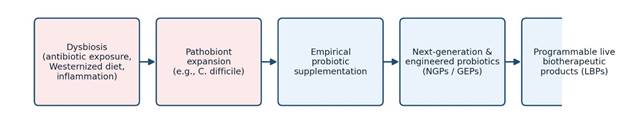
Figure 1: Evolution of microbiome therapeutics from unmanaged dysbiosis to programmable living drugs. The schematic traces the sequential transition described in Section 2.1: antibiotic-driven dysbiosis permits pathobiont expansion, which historically prompted empirical probiotic supplementation; this pathway has since been superseded by rationally engineered next-generation and genetically engineered probiotics (NGPs/GEPs), culminating in fully programmable live biotherapeutic products (LBPs).
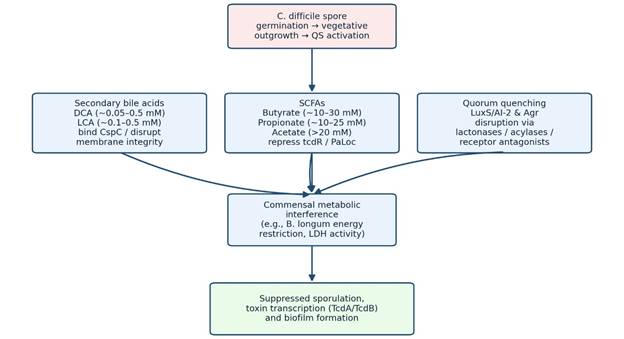
Figure 2: Metabolic and signaling battleground restraining Clostridioides difficile virulence, as synthesized in Sections 2.3–2.4 and 4.1. Secondary bile acids, short-chain fatty acids, and quorum-quenching interventions converge, together with direct commensal metabolic interference, to suppress spore germination, vegetative outgrowth, toxin transcription, and biofilm formation, with the quantitative inhibitory ranges for each metabolite summarized in Table 1.
intestinal epithelial cells once concentrations climb past the physiological range, exerting a detergent-like effect on host membranes (Nogueira et al., 2026). The design implication is therefore not "more is better" but something closer to a dosing tightrope: restoring balanced, spatially confined concentrations rather than maximizing accumulation (Nogueira et al., 2026).
2.4.2 SCFA Quantitative Fluxes and Virulence Regulation
Acetate, propionate, and butyrate—the major end products of commensal carbohydrate fermentation—exert a parallel, dose-dependent regulatory effect on both host mucosal immunity and pathogen physiology (Kamath et al., 2025; Sun et al., 2026). Butyrate at approximately 10–30 mM and propionate at approximately 10–25 mM directly suppress transcription of the PaLoc toxin genes by downregulating tcdR, while also altering cellular energy metabolism and reducing sporulation efficiency (Nogueira et al., 2026). Acetate, at concentrations above roughly 20 mM, lowers local luminal pH and imposes broader metabolic stress on vegetative cells (Nogueira et al., 2026). Should SCFA concentrations drop below these thresholds, however, their suppressive effect on virulence becomes inconsistent or disappears altogether (Nogueira et al., 2026)—which is precisely why maintaining physiological SCFA flux, not merely SCFA presence, has become a defining design requirement for live biotherapeutic products (Nogueira et al., 2026). Table 1 consolidates these quantitative thresholds and their associated mechanisms.
2.5 Quorum Sensing and Quorum Quenching: Disrupting Pathobiont Communication
C. difficile coordinates its more dangerous collective behaviors through two principal quorum-sensing (QS) networks: the LuxS/AI-2 system, which governs extracellular matrix production and biofilm formation, and the Agr system, which uses peptide signals to amplify toxin expression (Nogueira et al., 2026). Silencing either network—whether through mutational disruption of luxS, agrA, or tcdR—substantially attenuates virulence, which makes these regulatory circuits attractive targets for quorum quenching (QQ) strategies (Nogueira et al., 2026). In practice, QQ approaches tend to fall into two camps: enzymatic degradation of the signaling molecules themselves, using lactonases or acylases, or receptor-level antagonism that blocks signal transduction outright (Nogueira et al., 2026; Zhao et al., 2026). There is preclinical evidence that native commensals such as Bifidobacterium longum and Lactobacillus acidophilus already do something like this naturally, downregulating pathobiont virulence transcription in co-culture without any genetic engineering at all (Nogueira et al., 2026).
The complication—and it is a real one—is that AI-2 is not a private signal exclusive to pathogens. It is a highly conserved interspecies molecule used broadly across the gut community for metabolic cross-feeding and general community stability, so indiscriminate QQ risks doing collateral damage to the very commensal networks a therapy is meant to protect (Nogueira et al., 2026). The literature's response to this problem has been to push toward precision-guided QQ: inducible promoters, biosensors, or compartmentalized delivery systems designed to restrict signal disruption specifically to pathogenic niches, sparing the broader ecosystem (Nogueira et al., 2026). Figure 2 summarizes how these bile acid, SCFA, and quorum-quenching mechanisms converge to restrain pathobiont virulence.
2.6 Rational Design of Synthetic Consortia and Live Biotherapeutics
Executing these metabolic and signaling interventions reliably, it turns out, is difficult to do with a single strain. The field has consequently moved toward defined synthetic microbial consortia, which offer metabolic cooperation and functional redundancy that no lone organism can replicate (Hussain et al., 2026). One particularly elegant design pairs lactic acid bacteria (LAB), which establish comparatively durable relationships with the gut mucosa, with spore-forming Bacillus strains that behave more like temporary biochemical visitors—germinating, releasing metabolites, and then being cleared, but not before conditioning the local environment by shifting pH, oxygen tension, and nutrient availability (Oprișanu et al., 2026). This transient priming appears to smooth the way for stable colonizers and to upregulate protective host cytokines such as IL-22, G-CSF, and MIP-2 (Oprișanu et al., 2026).
This consortium-based logic is not merely theoretical; it has been clinically validated by defined biotherapeutics such as SER-109 and VE303 (Nogueira et al., 2026). Unlike heterogeneous, donor-dependent fecal transplant material, these are standardized formulations manufactured under batch-controlled GMP conditions (Nogueira et al., 2026; Sutanto & Fetarayani, 2026). In clinical trials, SER-109 reduced CDI recurrence to roughly 12–15%, compared with placebo, and multi-omic profiling tied that clinical success directly to durable reactivation of the bai operon, restoration of SCFA and secondary bile acid profiles, and transcriptional repression of the major toxin genes—mechanistic confirmation, in other words, of the metabolic story outlined above (Nogueira et al., 2026).
2.7 Precision Genome Engineering and Biological Containment
Synthetic biology has, in parallel, expanded what these platforms can actually be engineered to do, enabling probiotics that perform specific, programmed therapeutic tasks rather than simply persisting in the gut (Sutanto & Fetarayani, 2026).
2.7.1 CRISPR-Cas and CRISPRi: Precision Genetic Tools
CRISPR-Cas genome editing and CRISPR interference (CRISPRi) together permit sequence-specific modification and gene regulation within a probiotic chassis (Dey, 2026; Sutanto & Fetarayani, 2026). CRISPRi in particular—using catalytically inactive Cas9 (dCas9) guided by customized single-guide RNAs—can reversibly silence essential pathobiont pathways, among them the sporulation initiator spo0A, the quorum regulators luxS and agr, and the virulence regulator tcdR, all without ever cleaving chromosomal DNA (Karunakar et al., 2026; Nogueira et al., 2026). That reversibility matters clinically: because CRISPRi represses rather than kills, it minimizes the selective evolutionary pressure that tends to drive escape mutations under more punitive interventions (Karunakar et al., 2026; Nogueira et al., 2026). Engineered carriers add a delivery dimension to this toolkit; Saccharomyces boulardii, for instance, has been programmed to secrete a tetra-specific antitoxin fusion protein that binds and neutralizes TcdA and TcdB directly, preventing lethal inflammation in animal models (Zhao et al., 2026).
2.7.2 Multilayered Biosafety, Biocontainment, and Niche Control
Deploying a genetically modified organism in a human gut, understandably, is not something regulators or the field itself take lightly, and modern designs tend to stack several redundant safeguards rather than relying on any single one. Synthetic auxotrophy makes a strain dependent on an essential, host-specific metabolite—thymidine, via thymidylate synthase deletion, is a common choice—or on a synthetic, non-standard amino acid absent from nature altogether (Dey, 2026; Zhao et al., 2026). Synthetic kill switches, such as the so-called "Deadman" or "Passcode" circuits, use reciprocal transcriptional repression to trigger automatic cell death the moment a defined signal is withdrawn or the environment changes unexpectedly (Sutanto & Fetarayani, 2026). A third, more creative strategy is prebiotic-dependent niche engineering: Phocaeicola vulgatus has been engineered to depend on porphyran, a seaweed-derived sugar essentially absent from standard Western diets (Nogueira et al., 2026). Coupling essential survival genes to porphyran utilization carves out an exclusive, otherwise vacant ecological niche, allowing clinicians to tune colonization dose-dependently through diet while ensuring that any strain escaping into the wider environment is rapidly outcompeted and cleared (Nogueira et al., 2026). Figure 3 outlines how these editing platforms and containment layers combine within a single engineered chassis.
2.8 Regulatory Harmonization and Scale-Up Horizons
None of this molecular sophistication is worth much if it cannot be manufactured consistently or approved through a coherent regulatory pathway, and this is arguably where the field is least mature. Translating engineered probiotics and synthetic consortia into an industrial product means overcoming manufacturing and regulatory hurdles that are structurally different from those facing small-molecule drugs (Nogueira et al., 2026): potency and stability here depend on live-cell viability throughout anaerobic fermentation, on formulation stability, and on predictable engraftment after dosing—none of which map cleanly onto conventional pharmaceutical quality-control frameworks (Nogueira et al., 2026; Sutanto & Fetarayani, 2026). In response, developers are increasingly adopting multi-omic profiling as a GMP quality-control metric in its own right, linking specific genetic markers—expression of the bai operon, or of SCFA-synthesis genes such as but and buk—and specific metabolic flux rates to batch-to-batch standardization and potency assays (Nogueira et al., 2026). Regulatory bodies including the FDA and EMA are, concurrently, working toward harmonized frameworks for evaluating ecological safety and horizontal gene transfer risk, which together should eventually establish a clearer route to market (Nogueira et al., 2026; Sutanto & Fetarayani, 2026). Figure 4 depicts the broader computational-to-clinical pipeline that now underlies consortium design, from genome-scale modeling through
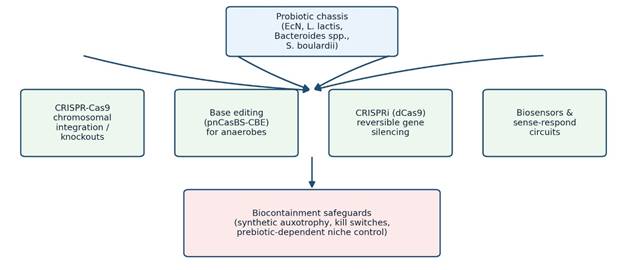
Figure 3: Molecular toolkit for engineering next-generation probiotic chassis, corresponding to the platforms detailed in Sections 2.6 and 4.3 and Table 3. CRISPR-Cas9 chromosomal integration, base editing in obligate anaerobes, CRISPR interference, and biosensor circuits are layered onto a probiotic chassis and paired with multilayered biocontainment safeguards to ensure both functional precision and biological safety.

Figure 4: Computational-to-clinical workflow for designing synthetic microbial consortia, as described in Sections 2.5 and 4.4. Metagenomic and metabolomic profiling of the target ecological niche informs genome-scale and community metabolic models, which are used to simulate cross-feeding and community stability in silico before empirical validation in gnotobiotic or murine models and, ultimately, Phase I–III clinical trials.
to regulatory-grade clinical evaluation.
