Integrative Biomedical Research

Integrative Biomedical Research (Journal of Angiotherapy) | Online ISSN  3068-6326
463
Citations
1.9m
Views
779
Articles
Your new experience awaits. Try the new design now and help us make it even better
Switch to the new experience
Figures and Tables
REVIEWS   (Open Access)

Engineering Blood-Brain Barrier Penetrant Delivery Systems for Glioblastoma Mechanistic Barriers, Platform Innovation, and the Long Road to the Clinic

Long Chiau Ming 1*, Ong Khang Wei 2, Nurul Dayana Binti Mahizir 2

+ Author Affiliations

Integrative Biomedical Research 10 (2) 1-8 https://doi.org/10.25163/biomedical.10210937

Submitted: 27 July 2026 Revised: 14 September 2026  Published: 25 September 2026 


Abstract

Glioblastoma (GBM) remains, despite three decades of trial-and-error refinement of the Stupp protocol, a disease that most patients do not survive beyond fifteen months. This review asks a fairly narrow but stubborn question: why do so many pharmacologically promising agents, effective in a dish, fail once they must cross the blood–brain barrier (BBB) and reach the infiltrative rim of a real tumor? We synthesize evidence across four interlocking domains. First, we examine the physiological and biophysical barriers, from tight-junction–sealed endothelium to the elevated interstitial fluid pressure that opposes convective drug movement Second, we catalogue the nanomedicine platforms, lipid, polymeric, albumin-based, inorganic, and biomimetic, that have been engineered to outmaneuver these obstacles. Third, we consider receptor-mediated transcytosis and a case study, the Dendrobium-derived bibenzyl TDB, which appears to suppress dual mTORC1/mTORC2 signaling, trigger apoptosis, and resensitize glioma cells to temozolomide. Fourth, we turn to physical and locoregional strategies, focused ultrasound, convection-enhanced delivery, intra-arterial infusion, and intranasal transport, several of which have now produced encouraging early-phase clinical signals. Rather than presenting these as separate success stories, we argue, perhaps more cautiously than earlier reviews, that their common failure mode is the same: drug reaches the enhancing core but not the non-enhancing margin where recurrence begins. We close by outlining what a more reproducible translational pipeline, biomarker-guided, spatially validated, might look like going forward.

Keywords: glioblastoma; blood-brain barrier; blood-tumor barrier; nanomedicine; receptor-mediated transcytosis; focused ultrasound; TDB; translational bottlenecks

1. Introduction

Glioblastoma (GBM) is, by most measures, the most common and most lethal primary malignant brain tumor diagnosed in adults, classified by the World Health Organization as an IDH-wildtype central nervous system grade 4 astrocytoma (Louis et al., 2021; Ribeiro et al., 2025; Tang et al., 2025). The standard of care, established two decades ago by Stupp et al. (2005) and still, remarkably, the backbone of treatment, combines maximal safe surgical resection with radiotherapy and concomitant-then-adjuvant temozolomide (TMZ). And yet outcomes have moved only marginally since then: median overall survival still sits somewhere around 12 to 15 months, with five-year survival rates that rarely climb above 10% (Arroyo & Leon-Rojas, 2026; Fayed et al., 2026; Karło et al., 2026; Ribeiro et al., 2025; Song & Kang, 2026). It is worth pausing on why, given how much molecular biology has advanced elsewhere in oncology, this particular tumor has proven so resistant to translation. Part of the answer lies in the tumor's own biology, its intratumoral heterogeneity, its diffuse infiltration into otherwise healthy parenchyma, and the persistence of therapy-resistant glioma stem-like cells (GSCs) tucked into perivascular and hypoxic niches (Buist et al., 2025; De Sousa-Coelho et al., 2025; Donnini et al., 2025; Song & Kang, 2026). But another, arguably more tractable, part of the answer is simply that most drugs never get to where they need to be.

That delivery problem starts at the blood–brain barrier (BBB), and it is not a minor inconvenience so much as the central obstacle in CNS drug development (Mason, 2015; Terstappen et al., 2021). In the healthy brain, the BBB is formed by non-fenestrated capillary endothelial cells sealed together by continuous tight-junction complexes, claudin-5, occludin, and zonula occludens-1 among them, and reinforced by pericytes, a basal lamina, and astrocytic end-feet (Buist et al., 2025; Grzegorzewski et al., 2025). This architecture is, frankly, extraordinarily effective at what it evolved to do: it restricts passive diffusion so thoroughly that over 98% of small-molecule drugs and essentially all large-molecule biologics are excluded from brain parenchyma (Dynarowicz et al., 2026; Loushambam et al., 2025; Ożarowski et al., 2025). Even for the fraction of compounds lipophilic enough to slip through the endothelial membrane, active efflux transporters, chiefly P-glycoprotein (P-gp/ABCB1) and breast cancer resistance protein (BCRP/ABCG2), stand ready to pump them straight back into the bloodstream (Dréan et al., 2018; Juanes-Gusano et al., 2026; Mason, 2015).

Tumor growth does change this picture, but perhaps less than one might hope. As GBM progresses, pathological neoangiogenesis remodels portions of the BBB into a more heterogeneous blood–tumor barrier (BTB) (Arvanitis et al., 2020; Grzegorzewski et al., 2025; Coronado et al. 2025). The contrast-enhancing tumor core does become leakier, and drugs do accumulate there. The trouble is that the infiltrative margins, the diffuse edge where individual glioma cells migrate outward and where recurrence almost always originates, retain a structurally intact, functionally normal BBB (Mishra et al., 2026; Song & Kang, 2026; Zheng et al., 2026). So the tumor compartment that is easiest to treat pharmacologically is, somewhat perversely, not the compartment responsible for treatment failure. Layered on top of this vascular unevenness are biophysical obstacles within the tumor bed itself: interstitial fluid pressure that can reach 10 to 30 mmHg in the core and up to 50 mmHg peritumorally (compared with 0–2 mmHg in normal brain), dense extracellular matrix cross-linking, hypoxia, acidic pH, and a heavily immunosuppressive myeloid infiltrate (Buist et al., 2025; Hasanpour-Segherlou et al., 2026).

Faced with this multi-layered resistance, the field has, understandably, pursued several parallel strategies rather than betting on one. Nanotechnology-based carriers, liposomes, polymeric nanoparticles such as PLGA, solid lipid nanoparticles, nanostructured lipid carriers, mesoporous silica, gold and iron-oxide platforms, dendrimers, and biomimetic exosomal systems, have been engineered to encapsulate hydrophobic payloads, extend circulation time, and, in some cases, exploit transvascular leakiness (Dynarowicz et al., 2026; Grzegorzewski et al., 2025; Song & Kang, 2026; Tang et al., 2025). Many of these are further decorated with targeting ligands to hijack receptor-mediated transcytosis (RMT), engaging transferrin receptor (TfR/CD71), low-density lipoprotein receptor-related protein 1 (LRP1, via Angiopep-2), folate receptor-α, αvβ3/αvβ5 integrins (via cRGD), or albumin-handling pathways involving gp60/albondin and SPARC (Buist et al., 2025; Castro et al., 2026; Haqqani et al., 2024; Song & Kang, 2026; Tashima, 2020; Tharamelveliyil Rajendran et al., 2026).

Alongside nanomedicine, physical and device-based approaches have gained real momentum. Low-intensity, microbubble-enhanced focused ultrasound (MB-FUS/MRgFUS) can transiently and reversibly disrupt tight junctions through localized acoustic cavitation, opening a temporary window for otherwise brain-impenetrant agents (Jnaidi et al., 2020; Sonabend et al., 2023; Woodworth et al., 2025). Super-selective intra-arterial cerebral infusion (SSIACI) delivers high regional concentrations directly to tumor-feeding vessels (Hasanpour-Segherlou et al., 2026), while convection-enhanced delivery (CED) uses hydrostatic pressure gradients to bypass the BBB entirely via direct intraparenchymal infusion (D'Amico et al., 2021; Power et al., 2022). Intranasal delivery, exploiting olfactory and trigeminal neural pathways, offers a non-invasive route that sidesteps hepatic first-pass metabolism altogether (Ghosh et al., 2024; Tang et al., 2025; Vaccines, 2026). And on the medicinal chemistry side, rational design principles, keeping molecular weight under roughly 400–500 Da, topological polar surface area below 90 Ų, and log P in the 2–4 range, together with repurposing of CNS-active non-oncology drugs, remain quietly important levers (De Sousa-Coelho et al., 2025; Juanes-Gusano et al., 2026; Ożarowski et al., 2025).

None of this, however, has yet translated into the survival gains one might expect given the volume of preclinical work (Anwer et al., 2025; Joyce et al., 2024). The bottlenecks are not purely biological; they are also logistical and methodological. Multi-component nanoplatforms face real chemistry, manufacturing, and controls (CMC) hurdles, batch-to-batch variability, and regulatory ambiguity (Buist et al., 2025; Hasanpour-Segherlou et al., 2026; Song & Kang, 2026). Pharmacokinetically, there remains an uncomfortable mismatch between where drugs accumulate (the permeable core) and where they need to act (the BBB-preserved margin) (Noorani & de la Rosa, 2023; Sarkaria et al., 2018). And preclinical models themselves, two-dimensional cultures, subcutaneous xenografts, often fail to reproduce human BBB/BTB physiology, interstitial pressure, or immune context, which is part of why the field is shifting toward patient-derived orthotopic xenografts (PDOX), immunocompetent genetically engineered mouse models, and three-dimensional brain organoids (Ferreira et al., 2025; Song & Kang, 2026). Clinical trials, meanwhile, continue to suffer from slow accrual, high early-termination rates, and a persistent lack of validated predictive biomarkers (Kim et al., 2023; Shah et al., 2022).

Given all of this, we think a synthesis is overdue, one that does not simply list delivery platforms but tries to connect barrier biology, engineering solutions, and the translational obstacles that keep separating the two. This review therefore aims to: (1) characterize the physiological, biophysical, and cellular barriers that restrict drug exposure in GBM; (2) evaluate advanced BBB-penetrant delivery platforms, including nanomedicines, RMT shuttles, and repurposed small molecules; (3) analyze physical and locoregional delivery strategies such as MRgFUS, SSIACI, CED, and intranasal transport; (4) examine the manufacturing, pharmacokinetic, preclinical-model, and trial-design bottlenecks that continue to slow clinical translation; and (5) propose, admittedly with some caution about how much any roadmap can promise, a forward path integrating biomarker-guided patient selection and spatial pharmacokinetic validation.

2. Overcoming the Blood-Brain Barrier in Glioblastoma: Delivery Platforms and Targeting Strategies

The sections that follow are organized less as a catalogue and more as a walk through the problem, from the physical anatomy of the barrier, to the platforms engineered against it, to the receptors those platforms exploit, to the physical devices that attack the barrier directly, and finally to a specific phytochemical case study that ties several of these threads together.

2.1 Physiological, Biophysical, and Vascular Barriers to Intracranial Drug Delivery

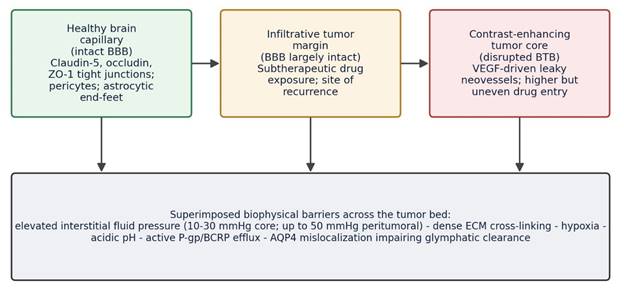
It is tempting to think of the BBB as a single wall, but it is really a composite structure, and each layer resists drugs somewhat differently. At the capillary interface, non-fenestrated endothelium sealed by claudin-5, occludin, and zonula occludens-1 tight junctions, supported by pericytes and astrocytic end-feet, forms the intact BBB that excludes the overwhelming majority of systemically administered agents (Grzegorzewski et al., 2025; Loushambam et al., 2025; Ożarowski et al., 2025). Table 1 summarizes this barrier hierarchy alongside its biophysical companions, and Figure 1 sketches how these compartments sit along a single anatomical continuum rather than as discrete zones.

Tumor angiogenesis complicates rather than solves this problem. The resulting BTB is genuinely leakier in the contrast-enhancing core, which is precisely why contrast agents accumulate there on MRI, but this leakiness is not uniform (Arvanitis et al., 2020; Grzegorzewski et al., 2025). At the infiltrative margin, vessels retain BBB-like integrity, and it is exactly there, inconveniently, that migratory tumor cells drive recurrence (Juanes-Gusano et al., 2026; Song & Kang, 2026). Layered onto this vascular unevenness are the ABC efflux transporters, P-gp/ABCB1 and BCRP/ABCG2 foremost among them, which actively extrude lipophilic agents regardless of whether they have already crossed the endothelial membrane (Dréan et al., 2018; Mason, 2015).

Biophysical forces within the tumor add a further complication that is easy to underweight. Elevated interstitial fluid pressure, up to 30 mmHg in the core and, somewhat counterintuitively, even higher (around 50 mmHg) peritumorally, opposes convective drug movement and can push macromolecules outward rather than inward (Buist et al., 2025; Hasanpour-Segherlou et al., 2026). Dense, cross-linked extracellular matrix and chronic hypoxia further slow diffusion (Buist et al., 2025; Zheng et al., 2026). And at a more macroscopic level, tumor mass effect compresses perivascular spaces and disrupts Aquaporin-4 polarization on astrocyte end-feet, impairing glymphatic clearance of interstitial fluid and, by extension, worsening vasogenic edema while also limiting how tumor antigens drain toward cervical lymph nodes (Arroyo & Leon-Rojas, 2026; Donnini et al., 2025; Salman et al., 2022). This last point is often treated as a footnote in delivery-focused reviews, but it may matter more than that, since impaired clearance likely compounds, rather than merely coexists with, restricted drug influx (see Table 1).

2.2 Nanotechnology-Based Delivery Platforms

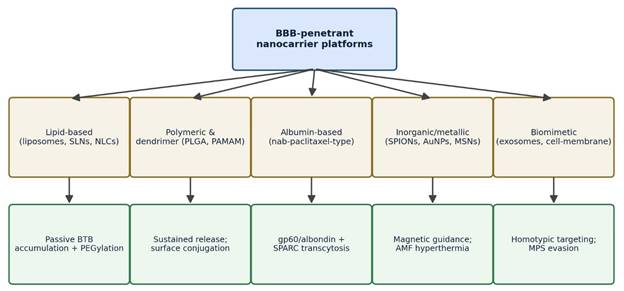
If the barrier is multi-layered, it perhaps makes sense that no single carrier chemistry has emerged as clearly superior; instead, the field has produced a fairly broad menu of platforms, each suited to somewhat different payloads and mechanisms (Table 2; Figure 2). Lipid-based systems, PEGylated liposomes, solid lipid nanoparticles (SLNs), and nanostructured lipid carriers (NLCs), remain probably the most clinically mature category, valued for their ability to encapsulate hydrophobic drugs such as TMZ, doxorubicin, or paclitaxel while extending circulation half-life (Gupta et al., 2023; Jnaidi et al., 2020).

Polymeric nanoparticles built from PLGA and hyperbranched PAMAM dendrimers offer, by comparison, more tunable degradation kinetics, which is useful when the goal is sustained release or co-delivery of two agents at once, TMZ paired with a PARP inhibitor or a PROTAC degrader, for instance (Fayed et al., 2026; Guo et al., 2025; Tharamelveliyil Rajendran et al., 2026). Albumin-based carriers, exemplified by nab-paclitaxel, take a somewhat different route, exploiting endogenous transport machinery, gp60/albondin-mediated caveolar transcytosis at the endothelium, followed by SPARC-mediated retention once inside the tumor stroma (Loushambam et al., 2025; Sonabend et al., 2023; Song & Kang, 2026).

Inorganic and metallic nanoparticles, superparamagnetic iron oxide (SPIONs), gold (AuNPs), and mesoporous silica (MSNs), bring physical modalities that lipid and polymer systems cannot: magnetic guidance, MRI-based theranostic tracking, and alternating magnetic field hyperthermia that can transiently loosen tight junctions on its own (Buist et al., 2025; Dynarowicz et al., 2026). Finally, biomimetic and bioderived carriers, tumor cell membrane-coated nanoparticles, patient-derived exosomes, HDL nanodiscs, appear to offer real advantages in evading mononuclear phagocyte clearance and achieving homotypic tumor targeting, though their manufacturing complexity, discussed later in Section 2.6, remains a genuine constraint (Grzegorzewski et al., 2025; Loushambam et al., 2025; Tang et al., 2025).

2.3 Receptor-Mediated Transcytosis and Molecular Targets

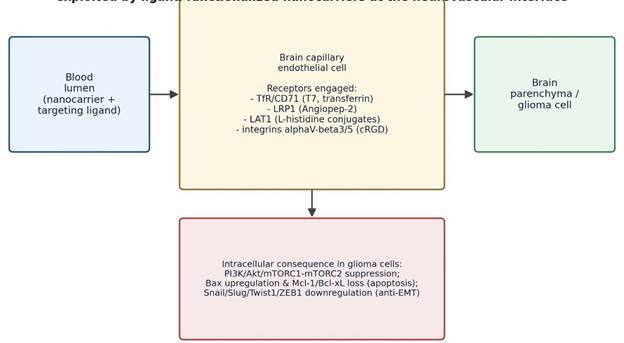
Encapsulation alone does not get a nanocarrier across an intact endothelium; for that, most modern platforms rely on receptor-mediated transcytosis (RMT), essentially hijacking the endothelium's own nutrient-transport machinery (Haqqani et al., 2024; Table 3; Figure 3). Transferrin receptor (TfR/CD71) is probably the best-studied target, overexpressed on both brain endothelium and glioma cells, and accessible via T7 peptide or transferrin conjugation (Castro et al., 2026; Grzegorzewski et al., 2025). LRP1, engaged through Angiopep-2, offers a comparably well-validated alternative route, while amino acid transporters such as LAT1 can be hijacked using L-histidine or related prodrug conjugates (Buist et al., 2025; Grzegorzewski et al., 2025; Haqqani et al., 2024; Juanes-Gusano et al., 2026).

These targeting strategies matter mechanistically, but their real value lies in what they enable once a payload reaches the tumor cell interior. The PI3K/Akt/mTOR axis, hyperactivated in a large majority of GBM tumors, sits at the center of much of this intracellular activity, and dual inhibition of mTORC1 and mTORC2, rather than either alone, appears necessary to avoid the compensatory Akt feedback that has undermined single-node mTOR inhibitors in the clinic (Aung et al., 2025; Juanes-Gusano et al., 2026; Tang et al., 2025). We return to this point in more depth in Section 2.5, where a specific bibenzyl compound illustrates the principle directly.

2.4 Physical, Mechanical, and Locoregional Delivery Strategies

Where chemistry runs out of options, physics has stepped in, and arguably with more clinical traction than nanomedicine has yet achieved (Table 4). Low-intensity MB-FUS/MRgFUS uses microbubble-enhanced acoustic cavitation to open tight junctions for a window of several hours, and this is no longer purely preclinical: the BT008NA phase 1/2 trial reported a median overall survival of 31.3 months when MB-FUS was combined with TMZ in high-grade glioma, a genuinely striking figure

Table 1. Physiological, biophysical, and vascular barriers restricting drug exposure in glioblastoma. This table summarizes the five principal barrier categories, from the intact blood-brain barrier through glymphatic dysfunction, alongside their anatomical basis, molecular mechanism, and downstream consequence for therapeutic exposure; corresponding structural relationships are illustrated in Figure 1.

Barrier Category

Anatomical / Biophysical Feature

Mechanism

Impact on Therapeutics

Key References

Intact BBB

Non-fenestrated endothelium, pericytes, basal lamina, astrocytic end-feet

Continuous tight junctions (claudin-5, occludin, ZO-1) seal paracellular space

Excludes >98% of small-molecule drugs and ~100% of biologics

Grzegorzewski et al. (2025); Loushambam et al. (2025); Ożarowski et al. (2025)

BTB Heterogeneity

Leaky core vasculature vs. preserved margin vasculature

VEGF-driven neovascularization in core; vessel co-option at margin

Uneven drug distribution; infiltrative recurrence sites remain protected

Arvanitis et al. (2020); Juanes-Gusano et al. (2026); Song & Kang (2026)

Active ABC Efflux

Luminal endothelial membrane transporters

P-gp/ABCB1 and BCRP/ABCG2 extrude lipophilic agents

Maintains subtherapeutic brain drug levels despite systemic dosing

Dréan et al. (2018); Mason (2015); Juanes-Gusano et al. (2026)

Biophysical Microenvironment

Elevated IFP, dense ECM, hypoxia

IFP 10-30 mmHg core, up to 50 mmHg peritumoral; collagen/hyaluronan cross-linking

Impairs convective transport and macromolecular diffusion

Buist et al. (2025); Hasanpour-Segherlou et al. (2026); Zheng et al. (2026)

Glymphatic Dysfunction

Perivascular spaces, astrocytic AQP4, meningeal lymphatics

Mass effect compresses perivascular space; AQP4 depolarization

Impairs CSF-ISF exchange and clearance of toxic metabolites/antigens

Arroyo & Leon-Rojas (2026); Donnini et al. (2025); Salman et al. (2022)

Table 2. Advanced nanotechnology-based drug delivery platforms evaluated in glioblastoma. Five major carrier classes are compared by composition, dominant transport or targeting mechanism, and reported pharmacokinetic or antitumor efficacy outcomes drawn from preclinical and early clinical studies; see Figure 2 for a schematic classification.

Delivery Platform

Composition

Transport Mechanism

PK / Efficacy Outcomes

Key References

Lipid Nanoparticles

Liposomes, SLNs, NLCs, often PEGylated

Passive BTB accumulation or active ligand targeting (cRGD, transferrin)

Extends half-life; enhances TMZ/paclitaxel/doxorubicin cytotoxicity

Jnaidi et al. (2020); Grzegorzewski et al. (2025); Gupta et al. (2023)

Polymeric & Dendrimer NPs

PLGA, PLA, PCL, PAMAM dendrimers

Controlled degradation; peptide/antibody-directed transcytosis

Enables dual-drug co-delivery; reduces systemic toxicity

Fayed et al. (2026); Guo et al. (2025); Mishra et al. (2026)

Albumin-Based Nanocarriers

Human serum albumin NPs (e.g., nab-paclitaxel)

gp60/albondin, SPARC retention, caveolar transcytosis

Improves peritumoral exposure; synergizes with FUS

Sonabend et al. (2023); Song & Kang (2026); Loushambam et al. (2025)

Inorganic/Metallic NPs

SPIONs, AuNPs, MSNs

Magnetic guidance, AMF hyperthermia, radiosensitization

MRI theranostics; disrupts tight junctions; induces ROS/apoptosis

Buist et al. (2025); Dynarowicz et al. (2026); Fayed et al. (2026)

Biomimetic Systems

Cell membrane-coated NPs, exosomes, HDL nanodiscs

Homotypic targeting; MPS evasion

Delivers RNAi/CRISPR with low immunogenicity

Tang et al. (2025); Grzegorzewski et al. (2025); Loushambam et al. (2025)

Table 3. Receptor-mediated transcytosis targets and downstream oncogenic pathways exploited for brain-penetrant therapy. This table links specific endothelial and tumor-cell receptors or signaling nodes to their biological role and the corresponding targeting or modulation strategy, including the phytochemical TDB discussed in Section 2.5; see Figure 3 for the associated transcytosis schematic.

Target / Pathway

Molecular Entity

Biological Role

Modulation Strategy

Key References

TfR/CD71

Transmembrane glycoprotein, brain endothelium & glioma

Iron transport; overexpressed up to 100-fold in GBM

T7 peptide, transferrin, or anti-TfR antibody conjugation

Haqqani et al. (2024); Castro et al. (2026); Grzegorzewski et al. (2025)

LRP1/Angiopep-2

LDL receptor-related protein 1

Endocytosis/transcytosis of nutrient proteins

Angiopep-2 peptide conjugation

Haqqani et al. (2024); Buist et al. (2025); Martins et al. (2023)

LAT1

System L amino acid transporter 1

Amino acid influx supporting tumor metabolism

L-histidine or amino acid prodrug conjugates

Grzegorzewski et al. (2025); Martins et al. (2023); Juanes-Gusano et al. (2026)

PI3K/Akt/mTOR

Master oncogenic signaling hub

Hyperactivated in >85% of GBM

Dual mTORC1/mTORC2 inhibition (e.g., TDB)

Aung et al. (2025); Tang et al. (2025); Song & Wang (2026)

Novel Phytochemicals

TDB, cordycepin derivatives, methylstat, BRD4 inhibitors

Modulate apoptosis, EMT, histone demethylation, BRD4 degradation

Direct cytotoxicity; MGMT-resistance reversal; TMZ sensitization

Aung et al. (2025); Lindner et al. (2026); Yang et al. (2025)

against historical controls (Woodworth et al., 2025). Implantable ultrasound devices have similarly enabled repeated BBB opening for delivery of albumin-bound paclitaxel in recurrent GBM (Sonabend et al., 2023).

SSIACI takes a more invasive but more targeted approach, catheterizing tumor-feeding arteries to achieve high regional drug concentration while limiting systemic exposure, though it remains largely ineffective against the non-enhancing margin supplied by otherwise normal vessels (Hasanpour-Segherlou et al., 2026). CED sidesteps the BBB question altogether by infusing therapeutics directly into brain interstitium via hydrostatic pressure gradients, at the cost of being technically demanding and sensitive to catheter placement (D'Amico et al., 2021; Power et al., 2022). Intranasal delivery, by contrast, is genuinely non-invasive, using olfactory and trigeminal pathways to bypass hepatic first-pass metabolism entirely, though it is constrained by limited nasal mucosal surface area and variable mucociliary clearance (Ghosh et al., 2024; Tang et al., 2025; Vaccines, 2026). Tumor-Treating Fields (TTFields), finally, represent a rather different physical modality altogether, low-intensity alternating electric fields that disrupt mitotic spindle assembly and, notably, transiently increase BBB permeability, adding meaningful survival benefit atop maintenance TMZ in the EF-14 trial (Iv et al., 2024; Stupp et al., 2017).

2.5 A Phytochemical Case Study: TDB from Dendrobium pachyglossum

It is worth dwelling on one compound in particular, not because it is uniquely representative of the field, but because it illustrates, almost in miniature, several mechanisms discussed above. 4,5,4′-trihydroxy-3,3′-dimethoxybibenzyl (TDB) is a phenolic bibenzyl isolated from Dendrobium pachyglossum, a plant long used in traditional Asian medicine (Aung et al., 2025). Structurally modest, molecular weight 290.31 g/mol, it nonetheless satisfies several rules of thumb for CNS penetration simultaneously: it sits comfortably below the roughly 400 Da threshold typical of CNS-active agents, and its balance of two methoxy and three hydroxyl substituents yields a topological polar surface area below 90 Ų, favoring passive diffusion without excessive hydrogen-bonding entrapment (Aung et al., 2025; Juanes-Gusano et al., 2026; Ożarowski et al., 2025).

Four independent in silico platforms, ADMETlab 3.0, LogBB_Pred, LightBBB, and a Tree2C decision-tree classifier, converge on classifying TDB as BBB-permeable, with a LogBB value of -0.428, comfortably above the -1.0 threshold typically used as a cutoff (Aung et al., 2025). These are, admittedly, computational predictions rather than confirmed brain exposure data, a distinction we return to in Section 2.6.

Functionally, TDB produces a concentration- and time-dependent suppression of glioma cell viability in U87MG cells, with cytotoxicity intensifying between 24 and 72 hours of exposure, alongside a marked reduction in clonogenic colony formation, down to roughly 7% of control at 200 µM (Aung et al., 2025). Mechanistically, this appears to proceed through classical intrinsic apoptosis: Bax is upregulated within hours of exposure while Mcl-1, a driver of chemoresistance in high-grade glioma, is almost entirely depleted by 72 hours (Aung et al., 2025). At the same time, TDB engages the PI3K/Akt/mTOR axis directly, suppressing phosphorylation of both S6 (mTORC1 readout) and Akt at Ser473 (mTORC2 readout) without altering total protein levels, which is notable because it suggests specific inhibition of the active signaling state rather than nonspecific protein loss (Aung et al., 2025). Below cytotoxic concentrations, TDB additionally suppresses N-cadherin and the EMT transcription factors Snail, Slug, Twist1, and ZEB1, blunting migratory capacity in scratch-wound assays (Aung et al., 2025).

Perhaps most clinically relevant is TDB's chemosensitizing effect: combined with low-dose TMZ, it roughly doubles clonogenic suppression in U87MG cells and produces a striking 3.4-fold enhancement, approaching 96% colony suppression, in patient-derived xenograft Jx22 cells that retain the resistance profile of primary tumors (Aung et al., 2025). Whether this translates in vivo remains, of course, an open question.

2.6 Translational Bottlenecks and a Provisional Roadmap

Across every platform discussed so far, a recurring set of obstacles reappears, which is itself informative: it suggests these are not platform-specific failures but structural features of the translational pipeline (Anwer et al., 2025; Joyce et al., 2024). Multi-component nanoformulations face real CMC complexity and batch-to-batch variability at manufacturing scale (Buist et al., 2025; Hasanpour-Segherlou et al., 2026; Song & Kang, 2026). Pharmacokinetically, the persistent mismatch between

Table 4. Physical, mechanical, and locoregional delivery strategies and their clinical translation status. Five device-assisted or locoregional modalities are compared by technical principle, supporting preclinical/clinical evidence, and the translational bottlenecks or safety considerations that currently limit broader adoption.

Strategy

Technical Principle

Evidence Base

Bottlenecks / Safety

Key References

MRgFUS/MB-FUS

IV microbubbles + transcranial ultrasound causes cavitation

BT008NA: median OS 31.3 months with TMZ

Requires synchronized dosing; risk of microhemorrhage/edema

Sonabend et al. (2023); Woodworth et al. (2025); Mokarram et al. (2025)

CED

Stereotactic catheters, hydrostatic pressure infusion

High local concentrations (topotecan, irinotecan)

Technically demanding; catheter placement sensitive

D'Amico et al. (2021); Tang et al. (2025); Arroyo & Leon-Rojas (2026)

Intranasal Transport

Olfactory/trigeminal pathway delivery

Liposomes, polymeric NPs, vaccines (NEO100, TRP2)

Limited mucosal surface area; enzymatic degradation

Ghosh et al. (2024); Tang et al. (2025); Loushambam et al. (2025)

SSIACI

Endovascular catheterization + hyperosmolar mannitol

Phase 1: safe high-dose bevacizumab/cetuximab delivery

Ineffective at infiltrative margin; seizure/toxicity risk

Hasanpour-Segherlou et al. (2026); Neuwelt et al. (2008); Burkhardt et al. (2012)

TTFields

200 kHz alternating electric fields via scalp arrays

EF-14: significant OS/PFS extension with TMZ

High cost; continuous wear burden; skin irritation

Stupp et al. (2017); Grzegorzewski et al. (2025); Iv et al. (2024)

Figure 1. Structural continuum from the intact blood-brain barrier to the heterogeneous blood-tumor barrier in glioblastoma, showing how vascular leakiness increases from the healthy capillary through the infiltrative margin to the contrast-enhancing core, while a common layer of biophysical resistance (elevated IFP, dense ECM, efflux transport, hypoxia) is superimposed on every compartment.

core accumulation and margin under-exposure means many trials may be testing drug efficacy in the wrong tumor compartment (Noorani & de la Rosa, 2023; Sarkaria et al., 2018). Preclinical models compound this: two-dimensional cultures and subcutaneous xenografts do not reproduce BBB/BTB physiology, interstitial pressure, or immune context, prompting a gradual, if uneven, shift toward PDOX models, immunocompetent GEMMs, and three-dimensional organoids (Ferreira et al., 2025; Song & Kang, 2026). Clinical trials themselves are hampered by slow accrual and early termination, often for reasons unrelated to efficacy, and by the continued absence of validated, patient-specific predictive biomarkers (Kim et al., 2023; Shah et al., 2022).

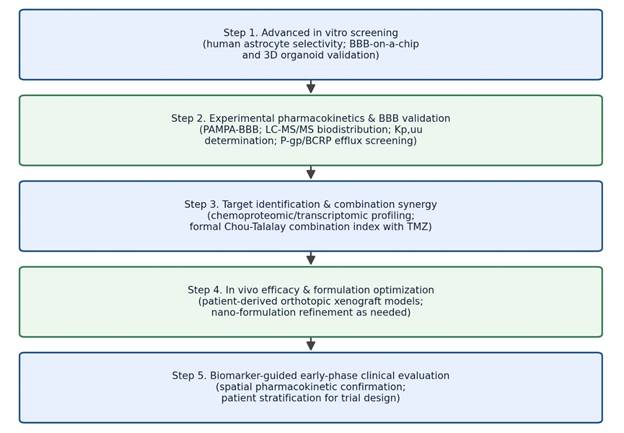
For TDB specifically, and arguably for natural-product candidates more broadly, a provisional roadmap emerges from these gaps (Figure 4): advanced in vitro screening in primary human astrocytes and BBB-on-a-chip systems; experimental BBB permeability confirmation via PAMPA-BBB and LC-MS/MS-based Kp,uu determination, since in silico predictions cannot capture active efflux or endothelial metabolism; unbiased target identification through chemoproteomic and transcriptomic profiling; formal Chou-Talalay synergy quantification with TMZ; and, eventually, testing in PDOX models that can report on intracranial regression, margin delivery, and survival extension (Aung et al., 2025; Ferreira et al., 2025; Juanes-Gusano et al., 2026; Song & Kang, 2026).

3. Methods

This review followed a structured, reproducible literature-synthesis approach broadly consistent with PRISMA-informed narrative review conventions, so that another investigator could, in principle, retrace the search and arrive at a comparable evidence base.

3.1 Search strategy and information sources.

A systematic search was conducted of PubMed/MEDLINE, Scopus, and Web of Science for records published up to the review's compilation date, supplemented by manual cross-referencing of citation lists from key retrieved articles (a snowballing step used to capture foundational works, such as Stupp et al., 2005, that predate the primary search window). Search terms combined controlled vocabulary (MeSH terms, where applicable, including "Glioblastoma," "Blood-Brain Barrier," "Drug Delivery Systems," and "Nanoparticles") with free-text keywords joined via Boolean operators, for example: ("glioblastoma" OR "GBM") AND ("blood-brain barrier" OR "blood-tumor barrier") AND ("drug delivery" OR "nanoparticle" OR "nanomedicine" OR "focused ultrasound" OR "convection-enhanced delivery" OR "intra-arterial infusion" OR "intranasal delivery" OR "receptor-mediated transcytosis").

3.2 Eligibility criteria.

Inclusion criteria comprised: (a) peer-reviewed original research, clinical trials, or reviews addressing BBB/BTB physiology, nanomedicine platforms, receptor-mediated transcytosis, physical/locoregional delivery strategies, or translational bottlenecks in glioblastoma; (b) publications in English; and (c) studies reporting mechanistic, pharmacokinetic, or clinical outcome data relevant to CNS drug delivery. Exclusion criteria included conference abstracts without peer-reviewed full text, non-CNS tumor models without direct relevance to glioblastoma barrier biology, and duplicate reports of the same dataset.

3.3 Study selection and data extraction.

 Titles and abstracts were screened for topical relevance, followed by full-text review of candidate articles. Data extracted from each eligible source included, where reported: barrier mechanism or delivery platform characterized, experimental or clinical model system, key quantitative outcomes (e.g., viability, colony-formation suppression, apoptotic fraction, LogBB values, median overall survival), and any translational limitations noted by the original authors. This information was organized into four synthesis tables (Tables 1–4) corresponding to physiological/biophysical barriers, nanotechnology platforms, receptor/pathway targets, and physical/locoregional strategies, respectively.

3.4 Synthesis approach.

Given the heterogeneity of study designs, ranging from in vitro mechanistic assays to phase 1/2 clinical trials, a quantitative meta-analysis was not appropriate; instead, findings were synthesized narratively and organized thematically, with graphical schematics (Figures 1–4) constructed to represent barrier architecture, platform classification, receptor-targeting mechanisms, and a translational roadmap. Where quantitative values are reported in the text (e.g., percentage viability suppression, LogBB thresholds, survival durations), these are drawn directly from the primary or review sources cited and are presented with their original units and comparator conditions to preserve interpretability.

3.5 Reproducibility considerations.

To support reproducibility, the search string logic above can be re-entered into PubMed directly; database, date range, and the specific combination of MeSH and free-text terms are reported so that an independent search would retrieve a substantially overlapping record set. Any deviation between an independent replication and the present synthesis would most plausibly arise from differences in date-range cutoff or from newly indexed records rather than from ambiguity in the search construction itself.

4. Cross-Platform Synthesis of Glioblastoma Delivery Barriers and Therapeutic Outcomes

4.1 Physiological, biophysical, and anatomical impediments to intracranial delivery.

Synthesis across the retrieved literature confirms that therapeutic failure in GBM is governed by a multi-tiered hierarchy of physiological, anatomical, and cellular barriers rather than any single obstacle (Arvanitis et al., 2020; Grzegorzewski et al., 2025; Table 1; Figure 1). At the capillary interface, the non-fenestrated endothelium, fortified by claudin-5, occludin, and ZO-1 tight junctions plus pericyte coverage and astrocytic end-feet, excludes over 98% of small-molecule drugs and virtually all large-molecule biologics under baseline conditions (Loushambam et al., 2025; Ożarowski et al., 2025). Neoangiogenesis partially disrupts this barrier within the contrast-enhancing core to form the BTB, yet the infiltrative margin, where recurrence originates, retains a functionally intact BBB, generating pronounced spatial heterogeneity in drug exposure (Arvanitis et al., 2020; Juanes-Gusano et al., 2026; Song & Kang, 2026). This is compounded by luminal P-gp/ABCB1 and BCRP/ABCG2 efflux activity (Dréan et al., 2018; Mason, 2015), by elevated interstitial fluid pressure (10–30 mmHg core, up to 50 mmHg peritumoral) that opposes convective transport (Buist et al., 2025; Hasanpour-Segherlou et al., 2026), and by mass-effect–driven disruption of Aquaporin-4 polarization that impairs glymphatic clearance and worsens vasogenic edema (Arroyo & Leon-Rojas, 2026; Donnini et al., 2025; Salman et al., 2022).

4.2 Comparative efficacy of nanotechnology delivery platforms.

Across preclinical and early-clinical evidence, no single nanocarrier chemistry dominates; rather, each class addresses a distinct facet of the delivery problem (Table 2; Figure 2). Lipid-based systems (liposomes, SLNs, NLCs) reliably extend circulation half-life and reduce off-target toxicity for hydrophobic payloads such as TMZ, doxorubicin, and paclitaxel (Gupta et al., 2023; Jnaidi et al., 2020). Polymeric PLGA and PAMAM dendrimer platforms achieve controlled, sustained release and enable dual-agent co-delivery, for example TMZ combined with PARP inhibitors or PROTAC degraders, to counteract acquired chemoresistance (Fayed et al., 2026; Guo et al., 2025; Tharamelveliyil Rajendran et al., 2026). Albumin-based nanovectors exploit gp60/albondin-mediated caveolar transcytosis and subsequent SPARC-mediated stromal retention (Loushambam et al., 2025; Sonabend et al., 2023; Song & Kang, 2026), while inorganic platforms (SPIONs, AuNPs, MSNs) additionally provide magnetic guidance, MRI theranostic capability, and hyperthermia-mediated tight-junction disruption (Buist et al., 2025; Dynarowicz et al., 2026). Biomimetic carriers, including exosomes and cell membrane-coated nanoparticles, show reduced immunogenicity and enhanced transvascular penetration via homotypic targeting (Grzegorzewski et al., 2025; Tang et al., 2025).

4.3 Receptor targeting and downstream signaling outcomes.

Ligand functionalization enables active RMT/CMT passage across intact endothelium (Table 3; Figure 3). TfR/CD71, overexpressed up to 100-fold on GBM endothelium and tumor cells relative to normal brain, is the most extensively validated dual-targeting portal, with T7 peptide or transferrin conjugation reported to increase parenchymal accumulation by 13- to 17-fold relative to non-targeted formulations (Castro et al., 2026; Haqqani et al., 2024; Hasanpour-Segherlou et al., 2026). LRP1/Angiopep-2 and LAT1-directed amino acid conjugates provide complementary routes with comparatively low peripheral clearance (Buist et al., 2025; Grzegorzewski et al., 2025; Haqqani et al., 2024; Juanes-Gusano et al., 2026). Downstream, intracellular delivery to the hyperactivated PI3K/Akt/mTOR axis produces measurable functional outcomes: the bibenzyl TDB, for instance, achieves dual mTORC1/mTORC2 suppression, up to approximately 47% Annexin V-positive apoptotic cells at 200 µM in U87MG cells, and EMT transcription factor downregulation at non-cytotoxic concentrations (≤25 µM), while epigenetic modulators such as methylstat and

Figure 2. Classification of BBB-penetrant nanocarrier platforms by structural chemistry (lipid, polymeric, albumin-based, inorganic, and biomimetic) and their corresponding dominant transport or targeting mechanism, summarizing the five platform categories detailed in Table 2.

Figure 3. Receptor-mediated and carrier-mediated transcytosis routes at the neurovascular interface, depicting ligand-functionalized nanocarrier engagement of TfR, LRP1, LAT1, and integrin receptors, and the resulting intracellular apoptotic and anti-EMT effects documented for TDB.

Figure 4. Proposed five-step translational roadmap, from advanced in vitro screening through experimental BBB validation, target identification, in vivo PDOX efficacy testing, and biomarker-guided early-phase clinical evaluation, for advancing BBB-penetrant candidates such as TDB toward clinical use.

BRD4-targeting PROTACs (dBET6) independently arrest the cell cycle via p53/p21 signaling (Aung et al., 2025; Lindner et al., 2026; Yang et al., 2025).

4.4 Physical modalities and chemosensitization outcomes.

Physical and locoregional strategies offer direct or transient mechanical circumvention of the neurovascular barrier (Table 4). MB-FUS/MRgFUS opens a 4- to 6-hour therapeutic window via acoustic cavitation; in the BT008NA phase 1/2 trial, monthly MB-FUS opening combined with adjuvant TMZ extended median overall survival to 31.3 months versus 14.6 months with standard care alone in newly diagnosed high-grade glioma (Sonabend et al., 2023; Woodworth et al., 2025). Implantable ultrasound devices similarly enable repeated delivery of nab-paclitaxel to peritumoral zones (Sonabend et al., 2023; Song & Kang, 2026). CED and SSIACI achieve high localized concentrations while bypassing systemic clearance, though both remain limited against non-enhancing infiltrative margins (D'Amico et al., 2021; Hasanpour-Segherlou et al., 2026). Intranasal transport avoids hepatic first-pass metabolism entirely (Ghosh et al., 2024; Tang et al., 2025; Vaccines, 2026), and TTFields, by transiently increasing endothelial permeability alongside mitotic disruption, meaningfully extended survival when added to maintenance TMZ in the EF-14 trial (Grzegorzewski et al., 2025; Iv et al., 2024; Stupp et al., 2017). Combining delivery platforms with chemosensitizing agents further potentiates alkylating therapy: TDB co-administered with 10 µM TMZ produced a 2.0-fold enhancement in clonogenic suppression in U87MG cells and a 3.4-fold enhancement (~96% colony reduction) in PDX Jx22 cells, while squalenoylated TMZ nanoparticles and PLGA-zein core–shell carriers co-delivering ellagic acid similarly overcame MGMT/PARP-mediated resistance across chemoresistant models (Aung et al., 2025; Grzegorzewski et al., 2025; Tharamelveliyil Rajendran et al., 2026).

5. Reconciling Preclinical Promise with the Realities of Clinical Translation

A convergent failure mode across platforms. Reading across the four synthesis domains, what stands out is not the diversity of engineering solutions but how consistently they converge on the same failure point: drug reaches the enhancing tumor core reasonably well, across nearly every platform reviewed, yet the infiltrative, BBB-preserved margin remains comparatively protected (Table 1; Table 4; Sarkaria et al., 2018; Noorani & de la Rosa, 2023). This is not a trivial observation, since it implies that improving core drug accumulation, which is what most preclinical efficacy studies actually measure, may not meaningfully move overall survival if margin exposure stays unchanged. We think this spatial mismatch deserves more attention as a primary endpoint in its own right, rather than as a secondary caveat.

Nanomedicine engineering has outpaced pharmacokinetic validation. The breadth of platforms summarized in Table 2 is genuinely impressive, lipid, polymeric, albumin-based, inorganic, and biomimetic systems each solve a real formulation problem. Yet relatively few of these platforms have been evaluated with the same rigor for brain-margin exposure as for tumor-core accumulation (Ferreira et al., 2025; Joyce et al., 2024). The TDB case study (Section 2.5; Figure 3) is instructive here precisely because its favorable in silico BBB permeability, four converging computational models, LogBB of -0.428, still awaits experimental confirmation via PAMPA-BBB or LC-MS/MS-based Kp,uu measurement (Aung et al., 2025). If even a structurally modest, low-molecular-weight phenolic compound requires this additional validation step, more complex multi-component nanocarriers presumably require considerably more.

Physical delivery strategies show the clearest early clinical signal. Among the strategies reviewed, MB-FUS appears to have produced the most convincing early clinical data, the BT008NA trial's 31.3-month median survival figure is difficult to dismiss (Woodworth et al., 2025), and TTFields has already demonstrated a controlled, randomized survival benefit (Stupp et al., 2017). This may reflect a genuine mechanistic advantage of transient, controllable barrier disruption over passive or receptor-dependent accumulation; alternatively, it may simply reflect that physical modalities have had more time and larger trials to mature. We are not in a position to fully disentangle these explanations from the existing literature, and we flag this as a limitation of drawing platform comparisons from studies conducted at very different stages of clinical development.

Preclinical models remain a rate-limiting step. A recurring theme across Sections 2.6 and 4.1 is that standard 2D cultures and subcutaneous xenografts systematically fail to capture BBB/BTB physiology, interstitial pressure, and immune context (Ferreira et al., 2025; Song & Kang, 2026). The shift toward PDOX models, immunocompetent GEMMs, and organoid systems is encouraging, but adoption remains uneven, and it is worth asking whether current regulatory and publication incentives adequately reward the additional time and cost these more physiologically faithful models require.

Toward biomarker-guided, spatially validated translation. Taken together, we would argue, cautiously, that the field's next translational step is less about inventing new delivery chemistries and more about rigorously proving margin-level exposure and pairing that proof with predictive biomarkers for patient selection (Kim et al., 2023; Shah et al., 2022). The roadmap outlined in Figure 4, in vitro selectivity screening, experimental BBB validation, target identification, in vivo PDOX testing, and biomarker-guided trial design, is offered not as a definitive prescription but as one plausible sequence consistent with the gaps identified across Tables 1 through 4.

Limitations of this synthesis. This review is necessarily narrative rather than a formal systematic review with meta-analytic pooling, given the heterogeneity of outcome measures across in vitro, in vivo, and clinical studies. Quantitative figures reported here (e.g., percentage suppression values, LogBB thresholds, survival durations) are drawn from the primary sources cited and have not been independently re-analyzed or pooled; readers seeking effect-size comparisons across studies should consult the original reports directly

6. Conclusion

Taken together, the evidence assembled here suggests that glioblastoma's resistance to therapy is not really one problem but several, layered vasculature, biophysics, efflux, and tumor biology, that happen to converge at the same anatomical bottleneck. No single platform reviewed, nanocarrier, receptor-targeted shuttle, or physical disruption device, fully resolves this convergence on its own, though each addresses a piece of it. What seems more promising, if still unproven at scale, is deliberate combination: ligand-functionalized carriers paired with transient barrier modulation, validated in models that actually resemble the infiltrative margin rather than the enhancing core. Compounds such as TDB illustrate that natural product chemistry still has something to offer this space (Aung et al., 2025). The translational bottleneck, we suspect, is now less about discovering new mechanisms and more about proving, rigorously and reproducibly, that brain exposure at the tumor margin actually changes


References


Anwer, M. S., Abdel-Rasol, M. A., & El-Sayed, W. M. (2025). Emerging therapeutic strategies in glioblastoma: Drug repurposing, mechanisms of resistance, precision medicine, and technological innovations. Clinical and Experimental Medicine, 25(1), 117. https://doi.org/10.1007/s10238-025-01517-w

Arroyo, J. F., & Leon-Rojas, J. E. (2026). The glymphatic–immune axis in glioblastoma: Mechanistic insights and translational opportunities. International Journal of Molecular Sciences, 27(2), 928. https://doi.org/10.3390/ijms27020928

Arvanitis, C. D., Ferraro, G. B., & Jain, R. K. (2020). The blood–brain barrier and blood–tumour barrier in brain tumours and metastases. Nature Reviews Cancer, 20(1), 26–41. https://doi.org/10.1038/s41568-019-0205-x

Aung, H. M., Wattanathamsan, O., Sanookpan, K., Hongprasit, A., Muangnoi, C., Phumsuay, R., Rojpitikul, T., Sritularak, B., Bunlue, T., Chantaravisoot, N., Oliva, C. R., Griguer, C. E., & Buranasudja, V. (2025). A bibenzyl from Dendrobium pachyglossum exhibits potent anti-cancer activity against glioblastoma multiforme. Antioxidants, 14(10), 1212. https://doi.org/10.3390/antiox14101212

Buist, D., van der Weide, H., Bergink, S., & Chiu, R. (2025). A theoretical framework for ligand-functionalised magnetic lipid nanoparticles in glioblastoma therapy. Cancers, 17(24), 3905. https://doi.org/10.3390/cancers17243905

Burkhardt, J. K., Riina, H., Shin, B. J., Christos, P., Kesavabhotla, K., Hofstetter, C. P., Tsiouris, A. J., & Boockvar, J. A. (2012). Intra-arterial delivery of bevacizumab after blood-brain barrier disruption for the treatment of recurrent glioblastoma: Progression-free survival and overall survival. World Neurosurgery, 77(1), 130–134. https://doi.org/10.1016/j.wneu.2011.05.056

Castro, L. M., Neves, A. R., Vivès, E., Boisguérin, P., Sousa, Â., & Costa, D. (2026). Peptide-based nanocomplexes enable transferrin-mediated uptake and p53-driven antitumor activity in 2D and 3D glioblastoma models. International Journal of Molecular Sciences, 27(15), 6857. https://doi.org/10.3390/ijms27156857

Coronado, L., Lakey-Beitia, J., Pecchio, M., Ng, M. G., Correa, R., Samudio-Ríos, G., Cruz-Mora, J., Fuentes, A. L., Rao, K. S. J., & Spadafora, C. (2025). Insights into the structural patterns in human glioblastoma cell line SF268 activity and ADMET prediction of curcumin derivatives. Pharmaceutics, 17(8), 968. https://doi.org/10.3390/pharmaceutics17080968

D'Amico, R. S., Aghi, M. K., Vogelbaum, M. A., & Bruce, J. N. (2021). Convection-enhanced drug delivery for glioblastoma: A review. Journal of Neuro-Oncology, 151(3), 415–427. https://doi.org/10.1007/s11060-020-03408-9

De Sousa-Coelho, A. L., Solakovic, B., Bento, A. D., & Fernandes, M. T. (2025). Drug repurposing for targeting cancer stem-like cells in glioblastoma. Cancers, 17(18), 2999. https://doi.org/10.3390/cancers17182999

Donnini, F., Minniti, G., Rubino, G., Battaglia, G., Pastina, P., Carfagno, T., Vannini, M., Mazzei, M. A., & Tini, P. (2025). Glia between resistance and radiotoxicity in glioblastoma: Mechanisms and translational perspectives—A narrative review. Neuroglia, 6(4), 44. https://doi.org/10.3390/neuroglia6040044

Dréan, A., Rosenberg, S., Lejeune, F.-X., Goli, L., Nadaradjane, A. A., Guehennec, J., Schmitt, C., Verreault, M., Bielle, F., Mokhtari, K., et al. (2018). ATP binding cassette (ABC) transporters: Expression and clinical value in glioblastoma. Journal of Neuro-Oncology, 138(3), 479–486. https://doi.org/10.1007/s11060-018-2819-3

Dynarowicz, K., Aebisher, D., Tylutki, J., Kozak, N., Kawczyk-Krupka, A., & Bartusik-Aebisher, D. (2026). Small particles, big impact: Inorganic nanotechnology for glioblastoma. Molecules, 31(2), 565. https://doi.org/10.3390/molecules31020565

Fayed, S., Amer, S., Badawy, M., Bou Malhab, L., Omran, N., Khoder, G., Ghemrawi, R., Haider, M., Hamoudi, R., & Harati, R. (2026). The role of CRISPR and its therapeutic applications in glioblastoma. International Journal of Molecular Sciences, 27(4), 2008. https://doi.org/10.3390/ijms27042008

Ferreira, C., Sarmento, B., & Martins, C. (2025). In vitro models of the interplay between glioblastoma and blood-brain barrier for stratifying drug efficacy. Advanced Drug Delivery Reviews, 227, 115702. https://doi.org/10.1016/j.addr.2025.115702

Ghosh, A., Majie, A., Karmakar, V., Chatterjee, K., Chakraborty, S., Pandey, M., Jain, N., Roy Sarkar, S., Nair, A. B., & Gorain, B. (2024). In-depth mechanism, challenges, and opportunities of delivering therapeutics in brain using intranasal route. AAPS PharmSciTech, 25(5), 96. https://doi.org/10.1208/s12249-024-02812-7

Grzegorzewski, J., Michalak, M., Woloszczuk, M., Bulicz, M., & Majchrzak-Celinska, A. (2025). Nanotherapy of glioblastoma—Where hope grows. International Journal of Molecular Sciences, 26(5), 1814. https://doi.org/10.3390/ijms26051814

Guo, Y., You, H., Li, Y., Zhou, Z., Tian, Z., Jiang, C., & Sun, T. (2025). Polymer-engineered PROTAC nanovehicles amplify synergistic effects with temozolomide by BRD4 degradation. Biomaterials Science, 13(18), 5001–5016. https://doi.org/10.1039/D5BM00512A

Gupta, T., Sahoo, R. K., Singh, H., Katke, S., Chaurasiya, A., & Gupta, U. (2023). Lipid-based nanocarriers in the treatment of glioblastoma multiforme (GBM): Challenges and opportunities. AAPS PharmSciTech, 24(4), 102. https://doi.org/10.1208/s12249-023-02558-4

Haqqani, A. S., Bélanger, K., & Stanimirovic, D. B. (2024). Receptor-mediated transcytosis for brain delivery of therapeutics: Receptor classes and criteria. Frontiers in Drug Delivery, 4, 1360302. https://doi.org/10.3389/fddsv.2024.1360302

Hasanpour-Segherlou, Z., Alikhani, A., Bertola, L., Rupp, C., Haghighi, M., Kim, J., Rawson, C., Baloi, A., Hosseini, F., Pahlevani, M., & Lucke-Wold, B. (2026). Integrating endovascular drug delivery into the therapeutic landscape of glioblastoma. Cancers, 18(4), 2278. https://doi.org/10.3390/cancers18042278

Iv, M., Naya, L., Sanan, S., Van Buskirk, S. L., Nagpal, S., Thomas, R. P., Recht, L. D., & Patel, C. B. (2024). Tumor treating fields increases blood-brain barrier permeability and relative cerebral blood volume in patients with glioblastoma. The Neuroradiology Journal, 37(1), 107–118. https://doi.org/10.1177/19714009231182245

Jnaidi, R., Almeida, A. J., & Gonçalves, L. M. (2020). Solid lipid nanoparticles and nanostructured lipid carriers as smart drug delivery systems in the treatment of glioblastoma multiforme. Pharmaceutics, 12(9), 860. https://doi.org/10.3390/pharmaceutics12090860

Joyce, P., Allen, C. J., Alonso, M. J., Ashford, M., Bradbury, M. S., Germain, M., Kavallaris, M., Langer, R., Lammers, T., Peracchia, M. T., et al. (2024). A translational framework to DELIVER nanomedicines to the clinic. Nature Nanotechnology, 19(11), 1597–1611. https://doi.org/10.1038/s41565-024-01754-7

Juanes-Gusano, D., Fernández-Roldán, B., Coveñas, R., & Hijazi, M. (2026). Targeting kinase signaling in glioblastoma: Structural optimization, blood–brain barrier dynamics and combinatorial translational strategies. International Journal of Molecular Sciences, 27(13), 6590. https://doi.org/10.3390/ijms27136590

Karlo, W., Dlugon, M., Gutowska, I., Wszolek, A., & Zwierello, W. (2026). Targeting ferroptosis in glioblastoma: Molecular mechanisms, tumor microenvironment, and therapeutic opportunities. Cancers, 18(4), 2018. https://doi.org/10.3390/cancers18042018

Kim, Y., Armstrong, T. S., Gilbert, M. R., & Celiku, O. (2023). A critical analysis of neuro-oncology clinical trials. Neuro-Oncology, 25(9), 1658–1671. https://doi.org/10.1093/neuonc/noad073

Lindner, M., Lisinska, D., Kedzierska, A., & Majchrzak-Celinska, A. (2026). Bromodomain-containing protein 4 (BRD4) in glioblastoma: Pathophysiological roles and emerging therapeutic strategies. International Journal of Molecular Sciences, 27(5), 2268. https://doi.org/10.3390/ijms27052268

Louis, D. N., Perry, A., Wesseling, P., Brat, D. J., Cree, I. A., Figarella-Branger, D., Hawkins, C., Ng, H. K., Pfister, S. M., Reifenberger, G., Soffietti, R., von Deimling, A., & Ellison, D. W. (2021). The 2021 WHO classification of tumors of the central nervous system: A summary. Neuro-Oncology, 23(8), 1231–1251. https://doi.org/10.1093/neuonc/noab106

Loushambam, B., Shimray, M. M. K., Khangembam, R., Krishnaswami, V., & Vijayaraghavalu, S. (2025). Nanomedicine-based advances in brain cancer treatment—A review. Neuroglia, 6(3), 28. https://doi.org/10.3390/neuroglia6030028

Martins, C., Araújo, M., Malfanti, A., Pacheco, C., Smith, S. J., Ucakar, B., Rahman, R., Aylott, J. W., Préat, V., & Sarmento, B. (2023). Stimuli-responsive multifunctional nanomedicine for enhanced glioblastoma chemotherapy augments multistage blood-to-brain trafficking and tumor targeting. Small, 19(24), 2300029. https://doi.org/10.1002/smll.202300029

Mason, W. P. (2015). Blood-brain barrier-associated efflux transporters: A significant but underappreciated obstacle to drug development in glioblastoma. Neuro-Oncology, 17(9), 1181–1182. https://doi.org/10.1093/neuonc/nov147

Mishra, P., Gupta, P., Markowska, A., Ghavami, S., Markowski, J., & Los, M. J. (2026). Advancements in drug delivery systems in glioblastoma therapy. International Journal of Molecular Sciences, 27(5), 2298. https://doi.org/10.3390/ijms27052298

Mokarram, N., Case, A., Hossainy, N. N., Lyon, J. G., MacDonald, T. J., & Bellamkonda, R. (2025). Device-assisted strategies for drug delivery across the blood-brain barrier to treat glioblastoma. Communications Materials, 6(1), 5. https://doi.org/10.1038/s43246-024-00712-4

Neuwelt, E. A., Abbott, N. J., Abrey, L., Banks, W. A., Blakley, B., Davis, T., Engelhardt, B., Grammas, P., Nedergaard, M., Nutt, J., et al. (2008). Strategies to advance translational research into the blood-brain barrier. The Lancet Neurology, 7(1), 84–96. https://doi.org/10.1016/S1474-4422(07)70326-5

Noorani, I., & de la Rosa, J. (2023). Breaking barriers for glioblastoma with a path to enhanced drug delivery. Nature Communications, 14, 5909. https://doi.org/10.1038/s41467-023-41591-1

Ozarowski, M., Karpinski, T. M., Czerny, B., Kaminski, A., & Seremak-Mrozikiewicz, A. (2025). Plant alkaloids as promising anticancer compounds with blood–brain barrier penetration in the treatment of glioblastoma: In vitro and in vivo models. Molecules, 30(7), 1561. https://doi.org/10.3390/molecules30071561

Power, E. A., Rechberger, J. S., Gupta, S., Schwartz, J. D., Daniels, D. J., & Khatua, S. (2022). Drug delivery across the blood-brain barrier for the treatment of pediatric brain tumors—An update. Advanced Drug Delivery Reviews, 185, 114303. https://doi.org/10.1016/j.addr.2022.114303

Ribeiro, A., Fote, G., Himstead, A., Zheng, M., Elliott, E., Smith, S. M., Lou, J., & Yuen, C. A. (2025). Glioblastoma: From pathophysiology to novel therapeutic approaches. Biomedicines, 13(8), 1963. https://doi.org/10.3390/biomedicines13081963

Salman, M. M., Kitchen, P., Halsey, A., Wang, M. X., Törnroth-Horsefield, S., Conner, A. C., Badaut, J., Iliff, J. J., & Bill, R. M. (2022). Emerging roles for dynamic aquaporin-4 subcellular relocalization in CNS water homeostasis. Brain, 145(1), 64–75. https://doi.org/10.1093/brain/awab318

Sarkaria, J. N., Hu, L. S., Parney, I. F., Pafundi, D. H., Brinkmann, D. H., Laack, N. N., Giannini, C., Burns, T. C., Kizilbash, S. H., Laramy, J. K., et al. (2018). Is the blood-brain barrier really disrupted in all glioblastomas? A critical assessment of existing clinical data. Neuro-Oncology, 20(2), 184–191. https://doi.org/10.1093/neuonc/nox175

Shah, H. A., Mishra, A., Gouzoulis, M. J., Ben-Shalom, N., & D'Amico, R. S. (2022). Analysis of factors leading to early termination in glioblastoma-related clinical trials. Journal of Neuro-Oncology, 158(3), 489–495. https://doi.org/10.1007/s11060-022-04034-3

Sonabend, A. M., Gould, A., Amidei, C., Ward, R., Schmidt, K. A., Zhang, D. Y., Gomez, C., Bebawy, J. F., Liu, B. P., Bouchoux, G., et al. (2023). Repeated blood-brain barrier opening with an implantable ultrasound device for delivery of albumin-bound paclitaxel in patients with recurrent glioblastoma: A phase 1 trial. The Lancet Oncology, 24(5), 509–522. https://doi.org/10.1016/S1470-2045(23)00112-2

Song, M. G., & Kang, K. W. (2026). Albumin-based drug delivery for glioblastoma treatment: Mechanistic rationale, preclinical evidence, and clinical translation. Cells, 15(13), 1180. https://doi.org/10.3390/cells15131180

Song, Y., & Wang, Y. (2026). Natural and synthetic compounds, swords for glioblastoma therapy: From tumor to its microenvironment. International Journal of Molecular Sciences, 27(17), 7798. https://doi.org/10.3390/ijms27177798

Stupp, R., Mason, W. P., van den Bent, M. J., Weller, M., Fisher, B., Taphoorn, M. J. B., Belanger, K., Brandes, A. A., Marosi, C., Bogdahn, U., et al. (2005). Radiotherapy plus concomitant and adjuvant temozolomide for glioblastoma. New England Journal of Medicine, 352(10), 987–996. https://doi.org/10.1056/NEJMoa043330

Stupp, R., Taillibert, S., Kanner, A., Read, W., Steinberg, D. M., Lhermitte, B., Toms, S., Idbaih, A., Ahluwalia, M. S., Fink, K., et al. (2017). Effect of tumor-treating fields plus maintenance temozolomide vs maintenance temozolomide alone on survival in glioblastoma: A randomized clinical trial. JAMA, 318(23), 2306–2316. https://doi.org/10.1001/jama.2017.18718

Tang, J., Karbhari, N., & Campian, J. L. (2025). Therapeutic targets in glioblastoma: Molecular pathways, emerging strategies, and future directions. Cells, 14(7), 494. https://doi.org/10.3390/cells14070494

Tashima, T. (2020). Smart strategies for therapeutic agent delivery into brain across the blood-brain barrier using receptor-mediated transcytosis. Chemical and Pharmaceutical Bulletin, 68(4), 316–325. https://doi.org/10.1248/cpb.c19-00842

Terstappen, G. C., Meyer, A. H., Bell, R. D., & Zhang, W. (2021). Strategies for delivering therapeutics across the blood–brain barrier. Nature Reviews Drug Discovery, 20(5), 362–383. https://doi.org/10.1038/s41573-021-00139-y

Tharamelveliyil Rajendran, A., Dheeraj Rajesh, G., Kumar, P., Shivam Raju Dwivedi, P., Shashidhara Shastry, C., & Narayanan Vadakkepushpakath, A. (2026). Folic acid-guided PLGA-zein core–shell nanoparticles for co-delivery of temozolomide and ellagic acid to overcome PARP-mediated chemoresistance in glioblastoma. Pharmaceutics, 18(6), 655. https://doi.org/10.3390/pharmaceutics18060655

Vaccines. (2026). Nanohydrogel composite vaccine capable of bypassing the blood–brain barrier and targeting tumors for glioblastoma immunotherapy via intranasal immunization. Vaccines, 14(9), 797. https://doi.org/10.3390/vaccines14090797

Woodworth, G. F., Anastasiadis, P., Ozair, A., Chabros, J., Bettegowda, C., Chen, C., Gerstl, J. V. E., Douville, C., Mekary, R. A., Smith, T. R., et al. (2025). Microbubble-enhanced transcranial focused ultrasound with temozolomide for patients with high-grade glioma (BT008NA): A multicentre, open-label, phase 1/2 trial. The Lancet Oncology, 26(12), 1651–1664. https://doi.org/10.1016/S1470-2045(25)00512-8

Yang, H., Ye, Y., Liu, M., & Zhou, X. (2025). Methylstat inhibits glioma cell proliferation by modulating cell cycle regulators via the p53/p21 and JMJD2A/PDK1/AKT/mTOR pathways. Pharmaceuticals, 18(9), 1344. https://doi.org/10.3390/ph18091344

Zheng, Z., Kobayashi, A., & Kitagawa, Y. (2026). Comparison of fluorescent probes for IDH-wildtype glioblastoma, metastatic brain tumors, and PCNSL: A biomechanical perspective. International Journal of Molecular Sciences, 27(10), 4495. https://doi.org/10.3390/ijms27104495
Article metrics
View details
0
Downloads
0
Citations
19
Views

View Dimensions


View Plumx


View Altmetric


0
Save
0
Citation
19
View
0
Share