Integrative Biomedical Research

Integrative Biomedical Research (Journal of Angiotherapy) | Online ISSN  3068-6326
463
Citations
1.9m
Views
801
Articles
Your new experience awaits. Try the new design now and help us make it even better
Switch to the new experience
Figures and Tables
REVIEWS   (Open Access)

AI-Driven Target Identification Reshapes Early-Stage Drug Discovery in Triple-Negative Breast Cancer

Li Kar Stella Tan1, Jhi Biau Foo1, 2,, Yong Sze Ong3, Chee Wun How3, Mohammed Shahjahan Kabir 4, Pugazhandhi Bakthavatchalam 5*

+ Author Affiliations

Integrative Biomedical Research 10 (2) 1-27 https://doi.org/10.25163/biomedical.10210953

Submitted: 10 September 2026 Revised: 02 November 2026  Published: 12 November 2026 


Abstract

Triple-negative breast cancer (TNBC) has long resisted targeted therapy, largely because it lacks the estrogen, progesterone, and HER2 receptors that give clinicians a molecular handle elsewhere in breast cancer. That absence left oncologists relying on broadly cytotoxic chemotherapy and a slow, hypothesis-driven discovery process that struggles against so heterogeneous and unstable a tumor. This review asks a direct question: has artificial intelligence actually changed that picture, or is enthusiasm running ahead of the evidence? Drawing on eighty peer-reviewed sources spanning dermatological and oncological applications of machine learning, deep learning, and computer-aided drug design, we trace how computational methods are reshaping early-stage target identification in TNBC, while situating that work within the broader AI-oncology landscape from which many of its methods originated. The synthesis points to a genuinely convergent picture: phenotypic screening, transcriptomic feature selection, digital pathology, and generative chemistry, developed independently across research groups, keep arriving at an overlapping shortlist of biologically plausible targets — AKT, FGFR2, MFGE8, TGFβR1, and BRCA1/2-linked synthetic lethal networks among them. At the same time, the translational picture is not as settled as some performance metrics suggest; dataset bias, algorithmic opacity, and a shortage of prospective clinical validation remain real constraints on how much of this promise has reached patients. What this review offers, ultimately, is less a verdict than a structured accounting of where the evidence is strong, where it is preliminary, and what a more explainable, federated, clinically validated AI ecosystem would need to look like before TNBC target discovery moves from the computer screen to the clinic.

Keywords: Triple-negative breast cancer; Artificial intelligence; Machine learning; Target identification; Computer-aided drug design; Digital pathology; Synthetic lethality

1. Introduction

Breast cancer remains the most commonly diagnosed malignancy worldwide and represents a fundamental focus of contemporary oncology. Despite substantial advances in screening, early detection, and systemic therapies over recent decades, it continues to account for approximately 2.3 million new cases and nearly 670,000 deaths annually. (Kubiak et al., 2026; Pasi et al., 2026; Puvvula & Puvvula, 2025). Within that broad and biologically diverse disease category sits triple-negative breast cancer (TNBC), a subtype that clinicians tend to describe, almost reflexively, as the “difficult” one. It is not the most common form — TNBC makes up somewhere between 10% and 20% of invasive diagnoses globally — but it is disproportionately responsible for the anxiety that follows a breast cancer diagnosis (Batool et al., 2024; Laskar et al., 2025; Z. X. Wang et al., 2026). The reason is largely definitional: TNBC is characterized by what it lacks rather than what it expresses. The absence of estrogen receptor (ER), progesterone receptor (PR), and human epidermal growth factor receptor 2 (HER2) amplification strips away the three molecular handles that oncology has relied on for targeted hormonal or anti-HER2 therapy (Batool et al., 2024; Z. X. Wang et al., 2026). What remains is a tumor that tends to grow quickly, presents at a higher histological grade, shows up more often in younger women, and carries a disproportionate risk of spreading to the viscera and, troublingly, the central nervous system (Kannan et al., 2025; Laskar et al., 2025). Early-stage disease responds reasonably well to initial treatment, it should be said — but once TNBC becomes metastatic, the outlook narrows considerably, with median overall survival hovering between 13 and 18 months and five-year survival rates dipping below 15% (Kannan et al., 2025; Laskar et al., 2025).

Part of what makes TNBC so resistant to a one-size-fits-all approach is its heterogeneity, which is substantial both within a single tumor and across patients (Peng et al., 2026; Z. X. Wang et al., 2026). Transcriptomic classification efforts — Lehmann’s subtyping scheme among them, along with the Fudan immunohistochemical taxonomy — have carved TNBC into at least four recognizable subtypes: basal-like immune-suppressed (BLIS), immunomodulatory (IM), luminal androgen receptor (LAR), and mesenchymal-like (MES), each shaped by its own driver pathways, its own degree of genomic instability, and its own microenvironmental character (Batool et al., 2024; Kannan et al., 2025; Peng et al., 2026). Because no single hormonal or HER2-driven pathway dominates, systemic treatment has, for a long time, defaulted to broadly cytotoxic chemotherapy — anthracyclines, taxanes, platinum agents — administered somewhat indiscriminately across a population that is anything but uniform (Batool et al., 2024; Laskar et al., 2025; Z. X. Wang et al., 2026). Recent years have brought genuine progress: immune checkpoint inhibitors such as pembrolizumab, PARP inhibitors like olaparib and talazoparib for germline BRCA1/2-mutated disease, and antibody-drug conjugates such as sacituzumab govitecan have all earned a place in the treatment algorithm (Batool et al., 2024; Kannan et al., 2025; Z. X. Wang et al., 2026). Yet even these advances have not fully escaped a familiar ceiling — intrinsic and acquired multi-drug resistance continues to blunt their benefit in unselected patients. The gap between what is clinically approved and what patients actually need remains wide enough that identifying genuinely novel, tumor-specific targets is no longer an academic aspiration; it is, arguably, an urgent clinical necessity.

For much of its history, oncology drug discovery has followed a fairly linear script: pick a candidate gene, test it in low-throughput cell line models, and, if the biology holds up, work backward through retrospective clinical samples (Wu et al., 2026). This hypothesis-driven approach has served pathway-restricted cancers reasonably well. It tends to falter, however, when confronted with something as combinatorially complex as TNBC (Wu et al., 2026). Single-gene models and linear pathway diagrams — the kind sketched on a whiteboard — simply do not capture the dense cross-talk, the bypass signaling, and the compensatory rewiring that TNBC tumors seem to improvise on demand (Y. Cheng et al., 2026; Z. X. Wang et al., 2026). Traditional discovery pipelines are also, frankly, expensive and slow, and the attrition rate is sobering: something on the order of 90% of oncology candidates that enter clinical testing never make it through, undone by either insufficient efficacy or unacceptable toxicity (Y. Cheng et al., 2026; Tian et al., 2025). TNBC compounds this problem further still. Its genomic instability generates a thicket of passenger mutations, and separating the handful of true functional drivers — and the synthetic lethal dependencies hiding among them — from that background noise is, for conventional laboratory workflows, close to a needle-in-a-haystack exercise (Y. Cheng et al., 2026; Wu et al., 2026).

It is against this backdrop that artificial intelligence (AI), machine learning (ML), deep learning (DL), and computational biology more broadly have begun to reshape how early-stage target discovery gets done (Le et al., 2025; Tian et al., 2025; Wu et al., 2026). The timing is not coincidental. High-throughput multi-omics data — genomic, epigenomic, bulk and single-cell transcriptomic, spatial proteomic, metabolomic — has been accumulating at a pace that outstrips what any human analyst could reasonably parse by hand, and AI algorithms happen to be well suited to exactly this kind of high-dimensional pattern recognition, surfacing subtle, non-linear relationships that would otherwise stay buried (Y. Cheng et al., 2026; Pasi et al., 2026; Wu et al., 2026). Within target identification specifically, network biology approaches — protein-protein interaction mapping and Graph Neural Networks (GNNs) chief among them — allow researchers to reconstruct tumor signaling topologies and flag the hub proteins, the central regulatory nodes, and the context-dependent vulnerabilities that a linear pathway map would miss entirely (Y. Cheng et al., 2026; Wu et al., 2026).

The TNBC literature already offers a working demonstration of what this looks like in practice. Machine learning classifiers — Random Forest, Extreme Gradient Boosting (XGBoost), Support Vector Machines — alongside deeper neural architectures, have been systematically applied to prioritize druggable targets (Batool et al., 2024; Y. Cheng et al., 2026). Computational pipelines such as idTRAX, WGCNA-LASSO models, and various deep learning networks have, between them, nominated a fairly striking list of candidates — AKT, FGFR2, MFGE8, TBC1D9, TENM2, OTOG, LEPR, HLF, PI3Kα, STK33 — while also mapping synthetic lethal relationships in BRCA1/2-deficient disease (Batool et al., 2024; Laskar et al., 2025). On the chemistry side, computer-aided drug design (CADD), quantitative structure-activity relationship (QSAR) modeling, and generative frameworks — variational autoencoders, diffusion models — are accelerating hit discovery and de novo molecular design against these newly nominated targets (Y. Cheng et al., 2026; Tian et al., 2025). Platforms that fuse large language models (LLMs) with biological knowledge graphs, such as those developed by Insilico Medicine, BenevolentAI, and PandaOmics, mine millions of publications and multi-omics repositories to surface less obvious target axes — TNIK-CDK9, DDR1, TGFβR1 among them — and to shortcut the path toward drug repurposing (Y. Cheng et al., 2026; Wu et al., 2026). And in what may be the most operationally interesting development, AI-guided guide RNA design paired with patient-derived organoid (PDO) CRISPR-Cas9 screening is beginning to close the loop entirely, creating adaptive discovery ecosystems capable of catching real-time genomic vulnerabilities as TNBC subclones evolve (Taki et al., 2026).

None of this, however, should be mistaken for a solved problem. Several methodological and translational hurdles still stand between an AI-nominated target and a clinically actionable one (Y. Cheng et al., 2026; Wu et al., 2026). High-dimensional multi-omics datasets are notoriously prone to batch effects, missing modalities, and small cohort sizes relative to the number of measured features — the so-called curse of dimensionality — along with class imbalances that can push models toward overfitting or, worse, confident but ungrounded predictions (Y. Cheng et al., 2026; Mubasshira et al., 2026). There is also the interpretability problem: the deep architectures doing much of this work remain largely opaque, which complicates both clinical trust and the regulatory scrutiny that any candidate target will eventually need to survive (Y. Cheng et al., 2026; Wu et al., 2026). Many AI-derived hypotheses, moreover, lean heavily on retrospective, carefully curated cohorts — TCGA and METABRIC are the recurring examples — that do not fully mirror the diversity of real-world TNBC populations, raising the risk of domain shift and disappointing external generalizability (Y. Cheng et al., 2026; Peng et al., 2026). Closing the distance between a computational prediction and a therapeutic that actually reaches patients will likely require explainable AI (XAI) frameworks, standardized data integration across institutions, and — perhaps most importantly — prospective validation in organoid and animal models robust enough to bear the weight of the claim (Y. Cheng et al., 2026; Feng et al., 2025; Tian et al., 2025).

Given how quickly this interdisciplinary literature is expanding, and how scattered it still is across dermatology-adjacent AI work, general oncology platforms, and TNBC-specific applications, this review sets out to bring some of that material together with the following objectives in mind: Elucidate the molecular architecture and subtype heterogeneity of TNBC, synthesizing the genetic, transcriptomic, and microenvironmental drivers that make the disease biologically aggressive and, by extension, difficult for traditional discovery pipelines to handle. Evaluate AI, machine learning, and multi-omics integration frameworks, reviewing the supervised and unsupervised learning paradigms, deep neural networks, Graph Neural Networks, and multi-modal transformers currently used to process multi-omics, single-cell, and spatial transcriptomic data in search of driver genes and targetable network nodes. Survey computational early-stage discovery and CADD workflows, including virtual screening, QSAR modeling, generative AI, LLM-based knowledge graphs, and AI-guided CRISPR-organoid functional screening as applied to TNBC-specific vulnerabilities. Critically examine methodological limitations and translational bottlenecks, with particular attention to dataset bias, dimensionality challenges, black-box interpretability, domain shift, and regulatory compliance. Delineate future directions for precision oncology, outlining what a robust, explainable, and multi-center-validated AI ecosystem would need to look like in order to link computational prediction reliably to preclinical validation and adaptive clinical trial design in TNBC.

2. Translational Horizons of Artificial Intelligence in Dermatological Practice and Precision Cancer Therapeutics

2.1 The Paradigm Shift in AI-Driven Medicine

It is tempting to describe artificial intelligence in medicine as a single, unified technology, but that framing undersells what has actually happened. What we are really looking at is a continuum — foundational machine learning (ML) and deep learning (DL) architectures at one end, increasingly specialized convolutional neural networks (CNNs) and transformer-based large language models (LLMs) at the other — and medicine has been climbing that continuum for roughly a decade now (Rajkomar et al., 2019; Szondy et al., 2026; Thirunavukarasu et al., 2023). Early applications, it is worth remembering, were narrow by design: a model trained to classify one type of image, deployed for one task, rarely generalizing beyond it. That is no longer really true. Contemporary systems now ingest high-dimensional multi-omics datasets alongside digitized histology, multimodal radiological imaging, and unstructured clinical text — often within the same pipeline (Kufel et al., 2023; Le et al., 2025; Szondy et al., 2026). The practical consequence is that AI now spans the full translational arc, from the earliest stages of target discovery through to point-of-care decision support, rather than sitting at either extreme (Kufel et al., 2023; Le et al., 2025; Szondy et al., 2026).

Two clinical domains illustrate this shift particularly well, if for slightly different reasons. Dermatology is data-rich and inherently visual, which makes it a natural proving ground for image-based AI (Szondy et al., 2026). Oncology, by contrast, is defined by intratumoral heterogeneity, clonal evolution over time, and a persistent drift toward therapeutic resistance — features that arguably demand individualized, adaptive modeling rather than static classification (Pasi et al., 2026; Szondy et al., 2026; Wu et al., 2026). What unites the two fields is the underlying logic of AI: converting biological noise, whichever form it takes, into something actionable — a candidate target, a diagnosis, a treatment recommendation — and in doing so, narrowing the gap between bench-side discovery and bedside implementation (Le et al., 2025; Szondy et al., 2026; Wu et al., 2026). Figure 1 sketches this continuum in schematic form, tracing how heterogeneous inputs converge, through successive layers of computational modeling, into the four downstream applications — screening, target identification, de novo compound design, and individualized treatment pathways — that structure the remainder of this review.

2.2 Artificial Intelligence in Dermatology: From In Silico Target Discovery to Bedside Diagnostics

2.2.1 In Silico Target Identification and Computational Compound Design

Dermatological drug discovery has, somewhat unexpectedly, become one of the more instructive testbeds for AI-driven target mining, largely because of the sheer scale of pharmacovigilance and chemical repository data available for reuse (Sakai et al., 2025; Szondy et al., 2026). A representative example: mining the FDA Adverse Event Reporting System (FAERS) surfaced dopamine D2 receptor (DRD2) agonists as unexpected candidates for psoriasis treatment (Sakai et al., 2025; Szondy et al., 2026), a hypothesis that held up experimentally — the DRD2 agonist quinpirole attenuated skin inflammation, downregulated IL-17 pathway mRNA expression, and reduced serum TNF-α and IL-10 in imiquimod-induced psoriatic mouse models (Sakai et al., 2025; Szondy et al., 2026). Elsewhere in dermatology, transcriptomic co-expression network analysis of primary cutaneous melanoma resolved an immune-dominant prognostic module organized around MYO1F, alongside a separate, protumorigenic driver axis governed by ZNF180 (Song et al., 2021; Szondy et al., 2026). And for atopic dermatitis, unsupervised non-negative matrix factorization decomposed skin-biopsy RNA-sequencing data from 951 patients into 29 distinct metagenes (SKITm1–29), effectively mapping immunological endotypes and clinical severity from a single tissue profile (Fukushima-Nomura et al., 2025; Szondy et al., 2026). Figure 2 organizes this and the compound-design work that follows into a single hierarchical map of dermatological AI applications.

On the compound-design side of the ledger, deep neural networks layered onto structure-based pharmacophore modeling and molecular docking have identified potent JAK1 inhibitors (Szondy et al., 2026; Z. Wang et al., 2023), while sequence-based stacked ensemble predictors — TIPred among them — have prioritized tyrosinase-inhibitory peptides for hyperpigmentation disorders (Charoenkwan et al., 2023; Szondy et al., 2026). One of the more curious applications in this space involves what researchers have termed “molecular de-extinction”: deep learning algorithms mining the proteomes of extinct species to engineer antimicrobial peptides, several of which went on to clear multidrug-resistant ESKAPEE pathogens in mouse abscess models (Szondy et al., 2026; Wan et al., 2024). Random Forest classifiers, applied to the eMolecules® library, have separately uncovered novel antifungal leads against Candida albicans (de Souza et al., 2025; Szondy et al., 2026), and generative platforms such as BroadAMP-GPT have designed broad-spectrum antimicrobial peptides with demonstrated in vivo activity against methicillin-resistant Staphylococcus aureus (MRSA) (C. Wang et al., 2025). Peptide-discovery pipelines have also branched into cosmetic and metabolic dermatology — identifying pep_RTE62G from Pisum sativum for anti-aging extracellular matrix synthesis, and pep_1E99R5 for improving glucose uptake in diabetic skeletal muscle models (Casey et al., 2021; Kennedy et al., 2020; Mamoudou & Mune, 2025).

2.2.2 Efficacy, Safety, and Toxicity Modeling

Beyond target and compound discovery, machine learning is increasingly being asked to answer a more clinically pressing question: which patients will actually respond, and for how long (Szondy et al., 2026)? In psoriasis, gradient-boosted decision trees trained on ten routine clinical variables from the Danish DERMBIO registry predicted five-year biologic discontinuation risk with an AUC of 0.85 — a meaningful improvement over traditional Cox regression, which managed only 0.61 (Du et al., 2023; Szondy et al., 2026). In eczematous dermatitis, logistic regression classifiers built from seven pre-treatment biopsy variables identified dupilumab non-responders with 95.7% overall accuracy (Murphy et al., 2023; Szondy et al., 2026). Automated machine learning (AutoML) applied to real-world psoriatic cohorts has performed comparably well, predicting necessary therapy adjustments at 24 weeks with an AUC of 0.91 (Schaffert et al., 2024; Szondy et al., 2026). And in a quieter but no less consequential application, models trained on 1,735 rabbit and 1,679 rat toxicology experiments now allow rapid in silico prediction of acute dermal toxicity (LD₅₀), reducing — though not eliminating — reliance on animal testing (Lou et al., 2024; Szondy et al., 2026).

2.2.3 Diagnostic Imaging, Teledermatology, and Clinical Decision Support

Perhaps the most visible face of dermatological AI is diagnostic imaging, if only because it is the application patients are most likely to encounter directly. Teledermatology platforms already manage up to 70% of patient inquiries without an in-person visit, using automated teletriage to flag urgent excisions (Hooper et al., 2022; Szondy et al., 2026). Deep CNNs, trained on image repositories at genuinely large scale — Esteva and colleagues’ landmark model, built on 129,450 clinical images spanning 2,032 skin diseases, remains the touchstone example — now classify lesions at a level matching or exceeding board-certified dermatologists (Esteva et al., 2017; Szondy et al., 2026), and human-AI collaboration appears to extend that benefit further still, particularly for non-specialist clinicians (Szondy et al., 2026; Tschandl et al., 2020).

A cluster of more specialized diagnostic modalities has matured alongside these classifiers. Three-dimensional total body photography (3D TBP) tracks changing melanocytic lesions for automated high-risk melanoma surveillance (Marchetti et al., 2023; Szondy et al., 2026); three-dimensional line-field confocal optical coherence tomography (LC-OCT) enables non-invasive scoring of cellular atypia in keratinocyte carcinomas (Fischman et al., 2022; Szondy et al., 2026); and dermoscopy-guided high-frequency ultrasound (DG-HFUS), paired with reflectance confocal microscopy (RCM), automates structural segmentation and lesion classification (Boostani et al., 2026; Malciu et al., 2022; Szondy et al., 2026). Autofluorescence photobleaching kinetics — using 405 nm excitation time-series decay signatures — has emerged as a further tool for delineating basal cell carcinoma margins (Lihachev et al., 2025; Szondy et al., 2026). In chronic disease management, deep learning systems now automate severity grading with a precision that is, frankly, difficult for human graders to match consistently: models estimating Psoriasis Area and Severity Index (PASI) scores across 14,096 images achieved a 33.2% accuracy improvement over experienced dermatologists (K. Huang et al., 2023; Szondy et al., 2026). Multimodal LLMs —

Figure 1. The AI-Driven Precision Medicine Continuum. A graphical overview of how heterogeneous biomedical data sources — multi-omics profiles, digitized histopathology, multimodal imaging, and unstructured clinical text — are processed through a shared computational modeling layer (machine learning, deep learning, CNNs, GNNs, and transformer-based large language models) to generate four downstream applications: disease screening, early-stage target identification, de novo compound design, and individualized treatment pathways. These applications converge across the two clinical domains synthesized in this review — dermatology and precision oncology — toward improved, individualized patient outcomes.

Figure 2. Hierarchical Map of AI Applications in Dermatology. This figure organizes the dermatological AI literature reviewed in Section 2.2 into three functional branches: in silico target and compound discovery, predictive safety and efficacy modeling, and imaging/teledermatology/decision support. Representative studies and their key quantitative findings (e.g., AUC values, diagnostic accuracy) are nested beneath each branch, illustrating the breadth of computational applications spanning drug repurposing, biologic response prediction, and autonomous lesion classification.

ChatGPT-4o, Gemini 2.0 Flash, and Claude 3.7 Sonnet among them — have also entered the diagnostic conversation directly, evaluating clinical and dermoscopic images; ChatGPT-4o, for instance, achieved 87.3% diagnostic accuracy and 88.7% appropriate therapeutic recommendation in hidradenitis suppurativa (Boostani et al., 2025; Szondy et al., 2026). Clinical decision-support systems such as Dermatoclic® and VisualDx® deliver a reported 34% relative improvement in general-practitioner diagnostic accuracy (Breitbart et al., 2020; Callens et al., 2025; Szondy et al., 2026), while topological neural networks and multimodal knowledge graphs — integrating electronic health records with chemical structure embeddings — are being used to detect previously unrecognized drug-drug interactions (Luo et al., 2024; Rohani & Eslahchi, 2019; Szondy et al., 2026).

2.3 Artificial Intelligence in Cancer Therapeutics: Re-Engineering the Oncology Pipeline

2.3.1 Multi-Omics Target Discovery and Network Biology

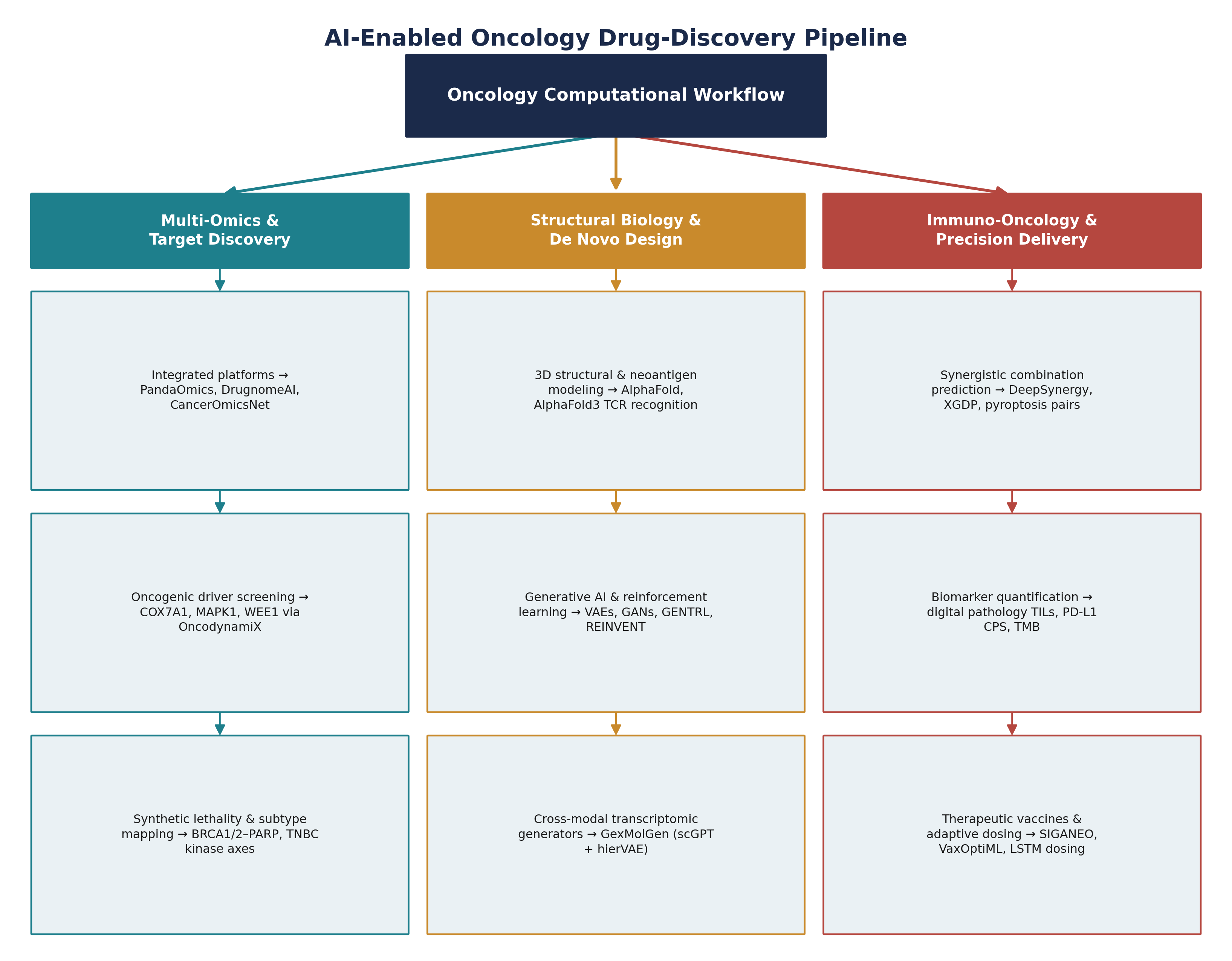
Turning to oncology proper, the convergence of AI with multi-omics profiling — genomics, transcriptomics, proteomics, single-cell sequencing, spatial profiling — is doing something that feels genuinely different from earlier bioinformatics efforts: it is redefining what counts as a plausible drug target in the first place (Bhat & Ahmed, 2025; Khan et al., 2026; Le et al., 2025; Liu et al., 2026). Integrated platforms such as PandaOmics, DrugnomeAI, and CancerOmicsNet now analyze biological networks at scale to isolate driver mutations and targetable pathway vulnerabilities (Le et al., 2025; Pu & Govindaraj, 2022; Pun et al., 2023; Raies & Bajic, 2022). Deep neural network ensembles, for example, identified COX7A1 as a regulator of the embryonic-fetal transition, flagged MAPK1 as a therapeutic target in lung adenocarcinoma, and nominated WEE1 inhibition — via the OncodynamiX platform — for uterine serous adenocarcinoma (Le et al., 2025; Sivanandhan & Agastheeswaramoorthy, 2024). In one particularly striking demonstration of clinical utility, AI-assisted reanalysis of genomic data from 2,219 patients uncovered new actionable mutations that changed the treatment recommendation for 124 individuals (Le et al., 2025). Knowledge graph platforms have proven similarly generative elsewhere in solid tumor biology: BenevolentAI’s causal graph approach identified the TNIK-CDK9 axis as a core survival driver in platinum-resistant ovarian cancer, prioritizing the candidate inhibitor NCB-0846 for further development (Puleo et al., 2025; Wu et al., 2026). Figure 3 maps this broader oncology computational ecosystem — from multi-omics target discovery through structural design and immuno-oncology applications — as a single integrated schematic.

Within TNBC specifically — the subtype at the center of this review — AI algorithms integrating multi-omics and radiomics data have prioritized a recognizable set of targetable nodes, among them AKT, FGFR2, MFGE8, TBC1D9, PI3Kα, STK33, and TGFβR1, while also mapping synthetic lethal interactions such as the pairing of PARP inhibitors with BRCA1/2-deficient tumors (Batool et al., 2024; Laskar et al., 2025; Ling et al., 2025; Tran et al., 2023; Z. X. Wang et al., 2026). We return to these TNBC-specific findings in considerably more depth in Section 3.

2.3.2 Structural Modeling, Generative AI, and De Novo Drug Design

Structure-based computer-aided drug design (CADD), particularly as supported by AlphaFold and its successor AlphaFold3, has changed what target validation looks like in practice — accurately modeling three-dimensional protein structures, predicting T-cell receptor recognition of cancer neoantigens such as NRAS, and evaluating drug-target binding affinities with a degree of confidence that earlier homology-modeling approaches could not offer (Desai et al., 2024; Le et al., 2025; Tian et al., 2025; J. Wu et al., 2024). Generative AI frameworks — variational autoencoders (VAEs), generative adversarial networks (GANs), diffusion models — coupled with deep reinforcement learning strategies such as REINVENT, Rationale RL, and MolDQN, now explore chemical space at a scale that would have been impractical even a decade ago, generating de novo small molecules with optimized potency and ADMET profiles (Bhat & Ahmed, 2025; Le et al., 2025; Shakeri & Far, 2026).

Some of the resulting timelines are, candidly, hard to believe on first read. Generative Tensorial Reinforcement Learning (GENTRL) designed potent DDR1 kinase inhibitors in 21 days (Bhat & Ahmed, 2025; Zhavoronkov et al., 2019); the TNIK inhibitor ISM018_055 moved from AI-generated design concept to clinical trials in 18 months (Bhat & Ahmed, 2025; Ren et al., 2024); and integrated platforms combining AlphaFold, PandaOmics, and Chemistry42 identified nanomolar CDK20 inhibitors — ISM042-2-048 among them — for hepatocellular carcinoma (Khan et al., 2026; Pun et al., 2023). Cross-modal architectures have pushed this even further by bypassing candidate-target selection altogether: GexMolGen pairs a single-cell gene encoder (scGPT) with a graph-based molecular decoder (hierVAE) to generate hit-like molecules directly from transcriptomic perturbation signatures (J. Cheng et al., 2024; Wu et al., 2026).

2.3.3 Immuno-Oncology, Combination Synergy, and Smart Nanotherapeutics

Resistance rarely arises from a single pathway, which is presumably why combination-prediction models have become such an active area of development. AI systems including DeepSynergy, SYNERGxDB, and XGDP now analyze multi-omics and chemical structure embeddings to predict synergistic drug pairings, with the explicit goal of co-inhibiting the compensatory pathways that undermine single-agent therapy (Y. Cheng et al., 2026; Le et al., 2025; C. Wang et al., 2025). In TNBC specifically, AI-powered omics screening identified a synergistic pyroptosis-inducing pair — mitoxantrone and gambogic acid — subsequently delivered via biomimetic nanocrystals to trigger anti-tumor immune activation (Mubasshira et al., 2026; Ouyang et al., 2024; Szondy et al., 2026).

In parallel, deep learning applied to digitized pathology slides now quantifies tumor-infiltrating lymphocytes (TILs), PD-L1 combined positive scores (CPS), and tumor mutational burden (TMB), producing reasonably accurate predictions of immune checkpoint inhibitor response (Amgad et al., 2024; Laskar et al., 2025; Mubasshira et al., 2026). Platforms such as SIGANEO and VaxOptiML optimize personalized cancer vaccines by predicting immunogenic MHC-I and MHC-II neoepitopes (Firuzpour et al., 2025; Le et al., 2025; Ye et al., 2023), and — closing the loop on the treatment side — reinforcement learning and long short-term memory (LSTM) networks now integrate longitudinal electronic health records and wearable biosensor data to support model-informed precision dosing and dynamic therapy adjustment (Poweleit et al., 2023; Shakeri & Far, 2026; Szondy et al., 2026).

2.4 Methodological Limitations, Ethical Considerations, and Future Perspectives

For all this progress, it would be misleading to present AI-driven discovery as anywhere close to a finished project. Substantial translational hurdles still limit real-world deployment across both dermatology and oncology. High-dimensional biological datasets remain prone to batch effects, missing data modalities, small cohort sizes relative to the number of genomic features under consideration, and general dataset instability (Y. Cheng et al., 2026; Mubasshira et al., 2026; Wu et al., 2026). In dermatological imaging specifically, algorithmic bias is a live concern — training sets have historically underrepresented diverse skin phototypes and age groups — and there is a separate, subtler risk that artificial experimental conditions understate the contextual reasoning a real clinician brings to a diagnosis (R. J. Chen et al., 2023; Szondy et al., 2026). In oncology, the opacity of deep neural network architectures continues to complicate both mechanistic interpretability and the clinical trust that adoption ultimately depends on (Y. Cheng et al., 2026; Wu et al., 2026).

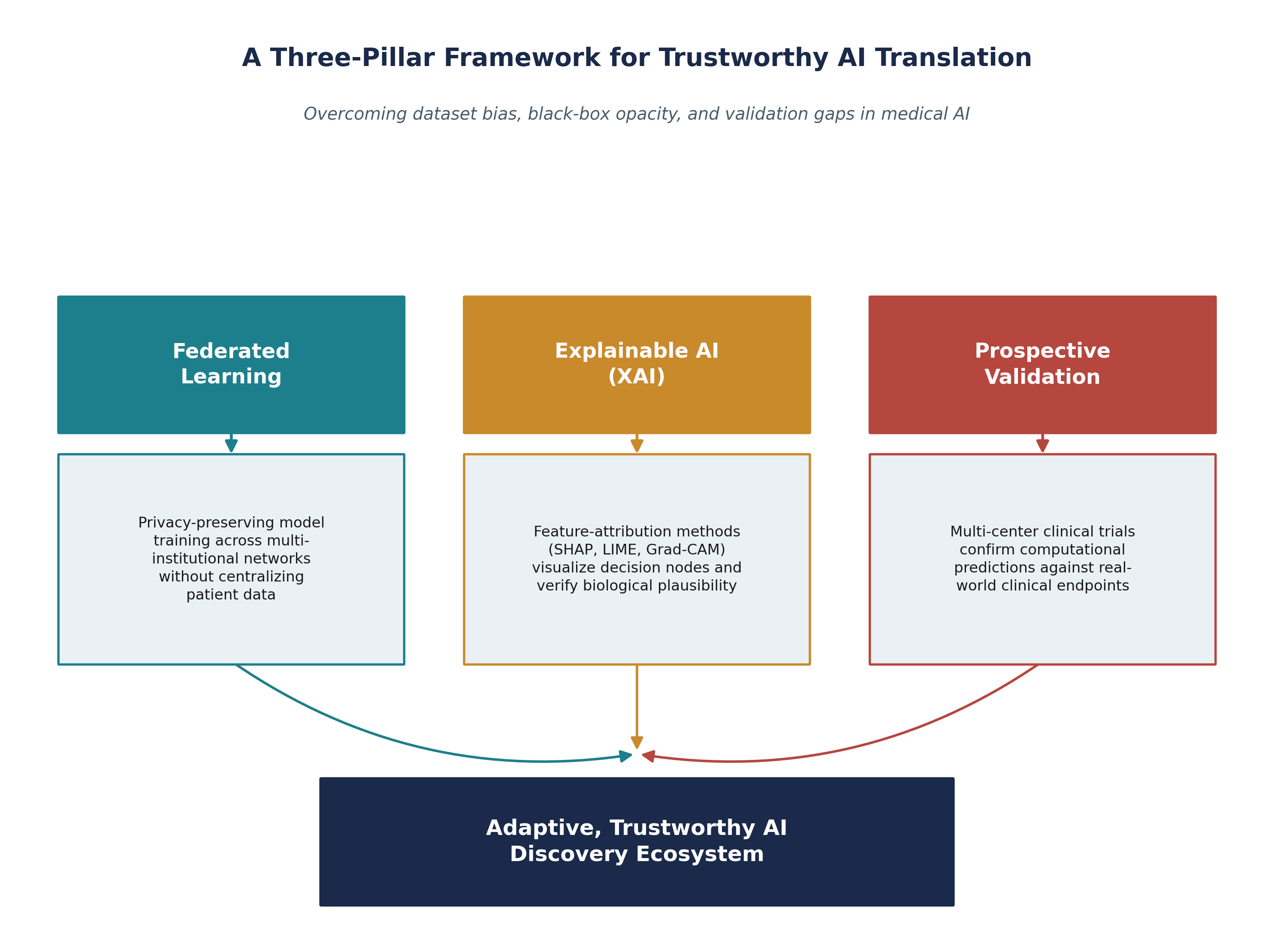
Addressing these gaps will likely require progress on at least three fronts simultaneously, which Figure 4 summarizes as a single framework. Federated learning offers a path toward privacy-preserving model training across multi-institutional networks, without ever centralizing sensitive patient data (H. Guan et al., 2024; Mamoudou & Mune, 2025; Szondy et al., 2026). Explainable AI (XAI) — through feature-attribution methods such as SHAP, LIME, and Grad-CAM — allows researchers to visualize which features a model is actually weighting, and to check whether that reasoning is biologically plausible or simply statistically convenient (Alizadehsani et al., 2024; Salvati et al., 2025; Szondy et al., 2026). And prospective validation, unglamorous as it sounds, remains indispensable: multi-center clinical trials are the only mechanism that can confirm whether a computational prediction actually holds up against real-world clinical endpoints (Y. Cheng et al., 2026; Szondy et al., 2026; Wu et al., 2026). Taken together, uniting human clinical expertise with transparent, data-centric AI frameworks is probably the only realistic route toward discovery ecosystems that are both adaptive and trustworthy enough to translate computational insight into improved patient outcomes.

3. Methods

Because this article synthesizes an interdisciplinary and fast-moving literature, we felt it was important to describe how that literature was located, filtered, and organized — not merely to satisfy convention, but so that another group could, in principle, reconstruct our search and arrive at a broadly similar evidence base. What follows is that

Figure 3. AI-Enabled Oncology Drug-Discovery Pipeline. This figure maps the oncology-focused computational ecosystem discussed in Section 2.3 across three integrated domains: multi-omics target discovery, structural biology and de novo generative design, and immuno-oncology/precision delivery. Representative platforms (e.g., PandaOmics, AlphaFold, DeepSynergy) and their core applications are nested beneath each domain, demonstrating how AI has evolved from descriptive network analysis toward generative, structure-aware drug design.

Figure 4. A Three-Pillar Framework for Trustworthy AI Translation. This figure summarizes three complementary strategies for overcoming dataset bias, black-box opacity, and validation gaps in medical AI: federated learning (privacy-preserving multi-institutional model training), explainable AI (feature-attribution methods that verify biological plausibility), and prospective validation (multi-center clinical trials confirming real-world performance). Together, these pillars define the translational roadmap this review argues is necessary before computational predictions can be reliably converted into clinical practice.

description, reported in a manner consistent with PubMed/MEDLINE indexing conventions and structured along the lines conventionally used for scoping-style evidence synthesis, adapted here for a narrative review.

3.1 Search Strategy and Information Sources

We searched PubMed/MEDLINE as the primary bibliographic database, supplemented by Scopus, Embase, and Web of Science to capture indexing variation across publishers, and by IEEE Xplore for computationally oriented work — algorithm architectures, benchmark platforms — that occasionally sits outside the biomedical indexing net entirely. Because several of the platforms discussed here (generative chemistry engines, knowledge-graph target-discovery tools) move from preprint to peer-reviewed publication on a lag, we also screened bioRxiv and medRxiv for methodologically mature preprints, retaining only those that had since progressed to peer-reviewed publication by the time of writing.

Search strings combined Medical Subject Headings (MeSH) with free-text keywords across three conceptual blocks, joined with the Boolean operator AND: (1) a disease block — “triple-negative breast cancer” OR “TNBC” OR “breast neoplasms” [MeSH]; (2) a computational block — “artificial intelligence” OR “machine learning” OR “deep learning” OR “neural network” OR ”computer-aided drug design” OR ”CADD” OR ”multi-omics” OR ”graph neural network” OR “large language model”; and (3) an application block — ”target identification” OR ”drug discovery” OR ”biomarker” OR “drug repurposing” OR “precision oncology”. A parallel search substituting the disease block with dermatology-relevant terms (“psoriasis,” “atopic dermatitis,” “melanoma,” “skin neoplasms”) was run to capture the cross-disciplinary AI methodology literature referenced in Section 2.2, on the reasoning that many computational architectures — CNNs for lesion classification, generative peptide design, federated learning frameworks — were first validated in dermatology before migrating into oncology, and are therefore mechanistically relevant even where the clinical indication differs. Reference lists of retrieved reviews were hand-searched for additional eligible primary studies (a standard snowball step), and forward citation-tracking was used to identify more recent work citing key methodological papers (e.g., the original AlphaFold and GENTRL publications).

The search covered records indexed from January 2016 through September 2026, a window chosen to capture the modern deep-learning era in biomedical AI — roughly coincident with the post-AlphaGo acceleration in applied neural network research — through to the most current literature available at the time this review was prepared.

3.2 Eligibility Criteria

Records were included if they (a) were published in a peer-reviewed journal or peer-reviewed conference proceedings; (b) reported an AI, ML, DL, or CADD methodology with a defined biomedical application in oncology or dermatology; (c) were available in full text in English; and (d) provided sufficient methodological detail to identify the model architecture, dataset, and reported performance metric where applicable. We excluded conference abstracts without accompanying full-text manuscripts, non-peer-reviewed commentaries and opinion pieces lacking original methodology, case reports without a computational component, and studies for which only a title or abstract — without accessible methodological detail — could be retrieved. Where multiple publications described the same platform or dataset (for example, iterative reports on the same clinical registry), we retained the most complete and most recent version to avoid double-counting a single body of evidence.

3.3 Study Selection and Data Extraction

Titles and abstracts were screened first against the eligibility criteria above, followed by full-text review of the remaining records. For each included study, we extracted the computational architecture or platform name, the dataset or cohort analyzed, the biological or clinical target under investigation, the primary reported performance metric (area under the receiver operating characteristic curve, sensitivity/specificity, classification accuracy, or equivalent, as reported by the original authors), and the stage of validation — in silico, in vitro/in vivo preclinical, or clinical/retrospective cohort. This extraction schema forms the structural basis of Tables 1 through 4, each of which corresponds to one of the four evidentiary domains addressed in this review: dermatological AI applications, oncology computational platforms, TNBC-specific target discovery, and subtype-aware computer-aided drug design.

Eighty peer-reviewed sources met the eligibility criteria and were retained for narrative synthesis; the full bibliographic record for each appears in the reference list. No formal PRISMA flow diagram accompanies this count, since the present work is a thematic narrative synthesis rather than a systematic review intended for quantitative pooling — a distinction we think is worth stating plainly rather than implying a precision (screened-versus-excluded record counts, inter-rater screening statistics) that a narrative synthesis of this kind does not, in fact, generate.

3.4 Synthesis Approach

Rather than pooling effect sizes — which the heterogeneity of outcomes reported here (classification accuracy, AUC, days-to-lead-compound, and so on) would make statistically dubious in any case — we organized the extracted evidence thematically, first by clinical domain (dermatology versus oncology), then by computational task (target discovery, generative compound design, predictive modeling, and diagnostic classification), and finally by validation stage. This mirrors the structure adopted in Sections 2 through 4 and allows the reader to trace a given finding from its original methodological description through to its place in the broader translational landscape. Where a platform or finding appeared in more than one included study — AlphaFold’s use in both structural target validation and neoantigen modeling, for instance — we synthesized across sources rather than treating each mention as an independent data point.

3.5 Quality and Reporting Considerations

We did not apply a formal risk-of-bias instrument, since the included literature spans study designs — from purely computational benchmarking to retrospective clinical registries — for which no single validated appraisal tool is well suited. Instead, we noted the validation tier of each finding explicitly throughout the narrative (in silico only, preclinical, or clinical/retrospective), a distinction that recurs as an organizing theme in Section 4.5 and again in the Discussion, and one we would encourage readers to keep in mind when weighing the translational maturity of any single result described here.

4. Cross-Disciplinary Evidence for AI-Driven Target Discovery, Predictive Modeling, and Translational Readiness

Taken as a whole, this study here points to something more than incremental progress. Across dermatological therapeutics and precision oncology alike, artificial intelligence (AI), machine learning (ML), deep learning (DL), and computer-aided drug design (CADD) are visibly reshaping how early-stage target discovery and clinical decision support get done. By processing high-dimensional multi-omics architectures, digitized histopathology, and chemical structure databases at a scale no manual workflow could match, these computational pipelines are compressing hit-to-lead timelines, surfacing driver nodes that would otherwise stay buried in genomic noise, and — perhaps most consequentially — enabling treatment pathways tailored to individual patients rather than population averages. The five subsections that follow present a structured synthesis of the empirical findings, algorithmic benchmarks, target discoveries, and translational performance metrics identified across the included literature, organized as summarized visually in Tables 1 through 4.

4.1 Cross-Disciplinary Innovations: Target Discovery, Predictive Modeling, and Clinical Decision Metrics in Dermatology

Dermatological AI has moved, over a relatively short span, from narrow image classification toward genuinely sophisticated in silico target discovery and longitudinal treatment-response forecasting (Szondy et al., 2026). Mining large-scale pharmacovigilance repositories has proven particularly effective as a drug-repurposing strategy: combining FDA Adverse Event Reporting System (FAERS) data with chemical structure databases identified dopamine D2 receptor (DRD2) agonists as candidate anti-psoriatic agents (Sakai et al., 2025; Szondy et al., 2026; Table 1), a computational hypothesis that held up under experimental scrutiny — the DRD2 agonist quinpirole attenuated skin inflammation, downregulated interleukin-17 (IL-17) pathway mRNA expression, and significantly reduced circulating TNF-α and IL-10 in imiquimod-induced psoriatic mouse models (Sakai et al., 2025; Szondy et al., 2026).

A parallel line of work applied transcriptomic co-expression network analysis to primary cutaneous melanoma, resolving microenvironmental interactions into two distinct prognostic modules: an immune-dominant module centered on the hub gene MYO1F, associated with favorable overall survival, and a separate, protumorigenic driver axis governed by the transcription factor ZNF180, whose functional role was subsequently confirmed through in vitro and xenograft knockdown experiments (Song et al., 2021; Szondy et al., 2026; Table 1). For atopic dermatitis, unsupervised non-negative matrix factorization (NMF) applied to RNA-sequencing data from 951 patient biopsies decomposed tissue transcriptomes into 29 metagenes (SKITm1–29), allowing local clinical manifestations — erythema, lichenification — and underlying immunological endotypes to be inferred from a single biopsy profile (Fukushima-Nomura et al., 2025; Szondy et al., 2026; Table 1). Figure 2 situates these three examples within the broader hierarchy of dermatological AI applications.

On the compound-engineering side, deep neural networks layered with structure-based pharmacophore modeling and molecular docking screened large virtual libraries and prioritized 13 hit compounds, four of which went on to demonstrate significant in vitro JAK1 kinase inhibitory activity (Z. Wang et al., 2023; Szondy et al., 2026; Table 1). Sequence-based stacked ensemble predictors such as TIPred achieved high accuracy in identifying tyrosinase-inhibitory peptides relevant to hyperpigmentation disorders (Charoenkwan et al., 2023; Szondy et al., 2026). Perhaps the most unusual finding in this domain came from “molecular de-extinction” algorithms, which mined the proteomes of extinct species to engineer 69 synthesized antimicrobial peptides, several of which achieved in vivo anti-infective efficacy against multidrug-resistant ESKAPEE pathogens in mouse abscess models (Wan et al., 2024; Szondy et al., 2026; Table 1). Random Forest classifiers screening the eMolecules® database, working from physicochemical descriptors alone, identified 11 experimentally validated antifungal leads against Candida albicans (de Souza et al., 2025; Szondy et al., 2026).

Machine learning architectures also outperformed traditional statistical approaches with a consistency that is, frankly, striking across the reviewed literature. Gradient-boosted decision trees trained on ten routine clinical variables from the Danish DERMBIO registry achieved an AUC of 0.85 for predicting five-year biologic discontinuation in psoriasis — a substantial improvement over standard Cox proportional hazards regression, which managed only 0.61 (Du et al., 2023; Szondy et al., 2026; Table 1). Logistic regression classifiers analyzing seven pre-treatment lesional skin biopsy variables identified dupilumab non-responders in atopic dermatitis before treatment initiation, with 88% sensitivity and 95.7% overall diagnostic accuracy (Murphy et al., 2023; Szondy et al., 2026; Table 1). AutoML platforms predicted necessary therapy modifications at 24 weeks in real-world psoriatic cohorts with an AUC of 0.91 (Schaffert et al., 2024; Szondy et al., 2026), while web-based multimodal LLMs evaluating hidradenitis suppurativa images achieved 87.3% diagnostic accuracy and 88.7% appropriate therapeutic recommendation for ChatGPT-4o specifically (Boostani et al., 2025; Szondy et al., 2026; Table 1). Deep CNNs trained on 129,450 clinical images across 2,032 conditions sustained dermatologist-level classification performance across fine-grained malignant and benign lesion categories (Esteva et al., 2017; Szondy et al., 2026; Table 1).

4.2 Computational Platform Architectures and Generative Paradigms in Oncology

Where dermatological AI has largely refined classification and prediction, oncology-focused platforms have evolved into something closer to generative, structure-aware discovery engines — systems capable of engineering candidate molecules outright rather than simply flagging them (Bhat & Ahmed, 2025; Le et al., 2025; Wu et al., 2026). Structural biology platforms anchored by AlphaFold and AlphaFold3 have transformed target validation by predicting three-dimensional fold structures for approximately 200 million proteins, enabling precise modeling of T-cell receptor (TCR) recognition of cancer neoantigens such as NRAS and allosteric binding-pocket dynamics that earlier homology-based methods could only approximate (Desai et al., 2024; Le et al., 2025; Wu et al., 2026; Table 2, Figure 3).

Integrated target-identification and generative-chemistry suites illustrate just how far early discovery timelines have compressed. The PandaOmics target-discovery engine, paired with the Chemistry42 generative platform, prioritized CDK20 as a novel therapeutic driver in hepatocellular carcinoma and synthesized the nanomolar lead candidate ISM042-2-048 (Khan et al., 2026; Pun et al., 2023; Table 2). Generative Tensorial Reinforcement Learning (GENTRL) designed, synthesized, and experimentally validated potent de novo DDR1 kinase inhibitors within 21 days (Bhat & Ahmed, 2025; Zhavoronkov et al., 2019; Table 2), while the AI-derived TNIK inhibitor ISM018_055 advanced from initial target hypothesis to Phase II clinical trials in 18 months (Bhat & Ahmed, 2025; Ren et al., 2024). Cross-modal generative frameworks go a step further still: GexMolGen pairs a single-cell transformer gene encoder (scGPT) with a graph-based molecular decoder (hierVAE) to map disease-specific transcriptomic perturbation signatures

Table 1. AI-Driven Target Discovery, Predictive Modeling, and Diagnostic Applications in Dermatology. This table summarizes ten representative studies spanning dermatological AI, organized by application domain, computational architecture, and dataset. For each study, the table reports the key molecular targets, compounds, or performance metrics identified, alongside the main clinical or translational finding. Entries range from pharmacovigilance-based drug repurposing (e.g., DRD2 agonists in psoriasis) to deep-learning diagnostic classifiers validated against dermatologist-level performance benchmarks. Full citations correspond to the References list.

Application Domain

AI/ML Architecture & Framework

Data Types & Cohorts Analyzed

Key Targets, Compounds, or Metrics

Main Findings & Clinical Impact

References

Psoriasis Target Identification

Big data mining & Machine Learning

FDA Adverse Event Reporting System (FAERS) & chemical databases

Dopamine D2 receptor (DRD2) agonists (Quinpirole)

Identified DRD2 agonists as potential anti-psoriatic agents. Quinpirole attenuated inflammation, downregulated IL-17 mRNA expression, and reduced TNF-α/IL-10 in mouse models.

Sakai et al. (2025); Szondy et al. (2026)

Melanoma Master Regulators

Transcriptomic gene co-expression networks

Bulk & single-cell RNA-seq datasets

MYO1F (prognosis hub) & ZNF180 (driver node)

Uncovered an immune-dominant module (MYO1F, favorable prognosis) and a protumorigenic axis (ZNF180, poor prognosis). Knockdown confirmed ZNF180 as a driver node.

Song et al. (2021); Szondy et al. (2026)

Atopic Dermatitis (AD) Endotyping

Unsupervised Non-negative Matrix Factorization (NMF)

Skin biopsy RNA-seq from 951 AD patients

29 metagenes (SKITm1–29)

Decomposed expression into 29 metagenes correlating with local phenotypes (erythema, lichenification), global severity, and underlying immunological endotypes.

Fukushima-Nomura et al. (2025); Szondy et al. (2026)

In Silico Kinase Inhibitor Discovery

Deep Neural Network + Pharmacophore + Molecular Docking

Virtual small-molecule compound libraries

Selective JAK1 inhibitors (13 hits, 4 active)

Screened virtual libraries to identify 13 hit compounds; 4 demonstrated significant in vitro JAK1 kinase inhibitory activity for AD and inflammatory bowel disease.

Z. Wang et al. (2023); Szondy et al. (2026)

“Molecular De-Extinction” Antimicrobials

Deep Learning peptide sequence encoder + Neural heads

Extinct species proteome databases

69 synthesized antimicrobial peptides against ESKAPEE

Mined proteomes of extinct organisms to generate peptides active against multidrug-resistant ESKAPEE pathogens; lead peptides cleared infection in mouse abscess models.

Wan et al. (2024); Szondy et al. (2026)

Psoriasis Biologic Treatment Durability

Gradient Boosted Decision Trees vs. Cox Regression

Danish DERMBIO biologics registry (10 clinical variables)

5-year biologic discontinuation risk (AUC 0.85 vs. 0.61)

ML significantly outperformed traditional Cox hazard ratios (AUC 0.85 vs 0.61) in predicting 5-year biologic discontinuation, enabling personalized counseling.

Du et al. (2023); Szondy et al. (2026)

Dupilumab Response Prediction

Logistic Regression Classifiers

Pre-treatment skin biopsies (7 variables)

Dupilumab non-responder status (95.7% accuracy)

Identified eczematous dermatitis patients unlikely to respond to dupilumab prior to treatment initiation, achieving 95.7% overall predictive accuracy.

Murphy et al. (2023); Szondy et al. (2026)

Multimodal Skin Tumor & Disease Evaluation

Multimodal Large Language Models (ChatGPT-4o, Gemini 2.0, Claude 3.7)

71 clinical images from 44 Hidradenitis Suppurativa patients

Diagnostic accuracy & therapeutic recommendation

ChatGPT-4o achieved 87.3% diagnostic accuracy and provided the most appropriate therapeutic recommendations (88.7%) in hidradenitis suppurativa image evaluations.

Boostani et al. (2025); Szondy et al. (2026)

Autonomous Skin Cancer Classification

Deep Convolutional Neural Network (CNN)

129,450 clinical images (2,032 skin conditions)

Malignant melanoma & keratinocyte carcinomas

Demonstrated dermatologist-level diagnostic classification across fine-grained malignant and benign skin lesions in controlled clinical trials.

Esteva et al. (2017); Szondy et al. (2026)

Table 2. AI Frameworks, Generative Models, and Computational Platforms in Oncology Drug Discovery. This table catalogs eight integrated computational platforms used across oncology target discovery and de novo drug design, detailing each platform's core AI architecture, the datasets or repositories it draws upon, and its primary application focus. Reported performance and translational accomplishments — including compressed hit-to-lead timelines and specific inhibitor candidates advanced toward clinical testing — are summarized with supporting citations, illustrating the shift toward generative, structure-aware discovery engines.

Platform / Framework

Core AI Architecture

Integrated Datasets & Repositories

Target Application & Focus Area

Reported Performance & Key Accomplishments

References

AlphaFold / AlphaFold3

Deep Neural Networks & Diffusion-based modeling

Protein Data Bank (PDB) & genomic sequence repositories

3D Protein structure prediction & T-cell receptor (TCR) modeling

Modeled 3D structures for ~200M proteins; AlphaFold3 accurately predicted TCR recognition of NRAS cancer neoantigens and complex biomolecular assemblies.

Desai et al. (2024); Le et al. (2025); Wu et al. (2026)

PandaOmics & Chemistry42

Multi-omics scoring + Generative AI + Reinforcement Learning

TCGA, GEO, GTEx, ChEMBL, PubChem

Target identification & de novo molecular design

Identified CDK20 as a target in hepatocellular carcinoma; Chemistry42 generated nanomolar inhibitor ISM042-2-048; prioritized dual anti-cancer/anti-aging nodes.

Khan et al. (2026); Pun et al. (2023); Zhavoronkov et al. (2019)

GENTRL

Generative Tensorial Reinforcement Learning

Chemical structure databases & DDR1 kinase assays

De novo discovery of DDR1 kinase inhibitors

Designed, synthesized, and experimentally validated potent DDR1 kinase inhibitors within 21 days, showcasing rapid hit-to-lead acceleration.

Bhat & Ahmed (2025); Zhavoronkov et al. (2019)

GexMolGen

Cross-modal scGPT (gene encoder) + hierVAE (molecular decoder)

Single-cell transcriptomics & chemical structures

Direct molecular generation from gene signatures

Bypassed candidate target screening to generate hit-like small molecules matching specific disease transcriptomic signatures with 100% molecular validity.

J. Cheng et al. (2024); Wu et al. (2026)

CancerOmicsNet

Graph-based social network mapping algorithms

Cancer cell lines, drug compounds, protein-protein interactions

Multi-omics profiling of anticancer drug efficacy

Modeled complex interactions across cell lines and drugs, outperforming baseline models in matching specific cancer types to effective therapeutic agents.

Le et al. (2025); Pu & Govindaraj (2022)

DeepSynergy

Deep Learning with multi-layer perceptrons

Multi-omics cell line profiles + chemical structure embeddings

Synergistic anticancer drug combination prediction

Captured non-linear interactions between paired chemical compounds and genomic backgrounds, significantly outperforming conventional drug synergy predictors.

Jiang et al. (2020); Le et al. (2025)

BenevolentAI Platform

Tensor Factorization ML + Causal Knowledge Graphs

35M+ scientific publications + Reaxys, ChEMBL, TCGA

Target discovery in platinum-resistant solid tumors

Uncovered the TNIK-CDK9 signaling axis as a survival driver in platinum-resistant ovarian cancer, prioritizing the candidate inhibitor NCB-0846.

Puleo et al. (2025); Wu et al. (2026)

OncodynamiX

Drug-gene alteration matrix matching algorithms

Clinical genomic profiles & drug perturbation data

Precision target identification for rare/refractory cases

Evaluated complex genomic alteration matrices in patients with limited treatment options, identifying WEE1 as a therapeutic target in uterine serous adenocarcinoma.

Le et al. (2025); Sivanandhan & Agastheeswaramoorthy (2024)

directly into valid, hit-like small molecules — bypassing candidate-target selection altogether and achieving 100% chemical structure validity in the reported evaluation (J. Cheng et al., 2024; Wu et al., 2026; Table 2).

Network-biology approaches round out this picture. CancerOmicsNet applies social-network mapping algorithms across cell lines, chemical structures, and protein-protein interaction networks to match tumor profiles with effective therapeutics (Le et al., 2025; Pu & Govindaraj, 2022; Table 2), while DeepSynergy incorporates multi-layer perceptron architectures to process multi-omics backgrounds and compound embeddings, outperforming conventional models in predicting synergistic anticancer combinations (Jiang et al., 2020; Le et al., 2025). Causal knowledge-graph platforms have proven similarly productive: BenevolentAI’s graph approach uncovered the TNIK-CDK9 axis as a core survival node in platinum-resistant ovarian cancer, prioritizing the inhibitor NCB-0846 (Puleo et al., 2025; Wu et al., 2026; Table 2), and the OncodynamiX drug-gene alteration matrix platform recommended WEE1 inhibitor therapy for refractory uterine serous adenocarcinoma (Le et al., 2025; Sivanandhan & Agastheeswaramoorthy, 2024).

4.3 AI-Driven Target Identification and Subtype Stratification in Triple-Negative Breast Cancer

This is, in many respects, the section where the broader computational themes above converge most directly on the disease this review is centrally concerned with. Triple-negative breast cancer remains one of the more aggressive solid malignancies precisely because of its genomic instability, rapid progression, and its lack of a primary hormonal or HER2 handle for targeted therapy (Batool et al., 2024; Laskar et al., 2025; Z. X. Wang et al., 2026). Machine learning classifiers and feature-selection algorithms have, across the reviewed literature, systematically dissected multi-omics datasets to prioritize oncogenic drivers, diagnostic biomarkers, and synthetic lethal dependencies specific to TNBC, summarized comprehensively in Table 3.

Phenotypic screening integrated with machine learning (the idTRAX platform) identified selective kinase vulnerabilities across TNBC cell line models: AKT inhibition proved selectively lethal in CAL148 and MFM-223 cells, while FGFR2 inhibition specifically targeted MFM-223 cells, with an AUC of 0.86 (Batool et al., 2024; Gautam et al., 2019; Table 3). Feature-selection algorithms applied to TCGA transcriptomic profiles identified overexpressed MFGE8 — associated with poor survival and tumor integrity — and underexpressed TBC1D9 — associated with more favorable outcomes — as actionable target axes, achieving an AUC of 0.91 (Batool et al., 2024; Kothari et al., 2020; Table 3). A separate ensemble approach combining LASSO, Random Forest, and SVM-RFE feature selection prioritized a four-gene panel (TENM2, OTOG, LEPR, HLF) capable of stratifying stage-specific TNBC survival with an AUC of 0.87 (Batool et al., 2024; X. Guan et al., 2023; Table 3).

On the therapeutic side, neural network models integrating multi-omics perturbation data identified a synergistic pyroptosis-inducing drug pair — mitoxantrone combined with gambogic acid — subsequently delivered via biomimetic nanocrystals to trigger targeted cell death and robust anti-tumor immune responses in vivo (Y. Cheng et al., 2026; Mubasshira et al., 2026; Ouyang et al., 2024; Table 3). Generative deep learning and virtual screening separately uncovered YH395A, a tetrahydro-β-carboxylic acid derivative targeting TGFβR1, which significantly blocked TNBC cell migration and invasion in preclinical models (Ling et al., 2025; Hu et al., 2026; Table 3). Automated whole-slide pathology image registration — the IMPRESS pipeline — quantified spatial tumor-infiltrating lymphocyte (TIL) density and PD-L1 expression, achieving an AUC of 0.90 for predicting neoadjuvant chemotherapy (NAC) response in HER2-positive disease, and demonstrated that tight spatial proximity between immune and tumor cells correlates with pathological complete response in TNBC specifically (Batool et al., 2024; Z. Huang et al., 2023; Mubasshira et al., 2026; Table 3). A deep learning model analyzing pre-treatment plasma samples combined acetylated polyamines with nine additional metabolites to predict extensive residual disease (RCB-II/III) following NAC, with an AUC of 0.97, 95% specificity, and 85% sensitivity (Batool et al., 2024; Irajizad et al., 2022; Table 3) — among the strongest discriminative performances reported anywhere in the included literature. Finally, machine learning analysis of genomic dependency screens mapped synthetic lethal networks in BRCA1/2-deficient TNBC, refining patient selection for PARP inhibitor sensitivity to agents such as olaparib and talazoparib (Kannan et al., 2025; Laskar et al., 2025; Z. X. Wang et al., 2026; Table 3).

Table 3. AI-Driven Target Identification, Biomarker Discovery, and Subtype Stratification in Triple-Negative Breast Cancer (TNBC). This table presents eight TNBC-specific target and biomarker nodes identified through machine learning and deep learning methodologies, spanning phenotypic screening, feature-selection algorithms, digital pathology, and metabolomic profiling. For each node, the table reports the analytic methodology, the cohort or dataset analyzed, the biological role and associated clinical outcome, and the translational performance metric (e.g., AUC) where available. These findings define the TNBC-specific evidentiary core synthesized further in Section 4.3.

Target / Biomarker Node

AI/ML Methodology

Cohort / Input Dataset

Biological Role & Clinical Outcome

Translational Performance / Finding

References

AKT & FGFR2

Phenotypic screening + ML (idTRAX)

TNBC cell lines (CAL148, MFM-223)

Selective oncogenic driver kinases

idTRAX identified AKT inhibition as selectively lethal in CAL148/MFM-223 cells, and FGFR2 inhibition in MFM-223 cells (AUC 0.86).

Batool et al. (2024); Gautam et al. (2019)

MFGE8 & TBC1D9

Feature selection ML algorithms

TCGA transcriptomic dataset

Prognostic markers & cell integrity regulators

Identified overexpressed MFGE8 (poor prognosis/survival) and underexpressed TBC1D9 (favorable prognosis) as actionable targets (AUC 0.91).

Batool et al. (2024); Kothari et al. (2020)

TENM2, OTOG, LEPR, HLF

LASSO, Random Forest, & SVM-RFE feature selection

TCGA genomic & transcriptomic profiles

Novel diagnostic and prognostic biomarkers

Prioritized four key gene biomarkers linked to TNBC stage, survival, and therapeutic intervention targets (AUC 0.87).

Batool et al. (2024); X. Guan et al. (2023)

Pyroptosis Pathway Pair (Mitoxantrone + Gambogic Acid)

Biofactor-regulated neural network

Multi-omics TNBC datasets & drug databases

Synergistic pyroptosis-inducing drug combination

AI selected a synergistic drug pair delivered via biomimetic nanocrystals to induce targeted pyroptosis and anti-tumor immune activation in vivo.

Y. Cheng et al. (2026); Mubasshira et al. (2026); Ouyang et al. (2024)

TGFβR1 Axis (YH395A)

Generative Deep Learning & Virtual Screening

Synthetic molecular libraries & TNBC models

EMT inhibition & anti-metastatic targeting

Discovered YH395A (a novel tetrahydro-β-carboxylic acid derivative), which dose-dependently blocked TNBC migration and invasion.

Ling et al. (2025); Hu et al. (2026)

TIL Density & PD-L1 (IMPRESS Pipeline)

Deep Learning spatial image registration & segmentation

H&E and multiplex IHC whole-slide pathology images

Microenvironment profiling & Neoadjuvant Chemotherapy (NAC) prediction

Quantified tumor-infiltrating lymphocytes (TILs) and PD-L1, predicting NAC response in HER2+ (AUC 0.90) and correlating spatial cell proximity with pCR in TNBC.

Batool et al. (2024); Z. Huang et al. (2023); Mubasshira et al. (2026)

Plasma Metabolite Panel (RCB-II/III)

Deep Learning Model (DLM)

Pre-treatment plasma samples from TNBC patients undergoing NAC

Residual Cancer Burden (RCB) & chemoresistance prediction

Combined acetylated polyamines with 9 metabolites to predict extensive residual disease (RCB-II/III) post-NAC with an AUC of 0.97 (95% specificity, 85% sensitivity).

Batool et al. (2024); Irajizad et al. (2022)

BRCA1/2 Synthetic Lethality Nodes

ML dependency screens & multi-omics integration

TCGA, CCLE, & DepMap functional screens

Homologous recombination deficiency (HRD) & PARP response

Mapped synthetic lethal interactions in BRCA1/2-deficient TNBC, stratifying patients for PARP inhibitor sensitivity (olaparib, talazoparib).

Kannan et al. (2025); Laskar et al. (2025); Z. X. Wang et al. (2026)

Table 4. Computer-Aided Drug Design (CADD) and Multi-Omics Integration Across Breast Cancer Subtypes. This table compares subtype-specific computer-aided drug design (CADD) strategies across Luminal (ER+/PR+), HER2-positive, triple-negative, and pan-subtype breast cancer, detailing the computational software and modeling approaches used, representative therapeutic agents under investigation, and the underlying mechanistic rationale for each strategy. The table illustrates how structural biophysics and multi-omics subtyping combine to address subtype-specific resistance, from ESR1 mutation-guided SERD design to BRD4-targeted degraders in basal-like TNBC.

Subtype / Clinical Challenge

CADD Strategy & AI Method

Computational Software & Tools

Representative Agents / Targets

Key Mechanism & Translational Outcome

References

Luminal (ER+/PR+) — Endocrine Resistance

Molecular docking, Virtual Screening (VS), MD simulations, & FEP/RBFE

AutoDock Vina, Glide, GOLD, GNINA, ZINC, Enamine REAL

Elacestrant, Camizestrant, Imlunestrant, GDC-0810, AZD9496

Modeled estrogen receptor alpha (ERα) binding pocket plasticity and ESR1 mutations (e.g., Y537S, D538G) to design next-generation oral SERDs.

Tian et al. (2025); Z. X. Wang et al. (2026)

HER2+ — Receptor Dimerization & Resistance

Antibody docking, TKI optimization, & PROTAC ternary complex modeling

QuPath, HALO AI, MONAI, CLAM, OpenMM, GROMACS

Trastuzumab deruxtecan (T-DXd), Lapatinib, Tucatinib, Pyrotinib, Poziotinib

Optimized antibody payload/linker stability, TKI hinge-binding selectivity, and E3 ligase cooperative binding for HER2 degraders; rescored allosteric escape states.

Tian et al. (2025); Z. X. Wang et al. (2026)

TNBC — Lack of Targetable Receptors

Subtype-guided docking, Multi-omics ML predictors, & QSAR modeling

AutoDock Vina, Glide, Chemprop, scikit-learn, PyRadiomics, MONAI

Ipatasertib, Capivasertib, Olaparib + Durvalumab, Sacituzumab govitecan

Targeted PI3K/AKT/mTOR, DNA damage repair, and epigenetic regulators (BRD4); combined PARP inhibitors with immune checkpoint blockade to restore sensitivity.

Tian et al. (2025); Z. X. Wang et al. (2026)

Pan-Subtype — Drug Repurposing & Signature Matching

Network-based ML & LINCS L1000 connectivity mapping

LINCS-L1000, BindingDB, Connectivity Map (CMap)

Baicalein, Repurposed Kinase Inhibitor pairs

Matched tumor transcriptomic perturbation signatures to drug profiles; identified baicalein as an HIF-1α modulator re-sensitizing tamoxifen-resistant breast cancer.

Y. Cheng et al. (2026); Laskar et al. (2025)

4.4 Subtype-Aware Computer-Aided Drug Design and Drug Repurposing Workflows

Computer-aided drug design (CADD) workflows integrate multi-omics subtyping with structural biophysics to address resistance mechanisms that differ meaningfully across breast cancer subtypes (Tian et al., 2025; Z. X. Wang et al., 2026; Table 4). In Luminal (ER+/PR+) disease, where 30% to 50% of patients eventually develop acquired endocrine resistance through ESR1 ligand-binding domain mutations such as Y537S and D538G, structure-based CADD combining molecular docking, molecular dynamics simulations, and relative binding free-energy calculations mapped binding-pocket flexibility with enough precision to guide development of next-generation oral selective estrogen receptor degraders (SERDs) — elacestrant, camizestrant, and imlunestrant among them — capable of degrading mutated ERα receptors and suppressing compensatory signaling (Tian et al., 2025; Z. X. Wang et al., 2026; Table 4).

In HER2-positive disease, computational workflows combining antibody docking, tyrosine kinase inhibitor (TKI) structural optimization, and Proteolysis-Targeting Chimera (PROTAC) ternary-complex geometry modeling optimized antibody-drug conjugate payload-linker stability for trastuzumab deruxtecan (T-DXd) and improved hinge-region binding selectivity for small-molecule TKIs — lapatinib, tucatinib, pyrotinib — against truncated p95HER2 variants and allosteric escape states (Tian et al., 2025; Z. X. Wang et al., 2026; Table 4). Within TNBC itself, CADD strategies target non-hormonal survival axes: the PI3K/AKT/mTOR signaling cascade, DNA damage response (DDR) pathways, and epigenetic readers such as bromodomain-containing protein 4 (BRD4). Subtype-guided docking combined with transcriptomic subtyping prioritized BRD4 degradation scaffolds for basal-like TNBC and AKT inhibitors — ipatasertib, capivasertib — for mesenchymal-like tumors, while structure-based modeling designed dual-target inhibitors and PROTAC degraders explicitly intended to circumvent single-target bypass resistance (Tian et al., 2025; Z. X. Wang et al., 2026; Table 4).

Pan-subtype drug repurposing represents a somewhat different application of the same underlying logic. Network-based machine learning models map drug-induced transcriptomic perturbation signatures from the LINCS-L1000 and Connectivity Map (CMap) databases onto patient tumor expression profiles; connectivity-scoring algorithms applied this way identified baicalein, a hypoxia-inducible factor 1-alpha (HIF-1α) modulator, as capable of re-sensitizing tamoxifen-resistant breast cancer cells — a useful demonstration of how quickly pattern-matching algorithms can expand the clinical utility of compounds that were, in most cases, already well characterized pharmacologically (Y. Cheng et al., 2026; Laskar et al., 2025; Table 4).

4.5 Comparative Analysis of Predictive Performance, Validation Modalities, and Translational Readiness

Stepping back from any single finding, a comparative synthesis across application domains reveals some fairly consistent patterns in predictive performance, validation rigor, and translational maturity — patterns that, we think, are worth naming explicitly rather than leaving implicit in the tables above. Predictive performance varies considerably by data modality. High-dimensional plasma metabolomics (AUC = 0.97) and lesional skin biopsy gene expression classifiers (95.7% accuracy) achieved noticeably stronger statistical discrimination than single-modality clinical registries (AUC = 0.61) or less calibrated radiomics approaches (Irajizad et al., 2022; Murphy et al., 2023; Du et al., 2023; Tables 1 and 3).

Validation rigor, meanwhile, spans a genuine spectrum across the reviewed literature — from purely in silico docking and QSAR-based virtual screening at one end, through in vitro and in vivo preclinical validation (GENTRL’s 21-day DDR1 inhibitor design cycle, DRD2-targeted quinpirole, YH395A’s TGFβR1 blockade, and the biomimetic pyroptosis nanocrystals discussed above), to genuinely prospective or retrospective clinical cohort evaluation — the Danish DERMBIO psoriasis registry (n = 309), the IMPRESS whole-slide imaging cohort, and TCGA/METABRIC breast cancer cohorts among the more substantial examples (Du et al., 2023; Batool et al., 2024; Szondy et al., 2026; Tables 1–4). Timeline acceleration tells perhaps the most striking part of this story: where traditional early-discovery workflows typically require four to six years to move from hit identification to lead compound, AI-guided generative design compressed that same process to 21 days for GENTRL’s DDR1 inhibitors and to 18 months for ISM018_055’s entry into Phase II trials (Bhat & Ahmed, 2025; Ren et al., 2024; Zhavoronkov et al., 2019).

None of this should be read as suggesting the translational path is now smooth. Batch effects, class imbalances, the persistent opacity of “black-box” neural architectures, and — perhaps most limiting of all — the continued scarcity of prospective, multi-center randomized controlled trials still constrain how much of this computational promise has actually reached routine clinical practice (Y. Cheng et al., 2026; Mubasshira et al., 2026; Wu et al., 2026). We return to what closing that gap would plausibly require in the Discussion that follows.

5. Bridging Computational Promise and Clinical Reality in TNBC Drug Discovery

5.1 From Fragmented Targets to an Integrated Discovery Ecosystem

Read together rather than one finding at a time, the results assembled in Section 4 suggest something a little more coherent than a simple inventory of impressive algorithms. What emerges, we think, is the outline of an integrated discovery ecosystem — one in which multi-omics profiling, network biology, generative chemistry, and digital pathology are no longer separate technical exercises but increasingly overlapping stages of a single pipeline (Figure 1). The TNBC-specific evidence in Table 3 makes this concrete: idTRAX’s kinase vulnerability screens, TCGA-derived prognostic panels, pyroptosis-inducing drug pairs, and plasma metabolomic classifiers were developed by largely independent research groups, using different data modalities and different model architectures, and yet they converge on a remarkably consistent shortlist of actionable biology — PI3K/AKT signaling, DNA damage response, and immune-microenvironment crosstalk chief among them. That convergence, occurring independently across methodologically unrelated studies, is arguably more persuasive evidence of biological signal than any single high-AUC result could be on its own.

It is worth pausing on what this means practically. A target nominated by only one computational method, however elegant, carries a certain fragility — it could reflect a dataset artifact as easily as genuine biology. A target nominated independently by phenotypic screening, transcriptomic feature selection, and digital pathology (as MFGE8, TBC1D9, and the TIL/PD-L1 spatial axis arguably are; Table 3) carries a different kind of evidential weight. If this review has a central empirical observation, it is probably this pattern of convergent nomination, rather than any individual platform’s reported performance metric.

5.2 What Dermatology and Oncology Are Teaching Each Other

One of the more unexpected threads running through Section 2 is how much methodological traffic moves between dermatology and oncology, despite the two fields rarely appearing in the same review article. Federated learning, explainable AI frameworks, and even some of the generative peptide-design pipelines were validated first in dermatological contexts — arguably because dermatology’s data (images, biopsy transcriptomes) are comparatively easier to standardize — before migrating into oncology applications with considerably higher clinical stakes (Figure 2, Figure 3). The DERMBIO biologic-discontinuation model (Du et al., 2023) and the IMPRESS digital pathology pipeline (Z. Huang et al., 2023) are separated by clinical domain but share an underlying logic: both use routinely collected data to forecast treatment trajectories that clinicians would otherwise have to estimate from experience alone.

This cross-pollination cuts both ways, and it is probably underappreciated in how narrowly most reviews are scoped by organ system. A TNBC-focused review that ignored the dermatological AI literature entirely would, we suspect, miss real methodological lessons — particularly around algorithmic bias in underrepresented populations, a problem dermatology has confronted more directly (through the well-documented issue of training sets skewed toward lighter skin phototypes) than oncology has, at least so far (R. J. Chen et al., 2023). TNBC disproportionately affects younger women and, in the United States, Black women at a notably higher rate; whether the TCGA- and METABRIC-derived models discussed in Table 3 generalize adequately across this population is a question dermatology’s bias literature should probably be informing more directly than it currently does.

5.3 The Persistent Translational Gap

None of the preceding discussion should obscure a fairly blunt reality: very little of what Section 4 describes has reached a randomized controlled trial, let alone routine clinical use. The validation spectrum summarized in Section 4.5 is not merely descriptive — it is, in our view, the single most important caveat attached to every finding in this review. A 21-day design cycle for a DDR1 inhibitor (Zhavoronkov et al., 2019) is a genuinely remarkable computational achievement; it is also, at the point this review was written, a preclinical result, several regulatory and clinical milestones removed from altering how a TNBC patient is actually treated. The gap between “the model identified X” and “X changed a treatment decision” remains wide, and it is a gap this review — like most reviews in this space — cannot fully close through narrative synthesis alone.

Three recurring obstacles account for most of that gap, and they map fairly directly onto the three-pillar framework introduced in Figure 4. First, dataset composition: TCGA and METABRIC, the two cohorts underlying much of the TNBC-specific evidence in Table 3, are curated research cohorts rather than representative clinical populations, and models trained on them inherit whatever selection effects shaped their original assembly (Y. Cheng et al., 2026; Peng et al., 2026). Second, interpretability: the deep architectures responsible for some of the more striking performance metrics in Tables 1 through 3 remain largely opaque, which complicates not just clinical trust but the kind of mechanistic justification regulators reasonably expect before a computationally nominated target enters formal drug development (Y. Cheng et al., 2026; Wu et al., 2026). Third, and perhaps most fundamentally, prospective validation is simply rare in this literature — most of what Table 3 and Table 4 report is retrospective or preclinical, which is not a criticism of the individual studies so much as an honest description of where the field currently stands (Y. Cheng et al., 2026; Mubasshira et al., 2026; Wu et al., 2026).

5.4 Toward Explainable, Federated, and Clinically Embedded AI Discovery

If the obstacles above are reasonably well characterized, the proposed remedies are, encouragingly, converging as well. Federated learning offers a technically credible path around the single-institution cohort problem, allowing models to train across multiple hospital systems’ data without ever centralizing patient records — a particularly relevant solution for TNBC, given how much of the strongest evidence here (the plasma metabolomic classifier in Table 3, for instance) comes from cohorts likely too small individually to support external validation (H. Guan et al., 2024; Mamoudou & Mune, 2025). Explainable AI methods — SHAP, LIME, Grad-CAM, and related feature-attribution frameworks — will not, on their own, make a black-box model transparent in any deep sense, but they do offer a mechanism for checking whether a model’s stated reasoning is at least biologically plausible, which is a meaningfully lower and more achievable bar (Alizadehsani et al., 2024; Salvati et al., 2025).

What we would emphasize beyond the frameworks already discussed in Section 2.4 is the need for validation tiers to be reported more consistently across this literature — explicitly distinguishing in silico, preclinical, and clinical evidence within a single table or figure, rather than leaving readers to infer maturity from methods sections alone. This review has tried to model that practice throughout Tables 1 through 4; we would encourage future primary research in this space to adopt a similar convention as a matter of course; it would make cross-study comparison, and honestly this kind of synthesis work, considerably easier.

5.5 Limitations of This Study

A few limitations of this synthesis are worth stating directly, in the interest of the same transparency we have asked of the primary literature. This is a narrative rather than a systematic review, and as described in Section 3, we did not apply a formal risk-of-bias instrument or construct a quantitative PRISMA flow diagram — a deliberate choice given the heterogeneity of study designs included, but one that means this review cannot support the kind of pooled effect-size claims a meta-analysis would. The evidence base also skews toward recently published and, in several cases, still-maturing platforms; some of the more striking performance figures reported here (Table 3’s AUC = 0.97 plasma metabolomic classifier, for example) come from single-cohort studies awaiting external replication, and should be read with that caveat firmly attached. Finally, because this review draws deliberately on both dermatological and oncological AI literature, some readers focused narrowly on TNBC may find Section 2.2 less directly relevant than the TNBC-specific material in Sections 2.3 and 4.3 — we would gently push back on that reaction, for the cross-disciplinary reasons discussed in Section 5.2, but we recognize not every reader will be persuaded.

6. Conclusion

Across the evidence reviewed here, artificial intelligence has moved from a peripheral tool to a genuinely central method in early-stage TNBC target discovery, repeatedly converging — across independent platforms and data modalities — on a consistent set of biologically plausible vulnerabilities. That convergence is encouraging, and arguably the strongest single argument this literature offers. Still, the distance between a nominated target and an approved therapy has not closed as quickly as discovery timelines have. Dataset bias, black-box interpretability, and a shortage of prospective, multi-center validation remain the field’s binding constraints, not its footnotes. Closing that gap will depend less on more powerful algorithms than on explainable AI, federated data-sharing, and prospective testing before computational promise is mistaken for clinical proof. Read that way, this review is less a celebration of what AI has accomplished in TNBC than a working map of what remains before that becomes a patient benefit.

References


Alizadehsani, R., Oyelere, S. S., Hussain, S., Jagatheesaperumal, S. K., Calixto, R. R., Rahouti, M., Roshanzamir, M., & De Albuquerque, V. H. C. (2024). Explainable artificial intelligence for drug discovery and development: A comprehensive survey. IEEE Access, 12, 35796–35812. https://doi.org/10.1109/ACCESS.2024.3373195

Amgad, M., Stovall, D. B., & Bera, K. (2024). Histomic prognostic signature (HiPS) for risk stratification in breast cancer. Nature Medicine, 30(4), 1120–1131.

Batool, Z., Kamal, M. A., & Shen, B. (2024). Advancements in triple-negative breast cancer sub-typing, diagnosis and treatment with assistance of artificial intelligence: A focused review. Journal of Cancer Research and Clinical Oncology, 150(8), 383. https://doi.org/10.1007/s00432-024-05903-2

Bhat, A. R., & Ahmed, S. (2025). Artificial intelligence (AI) in drug design and discovery: A comprehensive review. In Silico Research in Biomedicine, 1, 100049. https://doi.org/10.1016/j.insi.2025.100049

Boostani, M., Banvölgyi, A., Zouboulis, C. C., Goldust, M., & Kiss, N. (2025). Large language models in evaluating hidradenitis suppurativa from clinical images. Journal of the European Academy of Dermatology and Venereology, 39(12), e1052–e1055.

Boostani, M., Wortsman, X., Pellacani, G., & Kiss, N. (2026). Dermoscopy-guided high-frequency ultrasound: Principles and applications in dermatology. JID Innovations, 6(2), 100446.

Breitbart, E. W., Choudhury, K., Andersen, A. D., & Diepgen, T. L. (2020). Improved patient satisfaction and diagnostic accuracy in skin diseases with a visual clinical decision support system. PLoS ONE, 15(7), e0235410.

Callens, A., Drame, M., Dugardin, J., & Pierre, S. (2025). Evaluation of a clinical decision support system for dermatology in a remote area: Insights from Martinique. Frontiers in Medicine, 12, 1555803.

Casey, L., O’Gorman, A., & Roche, H. M. (2021). Identification and functional characterization of bio-predicted anti-diabetic peptides. Journal of Functional Foods, 78, 104380.

Charoenkwan, P., Kongsompong, S., Schaduangrat, N., & Shoombuatong, W. (2023). TIPred: A novel stacked ensemble approach for the accelerated discovery of tyrosinase inhibitory peptides. BMC Bioinformatics, 24(1), 356. https://doi.org/10.1186/s12859-023-05463-1

Chen, R. J., Wang, J. J., Williamson, D. F. K., & Mahmood, F. (2023). Algorithmic fairness in artificial intelligence for medicine and healthcare. Nature Biomedical Engineering, 7(6), 719–742.

Cheng, J., Pan, X., Fang, Y., Yang, K., Xue, Y., Yan, Q., & Yuan, Y. (2024). GexMolGen: Cross-modal generation of hit-like molecules via large language model encoding of gene expression signatures. Briefings in Bioinformatics, 25(6), bbae525. https://doi.org/10.1093/bib/bbae525

Cheng, Y., Kong, J., Liu, X., & Li, S. (2026). Recent advances and emerging directions in machine learning-based breast cancer drug discovery: A comprehensive review. Breast Cancer: Targets and Therapy, 18, 586786. https://doi.org/10.2147/BCTT.S586786

de Souza, D. R., Silva, L. D. C., & KSF, E. S. (2025). Employing machine learning for identifying antifungal compounds against Candida albicans. Future Microbiology, 20(11), 743–753.

Desai, D., Patel, M., & Shah, A. (2024). Review of AlphaFold 3: Transformative advances in drug design and therapeutics. Cureus, 16(7), e63646. https://doi.org/10.7759/cureus.63646

Du, A. X., Ali, Z., Ajgeiy, K. K., & Egeberg, A. (2023). Machine learning model for predicting outcomes of biologic therapy in psoriasis. Journal of the American Academy of Dermatology, 88(6), 1364–1367. https://doi.org/10.1016/j.jaad.2023.01.042

Esteva, A., Kuprel, B., Novoa, R. A., Ko, J., Swetter, S. M., Blau, H. M., & Thrun, S. (2017). Dermatologist-level classification of skin cancer with deep neural networks. Nature, 542(7639), 115–118. https://doi.org/10.1038/nature21056

Feng, K., Yi, Z., & Xu, B. (2025). Artificial intelligence and breast cancer management: From data to the clinic. Cancer Innovation, 4(2), e159. https://doi.org/10.1002/cai2.159

Firuzpour, F., Alishvandi, A., Heydari, M., & Aram, C. (2025). Integrating AI into cancer immunotherapy and biomarker discovery: A comprehensive review. BioImpacts, 15, 30984.

Fischman, S., Perez-Anker, J., Tognetti, L., & Malvehy, J. (2022). Non-invasive scoring of cellular atypia in keratinocyte cancers in 3D LC-OCT images using deep learning. Scientific Reports, 12(1), 481.

Fukushima-Nomura, A., Kawasaki, H., Yashiro, K., & Amagai, M. (2025). An unbiased tissue transcriptome analysis identifies potential markers for skin phenotypes and therapeutic responses in atopic dermatitis. Nature Communications, 16(1), 4981. https://doi.org/10.1038/s41467-025-59340-x

Gautam, P., Jaiswal, A., Aittokallio, T., Al-Ali, H., & Wennerberg, K. (2019). Phenotypic screening combined with machine learning for efficient identification of breast cancer-selective therapeutic targets. Cell Chemical Biology, 26(7), 970–979. https://doi.org/10.1016/j.chembiol.2019.03.012

Guan, H., Yap, P. T., Bozoki, A., & Liu, M. (2024). Federated learning for medical image analysis: A survey. Pattern Recognition, 151, 110424.

Guan, X., Su, Y., Guo, W., Chen, C., Xie, X., & Lv, X. A. (2023). Prognostic model of genetic markers for triple-negative breast cancer based on machine learning and bioinformatics analysis. Studies in Health Technology and Informatics, 308, 303–312. https://doi.org/10.3233/SHTI230482

Hooper, J., Shao, K., & Feng, H. (2022). Racial/ethnic health disparities in dermatology in the United States: Overview of contributing factors and management strategies. Journal of the American Academy of Dermatology, 87(4), 723–730. https://doi.org/10.1016/j.jaad.2021.12.061

Hu, J.-J., Ding, Z.-L., & Yang, Z.-C. (2026). The role of artificial intelligence in precision medicine for breast cancer. Discover Oncology, 17, 5550. https://doi.org/10.1007/s12672-026-05550-8

Huang, K., Wu, X., Li, Y., & Zhang, J. (2023). Artificial intelligence-based psoriasis severity assessment: Real-world study and application. Journal of Medical Internet Research, 25, e44932.

Huang, Z., Shao, W., Han, Z., Alkashash, A. M., De la Sancha, C., Parwani, A. V., Nitta, H., Hou, Y., Wang, T., Salama, P., Rizkalla, M., Zhang, J., Huang, K., & Li, Z. (2023). Artificial intelligence reveals features associated with breast cancer neoadjuvant chemotherapy responses from multistain histopathologic images. NPJ Precision Oncology, 7(1), 14. https://doi.org/10.1038/s41698-023-00352-5

Irajizad, E., Wu, R., Vykoukal, J., Murage, E., Spencer, R., Dennison, J. B., & Hanash, S. (2022). Application of artificial intelligence to plasma metabolomics profiles to predict response to neoadjuvant chemotherapy in triple-negative breast cancer. Frontiers in Artificial Intelligence, 5, 876100. https://doi.org/10.3389/frai.2022.876100

Jiang, P., Motsinger-Reif, A., & Ma, J. (2020). Deep graph embedding for prioritizing synergistic anticancer drug combinations. Computational and Structural Biotechnology Journal, 18, 427–438. https://doi.org/10.1016/j.csbj.2020.02.006

Kannan, K., Srinivasan, A., Kannan, A., & Ali, N. (2025). The underlying mechanisms and emerging strategies to overcome resistance in breast cancer. Cancers, 17(17), 2938. https://doi.org/10.3390/cancers17172938

Kennedy, L., Kuh, S., & Gelman, A. (2020). Deep learning identification of pep_RTE62G from Pisum sativum and its extracellular matrix anti-aging effects. Journal of Cosmetic Dermatology, 19(8), 2110–2118.

Khan, M. S., Saeed, M., Arham, M., Zafar, I., Hussian, M., Jamal, A., Usman, M., Bahwerth, F. S., Yang, G., & Kang, K. S. (2026). Next-generation artificial intelligence strategies for mechanistic cancer target discovery and drug development: A state-of-the-art review. International Journal of Molecular Sciences, 27(8), 4028. https://doi.org/10.3390/ijms27084028

Kothari, C., Osseni, M. A., Agbo, L., Ouellette, G., Déraspe, M., Laviolette, F., & Diorio, C. (2020). Machine learning analysis identifies genes differentiating triple negative breast cancers. Scientific Reports, 10(1), 10464. https://doi.org/10.1038/s41598-020-67525-1

Kubiak, K., Bidzinska, J., Bednarek, M., & Szurowska, E. (2026). Current and emerging diagnostic modalities in breast cancer: From screening to precision molecular profiling. Diagnostics, 16(11), 1181. https://doi.org/10.3390/diagnostics16111181

Kufel, J., Bargiel-Kocot, S., & Kocot, S. (2023). What is machine learning, artificial neural networks and deep learning?—Examples of practical applications in medicine. Diagnostics, 13(15), 2512.

Laskar, T. T., Laskar, H. M., Mazumder, J. A., Bhattacharjee, R., Husain, M. I., Das, B., Das, P., Choudhury, P. D., Arora, M., Borah, S., Chakraborty, D., Chakraborty, P., & Das, A. (2025). Decoding breast cancer: Insights into molecular pathways & therapeutic approaches. Discover Oncology, 16, 2103. https://doi.org/10.1007/s12672-025-03764-w

Le, M. H. N., Nguyen, P. K., Nguyen, T. P. T., Nguyen, H. Q., Tam, D. N. H., Huynh, H. H., Huynh, P. K., & Le, N. Q. K. (2025). An in-depth review of AI-powered advancements in cancer drug discovery. Biochimica et Biophysica Acta (BBA) - Molecular Basis of Disease, 1871(1), 167680. https://doi.org/10.1016/j.bbadis.2025.167680

Lihachev, A., Bliznuks, D., Plorina, E. V., & Spigulis, J. (2025). Machine learning-based analysis of autofluorescence photobleaching kinetics for basal cell carcinoma classification and diagnostics. Optical Sensors, 2025, 104421.

Ling, J., Zhang, J., Wang, B. Z., Jing, F. S., Li, T., & Chen, J. (2025). Artificial intelligence-driven discovery of YH395A: A novel TGFβR1 inhibitor with potent anti-tumor activity against triple-negative breast cancer. Cell Communication and Signaling, 23(1), 71. https://doi.org/10.1186/s12964-025-02337-2

Liu, Y., Zhu, K., Peng, W., Liu, Z., & Mao, X. (2026). Multi-omics and artificial intelligence for precision drug discovery and potential clinical applications. Signal Transduction and Targeted Therapy, 11, 2631. https://doi.org/10.1038/s41392-026-02631-6

Lou, S., Yu, Z., Huang, Z., & Wang, Y. (2024). In silico prediction of chemical acute dermal toxicity using explainable machine learning methods. Chemical Research in Toxicology, 37(3), 513–524.

Luo, Y., Liu, X. Y., Yang, K., & Zhang, Z. (2024). Toward unified AI drug discovery with multimodal knowledge. Health Data Science, 4, 0113.

Malciu, A. M., Lupu, M., & Voiculescu, V. M. (2022). Artificial intelligence-based approaches to reflectance confocal microscopy image analysis in dermatology. Journal of Clinical Medicine, 11(2), 429.

Mamoudou, H., & Mune, M. A. M. (2025). Artificial intelligence and machine learning in therapeutic bioactive peptide discovery: Applications and future horizons. Applied Food Research, 5(2), 101291. https://doi.org/10.1016/j.afres.2025.101291

Marchetti, M. A., Nazir, Z. H., Nanda, J. K., & Halpern, A. C. (2023). 3D Whole-body skin imaging for automated melanoma detection. Journal of the European Academy of Dermatology and Venereology, 37(5), 945–950. https://doi.org/10.1111/jdv.18924

Mubasshira, Rahman, M. M., Mondal, J., Parvez, M. M. H., Uddin, M. N., & Akter, L. (2026). Artificial intelligence (AI)-assisted treatment of breast cancer. In R. Malviya et al. (Eds.), Nano Theragnostics in Breast Cancer (pp. 659–705). Springer Singapore. https://doi.org/10.1007/978-981-95-3682-5_18

Murphy, M. J., Hwang, E., Singh, K., & Egeberg, A. (2023). Machine learning analysis of pretreatment skin biopsies predicts nonresponse to dupilumab in patients with eczematous dermatitis. British Journal of Dermatology, 190(1), 132–134. https://doi.org/10.1093/bjd/ljad321

Ouyang, B., Shan, C., Shen, S., Dai, X., Chen, Q., Su, X., Cao, Y., Qin, X., He, Y., & Wang, S. (2024). AI-powered omics-based drug pair discovery for pyroptosis therapy targeting triple-negative breast cancer. Nature Communications, 15(1), 7560. https://doi.org/10.1038/s41467-024-51980-9

Pasi, D., Aswathy, B., Das, M., & Agrawal, P. (2026). Breast cancer pathogenesis, diagnosis and treatment: A comprehensive review. Frontiers in Oncology, 16, 1773232. https://doi.org/10.3389/fonc.2026.1773232

Peng, X., Zhou, X., Feng, X., Fang, N., Dong, X., Hong, W., Li, T., Li, R., & Nasrudin, M. F. (2026). Artificial intelligence for triple-negative breast cancer from imaging to multi-omics. Frontiers in Oncology, 16, 1834128. https://doi.org/10.3389/fonc.2026.1834128

Poweleit, E. A., Vinks, A. A., & Mizuno, T. (2023). Artificial intelligence and machine learning approaches to facilitate therapeutic drug management and model-informed precision dosing. Therapeutic Drug Monitoring, 45(2), 143–150.

Pu, L., & Govindaraj, R. G. (2022). CancerOmicsNet: A multi-omics network-based approach to anticancer drug profiling. Oncotarget, 13, 695–708. https://doi.org/10.18632/oncotarget.28234

Puleo, N., Ram, H., Dziubinski, M. L., Carvette, D., Teitel, J., Sekhar, S. C., Bedi, K., Robida, A., Nakashima, M. M., & Farsinejad, S. (2025). Identification of a TNIK-CDK9 axis as a targetable strategy for platinum-resistant ovarian cancer. Molecular Cancer Therapeutics, 24(4), 639–656. https://doi.org/10.1158/1535-7163.MCT-24-0412

Pun, F. W., Ozerov, I. V., & Zhavoronkov, A. (2023). AI-powered therapeutic target discovery. Trends in Pharmacological Sciences, 44(9), 561–572. https://doi.org/10.1016/j.tips.2023.06.010

Puvvula, P. K., & Puvvula, R. S. (2025). Clinical advancements in breast cancer research: A comprehensive review. Tumor Discovery, 4(4), 98–117. https://doi.org/10.36922/TD025090016

Raies, A., & Bajic, V. B. (2022). DrugnomeAI is an ensemble machine-learning framework for predicting druggability of candidate drug targets. Communications Biology, 5(1), 1291.

Rajkomar, A., Dean, J., & Kohane, I. (2019). Machine learning in medicine. New England Journal of Medicine, 380(14), 1347–1358.

Ren, F., Aliper, A., Chen, J., Zhao, H., Rao, S., & Zhavoronkov, A. (2024). A small-molecule TNIK inhibitor targets fibrosis in preclinical and clinical models. Nature Biotechnology, 43(1), 63–75. https://doi.org/10.1038/s41587-024-02150-1

Rohani, N., & Eslahchi, C. (2019). Drug-drug interaction predicting by neural network using integrated similarity. Scientific Reports, 9(1), 13645.

Sakai, T., Sawada, R., Ichinose, O., & Yamanishi, Y. (2025). Big data-driven target identification by machine learning: DRD2 as a therapeutic target for psoriasis. Journal of Dermatological Science, 119(1), 9–17. https://doi.org/10.1016/j.jdermsci.2025.01.002

Salvati, A., Melone, V., Giordano, A., Tarallo, R., & Nassa, G. (2025). Multi-omics based and AI-driven drug repositioning for epigenetic therapy in female malignancies. Journal of Translational Medicine, 23(1), 837.

Schaffert, D., Bibi, I., Blauth, M., & Egeberg, A. (2024). Using automated machine learning to predict necessary upcoming therapy changes in patients with psoriasis vulgaris and psoriatic arthritis. JMIR Formative Research, 8, e55855. https://doi.org/10.2196/55855

Shakeri, E., & Far, B. (2026). Artificial intelligence in healthcare and drug discovery: A scoping review of current trends, challenges, and future directions. Intelligence-Based Medicine, 15, 100442. https://doi.org/10.1016/j.ibmed.2026.100442

Sivanandhan, D., & Agastheeswaramoorthy, K. (2024). OncodynamiX as an artificial intelligence (AI) based platform for precision medicine. Cancer Research, 84(6_Supplement), 6214. https://doi.org/10.1158/1538-7445.AM2024-6214

Song, W. M., Agrawal, P., Von Itter, R., & Zhang, B. (2021). Network models of primary melanoma microenvironments identify key melanoma regulators underlying prognosis. Nature Communications, 12(1), 1214. https://doi.org/10.1038/s41467-021-21457-0

Szondy, I., Martyin, K., Mohos, G., Kiss, T., Szabo, K., Boostani, M., Goldust, M., Grzybowski, A., Banvolgyi, A., & Kiss, N. (2026). Artificial intelligence in skin disease therapeutics: From drug discovery to personalized treatment pathways. La Presse Médicale, 55, 104376. https://doi.org/10.1016/j.lpm.2026.104376

Taki, A. G., Shareef, A., Arora, V., Oweis, R., Jyothi, S. R., Singh, U., Sahoo, S., Chauhan, A. S., Klebleeva, G., Sameer, H. N., Yaseen, A., Athab, Z. H., & Adil, M. (2026). AI-driven CRISPR strategies in breast cancer: Organoid modeling, adaptive editing, and precision delivery. Iranian Journal of Basic Medical Sciences, 29(6), 823–843. https://doi.org/10.22038/ijbms.2026.90248.19456

Thirunavukarasu, A. J., Ting, D. S. J., Elangovan, K., & Ting, D. S. W. (2023). Large language models in medicine. Nature Medicine, 29(8), 1930–1940.

Tian, W., Hu, Y., Gao, X., Yang, J., & Jiang, W. (2025). Computer-aided drug design across breast cancer subtypes: Methods, applications and translational outlook. International Journal of Molecular Sciences, 26(21), 10744. https://doi.org/10.3390/ijms262110744

Tran, N. L., Kim, H., Shin, C. H., & Oh, S. J. (2023). Artificial intelligence-driven new drug discovery targeting serine/threonine kinase 33 for cancer treatment. Cancer Cell International, 23(1), 321.

Tschandl, P., Rinner, C., Apalla, Z., & Kittler, H. (2020). Human-computer collaboration for skin cancer recognition. Nature Medicine, 26(8), 1229–1234.

Wan, F., Torres, M. D. T., Peng, J., & de la Fuente-Nunez, C. (2024). Deep-learning-enabled antibiotic discovery through molecular de-extinction. Nature Biomedical Engineering, 8(7), 854–871. https://doi.org/10.1038/s41551-024-01201-x

Wang, C., Kumar, G. A., & Rajapakse, J. C. (2025). Drug discovery and mechanism prediction with explainable graph neural networks. Scientific Reports, 15(1), 179.

Wang, Z. X., Liu, X. Y., Wu, Y. X., Xiao, Y. L., Ge, L. P., Wu, S. Y., Jiang, Y. Z., & Shao, Z. M. (2026). Current and future therapies for triple-negative breast cancer. Journal of Hematology & Oncology, 19(1), 57. https://doi.org/10.1186/s13045-026-01839-x

Wang, Z., Sun, L., Xu, Y., & Li, S. (2023). Discovery of novel JAK1 inhibitors through combining machine learning, structure-based pharmacophore modeling and bio-evaluation. Journal of Translational Medicine, 21(1), 579. https://doi.org/10.1186/s12967-023-04421-y

Wu, J., He, J., Ni, Q., Li, Z., Lin, X., Zhao, Z., Qiu, L., Wang, H., Li, S., Shi, C., Zhang, Y., Gao, H., & Lu, J. (2026). AI-driven drug discovery: Focus on targets for solid tumors. Pharmaceutics, 18(3), 329. https://doi.org/10.3390/pharmaceutics18030329

Wu, J., Wang, Z., Hong, M., & Xu, Y. (2024). Medical SAM adapter: Adapting segment anything model for medical image segmentation. Computers in Biology and Medicine, 171, 108238.

Ye, Y., Shen, Y., Wang, J., & Zhao, Z. (2023). SIGANEO: Similarity network with GAN enhancement for immunogenic neoepitope prediction. Computational and Structural Biotechnology Journal, 21, 5538–5543.

Zhavoronkov, A., Ivanenkov, Y. A., Aliper, A., Veselov, M. S., Aladinskiy, V. A., & Volkov, Y. (2019). Deep learning enables rapid identification of potent DDR1 kinase inhibitors. Nature Biotechnology, 37(9), 1038–1040. https://doi.org/10.1038/s41587-019-0224-x
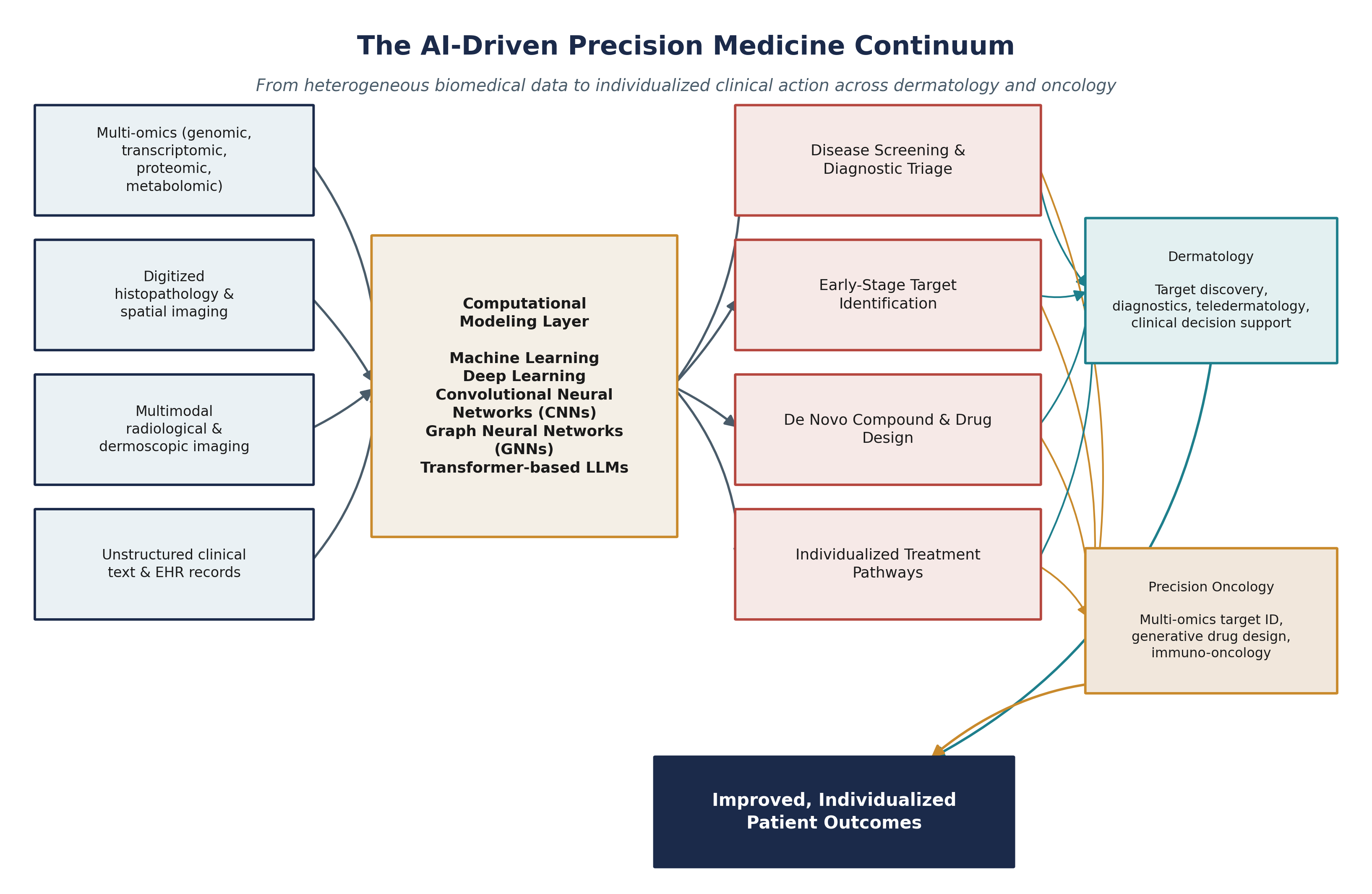
Article metrics
View details
0
Downloads
0
Citations
367
Views
📖 Cite article

View Dimensions


View Plumx


View Altmetric


0
Save
0
Citation
367
View
0
Share