Business and Social Sciences

Business and social sciences | Online ISSN 3067-8919
89
Citations
136.2k
Views
51
Articles
Your new experience awaits. Try the new design now and help us make it even better
Switch to the new experience
Figures and Tables
RESEARCH ARTICLE   (Open Access)

Commodity Price Inflation in Bangladesh: Drivers, Household Impact, and Policy Responses

Kamruzzaman Mithu 1*

+ Author Affiliations

Business and Social Sciences 4 (1) 1-8 https://doi.org/10.25163/business.4110877

Submitted: 17 June 2026 Revised: 08 August 2026  Published: 19 August 2026 


Abstract

Between 2020 and 2022, Bangladesh experienced a sustained rise in the price of essential commodities — rice, edible oil, sugar, lentils, and onions among them — that outpaced both wage growth and, at times, global commodity price trends. This paper undertakes a structured narrative review and secondary-data synthesis, drawing on Bangladesh Bureau of Statistics trade and inflation records, Foreign Trade Statistics, and peer-reviewed and institutional literature on commodity-price volatility, supplemented by contemporaneous news and market reporting. Domestic prices for several staples — wheat flour, lentils, and sugar in particular — rose disproportionately relative to their global benchmarks, a divergence attributable less to global shocks alone than to import dependency, market concentration among wholesalers, and, plausibly, opportunistic pricing behavior. Overall inflation reached 6.17 percent by February 2022, its highest level since October 2020, with edible oil, sugar, and egg prices identified as principal contributors. The evidence suggests that Bangladesh’s commodity price crisis is not reducible to imported inflation; domestic market structure and regulatory gaps appear to compound external shocks, disproportionately burdening low-income and food-insecure households. Targeted market regulation, agricultural investment, and tariff relief are proposed as complementary, near-term policy responses.

Keywords: commodity price inflation; food security; import dependency; cost-of-living crisis; Bangladesh

1. Introduction

When a currency loses purchasing power for staple foods such as rice, it is tempting to point to a single cause — war, pandemic, a poor harvest — rather than the interplay of several factors at once. Bangladesh's experience over the past several years has been messier than that. Household budgets have absorbed price increases that, on closer inspection, seem only partly explained by international markets. Something more local, and more stubborn, appears to be at work as well.

The scale of the problem is not abstract. Rice, lentils, flour, vegetable oil, dried chilies, onions, and sugar — the staples of a typical Bangladeshi kitchen — have all become measurably more expensive, and not gradually. Prices have moved week to week, occasionally day to day, outpacing the slower arithmetic of wage growth. For a household already spending half or more of its income on food, this is not an inconvenience; it is closer to a crisis (Halder, 2022). And it is a crisis that has persisted even during periods when Bangladesh's own rice harvest was reportedly sufficient — suggesting that domestic supply is not the whole story.

Economists have long recognized that commodity prices move for structural reasons as much as episodic ones. Supply and demand imbalances, currency pressures, speculative trading, hoarding, and what might delicately be called "artificial scarcity" all play a role, and disentangling their relative contributions is genuinely difficult; this paper does not claim to resolve that question definitively. What can be said is that the global literature on commodity-price shocks, while extensive, has focused disproportionately on macro-level and cross-country patterns rather than the lived experience of import-dependent economies like Bangladesh's. Rudkin's (2021) meta-analysis of 46 natural experiments, for instance, found that commodity price shocks do not uniformly predict armed conflict, though the effect varies by commodity type — a finding echoed, more narrowly, by Dube and Vargas (2013), who traced how falling coffee prices in 1990s Colombia depressed rural wages and, indirectly, fueled violence. These studies are conflict-focused, a step removed from Bangladesh's present circumstances, but they underline a broader point: commodity price movements rarely stay confined to the commodity itself. They ripple outward into wages, into social stability, into the texture of daily life.

Closer to the mechanics of price formation, Alquist et al. (2019) proposed a factor-based framework for decomposing the drivers of global commodity price co-movement, distinguishing shocks that operate through general economic equilibrium from those specific to individual markets — a useful reminder that "rising commodity prices" is rarely a single phenomenon, even when discussed as one. Mlachila and Ouedraogo (2019), studying 68 raw-material-intensive emerging economies between 1980 and 2014, identified a financial-development curse: commodity price volatility appears to retard financial sector growth precisely in the countries least equipped to absorb the shock, although effective governance seems to blunt the effect considerably. If that finding generalizes, Bangladesh's policy response — not merely its exposure to global markets — will shape how deeply this episode cuts.

The COVID-19 pandemic complicated matters further, and not always predictably. Umar et al. (2021), using wavelet-based time-frequency analysis, documented shifting coherence between commodity prices and pandemic-related fear indices, suggesting periods of genuine diversification opportunity even amid crisis — a counterintuitive result that cautions against treating "pandemic" and "price shock" as synonyms. Bakas and Triantafyllou (2020) linked OPEC's pandemic-era production cuts, made in anticipation of falling demand, to broader volatility in energy-linked commodities, while their earlier work (Bakas & Triantafyllou, 2018) found that unobservable, "hidden," uncertainty shocks exert a more durable influence on commodity price volatility than visible, headline-grabbing indicators do — a distinction easier to state than to act on. Watugala (2015) extended this line of inquiry by tying futures-market volatility to emerging-market demand growth and macroeconomic uncertainty, while Joëts et al. (2017) showed that the 2007–2009 recession produced an unusually long phase of pricing uncertainty. Borgards et al. (2021), examining intraday data across twenty commodity futures during the early pandemic, found that price overreactions became more frequent and more pronounced, particularly in energy markets, than in prior years.

None of this literature was written with Bangladesh specifically in mind, and that gap is, in a sense, the motivation for this paper. Bangladesh imports roughly 95 percent of its edible oil (Halder, 2022), leaving the country structurally exposed to exactly the kind of global volatility this research describes. But exposure to global shocks does not fully explain what has happened domestically. Wheat flour prices, for example, rose by roughly 67 percent on the local market even as global wheat prices increased by only about 8 percent over the same period (Islam, 2022) — a gap too large to be explained by shipping costs or currency depreciation alone. Lentil prices moved similarly, climbing 29 to 39 percent domestically even as international prices fell (Halder, 2022). These are not small discrepancies, and they point toward domestic market dynamics — concentration among wholesalers, weak regulatory enforcement, and possibly opportunistic pricing during a period when consumers had little capacity to push back — that deserve closer scrutiny than the existing global literature provides.

This paper attempts, modestly, to fill part of that gap. It synthesizes institutional statistics from the Bangladesh Bureau of Statistics alongside the empirical commodity-pricing literature to ask: how much of Bangladesh's recent price inflation is genuinely imported, and how much is generated, or at least amplified, closer to home? The answer, as the sections that follow suggest, is probably both — but not in equal measure, and not without consequence for the households least able to absorb the difference.

2. Methodology

2.1 Study Design

This paper adopts a structured narrative review and secondary-data synthesis design, rather than a primary empirical or experimental approach. This distinction is stated explicitly at the outset because it governs what the paper can and cannot claim: the analysis describes and contextualizes observed price patterns using existing institutional and academic sources, but it does not test a pre-registered hypothesis, nor does it generate new primary price data. Readers should interpret the findings as an evidence synthesis rather than as causal inference from a controlled design.

2.2 Data Sources

Two categories of source material were used, and it is worth separating them clearly, since they carry different evidentiary weight.

Institutional and statistical sources. Domestic price and trade figures were drawn from the Bangladesh Bureau of Statistics (BBS), specifically its Foreign Trade Statistics (FTS) publications and national accounts / provisional GDP estimates for the 2020–21–22 period (Bangladesh Bureau of Statistics, 2022a, 2022b). These publications report monthly and annual trade volumes, import values, and headline inflation figures, and were treated as the primary quantitative backbone of the paper.

Academic and journalistic sources. To situate Bangladesh’s experience within the broader empirical literature on commodity-price volatility, peer-reviewed studies were identified through a manual, non-systematic search of commodity-economics literature, prioritizing studies published in economics and finance journals between 2013 and 2021 that addressed commodity-price shocks, volatility, or their downstream social and financial effects (e.g., Alquist et al., 2019; Bakas & Triantafyllou, 2018, 2020; Borgards et al., 2021; Dube & Vargas, 2013; Joëts et al., 2017; Mlachila & Ouedraogo, 2019; Rudkin, 2021; Umar et al., 2021; Watugala, 2015). Because this was not a systematic review, no formal database search string, PRISMA flow diagram, or inter-rater screening protocol was applied; this is disclosed as a limitation in Section 2.5, and readers seeking a systematic evidence base should treat this review as hypothesis-generating rather than exhaustive.

Contemporaneous market and price data not captured in BBS releases — including local kitchen-market prices, per-unit price changes over specific two-to-four-week windows, and cost-of-living reporting — were drawn from reputable financial and news outlets, including the Dhaka Tribune (2022a), The Daily Star (Halder, 2022), Deutsche Welle (Islam, 2022), The Business Standard (Billah, 2022), CaixaBank Research (Serrano, 2022), and ATB Financial (Kadziolka, 2022). These sources were used specifically where they reported figures traceable to a named institutional origin (e.g., the Trading Corporation of Bangladesh, or the Bangladesh Trade and Tariff Commission); sources without a clear attributable data origin were excluded.

2.3 Inclusion Period and Scope

The primary analytic window is January 2020 through September 2022, chosen to bracket the COVID-19 pandemic onset and the initial post-invasion (Russia–Ukraine, February 2022) commodity shock, while allowing observation of price behavior in the months immediately following each event. Where earlier data were needed for historical context — for instance, the 2005 Household Income and Expenditure Survey figures on food’s share of household expenditure — this is flagged explicitly in the text rather than treated as current.

2.4 Analytical Approach

Rather than statistical hypothesis testing, the paper applies a comparative descriptive method: for each commodity of interest, the reported domestic percentage price change over a defined period is set alongside the reported global (international market) percentage change over the same or a comparable period, drawn from the sources above. Where both figures were available from a traceable source, the differential between them is reported as an indicator of the extent to which domestic pricing diverges from global benchmarks — a proxy, admittedly imperfect, for the relative contribution of domestic versus imported inflationary pressure. This approach follows the comparative logic used descriptively by Islam (2022) in analyzing Bangladesh’s local-versus-global price divergence, extended here across a wider commodity basket.

2.5 Limitations and Reproducibility Statement

For transparency and reproducibility, three limitations are noted. First, because source selection was not conducted via a systematic, pre-registered protocol, selection bias toward more widely reported commodities and events cannot be ruled out; a future systematic review following PRISMA guidelines, with defined database search terms (e.g., “commodity price,” “Bangladesh,” “inflation,” “import dependency”) across databases such as Scopus, Web of Science, and EconLit, would strengthen the evidentiary base. Second, price figures drawn from news sources, while cross-checked against institutional attribution where possible, were not independently re-verified against raw BBS microdata; researchers seeking to replicate this analysis should request primary FTS and CPI datasets directly from BBS. Third, the descriptive divergence method used here identifies association, not causation, between domestic and global price movements, and should not be interpreted as establishing that domestic actors caused the observed gap — only that the gap exists and merits further, more rigorously causal, investigation.

3. Results and Discussion

3.1 Statistical Overview of Price and Trade Trends

Start with the headline number, because it frames everything that follows: Bangladesh's overall inflation rate climbed to 6.17 percent in February 2022, the highest reading since October 2020, with sugar, eggs, and edible oil doing most of the damage (Halder, 2022). That is not a subtle shift. It is the kind of figure that shows up not in a spreadsheet but in a household's weekly shopping bag, where the same basket simply costs more than it did a few months earlier.

The trade data behind that number tell a related, though not identical, story. Import volumes for essential commodities moved unevenly across the period under review — up sharply for some items, down for others — a pattern visible in the country's shifting import composition between December 2021 and July 2022 [Table 1; Table 2]. Raw sugar imports, for instance, jumped by more than 85 percent month-on-month between December 2021 and January 2022, while soybean oil imports fell by roughly 27 percent over the same window [Table 1]; by mid-2022, onion imports had spiked by an almost implausible 3,183 percent from June to July, alongside a 939 percent jump in rice imports [Table 2]. Numbers that volatile are, frankly, a little hard to interpret cleanly — they may reflect genuine demand shifts, seasonal restocking, or simply the lumpiness of how import shipments get recorded month to month. Still, taken together, they point to a supply chain under considerable strain.

Trade figures for January 2022 sharpen the picture further: exports totaled Tk. 493.95 billion against imports of Tk. 917.94 billion, leaving a trade gap of Tk. 423.99 billion, with both export and import growth rates weaker than the previous year's (Bangladesh Bureau of Statistics, 2022b). Put plainly, Bangladesh was paying more for what it brought in while earning comparatively less from what it sent out — not, by any measure, a combination conducive to price stability.

Table 1. Import volumes for fifteen essential commodities, comparing December 2021 and January 2022, together with the month-on-month percentage change and the cumulative import total through January 2022. The data, sourced from the Bangladesh Bureau of Statistics (2022a), illustrate the sharp swings in import activity — most notably an 85.6 percent rise in raw sugar imports — that coincided with the onset of the price increases discussed in Section 3.1. (The wheat percentage in the image appears as −1773, but based on the December and January values, the calculated percentage change is approximately −17.73%.)

Item

Dec. 2021

Jan. 2022

Percent Change from Previous Month

Cumulative (Jan. 2022)

Raw sugar

307,288

570,241

85.57%

2,747,104

Palm oil

138,223

160,493

16.11%

1,566,561

Soya bean oil

176,670

129,811

−26.52%

735,051

Milk & Cream

7,544

11,893

78,347

Ginger

Chillies

Wheat

416,440

342,597

−17.73%

2,180,849

Rice

44,290

38,670

−12.69%

997,793

Lentil & Other

10,546

9,563

−9.32%

178,722

Onion

81,838

83,509

2.04%

774,697

Garlic

2,682

4,916

83.30%

29,258

Tea

104

6

−94.23%

557

Oilseed

439,750

185,385

−57.84%

185,385

Gram/Anchor

2

2

Turmeric

2,539

1,351

−46.79%

14,046

Top of Form


Bottom of Form

Table 2: Import volumes for the same fifteen essential commodities, comparing June and July 2022, with month-on-month percentage change and cumulative totals through July. Drawn from the Bangladesh Bureau of Statistics (2022a), the figures capture extreme short-term volatility later in the review period, including a 3,183 percent surge in onion imports and a 939 percent jump in rice imports, underscoring how unevenly import flows moved across commodities.

Items

Jun'22

July'22

Percent change from previous month

Cumulative (Jan-22)

Raw sugar

200,114

263,796

31.82

263,796

Palm oil

214,613

212,000

-1.22

212,000

Soya bean oil

211,287

81,555

-61.40

81,555

Milk & Cream

17,517

11,423

-34.79

11,423

Ginger

-

-

-

-

Chillies

-

-

-

-

Wheat

72,126

53,085

-26.40

53,085

Rice

2,026

21,042

938.60

21,042

Lentil & other

43,701

41,564

-4.89

41,564

Onion

3,282

107,755

3183.21

107,755

Garlic

11,122

6,664

-40.08

6,664

Tea

381

13

-96.59

13

Oil seed

402,535

563,503

39.99

563,503

Gram/Anchor

38

-

-1

-

Turmeric

4,410

1,387

-68.55

1,387

3.2 Global Versus Domestic Price Divergence

Here is where the analysis gets more interesting, and arguably more uncomfortable. The gap between how much prices rose internationally and how much they rose inside Bangladesh is, in places, difficult to explain through global shocks alone. Wheat flour is the clearest case: its domestic price rose by roughly 67 percent even as the international wheat price increased by only about 8 percent over the same stretch (Islam, 2022). An eightfold divergence of that size is not the kind of thing shipping costs or a weaker taka can fully account for, though both surely played some part.

Lentils followed a similarly lopsided path — up 29 to 39 percent on local markets while global lentil prices were, if anything, falling (Halder, 2022). Sugar told much the same story: domestic prices rose by Tk 150 per maund over just two weeks, during a period when world sugar prices were trending downward (Billah, 2022). This pattern of domestic prices moving opposite to, or well beyond, global benchmarks recurs often enough across the sources reviewed here that it looks less like coincidence and more like a structural feature of the period [Fig. 1].
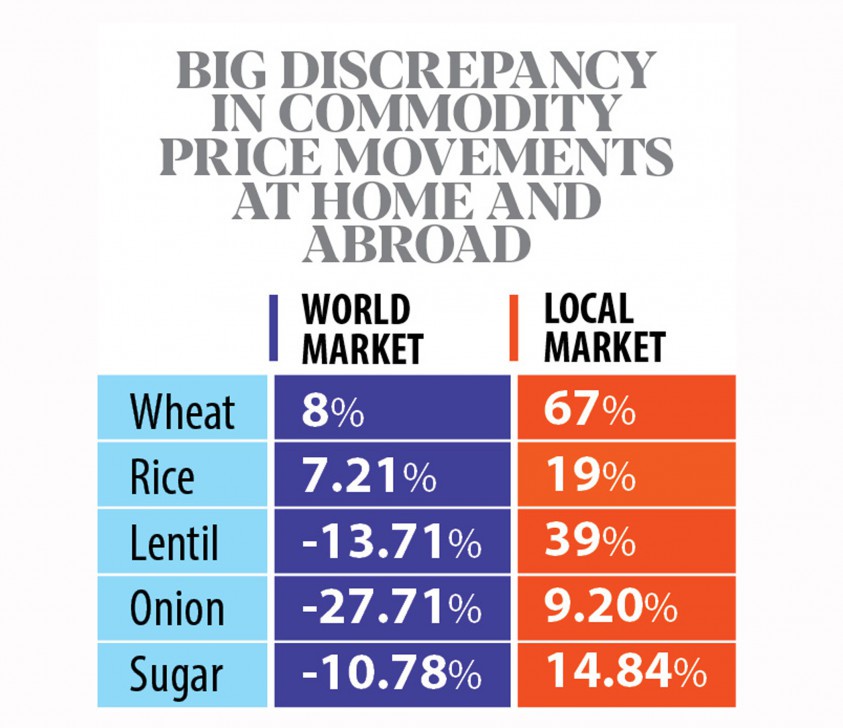
Fig. 1. Comparison of domestic and international price movements for selected commodities, highlighting the extent to which local prices in Bangladesh diverged from global benchmarks over the same period. Reproduced from Islam (2022), the figure visually supports the argument developed in Section 3.2 that domestic pricing behavior cannot be explained by global market conditions alone.

What might be driving that gap? Import costs, freight charges, and currency depreciation are the obvious first suspects, and they are real — but they would not typically be expected to produce a divergence as large as the one observed for flour. A less comfortable, though arguably more plausible, explanation points toward domestic market structure: concentrated wholesaling, thin retail competition, and — as Islam (2022) reports fairly directly — instances in which dealers appear to have used a genuine global crisis as cover to raise prices beyond what that crisis alone would justify. It is worth noting, too, that average inflation rose from 5.6 percent in fiscal 2020–21 to 6.2 percent the following year, overshooting the government's own revised target of 5.7 percent (Islam, 2022). Modest as that overshoot looks on paper, it is a fairly telling sign that domestic price management has not kept pace with its own stated ambitions.

3.3 Structural Drivers Behind the Price Increases

No single factor explains all of this, and the literature reviewed for this paper is reasonably consistent on that point [Table 3]. A few structural drivers recur often enough to merit individual naming.

Table 3. Comparative summary of nine peer-reviewed studies on commodity price shocks, spanning 2013 to 2021. Each row lists the source publication, its central research focus, and its principal finding, ranging from links between price shocks and armed conflict to the role of governance in moderating financial-development effects. Together, the studies establish the broader empirical backdrop against which Bangladesh's own price experience is interpreted in this paper.

Scientific Paper

Proposed System / Focus

Finding / Solution

Year

Do commodity price shocks cause armed conflict? A meta-analysis of natural experiments

Rudkin (2021) examines the relationship between commodity prices and armed civil conflict.

Meta-analysis of 46 natural experiments using difference-in-difference designs.

2021

Commodity price shocks and civil conflict: Evidence from Colombia. The Review of Economic Studies

Dube and Vargas (2013) exploit exogenous price shocks in global commodity markets and examine how income shocks affect conflict.

Variation in labor-intensive agricultural product prices versus natural resource prices.

2013

Commodity-price comovement and global economic activity. Journal of Monetary Economics

Alquist et al. (2019) study changes in commodity prices and global economic activity using a factor-based identification technique.

A factor structure for commodity prices with identification criteria that support economic interpretation.

2019

Financial development curse in resource-rich countries: The role of commodity price shocks. The Quarterly Review of Economics and Finance

Mlachila and Ouedraogo (2019) investigate whether commodity price fluctuations retard financial growth.

Effective governance can lessen the effects of commodity price shocks.

2019

The impact of Covid-19 on commodity markets volatility: Analyzing time-frequency relations between commodity prices and coronavirus panic levels. Resources Policy

Umar et al. (2021) use wavelet analytics to examine the impact of Covid-19 on commodity price volatility.

N/A

2021

Commodity price volatility and the economic uncertainty of pandemics. Economics Letters

Bakas and Triantafyllou (2020) study aggregate demand and supply shocks driving commodity prices.

OPEC responded by reducing oil output in line with IEA projections during the pandemic.

2020

The impact of uncertainty shocks on the volatility of commodity prices. Journal of International Money and Finance

Bakas and Triantafyllou (2018) use VAR analysis to determine the impact of uncertainty on commodity price volatility.

Unobservable economic uncertainty metrics have a durable, beneficial impact on volatility.

2018

Economic uncertainty and commodity futures volatility (Working Paper 15-14, Office of Financial Research)

Watugala (2015) examines the relationship between commodity volatility and fundamental uncertainty.

Futures volatility is related to commodities whose importers are concentrated in emerging markets.

2015

Does the volatility of commodity prices reflect macroeconomic uncertainty? Energy Economics

Joëts et al. (2017) examine whether macroeconomic uncertainty affects agricultural, industrial, and precious metals markets.

The 2007–2009 recession caused an unusual phase of extreme price uncertainty.

2017

Price overreactions in the commodity futures market: An intraday analysis of the Covid-19 pandemic impact. Resources Policy

Borgards et al. (2021) investigate overreaction behavior in 20 commodity futures during the pandemic.

Overreactions occurred more often and with greater amplitude during Covid-19.

2021


Market syndication and the role of intermediary "middlemen" come up repeatedly as amplifiers — not originators, necessarily, but amplifiers — of price movements beyond what supply conditions alone would predict. Reduced domestic agricultural output in certain seasons compounds an already heavy reliance on imports, particularly for edible oil, roughly 95 percent of which Bangladesh imports (Halder, 2022). When the global price of a barrel of edible oil climbed from around US$700 to nearly US$1,940 following Russia's invasion of Ukraine, the country had little room to absorb that shock (Halder, 2022). That kind of exposure is broadly consistent with Alquist et al.'s (2019) factor-based account of commodity price co-movement, which suggests that general-equilibrium shocks — the sort that move across many markets at once, the way an energy shock tends to — hit import-dependent economies more uniformly than commodity-specific shocks do.

The war's reach extended well beyond edible oil. Russia and Ukraine together account for roughly 30 percent of global wheat exports, and Ukraine alone for about 17 percent of maize exports; the resulting disruption, combined with weaker anticipated harvests elsewhere, pushed wheat and corn prices up by an estimated 39 percent and 23 percent, respectively, over the year (Kadziolka, 2022) [Fig. 2]. Bangladesh's own response — a 12 percent domestic LPG price increase within a single month (Kadziolka, 2022) — was defensible as a short-term fiscal adjustment, though it also passed costs directly onto households already stretched thin by food-price increases on several fronts simultaneously.
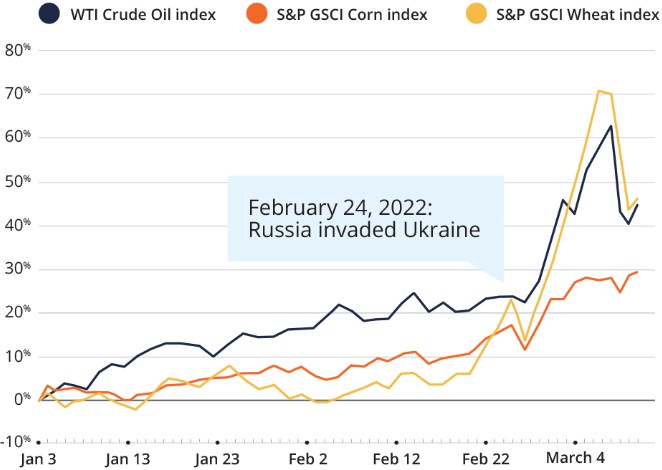
Fig. 2. Trend of rising global commodity prices across 2022, tracking categories such as energy, grains, and metals in the months following the onset of the Russia–Ukraine conflict. Sourced from Kadziolka (2022), the figure situates Bangladesh's import cost pressures within the wider pattern of global commodity inflation discussed in Section 3.3.

It is worth pausing, briefly, on why global commodity markets behave this unpredictably in the first place, since it bears on how much of Bangladesh's exposure was avoidable. Umar et al. (2021) found that the relationship between commodity prices and pandemic-era fear indices shifted over time, occasionally opening genuine diversification opportunities even amid crisis — a counterintuitive finding that cautions against treating "pandemic" and "price shock" as interchangeable terms. Bakas and Triantafyllou (2020) linked OPEC's pandemic-era production cuts to broader volatility in energy-linked commodities, while their earlier work (Bakas & Triantafyllou, 2018) suggested that unobservable, "hidden" uncertainty shocks influence commodity price volatility more durably than visible, headline indicators do. Watugala (2015) tied futures-market volatility to emerging-market demand growth, and Joëts et al. (2017) showed that the 2007–2009 recession produced an unusually long stretch of pricing uncertainty. Borgards et al. (2021), examining intraday data across twenty commodity futures, found that price overreactions grew both more frequent and more severe during the early pandemic, especially in energy markets. None of this was written with Bangladesh specifically in mind, but together it sketches an environment of heightened, somewhat erratic global volatility into which Bangladesh's own import dependency and market concentration fed directly.

3.4 Household and Poverty Impacts

None of the preceding discussion means much without asking who actually absorbs these price movements — and the answer, unsurprisingly, is that the burden falls unevenly. Food typically accounts for 50 to 60 percent of total spending among disadvantaged households in Bangladesh (Halder, 2022), which means a proportional rise in food prices consumes a share of household income that wealthier consumers simply never feel in the same way. Older data offer useful context here: according to the 2005 Household Income and Expenditure Survey, staple foods already made up more than a third of annual expenditure for the poorest fifth of the population, well before the 2020–2022 shocks arrived. If anything, that earlier vulnerability appears to have deepened rather than been newly created.

Islam (2022) cites estimates suggesting the pandemic alone pushed roughly 32 million people into poverty nationally, with some critics attributing part of that increase to domestic policy choices rather than external shocks alone. This review cannot independently verify that attribution — it draws on secondary sources rather than primary poverty data — but it does not find the claim implausible, given the price patterns documented in Sections 3.1 through 3.3. The visible queues of middle- and lower-income households at Trading Corporation of Bangladesh discount trucks are, seen in this light, less an anecdote worth mentioning in passing and more a fairly direct, observable symptom of the affordability gap this paper has tried to trace.

3.5 Policy Responses and Their Limits

Government interventions so far — LPG price adjustments, TCB discount distribution — address symptoms more than causes, at least as far as the evidence reviewed here suggests. Given the scale of the domestic-versus-global divergence documented in Section 3.2, it seems reasonable to conclude that policy attention aimed solely at import costs will likely under-address the underlying problem.

There is, however, a cautiously optimistic thread running through the comparative literature. Mlachila and Ouedraogo (2019) found that effective governance measurably reduces the financial-development costs associated with commodity price shocks — meaning institutional quality, not global market conditions alone, appears to shape how severely a given shock is ultimately felt. Whether Bangladesh's regulatory apparatus is currently positioned to play that moderating role is a separate, and considerably harder, question than this review can settle. It is, arguably, the more consequential one going forward.

3.6 Synthesis

Pulling these threads together: the evidence assembled here does not support a simple story in which Bangladesh's commodity price crisis is purely imported, nor one in which it is purely domestic. Both forces appear to be operating, and not always in ways that are easy to disentangle from secondary data alone — a limitation acknowledged explicitly in Section 2.5. What does seem reasonably clear is that domestic market structure and regulatory gaps are doing more of the work than a purely global-shocks narrative would predict, and that the households least equipped to absorb the difference are the ones bearing most of it.

4. Conclusion

Global market shocks alone cannot account for Bangladesh's recent commodity price inflation. The Russia–Ukraine conflict and pandemic-era supply disruptions undeniably raised import costs, but the evidence reviewed here shows domestic prices for staples like wheat flour and lentils rising far beyond their global counterparts — a gap most plausibly linked to market concentration, weak regulatory enforcement, and, in some documented cases, opportunistic pricing. Low-income households, who devote the largest share of their budgets to food, have absorbed the brunt of this divergence, with measurable poverty consequences. Addressing the crisis will likely take more than tariff relief or import support; regulating market syndicates, strengthening agricultural capacity, and improving institutional governance appear, based on the comparative literature, to matter at least as much as global price conditions themselves. Future research employing systematically collected primary price data would help establish these relationships with greater causal confidence.

References


Alquist, R., Bhattarai, S., & Coibion, O. (2019). Commodity-price comovement and global economic activity. Journal of Monetary Economics.

Bakas, D., & Triantafyllou, A. (2018). The impact of uncertainty shocks on the volatility of commodity prices. Journal of International Money and Finance.

Bakas, D., & Triantafyllou, A. (2020). Commodity price volatility and the economic uncertainty of pandemics. Economics Letters.

Bangladesh Bureau of Statistics. (2022a). Foreign trade statistics (FTS) of Bangladesh, 2020–21 to 2021–22. https://bbs.portal.gov.bd/       

Bangladesh Bureau of Statistics. (2022b). National accounts statistics (provisional estimates of GDP), 2020–21–22. http://www.bbs.gov.bd/          

Billah, M. (2022). Commodity price hikes are an international crisis, opportunity for Bangladeshi businesses. The Business Standard. https://www.tbsnews.net/features/panorama/commodity-price-hikes-are-intl-crises-opportunity-bangladeshi-businesses-502670   

Borgards, O., Czudaj, R. L., & Van Hoang, T. H. (2021). Price overreactions in the commodity futures market: An intraday analysis of the Covid-19 pandemic impact. Resources Policy.

Dhaka Tribune. (2022a, September 25). Why are commodity prices still high despite global dip? https://www.dhakatribune.com/commerce/2022/09/25/why-are-commodity-prices-still-high-despite-global-dip

Dube, O., & Vargas, J. F. (2013). Commodity price shocks and civil conflict: Evidence from Colombia. The Review of Economic Studies.         

Halder, S. (2022). Price rise: Global hike not justified. The Daily Star. https://www.thedailystar.net/health/food/price-essentials/news/price-rise-global-hike-not-justified-3128846

Islam, A. (2022). Bangladesh in economic turmoil over soaring commodity prices. Deutsche Welle. https://www.dw.com/en/bangladesh-in-economic-turmoil-over-soaring-commodity-prices/a-61290191        

Joëts, M., Mignon, V., & Razafindrabe, T. (2017). Does the volatility of commodity prices reflect macroeconomic uncertainty? Energy Economics.

Kadziolka, C. J. (2022). Rising commodity prices and their impacts. ATB Financial. https://www.atb.com/wealth/good-advice/markets/rising-commodity-prices-and-their-impacts/       

Mlachila, M., & Ouedraogo, R. (2019). Financial development curse in resource-rich countries: The role of commodity price shocks. The Quarterly Review of Economics and Finance.   

Rudkin, G. B. C. (2021). Do commodity price shocks cause armed conflict? A meta-analysis of natural experiments.

Serrano, B. V. (2022). The rise in commodity prices and its impact on inflation. CaixaBank Research. https://www.caixabankresearch.com/en/economics-markets/commodities/rise-commodity-prices-and-its-impact-inflation       

Umar, Z., Gubareva, M., & Teplova, T. (2021). The impact of Covid-19 on commodity markets volatility: Analyzing time-frequency relations between commodity prices and coronavirus panic levels. Resources Policy.

Watugala, S. W. (2015). Economic uncertainty and commodity futures volatility (Working Paper 15-14). Office of Financial Research.


Article metrics
View details
0
Downloads
0
Citations
4
Views

View Dimensions


View Plumx


View Altmetric


0
Save
0
Citation
4
View
0
Share