
Journal of Primeasia

Integrative Disciplinary Research | Online ISSN 3064-9870 | Print ISSN 3069-4353
570
Citations
220.7k
Views
147
Articles
Your new experience awaits. Try the new design now and help us make it even better
Switch to the new experience
Figures and Tables
RESEARCH ARTICLE   (Open Access)

Transparency, Accountability, and Citizen Participation as Drivers of Local Government Effectiveness: Evidence from Bangladesh

Md. Motaher Hossain 1*

+ Author Affiliations

Journal of Primeasia 7 (1) 1-10 https://doi.org/10.25163/primeasia.7110792

Submitted: 31 March 2026 Revised: 18 June 2026  Published: 26 June 2026 


Abstract

Local government institutions in Bangladesh, at least on paper, are supposed to be the closest point of contact between the state and its citizens — yet whether they actually function that way, in practice, is a question that deserves closer scrutiny than it usually receives. This study examines how transparency, accountability, and citizen participation jointly shape governance effectiveness within Union Parishads, Pourashavas, and City Corporations. A convergent mixed-methods design combined a structured survey of 400 respondents (local officials, elected representatives, and citizens) with semi-structured interviews from 20 key informants, allowing the numbers to be read alongside the stories behind them. Descriptive results indicated moderate transparency (M = 3.42, SD = 0.82) and accountability (M = 3.18, SD = 0.90), while citizen participation lagged noticeably behind (M = 2.95, SD = 0.87). Multiple regression confirmed that all three predictors significantly influenced governance effectiveness — transparency most strongly (β = 0.34, p < .001), followed by accountability (β = 0.28, p < .001) and participation (β = 0.22, p < .001) — together explaining 52% of the variance. Qualitative accounts, however, complicated this tidy statistical picture: participants repeatedly described participation as procedurally present but substantively hollow, and accountability as routinely diluted by political interference. Taken together, the findings suggest that governance effectiveness in Bangladesh's local institutions depends less on any single reform than on the alignment of transparency, accountability, and genuine citizen voice — a conclusion with direct implications for decentralization policy and institutional design.

Keywords: Local Governance; Decentralization; Accountability; Citizen Participation; Bangladesh

1. Introduction

Governance is one of those words that gets invoked so often, in so many different contexts, that it risks losing precision — and yet, when we look closely at how public institutions actually function, or fail to, the concept still does real analytical work. Over the past several decades the conversation has shifted away from a narrow preoccupation with formal government structures toward something broader: how responsively institutions treat citizens, how transparently they operate, and how willing they are to be held accountable (Rhodes, 1996). This shift did not happen in a vacuum. The World Bank and the United Nations Development Programme have both argued, at various points, that weak governance quietly erodes public trust and service delivery, particularly in countries where administration remains centralized and institutions are, in some sense, still finding their footing (UNDP, 2016; World Bank, 2017).

It is within this wider discourse that “good governance” emerged as something like a normative checklist — transparency, accountability, participation, equity, and rule of law, bundled together as markers of institutional quality (Kaufmann et al., 2011; Grindle, 2007). Whether such a checklist can ever be fully realistic is a fair question, but there is reasonably strong evidence that governance quality shapes economic growth, poverty outcomes, and democratic stability in ways that are difficult to dismiss (Fukuyama, 2013; Leftwich, 1994). The inclusion of Sustainable Development Goal 16 — peace, justice, and strong institutions — within the global development agenda only reinforced this point (United Nations, 2015). Governance, for better or worse, is no longer treated as a purely technical or administrative matter.

Local governance occupies a particularly interesting place in this story, mostly because local institutions are where citizens actually encounter the state — through sanitation, schools, roads, and the small, unglamorous machinery of everyday administration. Decentralization theory has long argued, sometimes rather optimistically, that moving authority closer to citizens should make institutions more responsive and accountable (Rondinelli et al., 1989; Oates, 1972). Scholars typically distinguish among political, administrative, and fiscal decentralization (Cole, 2008), and the underlying logic — that local governments simply know local needs better than distant central ministries — carries genuine intuitive appeal (Smoke, 2003; Ostrom, 2010). Yet the literature is not naive about this. Decentralization does not automatically produce better governance; weak institutional capacity, elite capture, and thin accountability mechanisms can just as easily reproduce old inequalities under a new administrative label (Crook & Manor, 1998).

The empirical record, perhaps unsurprisingly, is mixed. Some studies find that decentralization reforms, when paired with political commitment and adequate resources, genuinely improve service delivery and participation (Gadenne & Singhal, 2014; Faguet, 2014). Others document more or less the opposite — persistent bureaucratic inefficiency, corruption, and limited citizen oversight (Andrews, 2010; Brinkerhoff & Goldsmith, 2002). Across South Asia in particular, local governments often remain financially and administratively tethered to central authorities, which raises an uncomfortable question about how “local” local governance really is in practice (Robinson, 2007; Smoke & Lewis, 2005). And participatory mechanisms, even where they exist formally, do not always translate into substantive influence over planning or budgeting decisions (Cornwall, 2008; Gaventa & Barrett, 2012).

Bangladesh offers a particularly telling case in this respect. Its Constitution formally commits to decentralized, participatory local governance through Articles 59 and 60 (Government of Bangladesh, 1972), and the country's local government architecture — Union Parishads at the rural level, Pourashavas in municipalities, City Corporations in major urban centers — is reasonably well developed, at least on paper (Ahmed, 2013; Siddiqui, 2005). And yet successive reforms have not closed the gap between formal design and everyday practice. Political interference from Members of Parliament and party elites continues to shape local decision-making in ways that formal statutes do not really anticipate (Panday & Jamil, 2011), while accountability mechanisms — audits, financial disclosure, monitoring systems — remain patchy at best (Sarker, 2014; Transparency International Bangladesh, 2020). Citizen participation, meanwhile, often looks more procedural than substantive: ward meetings happen, but they tend to be dominated by local elites, leaving ordinary citizens, and especially women and marginalized groups, with limited real influence over outcomes (Rahman & Siddiquee, 2016; Hossain, 2018).

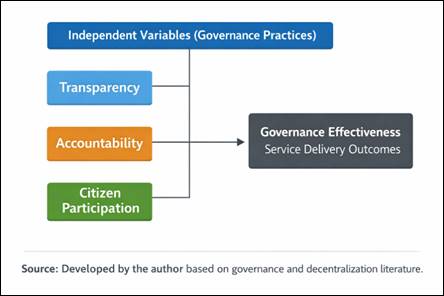
What seems to be missing from this literature — or at least underrepresented in it — is empirical work that combines measurable governance indicators with the lived, qualitative texture of how citizens and officials actually experience these institutions. Much existing scholarship leans heavily on macro-level or descriptive policy analysis; comparatively few studies integrate quantitative governance measurement with qualitative accounts of institutional and political dynamics. Given that governance is inherently multidimensional and context-dependent, this gap matters more than it might first appear. The present study attempts to address it by examining how transparency, accountability, and citizen participation jointly shape governance effectiveness within Bangladesh's local government institutions, drawing on both survey and interview data to build a fuller, and hopefully more grounded, picture of how governance actually works on the ground (Figure 1).

1.1 Theoretical Framework and Conceptual Foundation

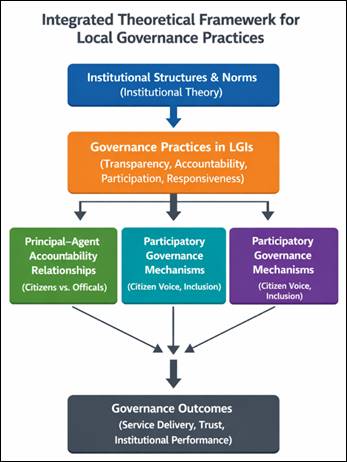
Three theoretical strands underpin this study — institutional theory, principal-agent theory, and participatory governance theory — which together offer a reasonably complete lens for examining how governance practices shape institutional effectiveness in Bangladesh (see Table 1). Institutional theory helps explain how formal and informal rules constrain or enable administrative behavior; principal-agent theory clarifies why accountability so often breaks down between citizens and the officials meant to serve them; and participatory governance theory speaks to the question of whether citizen engagement is substantive or merely symbolic. None of these theories, on its own, fully captures the complexity of local governance in Bangladesh, which is precisely why they are combined here rather than treated separately , as illustrated in the integrated framework below (Figure 2). 

Transparency, accountability, and citizen participation are treated as the three explanatory dimensions of governance effectiveness, the outcome variable of interest. Transparency refers to openness in institutional processes; accountability concerns the mechanisms through which officials are held responsible for their decisions; and participation reflects the extent to which citizens genuinely influence planning, budgeting, and monitoring. The framework assumes — and this is worth stating plainly — that these three dimensions are not independent of one another; transparency and participation are expected to reinforce accountability, and together to shape institutional effectiveness.

1.2 Research Hypotheses

Building on this framework, three hypotheses guided the empirical analysis:

H1: Transparency positively and significantly influences governance effectiveness in local government institutions in Bangladesh.
H2: Accountability positively and significantly influences governance effectiveness in local government institutions in Bangladesh.

H3: Citizen participation positively and significantly influences governance effectiveness in local government institutions in Bangladesh.

2. Methodology

2.1 Study Design

This study adopted a convergent mixed-methods design, in which quantitative and qualitative data were collected during roughly the same period, analyzed separately, and then merged during interpretation. The choice was not incidental. Governance, almost by definition, resists reduction to a single number — it is shaped by institutional rules, political relationships, and everyday practices that survey items alone tend to flatten out (Rhodes, 1996). A purely quantitative design risked missing the political and institutional texture that qualitative accounts are better suited to reveal, while a purely qualitative design would have made it difficult to establish the relative statistical weight of transparency, accountability, and participation. Combining the two, imperfect as any compromise is, seemed the more defensible option.

2.2 Study Setting

The research was conducted across a purposively selected set of local government institutions in Bangladesh, spanning all three administrative tiers: Union Parishads (rural), Pourashavas (municipal), and City Corporations (metropolitan). Institutions were selected to capture variation in governance performance and administrative context rather than to represent any single tier alone — partly because governance challenges in rural Union Parishads are not necessarily the same as those in urban City Corporations, and a design confined to one tier would have limited generalizability.

2.3 Population and Sampling Procedure

The target population comprised three groups directly connected to local governance: local government officials, elected representatives, and citizens receiving public services. A multi-stage sampling strategy was used. For the quantitative strand, respondents were selected through stratified random sampling, with strata defined by respondent category (official, elected representative, citizen) and institutional tier, to ensure that no single group dominated the sample disproportionately. Within each stratum, individuals were selected using systematic random sampling from institutional service or attendance records, with a fixed sampling interval applied to reduce selection bias. For the qualitative strand, 20 key

Figure 1. Conceptual framework of governance practices and effectiveness in local government institutions. The figure illustrates the hypothesized relationships among transparency, accountability, and citizen participation as predictors of governance effectiveness within Union Parishads, Pourashavas, and City Corporations in Bangladesh.

Figure 2. Integrated theoretical framework for local governance practices. The framework integrates institutional theory, principal–agent theory, and participatory governance theory to explain how transparency, accountability, and citizen participation jointly shape governance effectiveness. Source: Developed by the author, drawing on North (1990), Jensen and Meckling (1976), and Fung (2006).

Table 1. Theoretical Perspectives and Governance Indicators Applied in This Study. Note. This table summarizes the three theoretical perspectives underpinning the study's conceptual framework and links each to the governance challenges and empirical indicators examined in subsequent analyses.

Theory Applied

Core Focus

Key Governance Challenge

Governance Indicators Linked

Institutional Theory

Formal and informal institutional rules shaping governance behavior

Institutional rigidity, political patronage, weak autonomy

Rule compliance, administrative capacity, institutional effectiveness

Principal-Agent Theory

Accountability relationship between citizens (principals) and officials (agents)

Corruption risks, elite capture, weak monitoring

Transparency, financial accountability, oversight mechanisms

Participatory Governance Theory

Citizen engagement in decision-making and service monitoring

Low participation, symbolic consultation, exclusion of marginalized groups

Citizen participation, responsiveness, legitimacy, inclusiveness

informants were selected purposively, based on their direct governance experience — senior officials, elected representatives with multi-term service, and citizens who had actively engaged with ward-level consultations — since random selection would not have guaranteed access to individuals with sufficiently rich institutional knowledge.

The final quantitative sample size of 400 was determined using standard sample-size estimation procedures for a finite population at a 95% confidence level and a 5% margin of error, adjusted upward to account for an anticipated non-response rate of approximately 10–15%. This yielded a sample sufficiently powered to detect medium effect sizes in the planned regression model (three predictors, α = .05, power = .80).

2.4 Instrumentation and Measurement

Four constructs were measured: transparency, accountability, citizen participation, and governance effectiveness. Items were adapted from internationally recognized governance measurement frameworks, most notably the Worldwide Governance Indicators (Kaufmann et al., 2011), and were revised for linguistic and cultural relevance to the Bangladeshi local government context following consultation with subject-matter reviewers familiar with Union Parishad and Pourashava administration. All items used a five-point Likert scale (1 = strongly disagree, 5 = strongly agree). The full item pool, response anchors, and construct definitions are available from the corresponding author upon reasonable request, in keeping with standard transparency practice for survey-based governance research.

2.5 Pilot Testing and Reliability

Prior to full-scale administration, the instrument was pilot tested with a smaller, independent sample of respondents drawn from institutions not included in the main study, in order to assess item clarity, response variability, and internal consistency. Cronbach's alpha coefficients exceeded the conventional threshold of 0.70 for all four constructs, indicating acceptable internal consistency; minor wording revisions were made to two items that showed weak item-total correlations during piloting.

2.6 Data Collection Procedure

Quantitative data were collected through structured, self-administered and interviewer-assisted questionnaires delivered in person at institutional premises and community meeting venues, over a defined data collection period. Field enumerators received standardized training on questionnaire administration, informed-consent procedures, and neutral interviewing conduct to minimize interviewer bias. Qualitative data were collected through semi-structured, in-depth interviews conducted individually with the 20 key informants, each lasting approximately 45–60 minutes, audio-recorded with participant consent, and subsequently transcribed verbatim for analysis. An interview guide covering transparency practices, accountability mechanisms, and participatory experiences was used to maintain consistency across interviews while still allowing informants room to raise issues unprompted.

2.7 Data Analysis

Quantitative data were analyzed using SPSS. Descriptive statistics (means, standard deviations) summarized governance indicators, and multiple linear regression was used to test H1–H3, following the model:

GE = β0 + β1(T) + β2(A) + β3(P) + ε

where GE denotes governance effectiveness, T transparency, A accountability, and P citizen participation. Prior to interpreting the regression output, standard diagnostic checks were performed, including assessment of multicollinearity (variance inflation factors), linearity, and homoscedasticity of residuals, to ensure the assumptions underlying ordinary least squares estimation were reasonably satisfied. Qualitative interview transcripts were analyzed thematically, following an inductive-then-deductive coding process: initial open coding identified recurring concepts, which were then organized around the study's three governance dimensions and the effectiveness outcome, allowing themes to emerge from the data while remaining anchored to the theoretical framework.

2.8 Ethical Considerations

The study protocol, including consent procedures and data-handling safeguards, was reviewed and approved by the relevant institutional ethics review process prior to data collection. Written or verbal informed consent (as appropriate to respondent literacy) was obtained from all participants, who were informed of their right to withdraw at any stage without consequence. Confidentiality was maintained by anonymizing responses, storing data on password-protected devices, and reporting qualitative excerpts without identifying details. No vulnerable populations were targeted for recruitment beyond the

Table 2. Socio-Demographic Characteristics of Respondents (N = 400). Note. N = 400. Percentages are rounded to one decimal place and may not sum exactly to 100 due to rounding.

Variable

Category

Frequency (n)

Percentage (%)

Gender

Male

220

55.0


Female

180

45.0

Age Group (Years)

18–30

90

22.5


31–45

180

45.0


46–60

110

27.5


61 and above

20

5.0

Educational Qualification

Primary

60

15.0


Secondary

140

35.0


Graduate

140

35.0


Postgraduate

60

15.0

Respondent Category

Local Government Officials

80

20.0


Elected Representatives

70

17.5


Citizens / Service Recipients

250

62.5

Table 3. Descriptive Statistics of Governance Practices. Note. Items were rated on a five-point Likert scale (1 = strongly disagree, 5 = strongly agree). SD = standard deviation.

Governance Indicator

Mean

SD

Interpretation

Transparency

3.42

0.82

Moderate

Accountability

3.18

0.90

Moderate

Citizen Participation

2.95

0.87

Low–Moderate

Governance Effectiveness

3.11

0.85

Moderate

Table 4. Regression Results for Governance Effectiveness. Note. Dependent variable: Governance Effectiveness. β = standardized regression coefficient. N = 400.

Independent Variable

β

t-value

p-value

Significance

Transparency

0.34

5.12

< .001

Significant

Accountability

0.28

4.23

< .001

Significant

Citizen Participation

0.22

3.56

< .001

Significant

Constant

0.91

4.01

< .001

0.52

Moderate model fit

ordinary citizen respondent category, and no incentives were offered that might have introduced participation bias.

3. Results

3.1 Respondent Profile and Institutional Representation

A total of 400 respondents completed the survey, comprising local government officials, elected representatives, and citizens or service recipients (Table 2). The sample showed reasonably balanced gender representation (55% male, 45% female), and most respondents fell within the 31–45 age group (45%) — which is perhaps not surprising, since this is typically the age range most actively engaged with local institutions, whether through employment, elected office, or routine service use. Educational attainment was fairly high overall: 70% of respondents had at least secondary-level education, suggesting a sample reasonably well positioned to understand and comment on governance processes. Citizens and service recipients made up the largest respondent category (62.5%), which strengthens the study's ability to speak to public perceptions rather than only institutional viewpoints.

Interview participants added useful texture to these numbers. Several noted, somewhat matter-of-factly, that better-educated and middle-aged citizens tended to be more aware of budgeting and accountability mechanisms, while less-educated and marginalized citizens participated far less — not necessarily by choice, but owing to limited awareness, political exclusion, and, as one might expect, a certain wariness about whether their voice would matter anyway.

3.2 Governance Practices Across Local Government Institutions

Table 3 summarizes descriptive statistics for the four governance dimensions, each measured on a five-point scale. Transparency recorded the highest mean (M = 3.42, SD = 0.82), pointing to comparatively better openness in information-sharing than the other dimensions. Accountability followed at a moderate level (M = 3.18, SD = 0.90), while citizen participation trailed noticeably behind (M = 2.95, SD = 0.87) — the lowest of the four indicators. Governance effectiveness itself sat at a moderate overall level (M = 3.11, SD = 0.85).

The qualitative interviews helped explain why transparency scored comparatively well: several respondents pointed to open budget sessions and public notice boards as genuine, if incomplete, improvements over previous practice. Yet many were quick to add a caveat — that transparency initiatives, however welcome, do not automatically translate into accountability or citizen influence. As one citizen participant put it, “We are informed about meetings, but ordinary people rarely influence the final decisions.” A local government representative offered a similar, if more institutionally framed, observation: “Transparency has improved, but accountability is still difficult because many decisions depend on political approval.” Read together, these accounts suggest that formal openness has advanced further than substantive answerability — a distinction the quantitative means alone would not have revealed.

3.3 Determinants of Governance Effectiveness

Multiple regression analysis was conducted to test H1–H3 (Table 4). All three predictors were statistically significant. Transparency emerged as the strongest predictor (β = 0.34, t = 5.12, p < .001), followed by accountability (β = 0.28, t = 4.23, p < .001) and citizen participation (β = 0.22, t = 3.56, p < .001). The model explained 52% of the variance in governance effectiveness (R² = 0.52) — a moderate fit, and one that leaves room, it should be said, for other unmeasured institutional or political factors. On balance, though, the results support H1, H2, and H3.

The qualitative findings largely reinforced this pattern, while adding important nuance. Participants described accountability mechanisms — audits, complaint systems, monitoring committees — as genuinely useful when they functioned as intended, but frequently undermined by political influence and weak enforcement. Citizen participation, despite being statistically significant, produced the weakest coefficient of the three predictors, and interview data helped explain why: participation was widely described as procedurally present but substantively limited. “Participation exists formally, but real influence over planning and budgeting is still limited,” one local official observed, while a citizen respondent noted, somewhat wryly, that “people attend meetings mainly to listen, not to make decisions.” Taken together, the quantitative and qualitative strands point toward the same underlying story: governance effectiveness in Bangladesh's local institutions is shaped not only by formal structures but by the political dynamics and institutional habits that operate around them.

4. Discussion

The findings, taken as a whole, confirm that transparency, accountability, and citizen participation each contribute meaningfully to governance effectiveness in Bangladesh's local government institutions — though not equally, and not without important caveats that the qualitative evidence brings into focus.

4.1 Transparency: Progress Without Full Transformation

Transparency emerged as the strongest predictor, a result broadly consistent with earlier observations that formal disclosure practices have gradually taken root in Bangladeshi local government institutions (Rahman & Siddiquee, 2016). From an institutional-theory perspective, this suggests that procedural reforms — open budget sessions, public notice boards — can meaningfully shape administrative behavior, at least at the level of information availability. But the qualitative evidence complicates any tidy celebration of this result. Several participants described transparency as procedural rather than transformative — information is disclosed, yet this disclosure does not reliably translate into accountability or citizen influence. This echoes a concern raised elsewhere in the governance literature, namely that transparency reforms can produce symbolic compliance without disturbing the underlying power structures that transparency was, in principle, meant to check (Gaventa & Barrett, 2012). Put plainly: transparency seems to be a necessary condition for good governance in this context, but evidently not a sufficient one.

4.2 Accountability: Present in Form, Constrained in Practice

Accountability also showed a significant positive relationship with governance effectiveness, lending support to principal-agent theory's emphasis on oversight as a check against opportunistic official behavior. This aligns with earlier work highlighting the role of audits and administrative monitoring in strengthening local governance in Bangladesh (Panday & Jamil, 2011). And yet — much as with transparency — the interview data suggest that accountability mechanisms are frequently diluted by political influence, bureaucratic dependency, and weak enforcement capacity. Local officials described development priorities as often shaped by higher-level political actors rather than by institutional procedure, a pattern consistent with broader political-economy accounts of decentralization coexisting uneasily with centralized political control (Haque, 2012). Accountability, in other words, may exist as a formal architecture while remaining institutionally thin in day-to-day practice.

4.3 Citizen Participation: Statistically Significant, Substantively Underdeveloped

Citizen participation, although significant, recorded both the lowest descriptive mean and the weakest regression coefficient of the three predictors. This is perhaps the least surprising finding of the study, but it is no less important for that. Interview participants consistently described participatory forums as symbolic rather than substantive — citizens are invited, they attend, and their input is heard, yet rarely does it appear to shape final decisions. This is consistent with participatory-governance theory's long-standing caution that formal access does not equal genuine influence (Fung, 2006), and with earlier Bangladeshi evidence on the limits of ward meetings and open budget sessions as vehicles for real citizen power (Hossain, 2018).

A more generous reading is also possible, and probably worth stating. The fact that citizen participation remained statistically significant despite its comparatively weak and symbolic implementation suggests that even limited engagement carries some institutional value — which implies, in turn, that strengthening participation, rather than abandoning it as a lost cause, could yield meaningful governance gains if paired with genuine decentralization of decision-making authority.

4.4 Integration and Theoretical Implications

Read together, these findings suggest that governance effectiveness cannot be reduced to any single dimension. Rather, it emerges from the interaction of transparency, accountability, and participation within a broader institutional and political environment — exactly the interdependence the study's integrated theoretical framework anticipated. The regression model's moderate explanatory power (R² = 0.52) indicates that these three dimensions matter substantially, even while leaving room for other factors — informal political networks, administrative culture, resource constraints — that fall outside the scope of the present measurement model. Institutional theory helps explain how formal rules shape behavior; principal-agent theory clarifies why oversight so often breaks down under political pressure; and participatory governance theory accounts for why formal access to consultation processes does not guarantee substantive influence. None of the three theories alone would have told the full story.

4.5 Policy Implications

A few practical implications follow reasonably directly from these findings. First, strengthening institutional capacity at the local level — through technical training and greater administrative autonomy — would likely reduce the excessive bureaucratic and political control that currently constrains governance responsiveness. Second, legal and regulatory reform aimed at reinforcing accountability frameworks, including independent auditing and stronger enforcement, could meaningfully reduce political interference in local decision-making. Third, and perhaps most importantly given the findings here, citizen participation mechanisms need substantive strengthening rather than further procedural expansion; civic education and genuine empowerment of marginalized groups seem more likely to shift participation from symbolic to real than simply adding more consultation meetings. Finally, digital governance initiatives — e-governance platforms, online budget disclosure, digital complaint systems — offer a plausible, relatively low-cost avenue for reinforcing transparency and accountability simultaneously.

5. Conclusion

This study examined how transparency, accountability, and citizen participation shape governance effectiveness in Bangladesh's local government institutions. While transparency has improved moderately, accountability and, in particular, citizen participation remain comparatively underdeveloped, constrained by political interference and institutional dependency. The findings suggest that governance effectiveness is not the product of any single reform but of the alignment among transparency, accountability, and meaningful citizen voice — a conclusion that, while perhaps unsurprising in hindsight, is not always reflected in how decentralization reforms are actually designed. Strengthening institutional autonomy, reinforcing accountability frameworks, and moving participation from procedural to substantive appear to be the most promising directions for improving local governance and service delivery in Bangladesh, and quite possibly in comparable developing-country contexts more broadly.

Acknowledgement

The author M.M.H. gratefully acknowledges the local government officials, elected representatives, and citizens across the participating Union Parishads, Pourashavas, and City Corporations who generously gave their time to this study. Thanks are also due to the field enumerators involved in data collection and to colleagues at the Bangladesh Public Administration Training Centre (BPATC) for their institutional support and feedback during the development of this manuscript.

Author Contributions

M.M.H. conceived and designed the study, developed the research instruments, supervised data collection, conducted the quantitative and qualitative analyses, and drafted, reviewed, and approved the final manuscript.

Competing Financial Interests

The author  M.M.H.declares no competing financial interests related to this work.

References


Ahmed, N. (2013). Local government in Bangladesh: Contemporary issues and challenges. AH Development Publishing House.

Andrews, M. (2010). Good government means different things in different countries. Governance, 23(1), 7–35. https://doi.org/10.1111/j.1468-0491.2009.01465.x

Blair, H. (2000). Participation and accountability at the periphery: Democratic local governance in six countries. World Development, 28(1), 21–39. https://doi.org/10.1016/S0305-750X(99)00109-6

Brinkerhoff, D. W., & Goldsmith, A. A. (2002). Clientelism, patrimonialism and democratic governance: An overview and framework for assessment and programming. Abt Associates Working Paper.

Cole, A. (2008). Decentralisation and local governance. In Cambridge University Press eBooks (pp. 52–86). Cambridge University Press. https://doi.org/10.1017/cbo9780511756139.004

Cornwall, A. (2008). Unpacking “participation”: Models, meanings and practices. Community Development Journal, 43(3), 269–283. https://doi.org/10.1093/cdj/bsn010

Crook, R. C., & Manor, J. (1998). Democracy and decentralisation in South Asia and West Africa. Cambridge University Press.

Faguet, J. P. (2014). Decentralization and governance. World Development, 53, 2–13. https://doi.org/10.1016/j.worlddev.2013.01.002

Fukuyama, F. (2013). What is governance? Governance, 26(3), 347–368. https://doi.org/10.1111/gove.12035

Fung, A. (2006). Varieties of participation in complex governance. Public Administration Review, 66(s1), 66–75. https://doi.org/10.1111/j.1540-6210.2006.00667.x

Gadenne, L., & Singhal, M. (2014). Decentralization in developing economies. Annual Review of Economics, 6(1), 581–604. https://doi.org/10.1146/annurev-economics-080213-040833

Gaventa, J., & Barrett, G. (2012). Mapping the outcomes of citizen engagement. World Development, 40(12), 2399–2410. https://doi.org/10.1016/j.worlddev.2012.05.014

Government of Bangladesh. (1972). The Constitution of the People's Republic of Bangladesh. Ministry of Law, Justice and Parliamentary Affairs.

Grindle, M. S. (2007). Good enough governance revisited. Development Policy Review, 25(5), 533–574. https://doi.org/10.1111/j.1467-7679.2007.00385.x

Guha, J., & Chakrabarti, B. (2019). Achieving the Sustainable Development Goals (SDGs) through decentralisation and the role of local governments: A systematic review. Commonwealth Journal of Local Governance. https://doi.org/10.5130/cjlg.v0i22.6855

Haque, M. S. (2012). Decentralization and local governance in developing countries: A comparative perspective. International Political Science Review, 33(2), 219–235. https://doi.org/10.1177/0192512111430206

Hossain, N. (2018). The aid lab: Understanding Bangladesh's unexpected success. Oxford University Press.

Jensen, M. C., & Meckling, W. H. (1976). Theory of the firm: Managerial behavior, agency costs and ownership structure. Journal of Financial Economics, 3(4), 305–360. https://doi.org/10.1016/0304-405X(76)90026-X

Kaufmann, D., Kraay, A., & Mastruzzi, M. (2011). The worldwide governance indicators: Methodology and analytical issues. Hague Journal on the Rule of Law, 3(2), 220–246. https://doi.org/10.1017/S1876404511200046

Leftwich, A. (1994). Governance, the state and the politics of development. Development and Change, 25(2), 363–386. https://doi.org/10.1111/j.1467-7660.1994.tb00519.x

Manor, J. (1999). The political economy of democratic decentralization. World Bank.

Oates, W. E. (1972). Fiscal federalism. Harcourt Brace Jovanovich.

Ostrom, E. (2010). Beyond markets and states: Polycentric governance of complex economic systems. American Economic Review, 100(3), 641–672. https://doi.org/10.1257/aer.100.3.641

Panday, P. K. (2011). Local government system in Bangladesh: How far is it decentralized? Lex Localis – Journal of Local Self-Government, 9(3), 205–230. https://doi.org/10.4335/9.3.205-230(2011)

Panday, P. K., & Jamil, I. (2011). Challenges of democratic decentralization in Bangladesh. Local Government Studies, 37(5), 495–516. https://doi.org/10.1080/03003930.2011.604415

Rahman, M. H., & Siddiquee, N. A. (2016). Strengthening local government institutions in Bangladesh. Public Organization Review, 16(3), 391–408. https://doi.org/10.1007/s11115-015-0308-4

Rhodes, R. A. W. (1996). The new governance: Governing without government. Political Studies, 44(4), 652–667. https://doi.org/10.1111/j.1467-9248.1996.tb01747.x

Robinson, M. (2007). Does decentralisation improve equity and efficiency in public service delivery provision? IDS Bulletin, 38(1), 7–17. https://doi.org/10.1111/j.1759-5436.2007.tb00333.x

Rondinelli, D. A., McCullough, J. S., & Johnson, R. W. (1989). Analyzing decentralization policies in developing countries. Development and Change, 20(1), 57–87. https://doi.org/10.1111/j.1467-7660.1989.tb00340.x

Sarker, A. E. (2014). The political economy of decentralization in Bangladesh. Public Administration and Development, 34(1), 1–14. https://doi.org/10.1002/pad.1676

Siddiqui, K. (2005). Local government in Bangladesh. University Press Limited.

Smoke, P. (2003). Decentralisation in Africa: Goals, dimensions, myths and challenges. Public Administration and Development, 23(1), 7–16. https://doi.org/10.1002/pad.255

Smoke, P., & Lewis, B. D. (2005). Fiscal decentralization in Indonesia. World Development, 33(7), 1151–1173. https://doi.org/10.1016/j.worlddev.2005.04.001

Transparency International Bangladesh. (2020). Local governance and corruption in Bangladesh. TIB.

UNDP. (2016). Democratic governance and sustainable development. United Nations Development Programme.

United Nations. (2015). Transforming our world: The 2030 agenda for sustainable development. United Nations.

World Bank. (2017). World development report 2017: Governance and the law. World Bank.


Article metrics
View details
0
Downloads
0
Citations
16
Views
📖 Cite article

View Dimensions


View Plumx


View Altmetric


0
Save
0
Citation
16
View
0
Share