The present study demonstrates that mechanical aeration substantially improves the biological and economic performance of Nile tilapia cultured under semi-intensive pond conditions, particularly under moderate-to-high stocking densities. The findings clearly indicate that aeration mitigated density-induced environmental stress, improved growth and survival, enhanced biomass production, and increased economic return. More importantly, the study demonstrates that aeration effectively shifted the optimal stocking density upward, allowing greater production intensity without proportional deterioration in fish performance. This interaction between aeration and stocking density represents a key management implication for commercial tilapia farming under semi-intensive pond conditions.
Water quality parameters remained within acceptable ranges for Nile tilapia culture throughout the experimental period, indicating that the ponds provided environmentally suitable conditions for fish growth and survival. Mean temperature, dissolved oxygen, and pH values were consistent with optimal ranges previously reported for tilapia aquaculture (Makori et al., 2017). Maintaining stable environmental conditions is critically important because fluctuations in temperature, oxygen availability, and pH directly influence metabolic activity, appetite, feed conversion efficiency, and physiological stress responses in cultured fish (Abd El-Hack et al., 2022).
Among these variables, dissolved oxygen is widely
Table 2. Growth and production performance of Nile tilapia (Oreochromis niloticus) reared under non-aerated and aerated conditions at four stocking densities (Treatment-0 = 200, Treatment-1 = 230, Treatment-2 = 260, Treatment-3 = 300 fish decimal⁻¹) over a 243-day culture period. Data are presented as mean ± SD (n = 3 ponds per treatment). SGR, specific growth rate. Within each row, means bearing different superscript letters differ significantly (Tukey's HSD, p < 0.05); comparisons were made across stocking-density treatments within each aeration level. Values within the same row bearing different superscript letters differ significantly (p < 0.05).
|
Parameters
|
Type
|
Treatments
|
|
Treatment-0
|
Treatment-1
|
Treatment-2
|
Treatment-3
|
|
Initial weight (g)
|
Non-aerated
|
8.50 ± 0.52
|
8.50 ± 0.34
|
8.50 ± 0.76
|
8.50 ± 0.49
|
|
Aerated
|
10.0 ± 0.24
|
10.0 ± 0.43
|
10.0 ± 0.67
|
10.0 ± 0.12
|
|
Final weight (g)
|
Non-aerated
|
595.27 ± 10.73a
|
600.57 ± 8.78a
|
435.22 ± 10.52b
|
357.34 ± 27.53c
|
|
Aerated
|
698.59 ± 9.42a
|
717.80 ± 12.99a
|
687.57 ± 17.44a
|
499.64 ± 20.21b
|
|
Weight gain (g)
|
Non-aerated
|
586.77 ± 10.73a
|
592.07 ± 8.78a
|
426.72 ± 10.52b
|
348.84 ± 27.53c
|
|
Aerated
|
688.59 ± 9.42a
|
707.80 ± 12.99a
|
677.57 ± 17.44a
|
489.64 ± 20.21b
|
|
SGR
|
Non-aerated
|
1.77 ± 0.01a
|
1.77 ± 0.01a
|
1.64 ± 0.01b
|
1.56 ± 0.03c
|
|
Aerated
|
1.77 ± 0.01a
|
1.78 ± 0.01a
|
1.76 ± 0.01a
|
1.63 ± 0.02b
|
|
Mortality (%)
|
Non-aerated
|
1.70 ± 0.20c
|
1.55 ± 0.11d
|
2.86 ± 0.55b
|
4.86 ± 0.52a
|
|
Aerated
|
1.04 ± 0.06a
|
1.37 ± 0.14a
|
1.35 ± 0.08a
|
2.01 ± 0.33b
|
|
Gross yield (kg)
|
Non-aerated
|
13756.72 ± 9205.63a
|
22697.76 ± 7974.52a
|
14552.06 ± 8187.42a
|
13560.76 ± 6329.13a
|
|
Aerated
|
14977.91 ± 1996.54b
|
27193.26 ± 5224.24b
|
32288.31 ± 4780.81a
|
22134.84 ± 7995.70b
|
|
Net yield (kg)
|
Non-aerated
|
13561.72 ± 9077.78a
|
22377.05 ± 7863.72a
|
14265.22 ± 8022.15a
|
13229.36 ± 6157.05a
|
|
Aerated
|
14763.51 ± 1968.23b
|
26815.12 ± 5158.25b
|
31818.10 ± 4707.94a
|
21693.59 ± 7848.54b
|
|
Production (kg/decimal)
|
Non-aerated
|
115.36 ± 2.09a
|
134.06 ± 2.02b
|
107.76 ± 2.05c
|
99.57 ± 8.06d
|
|
Aerated
|
136.28 ± 1.89c
|
160.56 ± 3.16b
|
173.79 ± 4.40a
|
143.94 ± 5.91d
|
Table 3. Summary of two-way ANOVA F-statistics evaluating the independent and interactive effects of aeration and stocking density on key growth and production parameters of Nile tilapia. SGR, specific growth rate. Degrees of freedom: aeration (1, 16), stocking density (3, 16), interaction (3, 16). All effects were statistically significant at p < 0.001.
|
Parameter
|
Aeration (F)
|
Density (F)
|
Interaction (F)
|
p-value
|
|
Weight gain
|
548.29
|
267.17
|
27.04
|
<0.001
|
|
SGR
|
71.69
|
206.81
|
24.39
|
<0.001
|
|
Mortality
|
107.05
|
57.22
|
21.72
|
<0.001
|
|
Production
|
518.31
|
49.81
|
35.40
|
<0.001
|
Table 4. Partial budget analysis of Nile tilapia production under non-aerated and aerated conditions across four stocking densities (Treatment-0–Treatment-3). Values are mean ± SD (n = 3 ponds per treatment), expressed in Bangladeshi Taka (BDT) unless otherwise indicated. BCR, benefit-cost ratio, calculated as gross revenue divided by total production cost.
|
Parameters
|
Type
|
Treatments
|
|
Treatment-0
|
Treatment-1
|
Treatment-2
|
Treatment-3
|
|
Fry cost
|
Non-aerated
|
72000.00 ± 43266.62
|
115000.00 ± 39837.17
|
104000.00 ± 59573.48
|
138500.00 ± 71880.11
|
|
Aerated
|
70,000.00 ± 17,320.51
|
115,000.00 ± 19,918.58
|
130,000.00 ± 45,033.32
|
135,000.00 ± 45,000.00
|
|
Feed cost
|
Non-aerated
|
1069447.67 ± 748472.37
|
971200.00 ± 38184.65
|
1355530.33 ± 814350.51
|
1420390.33 ± 779943.18
|
|
Aerated
|
1,186,493.00 ± 340,920.17
|
1,754,128.00 ± 336,830.15
|
2,126,233.00 ± 696,377.19
|
1,966,984.00 ± 702,506.66
|
|
Pond management cost
|
Non-aerated
|
35553.33 ± 22166.50
|
30564.00 ± 8659.42
|
22151.67 ± 12089.22
|
29351.00 ± 15349.31
|
|
Aerated
|
48,135.67 ± 1,581.28
|
39,990.00 ± 7,778.23
|
60,528.33 ± 24,930.64
|
46,442.33 ± 6,003.90
|
|
Total expenditure
|
Non-aerated
|
1177001.00 ± 813190.36
|
1116764.00 ± 19970.10
|
1481682.00 ± 885692.17
|
1588241.33 ± 865003.01
|
|
Aerated
|
1,304,737.00 ± 158,127.99
|
1,909,285.00 ± 183,719.10
|
2,316,944.00 ± 450,883.30
|
2,148,910.00 ± 164,272.04
|
|
Total Revenue
|
Non-aerated
|
1483795.67 ± 895552.73
|
1493845.33 ± 184690.81
|
1842374.00 ± 994007.24
|
2020489.00 ± 1030400.39
|
|
Aerated
|
1,923,442.00 ± 452,845.10
|
2,899,257.00 ± 533,182.80
|
3,599,134.00 ± 1,217,061.00
|
3,082,245.00 ± 841,016.00
|
|
Net Revenue
|
Non-aerated
|
306794.67 ± 83693.99
|
377081.33 ± 197290.54
|
360692.00 ± 108357.62
|
432247.67 ± 165745.16
|
|
Aerated
|
618,704.67 ± 95,417.25
|
989,972.33 ± 183,719.10
|
1,282,190.00 ± 1,217,061.00
|
934,001.67 ± 164,272.04
|
|
BCR
|
Non-aerated
|
1.32 ± 0.12
|
1.34 ± 0.18
|
1.31 ± 0.16
|
1.30 ± 0.09
|
|
Aerated
|
1.48 ± 0.06
|
1.52 ± 0.04
|
1.55 ± 0.02
|
1.45 ± 0.09
|
recognized as one of the primary limiting factors in semi-intensive pond aquaculture systems (Bosma & Verdegem, 2011). In non-aerated ponds, oxygen depletion commonly occurs during night-time and early morning periods when respiratory oxygen consumption exceeds photosynthetic oxygen production (Xie et al., 2025). Under such conditions, fish may experience reduced aerobic scope, impaired nutrient assimilation, suppressed feeding activity, and increased physiological stress (Li et al., 2018; Li et al., 2020). The improved performance observed in aerated ponds in the present study strongly suggests that supplemental aeration stabilized oxygen availability and reduced the severity of hypoxic stress under elevated biomass conditions.
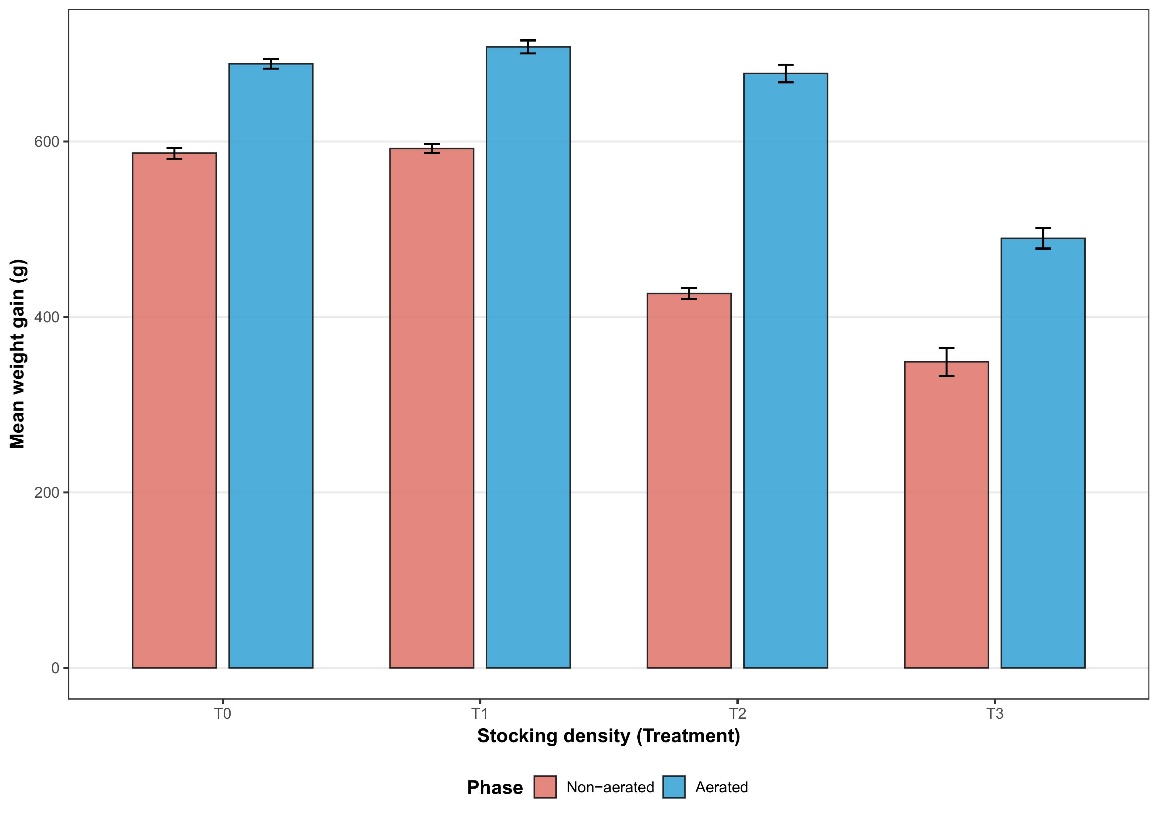
Stocking density exerted a strong negative influence on individual fish growth under non-aerated conditions. Final weight, weight gain, and specific growth rate declined progressively as stocking density increased, particularly beyond 230 fish decimal⁻¹. These findings are consistent with previous reports demonstrating that excessive stocking density intensifies competition for oxygen, feed, and spatial resources, thereby suppressing fish growth and welfare (Seo & Park, 2022; Wu et al., 2018).
The reduction in growth performance observed at higher stocking densities likely reflects a combination of physiological and environmental constraints. Elevated biomass increases total oxygen demand and accelerates the accumulation of metabolic wastes and suspended organic matter, ultimately reducing environmental carrying capacity. Under oxygen-limited conditions, fish redirect metabolic energy away from somatic growth toward maintenance metabolism and stress adaptation, resulting in reduced protein synthesis and slower growth rates (Sundh et al., 2019). Chronic crowding stress may also elevate cortisol secretion, impair feed utilization efficiency, and reduce appetite, collectively contributing to lower growth performance under intensive culture conditions (Watson et al., 2022).
Interestingly, the present study demonstrated that growth suppression became particularly severe at the highest stocking density (300 fish decimal⁻¹) under non-aerated conditions, suggesting that the carrying capacity of the pond ecosystem had been exceeded. Similar density-dependent reductions in tilapia growth have been documented by Mengistu et al. (2020), who reported that excessive stocking intensity significantly reduced growth performance because environmental demand exceeded natural pond oxygen replenishment capacity.
Mechanical aeration significantly improved growth performance across all stocking densities and substantially reduced the negative effects of density-dependent stress. Aerated ponds maintained comparatively stable weight gain and SGR up to Treatment-2 (260 fish decimal⁻¹), whereas equivalent non-aerated treatments exhibited pronounced growth depression. These findings support previous studies demonstrating that aeration enhances oxygen transfer, improves water circulation, and promotes better feed utilization efficiency in semi-intensive aquaculture systems (Xiao et al., 2020; El-Sayed et al., 2023).
The beneficial effects of aeration are closely linked to improved aerobic metabolism. Adequate dissolved oxygen availability enhances oxidative phosphorylation and ATP production, thereby improving nutrient assimilation, metabolic efficiency, and tissue growth (Thorarensen et al., 2010). Under aerated conditions, fish are therefore able to allocate more metabolic energy toward somatic growth rather than stress adaptation and anaerobic maintenance pathways. This likely explains the consistently higher SGR and weight gain observed in aerated treatments throughout the study.
The interaction effect between aeration and stocking density is particularly important from a management perspective. The positive influence of aeration became progressively stronger at moderate and high stocking densities, indicating that oxygen limitation was the principal constraint suppressing production under crowded conditions. Similar findings were reported by Sultana et al. (2017), who observed that supplemental aeration significantly improved tilapia growth performance under intensive culture conditions by stabilizing dissolved oxygen concentrations.
Although aeration substantially improved growth, performance declined slightly at the highest stocking density even under aerated conditions. This suggests that while aeration effectively alleviates oxygen limitation, it cannot entirely eliminate other crowding-related stressors such as behavioral competition, social interactions, and localized waste accumulation. Similar threshold responses have been reported by El-Sayed et al. (2023), indicating that excessively high biomass may eventually exceed the biological carrying capacity of the culture environment despite oxygen supplementation.
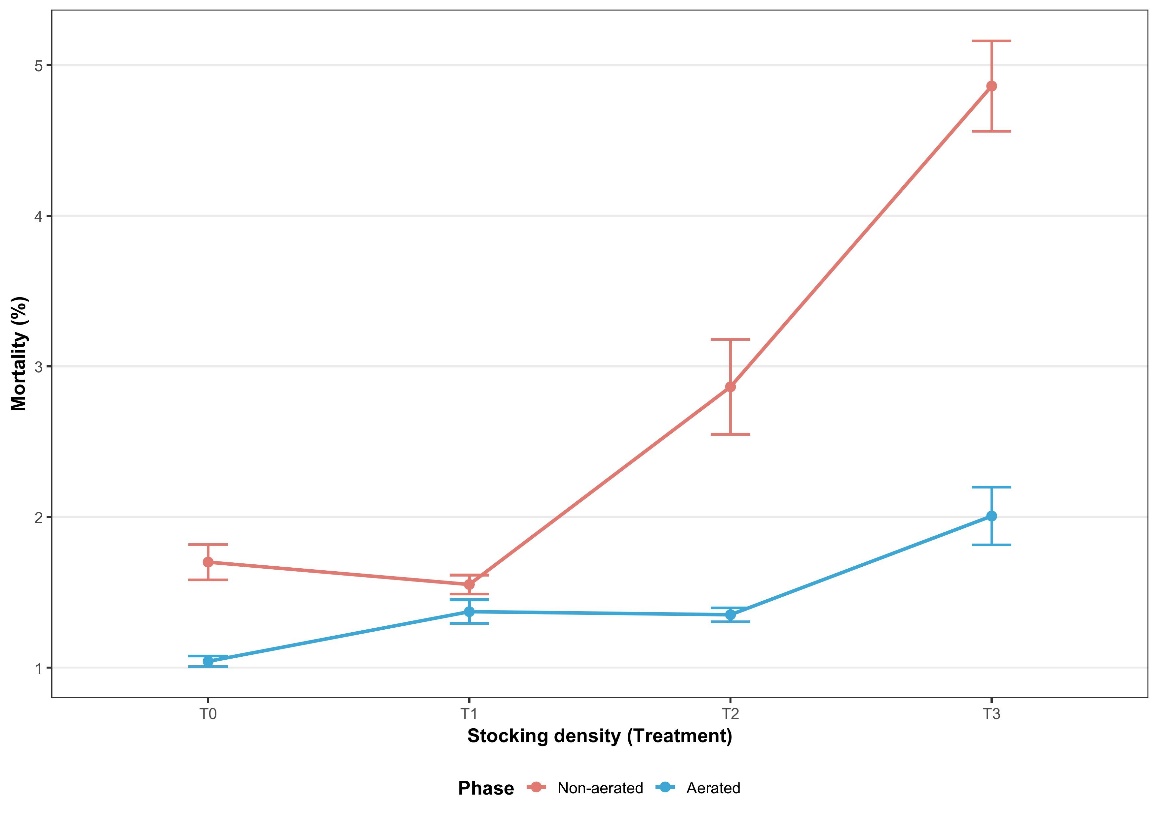
Mortality increased progressively with stocking density under non-aerated conditions, whereas aerated ponds maintained substantially lower mortality rates throughout the experiment. These findings emphasize the critical role of dissolved oxygen in regulating fish survival under semi-intensive pond culture conditions. Hypoxic stress is known to impair respiration, reduce immune competence, increase oxidative stress, and disrupt physiological homeostasis in cultured fish (Wu et al., 2024). Consequently, oxygen-deficient environments often lead to elevated mortality, particularly under intensive stocking conditions.
The highest mortality observed in non-aerated T3 likely resulted from severe oxygen competition associated with excessive biomass accumulation. Similar mortality responses have been documented in intensive tilapia culture systems where increasing stocking density elevated oxygen demand beyond the natural assimilative capacity of the pond ecosystem (M’balaka et al., 2012). Under such conditions, fish experience prolonged physiological stress that compromises immune defense and increases susceptibility to opportunistic disease and metabolic failure.
Aeration reduced mortality by more than half at the highest stocking density, clearly demonstrating its buffering effect against oxygen depletion and environmental instability. Improved oxygen availability likely enhanced respiratory efficiency, reduced physiological stress, and stabilized metabolic processes, thereby improving survival. Comparable observations were reported by Islam et al. (2025), who emphasized that dissolved oxygen management is fundamental for maintaining fish welfare and production stability under intensified aquaculture systems.
The strong interaction effect observed between aeration and stocking density further confirms that oxygen supplementation becomes increasingly important as biomass load increases. This finding highlights the importance of integrating aeration technology into semi-intensive pond management strategies when targeting higher production intensities.
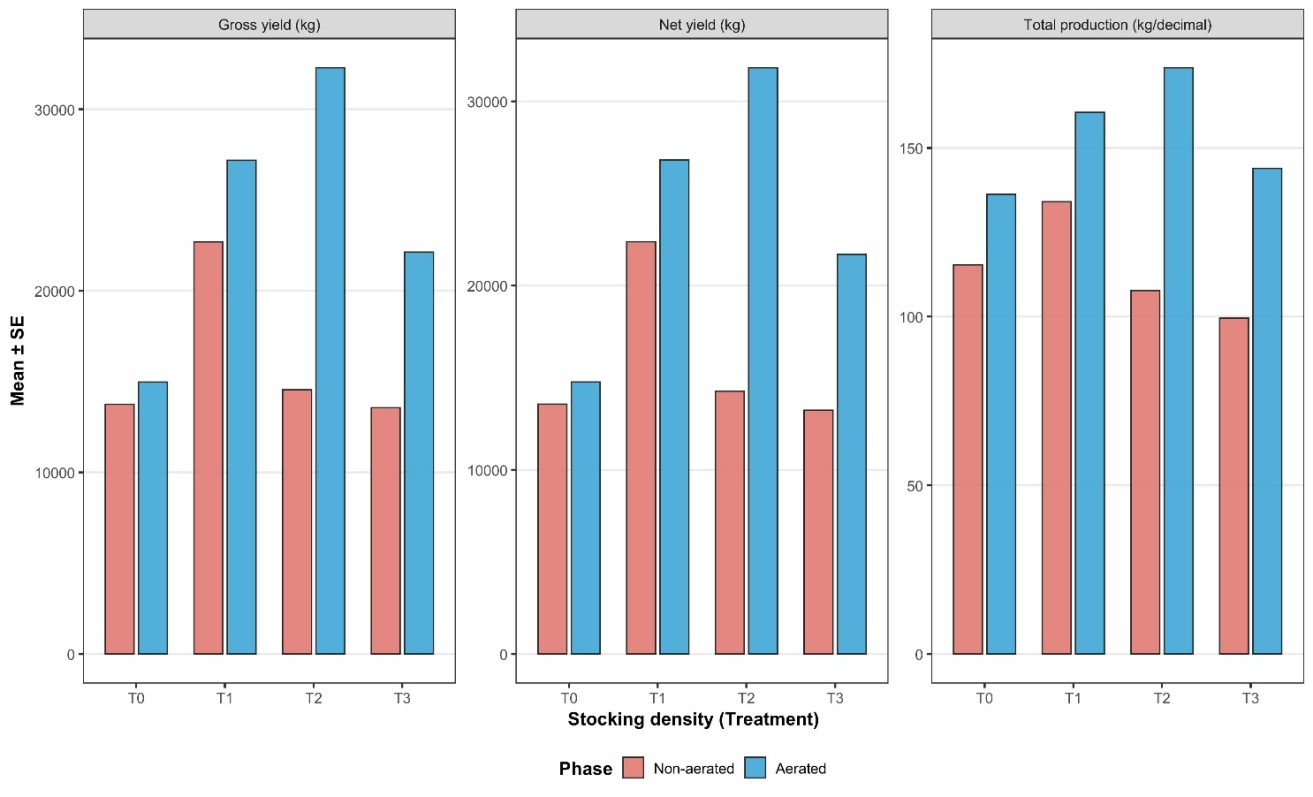
Production performance was strongly influenced by the interaction between stocking density and aeration. Under non-aerated conditions, production increased initially at moderate density but declined sharply at higher densities because reduced individual growth and elevated mortality offset the benefits of increased stocking. In contrast, aerated ponds maintained progressively higher production up to Treatment-2, where maximum biomass yield was achieved.
These findings suggest that aeration substantially enhanced the carrying capacity of the pond ecosystem by alleviating oxygen limitation and supporting greater biomass accumulation. Similar improvements in production performance under aerated conditions have been reported in previous studies involving intensive pond and recirculating aquaculture systems (Mohan et al., 2022; Pryce et al., 2022). However, the magnitude of improvement observed in the present study was particularly notable because the experiment was conducted under commercial pond conditions over a long production cycle, thereby providing practical evidence directly relevant to field-scale aquaculture operations.
The superior production achieved in aerated T2 indicates that the optimal balance between stocking density and environmental carrying capacity occurred at approximately 260 fish decimal⁻¹ when supplemental aeration was provided. This finding is especially important because it demonstrates that aeration not only improves fish performance but also modifies the density-productivity relationship itself. In practical terms, aeration shifted the production threshold upward, enabling farmers to maintain higher stocking densities without proportional reductions in biological efficiency.
Nevertheless, production declined slightly in aerated T3, indicating diminishing returns beyond the optimal density threshold. This pattern supports classical density-dependent production theory, which predicts that biomass output eventually plateaus or declines when ecological carrying capacity becomes saturated (Majhi et al., 2023). Therefore, although aeration substantially improves production potential, excessive crowding may still impose biological limitations that cannot be fully compensated by oxygen supplementation alone.
The economic analysis demonstrated that aeration substantially improved profitability despite increasing operational expenditure associated with aerator operation and energy consumption. Feed cost remained the dominant production expense across all treatments, reflecting the well-established relationship between stocking density, biomass accumulation, and feed demand in semi-intensive aquaculture systems (Suarez-Puerto et al., 2021).
Although aeration increased total production cost, the resulting improvements in growth, survival, and biomass yield generated substantially greater total revenue and net profit. Aerated Treatment-2 produced the highest economic return and benefit-cost ratio, indicating that intermediate-high stocking density combined with oxygen supplementation provided the most economically efficient production strategy.
The stabilization of BCR values at the highest stocking density suggests diminishing marginal economic returns under excessive crowding conditions. While biomass production remained relatively high, additional increases in stocking density did not proportionally improve profitability because operational costs increased more rapidly than marketable yield. Similar observations were reported by Burad-Méndez et al. (2023), who concluded that optimal economic performance in intensive aquaculture systems is generally achieved at moderate-to-high rather than maximum stocking densities.
Importantly, the present study integrated both biological and economic analyses under commercial farming conditions, which remains relatively uncommon in South Asian pond aquaculture research. Many previous studies have evaluated aeration primarily under experimental tank or small-scale pond systems, limiting direct applicability to commercial farming environments. Therefore, the current findings provide valuable field-scale evidence supporting the economic feasibility of aeration-based intensification strategies for tilapia farming in Bangladesh and similar subtropical production regions.
Although the study generated important findings regarding aeration and stocking density interactions, several limitations should be acknowledged. The experiment was conducted within a single farming region and production season, which may limit direct extrapolation to different climatic conditions or farming systems. In addition, pond sizes were not completely uniform because the experiment was performed under commercial farming conditions, although management practices were standardized across treatments. The study also focused primarily on growth, survival, yield, and economic performance without evaluating physiological stress biomarkers, nutrient dynamics, or feed conversion efficiency in detail. Future research should therefore investigate the physiological mechanisms underlying aeration-mediated stress reduction, including endocrine responses, oxidative stress indicators, and metabolic adaptation under high-density culture conditions.
Collectively, the findings demonstrate that dissolved oxygen availability is a major factor regulating biological performance and carrying capacity in semi-intensive Nile tilapia pond culture. Mechanical aeration effectively mitigated density-related stress, improved growth and survival, and enhanced biomass production under elevated stocking densities. However, the decline in performance observed at the highest density indicates that aeration can alleviate, but not completely eliminate, the biological constraints associated with excessive crowding.