Bioinfo Chem

System biology and Infochemistry | Online ISSN 3071-4826
1
Citations
43.4k
Views
34
Articles
Your new experience awaits. Try the new design now and help us make it even better
Switch to the new experience
Figures and Tables
REVIEWS   (Open Access)

Advancing Functional Toxicogenomics: Machine Learning and Deep Learning Approaches for Omics-Based Toxicity Assessment

Hares Bin Syed Md. Rifat 1*

+ Author Affiliations

Bioinfo Chem 8 (1) 1-8 https://doi.org/10.25163/bioinformatics.8110588

Submitted: 24 July 2026 Revised: 15 September 2026  Published: 26 September 2026 


Abstract

Chemical safety science is moving away from slow, animal-intensive observation toward prediction grounded in molecular mechanism, and functional toxicogenomics now sits at the centre of that shift. This review examines how high-throughput multi-omics profiling and artificial intelligence are being combined to forecast chemical toxicity in ways that are faster, more human-relevant, and increasingly acceptable to regulators. We first trace how transcriptomic, proteomic, metabolomic, and epigenomic platforms generate dense molecular readouts across human cell lines, organoids, and microphysiological systems, capturing early Molecular Initiating Events and Key Events rather than only late apical outcomes. We then evaluate the computational layer, benchmarking classical machine-learning classifiers—random forests, support vector machines, and gradient boosting—against deep and graph-based architectures, including multi-task neural networks, graph neural networks, and generative models such as Tox-GAN. Reported performance generally climbs as models move from tabular descriptors toward integrated chemical–omics representations, although gains come with real costs in interpretability and data demand. A third thread concerns mechanistic anchoring: how transcriptomic Benchmark Doses, Points of Departure, quantitative in vitro–to–in vivo extrapolation, and physiologically based kinetic modelling convert molecular signals into human-equivalent exposure limits for Next Generation Risk Assessment. Finally, we consider the bottlenecks that still slow adoption—technical noise, batch effects, the “black-box” problem, and fragmented data—and the emerging responses, from Explainable AI and biological knowledge graphs to FAIR, auditable infrastructures such as OpenTox 2.0. Taken together, the evidence suggests a field maturing into a reproducible, mechanism-anchored, and genuinely animal-free discipline, though data standardisation and model transparency remain the decisive hurdles to full regulatory adoption.

Keywords: functional toxicogenomics; multi-omics integration; machine learning; deep learning; adverse outcome pathway; Next Generation Risk Assessment; new approach methodologies; explainable AI

1.  Introduction

Toxicology is changing significantly. In the past, scientists mainly studied how animals responded to exposure to harmful substances to identify potential risks. Today, the focus is shifting towards understanding how these substances affect the body, measuring their effects, and predicting potential risks more accurately (Kim & Choi, 2025). The older approach was never without value; animal bioassays and apical phenotypic endpoints served as regulatory benchmarks for decades (Capone et al., 2023). Yet their limitations have become difficult to ignore. They are labour-intensive, costly, and low-throughput; they are ethically constrained under the 3Rs principle of Replace, Reduce, and Refine; and, because of interspecies physiological differences, they frequently fail to capture the biology that actually matters for humans (Pavan & Kumar, 2025).

The scale of the problem has grown faster than the old methods can cope with. Tens of thousands of industrial chemicals, pharmaceuticals, agricultural pesticides, novel food ingredients, and complex environmental mixtures now require evaluation, and animal testing simply cannot keep pace (Alnasser, 2025; Short et al., 2026). In response, scientific and regulatory communities have increasingly embraced New Approach Methodologies (NAMs) built around human-relevant cell lines, organoids, microphysiological systems, and high-throughput multi-omics profiling (Hussein, 2026; Ukaegbu et al., 2026).

At the centre of this movement is functional toxicogenomics—an interdisciplinary field that fuses classical toxicology with high-throughput genomic and molecular profiling to measure how gene expression, protein abundance, metabolic pathways, and epigenetic marks change after exposure (Capone et al., 2023; Tanveer et al., 2018). By reading thousands of molecular features at once, multi-omics platforms spanning transcriptomics, proteomics, metabolomics, and epigenomics provide global snapshots of early cellular stress, toxicity pathways, and modes of action (Serra et al., 2020; Xu & Yang, 2026). This allows toxicologists to move past the blunt binary of “toxic versus non-toxic” toward mapping Molecular Initiating Events (MIEs) and Key Events (KEs) within Adverse Outcome Pathway (AOP) networks (Vasant et al., 2024). Quantitative toxicogenomic endpoints go further still, supporting the derivation of transcriptomic Points of Departure (POD) and Benchmark Doses (BMD) that, when linked to quantitative in vitro–to–in vivo extrapolation (qIVIVE) and physiologically based pharmacokinetic (PBPK) modelling, can help set protective human exposure limits (ENVESOME Consortium, 2024; Pavan & Kumar, 2025).

Translating this abundance of molecular data into dependable predictive models, however, is far from trivial. Multi-omics datasets are high-dimensional, sparse, noisy, and plagued by technical heterogeneity and batch effects across platforms and laboratories (Kim & Choi, 2025; Serra et al., 2020). They embody the familiar “curse of dimensionality”—tens of thousands of transcripts or thousands of metabolites measured against a far smaller number of tested compounds (Xu & Yang, 2026). It is precisely here that artificial intelligence (AI), and specifically machine learning (ML) and deep learning (DL), have become indispensable for feature selection, biomarker discovery, and organ-level hazard forecasting (Singh et al., 2026).

Machine-learning algorithms are well suited to finding non-linear structure in complex biological feature spaces. Classical supervised models—random forests (RF), support vector machines (SVM), eXtreme gradient boosting (XGBoost), and partial least squares discriminant analysis (PLS-DA)—are widely used for feature selection and toxicity classification (Alnasser, 2025; Serra et al., 2020), and they have produced compact biomarker panels that predict genotoxicity, carcinogenicity, hepatotoxicity, and endocrine disruption (Meier et al., 2024; Singh et al., 2026). More recently, deep architectures—multi-layer perceptrons, deep neural networks (DNN), convolutional neural networks, and graph neural networks (GNN)—have reached high accuracy by learning hierarchical representations directly from raw multi-omics profiles and chemical SMILES strings (Kim & Choi, 2025; Pavan & Kumar, 2025). Generative frameworks such as Tox-GAN and variational autoencoders now go so far as to simulate chemical-induced expression profiles across doses and durations, opening the door to digital twins and virtual cell models that further reduce reliance on animals (Chen et al., 2022; Ukaegbu et al., 2026).

None of this comes free of difficulty. Deploying ML and DL in functional toxicogenomics raises hard methodological and regulatory questions around interpretability, reproducibility, applicability domains, and data standardisation (Abdelwahab & Hardy, 2026; Meier et al., 2024). Complex deep models often behave as “black boxes,” leaving it unclear whether a prediction reflects real biology or an artefact of the data (Kim & Choi, 2025; Short et al., 2026). To close this gap, Explainable AI (XAI) techniques—such as SHapley Additive exPlanations (SHAP) and related feature-attribution methods—are increasingly paired with biological knowledge graphs, AOP frameworks, and open-science repositories such as OpenTox 2.0, TOXRIC, and Open TG-GATEs to build transparent, FAIR (Findable, Accessible, Interoperable, Reusable), and regulatory-ready systems (Abdelwahab & Hardy, 2026; Ren et al., 2025; L. Wu et al., 2023).

Against this backdrop, the present review offers a systematic evaluation of functional toxicogenomics, multi-omics integration, and artificial intelligence in predictive toxicology. Four objectives organise the work. First, to synthesise multi-omics data generation and functional toxicogenomics platforms, assessing how transcriptomic, proteomic, metabolomic, and epigenomic technologies detect early molecular perturbations across human cell lines, organoids, microphysiological systems, and ecotoxicological sentinel organisms (Hussein, 2026; Short et al., 2026). Second, to critically evaluate ML and DL architectures, benchmarking classical supervised models against modern deep, graph-based, and generative frameworks across endpoints such as genotoxicity, carcinogenicity, hepatotoxicity, and cardiotoxicity (Alnasser, 2025; Kim & Choi, 2025; Singh et al., 2026). Third, to analyse how ML/DL predictions are integrated into mechanistic regulatory frameworks—AOPs, qIVIVE, BMD modelling, and virtual cell platforms—to support Next Generation Risk Assessment (NGRA), POD derivation, and Safe and Sustainable by Design (SSbD) strategies (Abdelwahab & Hardy, 2026; Pavan & Kumar, 2025; Ukaegbu et al., 2026). Fourth, to identify the principal methodological bottlenecks and outline future directions, including XAI, biological knowledge graph-driven networks, standardised FAIR platforms, and automated Integrated Approaches to Testing and Assessment (IATA) workflows (Abdelwahab & Hardy, 2026; Ren et al., 2025; Short et al., 2026).

2.  Multi-Omics Integration and Machine Learning Frameworks in Functional Toxicogenomics

2.1. Multi-omics data generation platforms and high-throughput screening paradigms

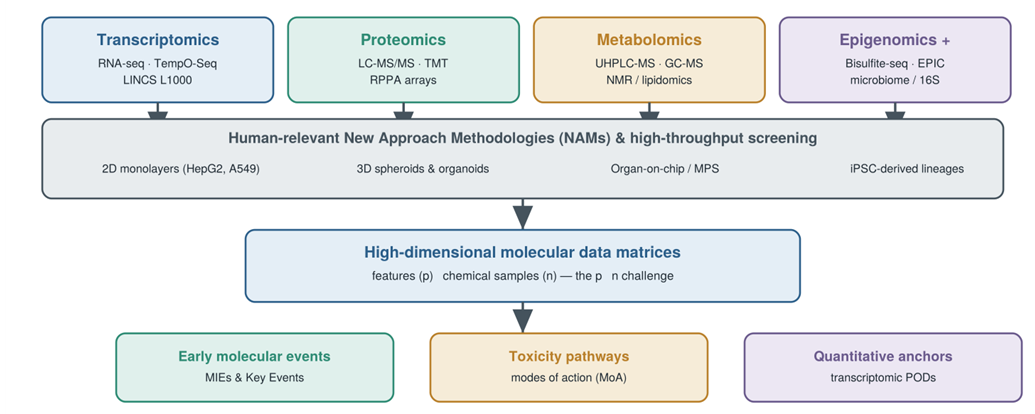
Toxicology has entered a new phase, one defined less by the observation of whole-animal outcomes and more by human-relevant, mechanistically grounded NAMs (Capone et al., 2023). Functional toxicogenomics is central to that transition, merging classical toxicological principles with high-throughput molecular profiling to capture global cellular responses across several biological layers at once (Tanveer et al., 2018). Instead of resting on apical endpoints alone, multi-omics platforms—transcriptomics, proteomics, metabolomics, epigenomics, and microbiomics—yield holistic molecular fingerprints of xenobiotic stress (Hussein, 2026; Xu & Yang, 2026). The overall logic of this workflow, from molecular layer to high-dimensional data matrix, is summarised in (Figure 1), and the comparative characteristics of each modality are detailed in (Table 1).

Transcriptomics remains the most widely adopted and standardised modality, largely because its analytical pipelines are mature and its pathway annotations well curated (Serra et al., 2020). Where legacy studies depended on DNA microarrays, contemporary functional toxicogenomics relies mostly on high-throughput RNA sequencing (RNA-seq) and targeted platforms such as TempO-Seq, RASL-seq, and the LINCS L1000 assay (Ukaegbu et al., 2026). These technologies cut profiling costs sharply while widening the dynamic range over which genome-wide transcriptional changes can be measured across doses and time points (Meier et al., 2024).

Phenotypic translation, however, is driven by the proteome and the metabolome, not transcripts alone. Proteomics uses mass spectrometry (MS) platforms and protein microarrays to quantify altered protein abundance, post-translational modifications, and protein–ligand interactions, exposing functional enzymatic shifts that transcriptomics cannot resolve on its own (Aslam et al., 2017). Metabolomics and lipidomics, in parallel, capture small-molecule fluxes that act as direct functional readouts of physiological state and cellular stress (Ramirez-Hincapie et al., 2023). Non-coding epigenetic layers—DNA methylation and histone modifications—add mechanistic insight into persistent, delayed, or transgenerational toxicities, and when microbiomics is included, evaluating xenobiotic biotransformation by the gut microbiome, the combined framework begins to resemble an integrated exposure–response continuum (Yang et al., 2024).

To raise human relevance, high-throughput screening (HTS) increasingly uses advanced cell models: human induced pluripotent stem cell (iPSC)-derived lineages, three-dimensional spheroids, hepatic organoids, and microphysiological systems or organ-on-chip devices (Pavan & Kumar, 2025; Ukaegbu et al., 2026). By reconstructing tissue architecture, cell–cell contacts, and metabolic competence, these systems generate more physiologically faithful bioactivity datasets for downstream computation (Ewart et al., 2018). Their respective strengths, throughput, and limitations are compared in (Table 3).

2.2.  Computational paradigms: machine learning and deep learning architectures

Table 1· multi-omics technologies in functional toxicogenomics: technical features, biological outputs, applications, and limitations. The table maps the principal molecular layers used in functional toxicogenomics against their core analytical platforms, the biological signals each one resolves, and their toxicological value. Transcriptomics provides the most mature and standardised readout for early molecular events, whereas proteomic and metabolomic layers sit closer to the functional phenotype and epigenomic and single-cell approaches add persistence and cellular resolution. The final columns summarise the dominant technical limitations of each modality and the representative studies cited in the text, underscoring why integrated multi-omics designs outperform any single layer in isolation.

Omics modality

Core technologies & platforms

Biological readouts & endpoints

Toxicological utility & mechanistic value

Major technical & analytical limitations

Representative references

Genomics

Whole-genome sequencing (WGS); targeted amplicon NGS (Illumina, Oxford Nanopore, PacBio)

SNPs, copy-number variations, DNA adducts, genomic-instability signatures

Baseline genetic susceptibility, pharmacogenomic variability, inherited predisposition to toxic response

Static readout; cannot capture dynamic stress responses, post-transcriptional change, or physiological adaptation

Hussein (2026); Singh et al. (2026)

Transcriptomics

High-throughput RNA-seq; targeted TempO-Seq, RASL-seq; LINCS L1000; microarrays

Genome-wide mRNA expression, differential regulation, splicing isoforms

Most mature layer for mapping early MIEs, modes of action, and transcriptomic benchmark doses (t-BMD)

Weak direct correlation with protein abundance; sensitive to noise, exposure timing, and batch effects

Serra et al. (2020); Meier et al. (2024); Pavan & Kumar (2025)

Proteomics

LC-MS/MS, TMT/iTRAQ; reverse-phase protein arrays (RPPA); MaxQuant pipelines

Protein abundance, post-translational modifications, protein–protein interactions

Captures functional effectors of toxicity, enzymatic shifts, and direct targets of reactive metabolites

Higher cost, lower throughput, incomplete database coverage, challenges with low-abundance proteins

Aslam et al. (2017); Proteomes (2024)

Metabolomics & lipidomics

UHPLC-MS, GC-MS, NMR spectroscopy

Endogenous metabolite and lipid profiles, metabolic fluxes, energy-state indicators

Direct functional readouts of metabolic status, mitochondrial dysfunction, oxidative stress, steatosis

Unknown-metabolite identification; lack of standardised spectral libraries; dynamic-range limits

Ramirez-Hincapie et al. (2023); Xu & Yang (2026)

Epigenomics

MeDIP-seq, bisulfite sequencing, EPIC 850K BeadChip, EV-miRNA profiling

DNA methylation (5mC/5hmC), histone modifications, non-coding RNA regulation

Elucidates persistent, non-mutagenic, transgenerational, and delayed toxicities

Complex multi-tissue mapping; high cell-type specificity; difficult causal linkage to apical outcomes

ENVESOME Consortium (2024)

Single-cell & spatial omics

scRNA-seq; spatial transcriptomics (10x Visium, MERFISH)

Cell-type-specific expression, cellular heterogeneity, spatial cell–cell interactions

Dissects cell-type-specific responses in heterogeneous tissues; localises injury loci

High cost; substantial sparsity (dropout); complex normalisation pipelines

Hussein (2026); Xu & Yang (2026)

Table 2 · Comparative evaluation of machine-learning and deep-learning architectures for toxicity prediction. The table benchmarks the main algorithm classes used in predictive toxicology, moving from classical supervised learners to deep, graph-based, and generative models. For each it states the computational principle, the chemical and omics inputs it consumes, the toxicity endpoints it has been applied to, and the reported performance together with an interpretability note. Read top to bottom, it shows accuracy tending to rise with model complexity—from roughly 80–83% for RF/SVM to a mean AUC-ROC near 0.95 for hybrid networks—while transparency correspondingly declines, motivating the explainable-AI strategies discussed in the text. Performance values are endpoint- and dataset-dependent and should be read as indicative.

ML/DL algorithm class

Underlying computational principle

Primary input features

Targeted toxicity endpoints

Reported performance & interpretability

Representative references

Random Forest (RF)

Ensemble of bagged decision trees with random feature selection

Molecular fingerprints (MACCS, ECFP4/Morgan), physicochemical descriptors, transcriptomic panels

Acute oral toxicity (LD50), Ames mutagenicity, genotoxicity, cardiotoxicity

Accuracy 80.5–83.4% for genotoxicity; robust to overfitting; intrinsic Gini feature ranking

Hemmerich & Ecker (2020); Alnasser (2025)

Support Vector Machine (SVM)

Maximum-margin hyperplanes in high-dimensional space via kernel functions

Structural descriptors (Dragon, PaDEL), expression signatures, target-binding profiles

Genotoxicity, mutagenicity, skin irritation/sensitisation, acute toxicity

>80% accuracy; effective in high-dimensional, small-sample (p ≫ n) settings; clear margin boundary

Serra et al. (2020); Alnasser (2025)

eXtreme Gradient Boosting (XGBoost)

Gradient-boosted trees optimising a regularised loss

Hybrid 2D/3D fingerprints, TOXRIC features, omics profiles

Carcinogenicity, hepatotoxicity, ecotoxicity endpoints

AUC-ROC > 0.75 on external tests; fast; handles missing values; strong on tabular data

L. Wu et al. (2023); Singh et al. (2026)

Deep / multi-task neural networks (DNN/MTDNN)

Multi-layer networks with backpropagation and joint multi-task learning

Whole-genome transcriptomic profiles, SMILES embeddings, multi-assay ToxCast profiles

Drug-induced liver injury (fibrosis, necrosis), clinical toxicity

SMILES embeddings improve AUC-ROC by 10–15% over single-task; abstract hierarchical features

Wang et al. (2019); Singh et al. (2026)

Graph neural networks (GNN/MOGONET)

Deep learning on non-Euclidean molecular and biological graphs

Molecular graphs (atoms/bonds), multi-omics similarity networks

QSAR toxicity, DILI (GeoDILI), cross-omics interactions

Superior classification over Euclidean vector ML; captures geometry and pathway structure

Wang et al. (2021); W. Wu et al. (2023)

Generative AI (Tox-GAN / VAE)

Generative adversarial networks and variational autoencoders modelling data distributions

Chemical SMILES, molecular descriptors, concentration–time parameters

De novo transcriptomic-profile generation; dose–time response simulation

>87% concordance with real TG-GATEs rat-liver data; enables virtual in silico toxicogenomics

Chen et al. (2022); Kim & Choi (2025)


Figure 1· Multi-omics data generation and the human-relevant testing workflow. The figure traces the functional-toxicogenomics workflow from molecular profiling to computable data. Four molecular layers—transcriptomics, proteomics, metabolomics, and epigenomics/microbiome—are generated within human-relevant New Approach Methodologies, including 2D monolayers, 3D organoids, organ-on-chip systems, and iPSC-derived lineages. These feed high-dimensional data matrices in which molecular features greatly outnumber tested chemicals (the p ≫ n challenge), which in turn yield early molecular events, toxicity pathways, and quantitative anchors. The schematic emphasises that transcriptomics anchors the pipeline while the other layers add functional and regulatory resolution.

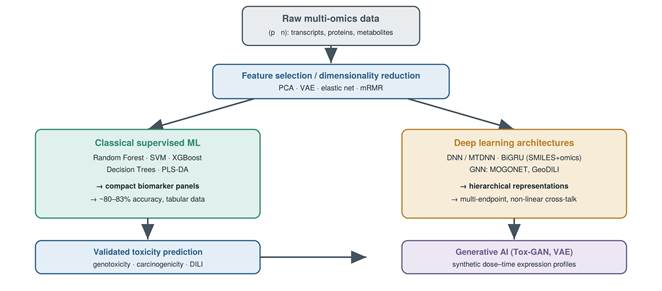
Figure 2· Machine-learning and deep-learning pipeline for toxicity prediction. The figure depicts the computational pipeline that converts raw high-dimensional omics into validated toxicity predictions. After feature selection and dimensionality reduction (PCA, VAE, elastic net, mRMR), the workflow branches into classical supervised learning (random forest, SVM, XGBoost) yielding compact biomarker panels, and deep-learning architectures (DNN/MTDNN, BiGRU, graph neural networks) that learn hierarchical, multi-endpoint representations. Generative models such as Tox-GAN synthesise dose–time expression profiles. The diagram conveys the review's central observation that deep and graph-based models progressively outperform classical classifiers as omics dimensionality and chemical complexity increase.


Multi-omics platforms produce high-content readouts, but the resulting matrices are high-dimensional, sparse, and awkward—a textbook p ≫ n problem in which biological features vastly outnumber the chemicals tested (Xu & Yang, 2026). Extracting predictive signal from such data is what has made AI, ML, and DL load-bearing pillars of modern predictive toxicology (Singh et al., 2026). The general flow from raw data through feature selection to classical and deep models is depicted in (Figure 2), and a structured comparison of the major algorithm classes appears in (Table 2).

Supervised ML has been applied broadly to classify hazard potential and surface predictive biomarker signatures. Classical algorithms—random forests (RF), support vector machines (SVM), XGBoost, decision trees, and PLS-DA—handle structured toxicological data well and are adept at isolating critical feature subsets (Alnasser, 2025; Kim & Choi, 2025). RF and SVM classifiers trained on transcriptomic and proteomic signatures have exceeded 80% accuracy in predicting acute genotoxicity, carcinogenicity, and organ-specific toxicities such as hepatotoxicity (Su et al., 2018). Feature-selection methods, including elastic net regression and minimum redundancy maximum relevance (mRMR), are frequently coupled with these models to reduce dimensionality, limit overfitting, and distil compact biomarker panels (Fortino et al., 2014).

In recent years deep learning has tended to outperform classical ML by learning hierarchical representations directly from omics profiles and chemical structures (Kim & Choi, 2025). Deep neural networks (DNN) and multi-task deep neural networks (MTDNN) allow joint modelling of several toxicity endpoints at once, capturing non-linear interactions across biological targets (Wang et al., 2019). By fusing SMILES embeddings or Morgan fingerprints with transcriptomic signatures, hybrid networks such as bidirectional gated recurrent units (BiGRU) have reached strong performance on benchmarks like Tox21 and Open TG-GATEs (Alnasser, 2025; Igarashi et al., 2015). Graph neural networks (GNN) extend this further by modelling relational biological structure: architectures such as MOGONET build heterogeneous networks connecting molecular features, pathways, and phenotypes, enabling cross-talk analysis across omics layers (Wang et al., 2021). And generative frameworks—Tox-GAN chief among them—can synthesise realistic chemical-induced transcriptomic profiles directly from molecular structures, supporting in silico screening without immediate animal or cell testing (Chen et al., 2022).

2.3.  Mechanistic frameworks: adverse outcome pathways, benchmark dose modelling, and quantitative extrapolation

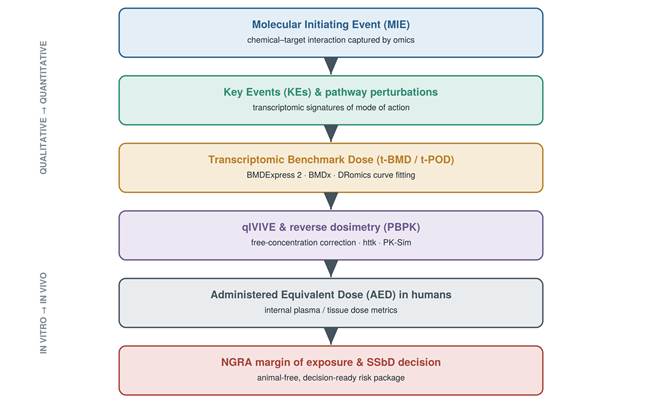
Moving predictive toxicology from empirical association to mechanistic causality requires that omics readouts and ML predictions be embedded within structured regulatory frameworks (Abdelwahab & Hardy, 2026). The AOP framework supplies that logical scaffold, tracing an MIE through a cascade of measurable KEs across cellular, organ, and organismal levels to an Adverse Outcome (Ankley et al., 2010; Vasant et al., 2024). Toxicogenomics is what populates these networks, defining the early perturbations that correspond to MIEs and KEs and establishing transcriptomic signatures of mode of action (Vinken, 2024). The full chain from molecular event to human-equivalent dose is laid out in (Figure 3), and the component frameworks are catalogued in (Table 4).

A core requirement for regulatory uptake is the shift from qualitative hazard classification to quantitative dose–response modelling (Pavan & Kumar, 2025). Benchmark Dose (BMD) analysis applied to toxicogenomic data yields transcriptomic Points of Departure (POD)—the concentration producing a pre-specified perturbation, such as a 5% or 10% change in pathway expression (Serra et al., 2020). Dedicated tools, including BMDExpress, BMDx, and the DRomics R package, fit expression matrices across dose ranges to models such as Hill, exponential, and polynomial functions to derive robust benchmark dose confidence intervals (Phillips et al., 2019). Reassuringly, these gene- and pathway-level PODs correlate closely with traditional apical NOAEL and LOAEL values, offering a rapid, animal-free benchmark for safety assessment (Farmahin et al., 2017).

Relating in vitro PODs to real-world exposures then depends on qIVIVE coupled with PBPK (or PBK) modelling (Deepika & Kumar, 2023). Free-concentration corrections account for assay protein binding and biokinetics, while reverse dosimetry translates bioactive in vitro concentrations into human-equivalent internal dose metrics (Moreau et al., 2024). This integrative chain underpins NGRA and IATA, allowing regulators to evaluate margins of exposure under realistic human scenarios (Dent et al., 2021; Li et al., 2021).

Table 3 · New approach methodologies (NAMs) and high-throughput screening (HTS) cell platforms. The table arranges human-relevant test systems along the central trade-off between experimental throughput and physiological fidelity. Simple 2D monolayers maximise automation and cost-efficiency but lose metabolic competence, whereas 3D organoids, microphysiological systems, iPSC-derived lineages, and bioprinted tissues progressively restore tissue architecture, cell–cell signalling, and dynamic flow at the expense of scalability. Each row pairs the platform's applications with its principal limitations and the standardisation strategies proposed to overcome them, clarifying why no single system is yet sufficient and why tiered, fit-for-purpose testing batteries are favoured in modern risk assessment.

NAM platform / cell model

Structural & biological complexity

HTS & automation compatibility

Primary applications in toxicity screening

Key limitations & mitigation

Representative references

2D cell monolayers (HepG2, A549, MCF-7)

Simple static 2D architecture; single cell type; no ECM or 3D microenvironment

Fully automated; 384/1536-well liquid handling

High-throughput cytotoxicity screening, baseline expression profiling, hazard prioritisation

Rapid loss of metabolic enzymes (CYP450); non-physiological morphology; mitigated by metabolically competent lines

Hinterberger & Stelmach (2026); Pavan & Kumar (2025)

3D spheroids & organoids

Intermediate-to-high complexity; self-organised multicellular architecture with ECM and gradients

Moderate-to-high via 3D bioprinting and high-content imaging

Metabolism-mediated hepatotoxicity, neurodevelopmental toxicity, organ-specific lesions (steatosis, fibrosis)

Batch variability, no vascularisation, core necrosis; mitigated by standardised differentiation and biofabrication

Wan et al. (2024); Nguyen & Yoo (2025)

Microphysiological systems (MPS / organ-on-chip)

High physiological relevance; microfluidic channels with flow, strain, multi-tissue interfaces

Low-to-moderate; increasingly multi-well microfluidic plates

Systemic toxicokinetics, barrier permeation (BBB, lung, kidney), multi-organ cross-talk

High cost; PDMS chemical absorption; mitigated by low-absorption polymers and automation

Samantasinghar et al. (2025)

iPSC-derived cell lineages

Human somatic cells reprogrammed and differentiated into specialised lineages

High compatibility with automated functional assays (electrophysiology, FLIPR, imaging)

Human-relevant cardiotoxicity (CiPA), neurotoxicity, electrophysiological screening

Immature phenotype, incomplete maturation, line-to-line variability; mitigated by maturation and co-culture

ENVESOME Consortium (2024); Jackman et al. (2015); Zushin et al. (2023)

Tissue-engineered & bioprinted tissue

High spatial precision; 3D-printed constructs with cells, bio-inks, vascular channels

Low-to-moderate; medium-throughput secondary screening

Skin/eye irritation, musculoskeletal toxicity, scaffold integration, regenerative response

Complex bio-ink formulation; shear stress; vascularisation limits; mitigated by shear-thinning inks

Cui et al. (2018); Mirshafiei et al. (2024)

Table 4 · Mechanistic integration frameworks: adverse outcome pathways, transcriptomic BMD/POD, and quantitative extrapolation (qIVIVE/PBPK). The table traces the components that convert molecular perturbations into human-relevant, decision-ready risk metrics. The AOP framework supplies causal structure; transcriptomic benchmark-dose modelling fixes a quantitative Point of Departure; qIVIVE and PBPK modelling then extrapolate bioactive in vitro concentrations to human-equivalent internal and external doses that feed Next Generation Risk Assessment. For each step the table lists the operational software, its role in the assessment chain, and the outstanding methodological and regulatory challenges, illustrating how the field moves from qualitative hazard to quantitative, animal-free exposure limits.

Framework component

Core concept & biological definition

Operational tools & packages

Role in quantitative risk assessment

Key methodological & regulatory challenges

Representative references

Adverse Outcome Pathway (AOP)

Construct linking a Molecular Initiating Event through Key Events and Key Event Relationships to an Adverse Outcome

AOP-Wiki, AOPGraphExplorer 2.0, AOPxGeneNet

Provides causal mechanistic anchoring, converting isolated molecular signals into weight-of-evidence decisions

Incomplete coverage of chronic toxicities; network cross-talk and mixtures hard to formalise

Ankley et al. (2010); Abdelwahab & Hardy (2026)

Transcriptomic Benchmark Dose (t-BMD / POD)

Exposure producing a pre-specified change in gene or pathway expression (e.g., 5% or 10% response)

BMDExpress 2, BMDx, DRomics, BMDS, PROAST

Establishes molecular Points of Departure that align with apical NOAEL/LOAEL without animal bioassays

Variability across models; no universal consensus on optimal t-POD selection logic

Farmahin et al. (2017); Serra et al. (2020); Phillips et al. (2019)

Quantitative in vitro-to-in vivo extrapolation (qIVIVE)

Algorithm converting bioactive in vitro concentrations (AC50 / t-POD) into equivalent human internal doses

R httk package, QIVIVE reverse-dosimetry modules

Bridges in vitro bioactivity thresholds to external human exposure, incorporating protein binding and biokinetics

In vitro chemical loss (volatilisation, plastic binding); non-specific lipid binding; transport kinetics

Moreau et al. (2024); Li et al. (2021)

Physiologically based pharmacokinetic (PBPK) modelling

Multicompartment model simulating absorption, distribution, metabolism, and excretion (ADME)

INTEGRA, PBPKO, GastroPlus, PK-Sim

Translates internal exposure estimates into external environmental or dietary limit values (RfD, TDI)

High parameterisation uncertainty; inter-individual variability; complex compartment validation

Capone et al. (2023); Deepika & Kumar (2023)

Next Generation Risk Assessment (NGRA) & SSbD

Animal-free, exposure-driven risk-assessment strategy embedded in Safe and Sustainable by Design

ASPA algorithm, OpenTox 2.0 framework, SPIDO NAMs roadmap

Delivers decision-ready, audit-compliant evidence packages for hazard identification and early design

Diverse international acceptance standards; requires formal governance and transparent uncertainty

Dent et al. (2021); Kim & Choi (2025); Abdelwahab & Hardy (2026)

2.4. Analytical bottlenecks, explainable AI, biological knowledge graphs, and regulatory translation

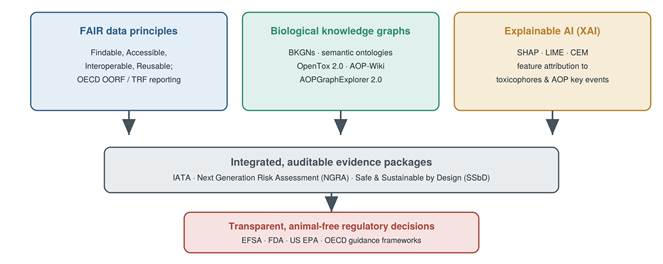
For all its progress, several bottlenecks still impede the move from omics-plus-AI models into regulatory practice (Kim & Choi, 2025). The most immediate are technical: noise, platform heterogeneity, data sparsity, and batch effects across studies (Ukaegbu et al., 2026). Cross-study integration therefore demands robust normalisation and batch-correction—ComBat, COCONUT, rank-invariance transformations—to harmonise matrices from microarrays, RNA-seq, and targeted platforms without erasing genuine biological signal (Johnson et al., 2007; Tang et al., 2021). The three pillars that convert this cleaned evidence into regulatory-ready decisions are summarised in (Figure 4), and the specific hurdles and their emerging solutions are tabulated in (Table 6).

A larger obstacle to the regulatory acceptance of deep models is the “black-box” problem—the lack of transparency about how an algorithm reaches a prediction (Alnasser, 2025). XAI has become the standard response (Santorsola & Lescai, 2023). Post-hoc methods such as SHAP and Local Interpretable Model-agnostic Explanations (LIME) compute feature-attribution scores that quantify which molecular descriptors or pathways drive a given output (Kim & Choi, 2025), while techniques like the Contrastive Explanations Method help localise toxicophore substructures and critical gene markers, aligning predictions with established toxicological reasoning (Alnasser, 2025).

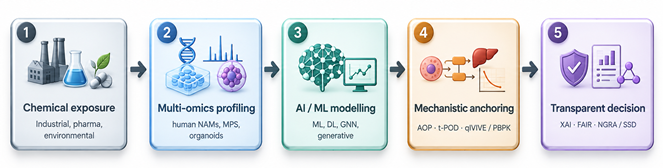
In parallel, biological knowledge graph-driven networks (BKGNs) and semantic ontologies are reshaping data integration by placing multi-omics perturbations within curated biological context (Ren et al., 2025). Knowledge graphs link chemical identities, molecular targets, pathways, and AOP key events through standardised ontologies, supporting cross-domain queries and automated reasoning (Pavan & Kumar, 2025). Frameworks such as OpenTox 2.0 operationalise these ideas by building open, FAIR, and auditable infrastructures (Abdelwahab & Hardy, 2026; Hardy et al., 2010). Meanwhile, agencies including EFSA, the FDA, the US EPA, and the OECD are actively drafting guidance for AI and NAM integration (Kim & Choi, 2025), and standardisation efforts such as the OECD Transcriptomics and Omics Reporting Frameworks set quality-assurance criteria for reporting omics experiments and model validity (Harrill et al., 2021; OECD, 2023). The toxicological databases and modelling platforms that feed all of this are compiled in (Table 5). Embedding XAI, FAIR practice, and transparent decision logic into unified pipelines positions functional toxicogenomics  (Figure 6) to deliver robust, animal-free, mechanistically defensible assessments consistent with SSbD goals (Abdelwahab & Hardy, 2026).

3.  Methods

This article is a structured narrative review of functional toxicogenomics at the intersection of multi-omics profiling and artificial intelligence. Because the aim was conceptual synthesis across a fast-moving and methodologically heterogeneous literature rather than a single quantitative estimate, a narrative design was chosen, but the search, selection, and extraction steps were documented in a reproducible, PRISMA-informed manner so that the evidence base can be reconstructed and updated by other investigators (Harrill et al., 2021).

3.1.  Information sources and search strategy

Four bibliographic databases were searched—PubMed/MEDLINE, Scopus, Web of Science Core Collection, and Google Scholar—complemented by targeted hand-searching of reference lists from key reviews and of preprint servers (bioRxiv) for emerging agentic-AI and virtual-cell work. The search covered publications from January 2010, the year the AOP framework was formalised (Ankley et al., 2010), through mid-2026, with no language restriction applied at the screening stage. Searches combined controlled vocabulary (MeSH terms where available) with free-text keywords across three conceptual blocks joined by the Boolean operator AND, with synonyms within each block joined by OR. Block 1 (domain) included “toxicogenomics,” “multi-omics,” “transcriptomics,” “proteomics,” “metabolomics,” and “epigenomics.” Block 2 (computational methods) included “machine learning,” “deep learning,” “neural network,” “graph neural network,” “generative adversarial network,” and “explainable AI.” Block 3 (application) included “toxicity prediction,” “risk assessment,” “adverse outcome pathway,” “new approach methodologies,” and “benchmark dose.” A representative PubMed query was: (toxicogenomic* OR “multi-omics” OR transcriptomic*) AND (“machine learning” OR “deep learning” OR “neural network”) AND (toxicity OR “risk assessment” OR “adverse outcome pathway”). The final searches were executed in the third quarter of 2026.

3.2.  Eligibility criteria

Table 5 · High-throughput toxicological databases, datasets, and computational modelling software. The table inventories the public data and software infrastructure that underpins AI-driven toxicology. It spans large benchmark compound repositories (TOXRIC, ToxCast/Tox21, CompTox), the gold-standard transcriptomic reference Open TG-GATEs, FAIR orchestration frameworks (OpenTox 2.0), benchmark-dose engines (BMDExpress 2/BMDx), and regulatory QSAR platforms (OECD QSAR Toolbox/VEGA). For each resource it records the managing body, the scale and type of data held, the principal analytical purpose, and the access model. Together these open, standardised resources enable reproducible model training and cross-study comparison, which the review identifies as a prerequisite for regulatory-grade predictive toxicology.

Database / software

Managing organisation

Data types, contents & scale

Primary functional goal

Licence / access

Representative references

TOXRIC

Research consortium (Wu et al.)

>113,000 compounds, 13 toxicity categories, 1,474 endpoints, 39 ML-ready feature types

Benchmark platform for training, validating, and comparing ML toxicity models

Open access / public domain

L. Wu et al. (2023)

Open TG-GATEs

Japanese Toxicogenomics Project

170 compounds; multi-dose/time-course microarray transcriptomics, histopathology, clinical chemistry (rat in vivo / human in vitro)

Gold-standard reference for predicting DILI, carcinogenicity, and mechanism discovery

Open access / public

Igarashi et al. (2015)

ToxCast & Tox21

US EPA, NCATS, FDA, NIEHS

>9,000 chemicals across >1,500 high-throughput biochemical and cell-based assays

High-throughput prioritisation, pathway-perturbation profiling, AOP key-event identification

Open access / public

Richard et al. (2016); Singh et al. (2026)

CompTox Chemicals Dashboard

US EPA

>1.2 million chemical structures; physicochemical properties, bioactivity, hazard and exposure values

Centralised hub for chemical data mining, read-across, and hazard identification

Open access / public

Williams et al. (2017)

OpenTox 2.0 infrastructure

OpenTox Association / Edelweiss Connect

Modular APIs, knowledge graphs (AOPGraphExplorer, AOPxGeneNet), ASPA workflow engines

Interoperable, FAIR-compliant framework orchestrating AI agents, NAMs, and models for NGRA

Open source / open standards

Hardy et al. (2010); Abdelwahab & Hardy (2026)

BMDExpress 2 & BMDx

US EPA & Greco Lab

Multi-model fitting (Hill, exponential, polynomial), pathway enrichment, benchmark-concentration tools

Automated transcriptomic and multi-omics benchmark-dose modelling and visualisation

Open source (R / Java / Shiny)

Phillips et al. (2019); Serra et al. (2020)

OECD QSAR Toolbox / VEGA

OECD, ECHA, Mario Negri Institute

Integrated chemical databases, structural-alert engines, read-across profiling and category tools

Regulatory-accepted in silico hazard prediction, read-across justification, QSAR profiling

Free for academic / regulatory use

Dimitrov et al. (2016); Pavan & Kumar (2025)

Table 6. Methodological bottlenecks, explainable AI, FAIR data standards, and regulatory guidelines. The table consolidates the principal obstacles that still slow the regulatory translation of omics-plus-AI toxicology and pairs each with its emerging technical remedy and the governing guideline. It spans data noise and batch effects, the interpretability of black-box models, the shift toward knowledge-graph and agentic-AI reasoning, FAIR data stewardship, and cross-species translation. The right-hand columns link each solution to the specific regulatory frameworks and acceptability criteria—reporting standards, applicability domains, provenance, and concordance evidence—that determine whether a model is considered defensible, highlighting that credibility now rests as much on transparency and reproducibility as on predictive accuracy.

Challenge / methodological domain

Specific technical hurdle

Technical solution & emerging framework

Regulatory guideline & acceptability criteria

Representative references

Data noise & batch effects

Technical variance and platform disparities (microarray vs RNA-seq) masking biological signal

Empirical-Bayes correction (ComBat), rank-invariance normalisation, COCONUT harmonisation

OECD Omics (OORF) and Transcriptomics (TRF) Reporting Frameworks; transparent, reproducible pipelines

Johnson et al. (2007); Tang et al. (2021); Serra et al. (2020)

Black-box model interpretability

Complex DL models (DNN, GNN) lack transparent biological logic

Post-hoc XAI: SHAP, LIME, Contrastive Explanations Method; attribution aligned to AOP key events

EU AI Act, FDA AI/ML framework, OECD QSAR Assessment Framework; defined applicability domain

Kim & Choi (2025); Alnasser (2025); Abdelwahab & Hardy (2026)

Knowledge graph & agentic AI

Static models fail to synthesise unstructured literature and multi-source evidence

Multi-agent systems (ToxMCP, ASPA), biological knowledge graph-driven networks (BKGN)

EFSA AI4NAMs roadmap, ECHA NAMs work plan; verifiable provenance and human-in-the-loop

Djidrovski (2026); Pathan et al. (2025); Abdelwahab & Hardy (2026)

FAIR data stewardship

Fragmented, unannotated, or proprietary datasets limiting reusability

FAIR-extended checklists, persistent URIs, semantic ontologies, standardised metadata repositories

OECD Mutual Acceptance of Data; machine-actionable metadata and open protocols

Wilkinson et al. (2016); Kim & Choi (2025)

Cross-species translation

Interspecies metabolic and physiological disparities causing false predictions

Human-relevant NAMs (iPSC, MPS), multi-species benchmarking, virtual-cell platforms

FDA Modernization Act 2.0, EPA NAMs work plan; human in vitro–clinical concordance evidence

Zushin et al. (2023); Ukaegbu et al. (2026);

Records were eligible if they were peer-reviewed original studies, authoritative reviews, database or software descriptors, or official regulatory guidance that addressed at least one of the following: (i) generation or integration of multi-omics data in a toxicological context; (ii) development, benchmarking, or application of ML/DL models for toxicity or hazard prediction; (iii) mechanistic or quantitative frameworks linking molecular data to risk assessment (AOP, BMD/POD, qIVIVE, PBPK); or (iv) methodological, interpretability, or data-standardisation issues (XAI, FAIR, knowledge graphs, reporting frameworks). Studies were excluded if they addressed pharmacological efficacy without a toxicological endpoint, used omics purely descriptively with no predictive or mechanistic component, or were editorials and conference abstracts lacking extractable methodological detail. Where multiple reports described the same resource, the most complete or most recent version was retained.

3.3.  Study selection and data extraction

Titles and abstracts were screened against the eligibility criteria, and the full texts of potentially relevant records were then assessed. From each included source, a standardised extraction grid captured bibliographic details, omics modality and platform, cell or test system, computational architecture and input features, reported performance metrics and benchmark datasets, the mechanistic or regulatory framework invoked, and stated limitations. These fields map directly onto the six synthesis tables presented after the conclusion (Table 1, Table 2, Table 3, Table 4, Table 5, and Table 6), which serve as the structured evidence matrix underpinning the narrative.

3.4. Synthesis approach

Given the heterogeneity of endpoints, platforms, and performance metrics, a meta-analytic pooling of accuracies would have been misleading; reported values are endpoint-, dataset-, and split-dependent, and are therefore presented descriptively and treated as indicative rather than directly comparable. Evidence was synthesised thematically into five domains—omics modalities, ML/DL architectures, NAM platforms, quantitative mechanistic integration, and data infrastructure with regulatory translation—mirroring the review objectives. Reporting and quality considerations were framed with reference to the OECD Omics and Transcriptomics Reporting Frameworks and FAIR data principles (OECD, 2023; Wilkinson et al., 2016), and model credibility was interpreted in light of applicability-domain definition and interpretability rather than headline accuracy alone (Hemmerich & Ecker, 2020).

4.  Synthesis of Findings: A Maturing Ecosystem from Molecular Profiling to Decision-Ready Risk

Read together, the multi-omics literature, the computational benchmarks, the catalogue of in vitro platforms, and the regulatory frameworks describe a field that is maturing quickly, if unevenly. Functional toxicogenomics has grown from exploratory molecular profiling into something closer to a quantitative, mechanistically grounded discipline—one capable of feeding NGRA and SSbD strategies rather than merely illustrating them (Abdelwahab & Hardy, 2026; Kim & Choi, 2025). The findings are organised below into five themes.

4.1.  Comparative performance and biological resolution across omics modalities

Across the modalities, one pattern is hard to miss: each omics layer captures a different slice of xenobiotic stress, yet transcriptomics keeps turning up as the backbone of high-throughput predictive work (Serra et al., 2020; Xu & Yang, 2026). RNA-seq, targeted TempO-Seq, and the LINCS L1000 assay show the greatest analytical maturity and the most consistent standardisation across laboratories (Meier et al., 2024; Ukaegbu et al., 2026), and whole-genome transcriptomic signatures reliably provide early molecular readouts of exposure—reaching upward of 80% predictive accuracy on benchmark endpoints such as acute genotoxicity, non-genotoxic carcinogenicity, and drug-induced liver injury (Alnasser, 2025; Wang et al., 2019). The characteristics behind these differences are set out in (Table 1).

That said, transcript abundance is not the whole story, and it would be a mistake to treat it as such. Proteomic and metabolomic platforms sit closer to the actual phenotype, resolving enzymatic alterations, protein–ligand interactions, and dynamic metabolic shifts that transcript levels only hint at (Aslam et al., 2017; Ramirez-Hincapie et al., 2023). Mass spectrometry-based metabolomics, in particular, is good at catching real-time stress responses—mitochondrial dysfunction, steatotic lipid accumulation, oxidative stress (Xu & Yang, 2026). The trade-off is practical: these platforms carry higher operational costs, lower throughput, incomplete database coverage, and zero-inflation artefacts in MS spectra (Hussein, 2026). Epigenomic layers, meanwhile, add something the others cannot—a window onto persistent, delayed, or transgenerational effects—though linking those marks causally to downstream apical outcomes remains genuinely hard to formalise.

4.2. Predictive efficacy and architectural benchmarks of ML and DL models

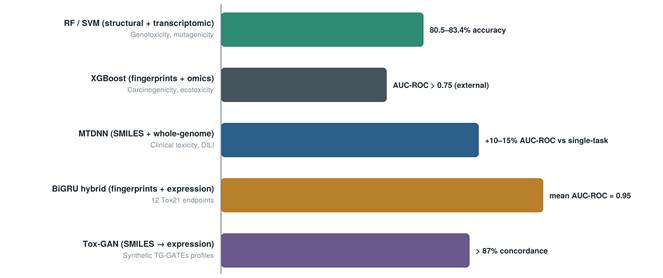
The comparative picture for algorithms is one of gradual ascent rather than sudden revolution (Kim & Choi, 2025; Singh et al., 2026). Classical supervised models—RF, SVM, XGBoost—still perform robustly on structured, small-sample data, where feature-selection strategies such as mRMR isolate compact biomarker signatures (Alnasser, 2025; Serra et al., 2020). Trained on structural descriptors and transcriptomic signatures, standard RF and SVM models land accuracies of roughly 80.5% to 83.4% for genotoxicity and Ames mutagenicity (Alnasser, 2025; Hemmerich & Ecker, 2020). The relative standings of the major architectures are summarised in (Figure 5) and detailed in (Table 2).

Deep learning tends to pull ahead once high-dimensional omics are combined with complex chemical spaces (Pavan & Kumar, 2025). MTDNNs that use SMILES embeddings together with whole-genome profiles improve AUC-ROC for clinical toxicity and liver-injury endpoints by around 10% to 15% over single-task baselines (Wang et al., 2019; W. Wu et al., 2023). Hybrid architectures pairing 2D/3D fingerprints with BiGRU networks go further, reaching a mean AUC-ROC near 0.95 across twelve Tox21 endpoints (Alnasser, 2025). Graph neural networks such as MOGONET and GeoDILI model non-Euclidean relationships across molecular graphs and biological target networks, capturing pathway cross-talk that vector-based models miss (Wang et al., 2021; W. Wu et al., 2023). And generative models—Tox-GAN most notably—achieve over 87% concordance with empirical Open TG-GATEs rat-liver profiles, which suggests, at least in principle, that realistic in silico toxicogenomic responses can be synthesised directly from structure without immediate animal testing (Chen et al., 2022; Kim & Choi, 2025). Whether that principle scales cleanly to novel chemistries is still an open question.

4.3.  Physiological relevance and limitations of new approach methodologies

A recurring tension runs through the NAM literature: throughput and physiological relevance pull in opposite directions (Pavan & Kumar, 2025; Ukaegbu et al., 2026). Two-dimensional monolayers such as HepG2 and A549 remain the workhorses of primary screening—cheap, reproducible, fully compatible with 384/1536-well robotics (Hinterberger & Stelmach, 2026). Their weakness is well known: static 2D cultures lose metabolic competence quickly, notably CYP450 activity, and so generate false negatives for metabolism-dependent toxicants (Capone et al., 2023; Pavan & Kumar, 2025). The comparative platform data appear in (Table 3).

Three-dimensional spheroids, stem-cell-derived organoids, and MPS/organ-on-chip devices were developed precisely to recover what flat cultures lose—cell–cell contact, extracellular matrix, and fluidic shear (Samantasinghar et al., 2025; Wan et al., 2024). Advanced liver, brain, and cardiac organoids recreate organ-level pathologies, from microplastic-induced steatosis to pesticide-linked neurodevelopmental disruption and pro-arrhythmic cardiotoxicity in the CiPA assay (Albanese et al., 2020; Zushin et al., 2023), and microfluidic lung- and kidney-on-chip devices can outperform animal models for nanoparticle translocation and heavy-metal nephrotoxicity. Even so, regulatory adoption stays bottlenecked by cost, technical complexity, the absence of standardised bio-ink validation, and chemical absorption onto polydimethylsiloxane channels (Nguyen & Yoo, 2025; Samantasinghar et al., 2025).

4.4. Quantitative integration: adverse outcome pathways, transcriptomic PODs, and kinetic modelling

If there is a single milestone that matters most here, it is the move from qualitative hazard labels to quantitative, mechanism-anchored dose–response modelling (Abdelwahab & Hardy, 2026; Vasant et al., 2024). The AOP framework organises toxicogenomic perturbations by mapping MIEs and sequential KEs onto apical AOs (Ankley et al., 2010), and the quantitative chain that follows is illustrated in (Figure 3) and tabulated in (Table 4).

Applying BMD workflows—BMDExpress 2, DRomics—to concentration–response transcriptomic profiles yields transcriptomic PODs based on 5% or 10% pathway-level perturbation (Farmahin et al., 2017; Phillips et al., 2019). The striking finding, repeated across studies, is that PODs derived from human in vitro cells and organoids track conventional in vivo NOAELs and LOAELs reasonably closely, which hands regulators an animal-free quantitative benchmark (Farmahin et al., 2017; Serra et al., 2020).

Figure 3· Mechanistic integration: AOP, transcriptomic PODs, and quantitative extrapolation. The figure presents the vertical chain that links molecular perturbation to protective human exposure limits. A Molecular Initiating Event propagates through Key Events and pathway perturbations captured by transcriptomics; benchmark-dose fitting (BMDExpress 2, BMDx, DRomics) then derives a transcriptomic Point of Departure. Quantitative in vitro-to-in vivo extrapolation and PBPK reverse dosimetry convert this into an Administered Equivalent Dose, which supports a Next Generation Risk Assessment margin of exposure and Safe-and-Sustainable-by-Design decision. The side labels mark the twin transitions from qualitative to quantitative and from in vitro to in vivo.

Figure 4. Regulatory translation backbone for AI-driven functional toxicogenomics. The figure shows the three pillars that convert AI-driven omics evidence into regulatory-ready risk assessment. FAIR data principles ensure findable, interoperable, and reusable datasets with standardised OECD reporting; biological knowledge graphs provide semantic context through ontologies and frameworks such as OpenTox 2.0; and Explainable AI (SHAP, LIME, CEM) attributes model outputs to toxicophores and AOP key events. These converge on integrated, auditable evidence packages (IATA, NGRA, SSbD) that in turn support transparent, animal-free regulatory decisions aligned with EFSA, FDA, US EPA, and OECD guidance.

Bridging those in vitro values to real human exposures then relies on qIVIVE combined with PBPK modelling (Deepika & Kumar, 2023; Moreau et al., 2024): free-concentration adjustments correct for protein binding and culture loss, while reverse dosimetry converts bioactive concentrations into human Administered Equivalent Doses (Li et al., 2021). This is the quantitative core of decision-ready NGRA evidence packages, and it is what lets agencies set protective margins of exposure without apical animal endpoints (Dent et al., 2021; Pavan & Kumar, 2025).

4.5. Big-data repositories, explainable AI, and regulatory standards

The growth of ML-ready toxicological repositories has, by most accounts, done as much to accelerate the field as any single algorithm (Kim & Choi, 2025; L. Wu et al., 2023). Centralised infrastructures—TOXRIC with more than 113,000 compounds and 39 feature types, Open TG-GATEs, ToxCast/Tox21, and the EPA CompTox Chemicals Dashboard—supply curated structural, bioactivity, and multi-omics datasets that make standardised cross-model evaluation possible (Igarashi et al., 2015; Richard et al., 2016; Williams et al., 2017; L. Wu et al., 2023). These resources are compiled in (Table 5).

To address the black-box concern, post-hoc XAI has been adopted widely (Alnasser, 2025; Santorsola & Lescai, 2023). SHAP, LIME, and the Contrastive Explanations Method identify the toxicophore substructures and pathway genes driving model outputs, nudging predictions back toward biological plausibility (Alnasser, 2025; Kim & Choi, 2025). Semantic knowledge graphs and agentic AI frameworks—OpenTox 2.0, AOPGraphExplorer 2.0, ToxMCP—go a step further, unifying disparate omics, literature, and AOP networks into auditable, FAIR-compliant decision engines (Abdelwahab & Hardy, 2026; Djidrovski, 2026). The outstanding challenges and their emerging fixes are consolidated in (Table 6). Collectively, these advances feed directly into regulatory modernisation—the FDA Modernization Act 2.0, the EPA NAMs Work Plan, and the EFSA SPIDO/AI4NAMs Roadmap (Kim & Choi, 2025; Zushin et al., 2023)—while the OECD Omics Reporting Framework and QSAR Assessment Framework set the reporting criteria that give AI-driven models the reproducibility and auditability regulators require (OECD, 2023; Pavan & Kumar, 2025).

5.  Discussion: Reconciling Predictive Power, Mechanistic Transparency, and Regulatory Trust

What the synthesis makes clear is that the pieces of an animal-free, mechanism-anchored toxicology now exist—omics platforms, predictive algorithms, quantitative extrapolation, and open data infrastructure. What is less clear, and worth dwelling on, is how well those pieces fit together in practice, and where the seams still show.

5.1.  Toward mechanism-anchored prediction

The most consequential trend is not that models have become more accurate, though they have, but that prediction and mechanism are converging. For much of the past decade the two advanced on separate tracks: statistical models chased accuracy while AOP work built biological narrative. The integration of transcriptomic PODs with AOP key events and qIVIVE/PBPK extrapolation (Figure 3; Table 4) begins to close that gap, turning a model output into something a toxicologist can defend mechanistically (Abdelwahab & Hardy, 2026; Vasant et al., 2024). This matters because regulators have never been persuaded by accuracy alone; a prediction that cannot be anchored to a plausible biological pathway is, for decision-making purposes, only half an answer (Pavan & Kumar, 2025).

5.2.  The performance–interpretability trade-off

There is an uncomfortable tension running through the benchmarks in (Table 2) and (Figure 5). The architectures that perform best—deep multi-task networks, GNNs, generative models—are also the hardest to interpret, while the models that regulators find easiest to trust are often the simpler ones that leave performance on the table (Alnasser, 2025; Kim & Choi, 2025). XAI methods such as SHAP and LIME are frequently offered as the resolution, and they do help. But it would be too comfortable to treat post-hoc attribution as a full solution; a feature-importance score explains what a model attended to, not necessarily why that attention is biologically correct (Santorsola & Lescai, 2023). The more durable path, hinted at across the literature, is to build mechanism in from the start—through knowledge-graph-constrained and AOP-informed architectures—rather than to explain an opaque model after the fact (Ren et al., 2025). AI-enabled functional toxicogenomics is also represented in Figure 6. 

5.3. Reproducibility, standardisation, and the data problem

If the field has an Achilles heel, it is probably data heterogeneity rather than algorithmic limitation. Batch

Figure 5 · Comparative predictive performance of ML/DL architectures. The figure summarises reported predictive performance across representative model classes, arranged to show the general upward trend from classical to hybrid and generative deep models. RF/SVM classifiers reach roughly 80.5–83.4% accuracy on genotoxicity and mutagenicity; XGBoost exceeds an external AUC-ROC of 0.75; multi-task deep networks add 10–15% AUC-ROC over single-task baselines; hybrid BiGRU models reach a mean AUC-ROC of about 0.95 across twelve Tox21 endpoints; and Tox-GAN attains over 87% concordance with empirical profiles. Values derive from different datasets and endpoints and are therefore indicative rather than directly comparable.

Figure 6· Graphical overview of AI-enabled functional toxicogenomics. The figure provides an integrated, left-to-right overview of the animal-free pipeline synthesised in this review: chemical exposure is profiled by multi-omics assays in human NAMs, modelled by machine-learning, deep-learning, and generative algorithms, anchored mechanistically through AOPs, transcriptomic PODs, and qIVIVE/PBPK, and finally translated into a transparent regulatory decision via Explainable AI, FAIR infrastructure, and NGRA/SSbD frameworks. Each stage reduces reliance on animal models while strengthening the mechanistic, human-relevant evidence base for chemical safety assessment.

effects, platform disparities, and inconsistent reporting still undermine cross-study integration (Table 6), and no amount of architectural sophistication fully compensates for a training set assembled from incompatible sources (Johnson et al., 2007; Tang et al., 2021). The response has been twofold: harmonisation methods on the technical side, and reporting standards on the governance side—the OECD Omics and Transcriptomics Reporting Frameworks and FAIR principles chief among them (OECD, 2023; Wilkinson et al., 2016). These are necessary, and their adoption is encouraging, but they are not yet universal, and a model trained on FAIR data in one laboratory cannot be assumed to transfer to another without revalidation.

5.4.  From validation to regulatory trust

Regulatory acceptance is moving, if cautiously. The FDA Modernization Act 2.0, the EPA NAMs Work Plan, and the EFSA roadmaps signal real institutional appetite for NAMs and AI (Magurany et al., 2023; Zushin et al., 2023), and auditable, FAIR infrastructures such as OpenTox 2.0 are being built precisely to meet the evidentiary bar that regulation demands (Abdelwahab & Hardy, 2026; Hardy et al., 2010). Still, trust is earned case by case. The close correspondence between human in vitro PODs and traditional NOAELs/LOAELs is perhaps the single most persuasive argument the field can make to a sceptical assessor (Farmahin et al., 2017), because it speaks the regulator's own quantitative language. Extending that kind of concordance evidence across more endpoints and chemistries is, arguably, more important for adoption than any further gain in headline accuracy.

5.5.  Limitations of the evidence base and of this study

A few caveats deserve stating plainly. The reported performance figures compiled here are not strictly comparable; they come from different datasets, endpoints, and validation splits, and selective reporting of best-case results is a known risk in the ML literature (Hemmerich & Ecker, 2020). Cross-species translation remains imperfect, and even human-relevant systems carry their own artefacts—immature iPSC phenotypes, PDMS absorption, organoid core necrosis (Table 3) (Nguyen & Yoo, 2025). As for this review itself, its narrative design, while reproducible in its search and selection, involves interpretive synthesis rather than quantitative pooling, and it necessarily reflects the coverage of the chosen databases and time window. Readers should treat the comparative claims as directional rather than definitive.

5.6.  Future directions

Several threads look likely to define the next phase. Environmental perturbation-aware virtual cells and digital twins promise to simulate exposure responses in silico, further displacing animal work if they can be validated convincingly (Ukaegbu et al., 2026). Agentic, guardrailed AI workflows that assemble evidence from literature, omics, and AOP networks—while keeping a human in the loop—may address the provenance and auditability problems that static models cannot (Djidrovski, 2026; Pathan et al., 2025). Generative approaches such as Tox-GAN could, in time, help with the chronic shortage of labelled toxicogenomic data (Chen et al., 2022). None of this will matter, though, unless standardisation and transparent validation keep pace; the field's credibility will ultimately rest less on how clever its models are than on how reproducibly and defensibly they can be shown to work (Abdelwahab & Hardy, 2026; Kim & Choi, 2025).

6.  Conclusion

Functional toxicogenomics, coupled with machine learning and deep learning, is reshaping chemical safety science into a faster, more human-relevant, and mechanistically grounded discipline. The evidence reviewed here shows multi-omics profiling—anchored by transcriptomics but enriched by proteomic, metabolomic, and epigenomic layers—feeding predictive models that climb in power from classical classifiers to deep, graph-based, and generative architectures. Crucially, these predictions are increasingly tethered to mechanism through AOP frameworks, transcriptomic Points of Departure, and qIVIVE/PBPK extrapolation, allowing animal-free derivation of human-relevant exposure limits for Next Generation Risk Assessment. Real obstacles persist—data heterogeneity, the interpretability of complex models, and uneven regulatory acceptance—but the emergence of Explainable AI, biological knowledge graphs, and FAIR, auditable infrastructures is steadily addressing them. The trajectory points toward a reproducible, transparent, and genuinely animal-free toxicology capable of meeting modern chemical-safety demands at scale. Realising it fully will depend less on further gains in predictive accuracy than on the reproducibility, transparency, and standardised reporting that regulatory confidence requires.


References


Abdelwahab, A. A., & Hardy, B. (2026). OpenTox 2.0: A perspective on the principles for predictive toxicology and risk assessment applications in the era of integrated new approach methods, computational modelling and artificial intelligence. Edelweiss Connect Preprint, 1–35.

Albanese, A., Swaney, J. M., Yun, D. H., Evans, N. B., Antonucci, J. M., Velasco, S., & Chung, K. (2020). Multiscale 3D phenotyping of human cerebral organoids. Scientific Reports, 10(1), 21487. https://doi.org/10.1038/s41598-020-78130-7      

Alnasser, S. M. (2025). Evolution of genetic toxicology: High-throughput screening and data-driven computational models for genotoxicity assessment. BioData Mining, 18(33), 1–19. https://doi.org/10.1186/s13040-025-00447-8             

Ankley, G. T., Bennett, R. S., Erickson, R. J., Hoff, D. J., Hornung, M. W., Johnson, R. D., Mount, D. R., Nichols, J. W., Russom, C. L., & Schmieder, P. K. (2010). Adverse outcome pathways: A conceptual framework to support ecotoxicology research and risk assessment. Environmental Toxicology and Chemistry, 29(3), 730–741. https://doi.org/10.1002/etc.34

Aslam, B., Basit, M., Nisar, M. A., Khurshid, M., & Rasool, M. H. (2017). Proteomics: Technologies and their applications. Journal of Chromatographic Science, 55(2), 182–196. https://doi.org/10.1093/chromsci/bmw167    

Capone, P., Chiarella, P., & Sisto, R. (2023). Advanced technologies in genomic toxicology: Current trend and future directions. Current Opinion in Toxicology, 36, 100444. https://doi.org/10.1016/j.cotox.2023.100444      

Chen, X., Roberts, R., Tong, W., & Liu, Z. (2022). Tox-GAN: An artificial intelligence approach alternative to animal studies—A case study with toxicogenomics. Toxicological Sciences, 186(2), 242–259. https://doi.org/10.1093/toxsci/kfab157         

Crute, C., et?al.?(2025). Advancing toxicology through Next Generation Risk Assessment and multi-omics approaches: The genesis of the Omics for Assessing Signatures for Integrated Safety Consortium. Toxicological Sciences, 208(2), 225–237. https://doi.org/10.1093/toxsci/kfaf128              

Cui, H., Miao, S., Esworthy, T., Zhou, X., Lee, S., Liu, C., & Zhang, L. G. (2018). 3D bioprinting for cardiovascular regeneration and pharmacology. Advanced Drug Delivery Reviews, 132, 252–269. https://doi.org/10.1016/j.addr.2018.07.014    

Deepika, D., & Kumar, V. (2023). The role of “physiologically based pharmacokinetic model (PBPK)” new approach methodology (NAM) in pharmaceuticals and environmental chemical risk assessment. International Journal of Environmental Research and Public Health, 20(4), 3473. https://doi.org/10.3390/ijerph20043473          

Dent, M. P., Amaral, R. T., Da Silva, P. A., Hirose, A., Kopp-Schneider, A., Buesen, R., & Carmichael, P. L. (2021). Next generation risk assessment for safety decision-making. Regulatory Toxicology and Pharmacology, 125, 105026. https://doi.org/10.1016/j.yrtph.2021.105026   

Dimitrov, S. D., Diderich, R., Sobanski, T., Pavlov, T. S., Chankov, G. V., Chapkanov, A. S., & Mekenyan, O. G. (2016). QSAR Toolbox—Workflow and major functionalities. SAR and QSAR in Environmental Research, 27(3), 203–219. https://doi.org/10.1080/1062936X.2015.1136680

Djidrovski, I. (2026). ToxMCP: Guardrailed, auditable agentic workflows for computational toxicology. bioRxiv. https://doi.org/10.1101/2026.02.06.703989     

ENVESOME Consortium. (2024). An integrative exposome framework for environmental health risk assessment and pathway-based dose–response analysis. Frontiers in Public Health, 12, 116195.          

Ewart, L., Fabre, K., Chakilam, A., & LeCluyse, E. (2018). Bridging the gap between in vitro and in vivo: Dose and schedule predictions for an organotypic human liver microphysiology system. Toxicology in Vitro, 45, 65–74. https://doi.org/10.1016/j.tiv.2017.08.004          

Farmahin, R., Williams, A., Evenson, L. O., & Yauk, C. L. (2017). Recommended practices for the analysis of transcriptomic benchmark dose data. Regulatory Toxicology and Pharmacology, 91, S14–S26. https://doi.org/10.1016/j.yrtph.2017.09.014       

Fortino, V., Kinaret, P., Fyhrquist, N., Alenius, H., & Greco, D. (2014). A robust and accurate method for feature selection and prioritization from multi-class OMICs data. PLoS ONE, 9(12), e114627. https://doi.org/10.1371/journal.pone.0114627 

Hardy, B., Douglas, N., Helma, C., Rautenberg, M., Jeliazkova, N., Jeliazkov, V., & Willighagen, E. (2010). Collaborative development of predictive toxicology applications. Journal of Cheminformatics, 2, 7. https://doi.org/10.1186/1758-2946-2-7

Harrill, J. A., Viant, M. R., Yauk, C. L., Sachana, M., Gant, T. W., Auerbach, S. S., Beger, R. D., Bouhifd, M., O’Brien, J., & Burgoon, L. (2021). Progress towards an OECD reporting framework for transcriptomics and metabolomics in regulatory toxicology. Regulatory Toxicology and Pharmacology, 125, 105020. https://doi.org/10.1016/j.yrtph.2021.105020

Hemmerich, J., & Ecker, G. F. (2020). In silico toxicology: From structure–activity relationships towards deep learning and adverse outcome pathways. WIREs Computational Molecular Science, 10(4), e1475. https://doi.org/10.1002/wcms.1475       

Hinterberger, M., & Stelmach, R. (2026). Toward human-relevant toxicology: A decision-oriented roadmap integrating modern tools for the safety evaluation of novel foods and functional ingredients. Archives of Toxicology, 100, 1–28.

Hussein, M. N. H. (2026). Toxicogenomics and personalized medicine: Applications, key technologies, and AI integration. Ain Shams Journal of Forensic Medicine and Clinical Toxicology, 46(1), 52–68.

Igarashi, Y., Nakatsu, N., Yamashita, T., Ono, A., Ohno, Y., Urushidani, T., & Yamada, H. (2015). Open TG-GATEs: A large-scale toxicogenomics database. Nucleic Acids Research, 43(D1), D921–D927. https://doi.org/10.1093/nar/gku955   

Johnson, W. E., Li, C., & Rabinovic, A. (2007). Adjusting batch effects in microarray expression data using empirical Bayes methods. Biostatistics, 8(1), 118–127. https://doi.org/10.1093/biostatistics/kxj037

Kim, D., & Choi, J. (2025). Big data and artificial intelligence in toxicology: Current status and future perspectives. Environmental Analysis Health and Toxicology, 40, e2025s07. https://doi.org/10.5620/eaht.2025s07             

Li, H., Yuan, H., Middleton, A., Li, J., Nicol, B., Carmichael, P., & Tran, L. (2021). Next generation risk assessment (NGRA): Bridging in vitro points-of-departure to human safety assessment using physiologically-based kinetic (PBK) modelling. Toxicology in Vitro, 74, 105171. https://doi.org/10.1016/j.tiv.2021.105171       

Lynch, C., Sakamuru, S., Ooka, M., & Xia, M. (2024). High throughput screening to advance in vitro toxicology: Accomplishments, challenges, and future directions. Annual Review of Pharmacology and Toxicology, 64, 215–236. https://doi.org/10.1146/annurev-pharmtox-112122-104310

Magurany, K. A., Chang, X., Clewell, R., Coecke, S., Haugabrooks, E., & Marty, S. (2023). A pragmatic framework for the application of new approach methodologies in one health toxicological risk assessment. Toxicological Sciences, 192(2), 155–177. https://doi.org/10.1093/toxsci/kfad018             

Mayr, A., Klambauer, G., Unterthiner, T., & Hochreiter, S. (2016). DeepTox: Toxicity prediction using deep learning. Frontiers in Environmental Science, 4, 2. https://doi.org/10.3389/fenvs.2016.00002     

Meier, M. J., Froetschl, R., & Yauk, C. L. (2024). Outcome of IWGT workshop on transcriptomic biomarkers for genotoxicity: Key bioinformatics approaches and recommendations. Environmental and Molecular Mutagenesis, 65(4), 135–151. https://doi.org/10.1002/em.22342      

Mirshafiei, M., Rashedi, H., Yazdian, F., Rahdar, A., & Baino, F. (2024). Advancements in tissue and organ 3D bioprinting: Current techniques, applications, and future perspectives. Materials & Design, 240, 112853. https://doi.org/10.1016/j.matdes.2024.112853

Moreau, M., Simms, L., Andersen, M. E., Trelles Sticken, E., Wieczorek, R., Pour, S. J., Chapman, F., Roewer, K., Otte, S., & Fisher, J. (2024). Use of quantitative in vitro to in vivo extrapolation (QIVIVE) for the assessment of non-combustible next-generation product aerosols. Frontiers in Toxicology, 6, 1373325. https://doi.org/10.3389/ftox.2024.1373325     

Multi-omics integration strategies and proteomic workflows in toxicology. (2024). Proteomes, 12(1), 25. https://doi.org/10.3390/proteomes12010025  

Nguyen, X. H., & Yoo, J. (2025). Current status and future prospects of toxicity assessment using organoids. Toxicological Research, 41(4), 325–333. https://doi.org/10.1007/s43188-025-00298-9  

OECD. (2023). Guidance document on reporting elements for the regulatory use of omics data from laboratory-based toxicology studies. OECD Publishing. https://doi.org/10.1787/6bb2e6ce-en  

Pathan, S., Perez Santin, E., & Jia, X. (2025). AI-driven target prediction and network toxicology in modern hazard assessment. Computational Toxicology, 30, 100312.

Pavan, M., & Kumar, V. (2025). New approach methodologies (NAMs) in chemical risk assessment: Opportunities and challenges for regulatory acceptance. Frontiers in Toxicology, 7, 1632941. https://doi.org/10.3389/ftox.2025.1632941     

Phillips, J. R., Svoboda, D. L., Tandon, A., Patel, S., Sedykh, A., Mav, D., Kuo, B., Yauk, C. L., Yang, L., & Thomas, R. S. (2019). BMDExpress 2: Enhanced transcriptomic dose-response analysis workflow. Bioinformatics, 35(10), 1780–1782. https://doi.org/10.1093/bioinformatics/bty878

Ramirez-Hincapie, S., Štampar, M., & Žegura, B. (2023). High-throughput targeted metabolomics platform for hepatotoxicity screening in HepG2 cells. Archives of Toxicology, 97(6), 1723–1738. https://doi.org/10.1007/s00204-023-03474-8

Ren, X., Zhang, Y., & Liu, S. (2025). Using environmental mixture exposure-triggered biological knowledge-driven machine learning to predict health risks. Environmental Science & Technology, 59(4), 1234–1245. https://doi.org/10.1021/acs.est.5c05389           

Richard, A. M., Judson, R. S., Houck, K. A., Grulke, C. M., Volarath, P., & Thomas, R. S. (2016). ToxCast chemical landscape: Paving the road to 21st century toxicology. Chemical Research in Toxicology, 29(8), 1225–1251. https://doi.org/10.1021/acs.chemrestox.6b00135           

Samantasinghar, A., Sunildutt, N., Ahmed, F., & Choi, J. H. (2025). Revolutionizing biomedical research: Unveiling the power of microphysiological systems with advanced assays, integrated sensor technologies, and real-time monitoring. ACS Omega, 10(10), 9869–9889. https://doi.org/10.1021/acsomega.4c11227

Santorsola, M., & Lescai, F. (2023). The promise of explainable deep learning for omics data analysis: Adding new discovery tools to AI. New Biotechnology, 77, 1–11. https://doi.org/10.1016/j.nbt.2023.06.002

Serra, A., Saarimäki, L. A., Fratello, M., Marwah, V. S., & Greco, D. (2020). Transcriptomics in toxicogenomics, part III: Data modelling for risk assessment. Nanomaterials, 10(4), 708. https://doi.org/10.3390/nano10040708    

Short, S., Green Etxabe, A., Swart, E., Rivetti, C., Campos, B., Krishnan, R., Kille, P., & Spurgeon, D. J. (2026). Exploiting omic data to advance predictive ecotoxicology. Environmental Science & Technology, 60(34), 23642–23660. https://doi.org/10.1021/acs.est.6c01198           

Singh, A. V., Bhardwaj, P., Laux, P., Pradeep, P., Busse, M., Luch, A., Hirose, A., Osgood, C. J., & Stacey, M. W. (2026). AI and ML-based risk assessment of chemicals: Predicting carcinogenic risk from chemical-induced genomic instability. Frontiers in Toxicology, 6, 1461587. https://doi.org/10.3389/ftox.2024.1461587           

Su, R., Wu, H., Xu, B., Liu, X., & Wei, L. (2018). Developing a multi-dose computational model for drug-induced hepatotoxicity prediction based on toxicogenomics data. IEEE/ACM Transactions on Computational Biology and Bioinformatics, 16(4), 1231–1239. https://doi.org/10.1109/TCBB.2018.2858756

Tang, K., Ji, X., Zhou, M., & Li, S. (2021). Rank-in: Enabling integrative analysis across microarray and RNA-seq for cancer and toxicity. Nucleic Acids Research, 49(17), e99. https://doi.org/10.1093/nar/gkab554 

Tanveer, T., Shaheen, K., Parveen, S., Misbah, Z. T., Babar, M. M., & Gul, A. (2018). Omics-based bioengineering in environmental biotechnology. In Omics technologies and bio-engineering: Towards improving quality of life (pp. 353–368). Academic Press/Elsevier. https://doi.org/10.1016/B978-0-12-815870-8.00019-X     

Ukaegbu, O. F., Zhang, J., & Rouquié, D. (2026). Environmental perturbation-aware virtual cells: Advancing computational toxicology for chemical safety assessment. ALTEX—Alternatives to Animal Experimentation, 43(1), 1–22. https://doi.org/10.14573/altex.2606062            

Vasant, M., Vinken, M., & Arnesdotter, E. (2024). Omics-based input and output in the development and use of adverse outcome pathways for human health risk assessment. International Journal of Molecular Sciences, 25(20), 11154. https://doi.org/10.3390/ijms252011154            

Vinken, M. (2024). Adverse outcome pathway networks as the basis for the development of new approach methodologies: Liver toxicity as a case study. Current Opinion in Toxicology, 40, 100504. https://doi.org/10.1016/j.cotox.2024.100504           

Wan, L., Wu, J., & Kong, X. (2024). Application of organoid technology in human health risk assessment. Environment International, 188, 108744. https://doi.org/10.1016/j.envint.2024.108744

Wang, H., Liu, R., Schyman, P., & Wallqvist, A. (2019). Deep neural network models for predicting chemically induced liver toxicity endpoints from transcriptomic responses. Frontiers in Pharmacology, 10, 42. https://doi.org/10.3389/fphar.2019.00042        

Wang, T., Shao, W., Huang, Z., Tang, H., Zhang, J., Ding, Z., & Huang, K. (2021). MOGONET integrates multi-omics data using graph convolutional networks allowing patient classification and biomarker identification. Nature Communications, 12, 3445. https://doi.org/10.1038/s41467-021-23774-w 

Wilkinson, M. D., Dumontier, M., Aalbersberg, I. J., Appleton, G., Axton, M., Baak, A., & Mons, B. (2016). The FAIR Guiding Principles for scientific data management and stewardship. Scientific Data, 3, 160018. https://doi.org/10.1038/sdata.2016.18       

Williams, A. J., Grulke, C. M., Edwards, J., McEachran, A. D., Mansouri, K., & Richard, A. M. (2017). The CompTox Chemistry Dashboard: A community data resource for environmental chemistry. Journal of Cheminformatics, 9(1), 61. https://doi.org/10.1186/s13321-017-0247-6    

Wu, L., Yan, B., Han, J., Li, R., Xiao, J., He, S., & Bo, X. (2023). TOXRIC: A comprehensive database of toxicological data and benchmarks. Nucleic Acids Research, 51(D1), D1432–D1445. https://doi.org/10.1093/nar/gkac955    

Wu, W., Qian, J., Liang, C., Yang, J., Ge, G., Zhou, Q., & Guan, X. (2023). GeoDILI: A robust and interpretable model for drug-induced liver injury prediction using graph neural network-based molecular geometric representation. Chemical Research in Toxicology, 36(11), 1717–1730. https://doi.org/10.1021/acs.chemrestox.3c00220      

Xu, Z., & Yang, M. (2026). Omics technologies in disinfection byproduct toxicology: Toward mechanistic and extrapolative frameworks. Environment & Health, 3(10), 1139–1153. https://doi.org/10.1021/envhealth.5c00874

Yang, R., Shi, Z., Li, Y., Huang, X., Li, Y., Li, X., ... & Li, X. (2024). Research focus and emerging trends of the gut microbiome and infant: a bibliometric analysis from 2004 to 2024. Frontiers in Microbiology, 15, 1459867.

Yi, X., et?al.?(2023). AI data pipeline for toxicity prediction in complex food and environmental matrices. Food Quality and Safety, 10, fyaf052. https://doi.org/10.1093/fqsafe/fyaf052        

Zushin, P. H., Mukherjee, S., & Wu, J. C. (2023). FDA Modernization Act 2.0: Transitioning beyond animal models with human cells, organoids, and AI/ML-based approaches. Journal of Clinical Investigation, 133(21), e175824. https://doi.org/10.1172/JCI175824      

Article metrics
View details
0
Downloads
0
Citations
48
Views

View Dimensions


View Plumx


View Altmetric


0
Save
0
Citation
48
View
0
Share