Journal of Primeasia

Integrative Disciplinary Research | Online ISSN 3064-9870 | Print ISSN 3069-4353
570
Citations
221.2k
Views
147
Articles
Your new experience awaits. Try the new design now and help us make it even better
Switch to the new experience
Figures and Tables
REVIEWS   (Open Access)

Potassium-Ion Batteries: Emerging Anode Materials and Strategies for High-Performance Energy Storage

Abbas Mohammed Sahib 1*

+ Author Affiliations

Journal of Primeasia 7 (1) 1-8 https://doi.org/10.25163/primeasia.7110783

Submitted: 14 January 2026 Revised: 06 March 2026  Published: 18 March 2026 


Abstract

Potassium-ion batteries (PIBs) have recently emerged as a promising alternative to lithium-ion batteries due to the abundance, low cost, and comparable electrochemical properties of potassium. The development of high-performance anode and cathode materials is critical for realizing the full potential of PIBs. This systematic review and meta-analysis synthesizes the current advancements in PIB electrode materials, electrolyte formulations, and structural engineering strategies, highlighting their impact on energy density, cycling stability, and rate capability. Particular attention is given to carbonaceous materials, transition metal dichalcogenides (especially MoS2), and alloy-type anodes, which demonstrate diverse mechanisms such as intercalation, conversion, and alloying reactions. The review integrates quantitative performance metrics from multiple studies, providing comparative insights on reversible capacity, Coulombic efficiency, and capacity retention over extended cycling. Key findings suggest that hierarchical nanostructuring, heteroatom doping, and carbon composite formation significantly enhance potassium storage performance by mitigating volume expansion, improving conductivity, and stabilizing the solid electrolyte interphase. Moreover, electrolyte optimization, including potassium salts and solvent systems, plays a pivotal role in reducing side reactions and improving long-term stability. Despite substantial progress, challenges remain in balancing energy density with cycle life and safety, particularly for large-scale applications. This work offers a comprehensive evaluation of PIB materials and identifies critical directions for future research, emphasizing strategies to achieve high-performance, cost-effective, and sustainable potassium-ion batteries.Keywords: Potassium-ion batteries; Anode materials; MoS2; Carbon composites; Energy storage; Electrolyte optimization; Cycle stability

1. Introduction

The search for safer, cheaper, and more sustainable energy-storage technologies has become increasingly urgent as modern societies move toward renewable energy systems, electric mobility, portable electronics, and decentralized power infrastructure. Lithium-ion batteries have undoubtedly shaped this transition. Their high energy density, relatively long cycle life, and well-established manufacturing ecosystem have made them the dominant rechargeable battery technology for decades. Yet, despite this success, lithium-based systems are not without limitations. Concerns over lithium availability, uneven resource distribution, cost fluctuation, safety, and the environmental burden of mining have encouraged researchers to look beyond conventional lithium-ion chemistry. In this broader context, post-lithium batteries are no longer viewed merely as distant alternatives; rather, they are increasingly discussed as necessary complementary systems for future energy storage (Gao et al., 2022; Zaman & Hatzell, 2022).

Among these emerging systems, potassium-ion batteries have attracted growing attention because potassium is naturally abundant, widely distributed, and electrochemically attractive. Potassium has a low redox potential close to that of lithium, which gives potassium-ion batteries the possibility of achieving competitive operating voltages. At the same time, the larger ionic radius of K⁺ introduces both opportunity and difficulty. On one hand, potassium ions can show favorable transport behavior in certain electrolyte environments. On the other hand, their large size often causes sluggish diffusion, structural strain, and severe volume expansion in host materials. This means that the success of potassium-ion batteries depends not only on identifying suitable electrode materials but also on carefully engineering the electrolyte, interphase, and electrode architecture (Xu et al., 2021; Liu, Gao, et al., 2020).

The anode is particularly important in determining the practical performance of potassium-ion batteries. Unlike lithium-ion systems, where graphite has become a commercially mature anode, potassium-ion systems face more complex challenges. Potassium can intercalate into carbonaceous hosts, but the process is accompanied by larger structural deformation. Hard carbon has therefore emerged as one of the most promising anode candidates because of its disordered structure, enlarged interlayer spacing, tunable porosity, and ability to accommodate K⁺ insertion more flexibly than highly crystalline graphite. Recent reviews have emphasized that rational design of hard carbon—including precursor selection, pore regulation, surface chemistry control, and advanced characterization—is essential for improving reversible capacity and cycling stability in potassium-ion batteries (Lei et al., 2022). Similarly, precursor-derived microspherical hard carbons have shown promise for both sodium-ion and potassium-ion batteries, suggesting that carbon morphology and microstructure can strongly influence alkali-ion storage behavior (Tyagi & Puravankara, 2022).

However, carbon materials alone may not fully satisfy the demand for high-performance energy storage. Transition-metal compounds, alloy-type materials, metal oxides, and composite architectures have therefore been investigated to improve capacity, rate capability, and durability. Some insights can be drawn from related lithium-, sodium-, and zinc-based systems, where nanoscale electrode design has repeatedly improved ion transport and structural stability. For example, three-dimensional TiO₂–graphene architectures have demonstrated enhanced lithium- and sodium-ion storage by combining conductive networks with stable oxide frameworks (Wang, Li, He, et al., 2020). In aqueous zinc-ion systems, electrospun core–shell Mn₃O₄/carbon fibers and MnO₂ nanowire-based microflowers have shown how hierarchical structures can strengthen electron transport and buffer mechanical degradation during cycling (Long et al., 2020; Shi et al., 2020). Although these examples belong to different battery chemistries, they illustrate a broader principle that is highly relevant to potassium-ion batteries: electrode architecture must be designed to manage both ion transport and mechanical stress.

Electrolyte design is another central issue. In potassium-ion batteries, the electrolyte does much more than shuttle ions between electrodes. It determines desolvation behavior, influences interfacial reactions, affects solid electrolyte interphase formation, and ultimately controls Coulombic efficiency and long-term cycling stability. Progress in sodium-based rechargeable batteries has already shown how electrolyte formulation and interphase chemistry can shape the reversibility of alkali-ion storage (Eshetu et al., 2020). For potassium-ion batteries, electrolyte optimization remains equally critical, especially because the large K⁺ ion can induce unstable interfaces and parasitic reactions if the electrolyte is not carefully matched with the anode surface (Liu, Gao, et al., 2020). Inorganic cathode development for potassium-ion batteries has also highlighted that full-cell performance requires coordinated progress in both electrode and electrolyte systems, rather than isolated improvements in a single component (Meng et al., 2022).

Lessons from lithium-based battery research are particularly useful here. Polymer electrolytes, gel electrolytes, solid composite electrolytes, and ionogel systems have been extensively studied to improve safety, mechanical flexibility, ionic conductivity, and interfacial compatibility. Polymer-based battery components have been reviewed as important tools for next-generation lithium-ion batteries, especially where safety and flexibility are desired (Costa et al., 2020). Garnet/polymer solid composite electrolytes, for example, have been explored as promising platforms for all-solid-state lithium batteries because they combine ceramic ion-conduction pathways with polymeric processability (Li et al., 2020). Similarly, composite polymer electrolytes based on liquid crystalline copolymers have shown high-temperature stability and bendability, which are attractive features for safer and more flexible energy-storage systems (Cao et al., 2020). These developments suggest that potassium-ion batteries may also benefit from electrolyte systems that are not only conductive but also mechanically adaptive and chemically stable.

A range of polymer and gel electrolyte strategies further demonstrates how transport and interfacial properties can be tuned through molecular and structural design. Poly(p-phenylene)s tethered with oligo(ethylene oxide) have been synthesized as solid polymer electrolytes, showing how ion-conducting side chains can be incorporated into rigid polymer backbones (Nederstedt & Jannasch, 2020). Copolymer electrolytes such as poly(1,3-dioxolane-co-formaldehyde) have also been investigated for their ability to support ion transport while maintaining polymeric stability (Liu, Li, et al., 2020). Other studies have used P(VDF-HFP)-based gel polymer electrolytes doped with porous carbon powders to improve lithium-ion battery performance, indicating that conductive and porous additives can help create more favorable ion-transport networks (Kou et al., 2020). Inorganic fillers in thermoplastic polymer/ionic liquid/LiTFSI systems have likewise shown synergistic effects, reinforcing the idea that hybrid electrolyte structures can outperform single-component designs (González et al., 2020).

Ionogels and hydrogel electrolytes broaden this discussion further. Proton-conducting ionogel electrolytes based on poly(ionic liquids) and protic ionic liquids show that ionic conductivity can be integrated with polymer-like mechanical stability (Rao et al., 2020). Chemically cross-linked chitosan–cellulose ionogels have demonstrated self-healability, high ionic conductivity, and thermo-mechanical robustness, qualities that may be valuable for flexible or durable energy-storage devices (Wang, Liu, Zhang, et al., 2020). Highly tough supramolecular double-network hydrogel electrolytes have also shown low-temperature tolerance and mechanical resilience in sensor applications, suggesting that soft electrolyte frameworks can be engineered for demanding operating environments (Chen et al., 2020). Although these studies are not all directly focused on potassium-ion batteries, they provide a useful materials-design vocabulary for future PIB electrolyte development.

At the device level, improving potassium-ion batteries will require a balanced view of both electrode and electrolyte engineering. Lithium battery research has shown that enhanced ion transport depends on coordinated electrolyte and electrode design rather than one factor alone (Boz et al., 2021). SiO₂-grafted polyimidazole solid electrolytes, for instance, illustrate how inorganic modification can strengthen polymer electrolyte performance for lithium-ion systems (Cheng et al., 2020). Low-temperature lithium-ion battery studies similarly emphasize that electrode materials must be constructed with attention to transport kinetics, structural stability, and electrolyte compatibility (Zhang et al., 2022). Meanwhile, solid-state lithium–sulfur battery research has shown that practical progress often requires moving from fundamental understanding toward deliberate engineering design (Yang et al., 2020). These lessons are directly relevant to potassium-ion batteries, where large-ion transport, volume change, and interfacial instability remain persistent barriers.

Therefore, the development of potassium-ion batteries should be understood as a materials-integration challenge. High-capacity anodes are desirable, but they must be supported by stable interfaces, fast ion pathways, conductive frameworks, and mechanically tolerant architectures. Hard carbons, advanced carbon composites, metal-based materials, polymer electrolytes, gel systems, and hybrid interphases each offer part of the solution. Still, no single strategy is likely to be sufficient on its own. The most realistic path forward may involve combining rational anode design with electrolyte engineering, interfacial stabilization, and scalable processing. Against this background, the present article, “Potassium-Ion Batteries: Emerging Anode Materials and Strategies for High-Performance Energy Storage,” examines recent advances in PIB anode materials and related design strategies, with particular attention to how structure, electrolyte chemistry, and interfacial control can work together to improve capacity, rate capability, cycling stability, and practical viability.
2. Materials and Methods

2.1. Study Design and Reporting Framework

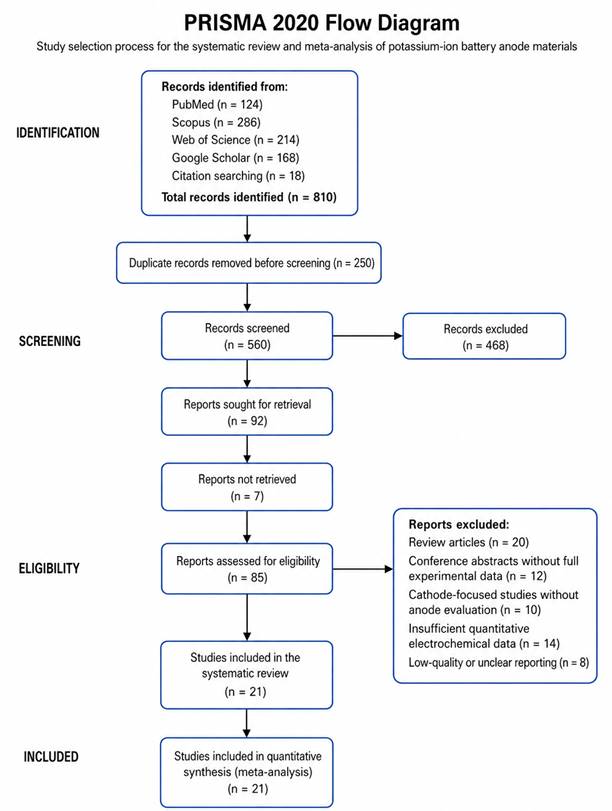
This study was designed as a systematic review and quantitative meta-analysis to evaluate recent progress in potassium-ion battery (PIB) anode materials, with particular attention to electrochemical performance, cycling durability, electrolyte effects, and structural engineering strategies. The methodological framework was developed to ensure transparency, reproducibility, and comparability across studies. The review process followed the PRISMA 2020 reporting guideline, which provides a structured approach for identifying, screening, selecting, and reporting studies in systematic reviews (Page et al., 2021) as represented in Figure 1. General principles for systematic review conduct, including protocol-driven screening, transparent eligibility decisions, and structured synthesis, were also guided by the Cochrane Handbook for Systematic Reviews of Interventions (Higgins et al., 2022). Although the present review focuses on materials and battery research rather than clinical interventions, these guidelines were adapted because they offer a rigorous framework for minimizing selection bias and improving reporting clarity.

2.2. Literature Search Strategy

A comprehensive literature search was conducted to identify original experimental studies reporting the electrochemical performance of potassium-ion battery materials. Particular emphasis was placed on anode development, electrolyte formulation, carbon hybridization, transition-metal-based materials, alloy-type anodes, and nanostructuring strategies. The databases searched included PubMed, Scopus, Web of Science, and Google Scholar. The search covered studies published between 2000 and 2025 in order to capture both foundational developments and recent advances in PIB research. A combination of keywords and Boolean operators was used to maximize retrieval of relevant studies. The main search terms included “potassium-ion battery” OR “K-ion battery” combined with “anode material,” “MoS₂,” “carbon composite,” “hard carbon,” “soft carbon,” “alloy anode,” “electrochemical performance,” “capacity retention,” and “Coulombic efficiency.” Reference mining and cross-citation tracking were also performed to identify additional studies that may not have been retrieved through database searching alone.

2.3. Study Screening and Eligibility Criteria

The screening process was performed in two stages. First, titles and abstracts were reviewed independently to remove clearly irrelevant studies. Second, full-text articles were assessed against the predefined eligibility criteria. Disagreements between reviewers were resolved through discussion, and where necessary, a third reviewer was consulted to reach consensus. Studies were included if they met the following criteria: they were original experimental articles; they investigated potassium-ion battery anode materials; they reported at least one quantitative electrochemical performance parameter, such as reversible capacity, initial Coulombic efficiency, current density, cycle number, or capacity retention; and they were available in English. Studies were excluded if they were review articles, conference abstracts without full experimental data, studies focused exclusively on cathode materials without anode evaluation, or papers lacking sufficient quantitative electrochemical information for synthesis. The final selection process was summarized using a PRISMA flow diagram, showing the number of records identified, screened, excluded, and included in the qualitative and quantitative analyses (Page et al., 2021).

2.4. Data Extraction and Organization

Data extraction was conducted using a structured Microsoft Excel template to ensure consistency across all included studies. For each eligible article, bibliographic information, anode material type, material family, synthesis or preparation method, electrolyte formulation, current density, reversible capacity, initial Coulombic efficiency, cycle number, and capacity retention were recorded. Materials were grouped into major categories, including pristine MoS₂, MoS₂/carbon hybrids, graphite-based anodes, hard and soft carbon materials, alloy-type anodes, and transition-metal-based compounds. When studies reported results at multiple current densities or cycling conditions, all relevant values were extracted so that performance variation could be captured more accurately. Where values were reported graphically rather than numerically, data were extracted carefully from figures where possible. If uncertainty values such as standard deviations, standard errors, or confidence intervals were available, they were also recorded to support quantitative synthesis.

2.5. Data Harmonization and Quantitative Synthesis

Because electrochemical studies often differ in testing conditions, units, electrolyte compositions, and current-density regimes, all extracted data were harmonized before analysis. Reversible capacity was standardized as mAh g⁻¹, current density as A g⁻¹ or mA g⁻¹ where appropriate,

Figure 1: PRISMA 2020 flow diagram showing the study identification, screening, eligibility assessment, and final inclusion process for the systematic review and meta-analysis of potassium-ion battery anode materials.

and cycling stability as percentage capacity retention after a defined number of cycles. Electrolytes were categorized into carbonate-based, ether-based, polymer-based, and other reported systems where sufficient information was available. Anode materials were further classified according to structural modification, such as pristine, doped, hybridized, nanostructured, or carbon-supported forms. This classification allowed subgroup-level comparisons and helped reduce methodological inconsistency between studies. The principles of quantitative synthesis and effect-size estimation were guided by standard meta-analytic approaches described by Borenstein et al. (2009).

2.6. Meta-Analytical Model and Effect Estimation

Quantitative synthesis was performed using the extracted electrochemical performance metrics from the included studies. Weighted averages were calculated for reversible capacity, initial Coulombic efficiency, and capacity retention, stratified by anode material family and structural modification type. Because battery studies commonly differ in synthesis method, electrolyte formulation, active-material loading, voltage window, and cycling protocol, heterogeneity across studies was expected. Therefore, random-effects models were applied when substantial variability was present, following the methodological logic proposed by DerSimonian and Laird (1986). Fixed-effect models were considered only when heterogeneity was low and studies were sufficiently comparable. Continuous outcomes, such as reversible capacity and initial Coulombic efficiency, were summarized using weighted mean differences where suitable. Capacity retention data were analyzed as proportional outcomes and expressed as percentage retention after the reported number of cycles.

2.7. Assessment of Heterogeneity

Statistical heterogeneity was assessed using Cochran’s Q-test and the I² statistic. The I² statistic was used to estimate the proportion of total variation across studies attributable to true between-study heterogeneity rather than chance. Values above 50% were interpreted as indicating substantial heterogeneity, while lower values suggested relatively greater consistency among studies (Higgins et al., 2003). Where high heterogeneity was detected, possible sources were explored through subgroup analysis based on material family, structural modification, electrolyte type, current density, and cycle number. This approach was important because performance variation in PIB anodes may arise not only from the intrinsic properties of the active material but also from differences in electrode fabrication, electrolyte compatibility, and testing conditions.

2.8. Quality Assessment and Risk of Bias

The methodological quality of the included studies was evaluated using a modified quality-assessment framework adapted for materials research. Assessment domains included clarity of synthesis protocol, adequacy of structural and morphological characterization, description of electrochemical testing conditions, reporting of key performance metrics, inclusion of cycling stability data, and transparency of statistical or replicate-based analysis. Studies were classified as high, moderate, or low quality based on the completeness and reliability of their reported methods and outcomes. Particular attention was given to potential sources of bias, including selective reporting of high-capacity values, absence of control materials, inconsistent electrolyte systems, unclear mass loading, and limited long-term cycling data. Only high- and moderate-quality studies were included in the final quantitative synthesis, while low-quality studies were considered only for qualitative discussion where appropriate.

2.9. Subgroup and Sensitivity Analyses

Subgroup analyses were conducted to examine whether electrochemical performance differed according to material family, structural design, and electrolyte system. The main subgroup categories included carbon-based anodes, alloy-type anodes, transition-metal dichalcogenides, oxide-based anodes, pristine materials, doped materials, and carbon-supported composites. Electrolyte-based subgroup analysis compared carbonate-based and ether-based systems where sufficient data were available. Sensitivity analysis was performed by sequentially removing individual studies from the dataset to determine whether pooled estimates were strongly influenced by any single study. This step helped assess the robustness of the meta-analytic findings and identify potential outliers. The general interpretation of pooled estimates, subgroup variation, and sensitivity outcomes followed established principles of meta-analysis (Borenstein et al., 2009; Higgins et al., 2022).

2.10. Publication Bias and Data Visualization

Publication bias and small-study effects were evaluated using funnel plots and Egger’s regression test. Funnel plots were used to visually assess whether studies were symmetrically distributed around the pooled effect estimate, while Egger’s test provided a statistical assessment of possible asymmetry (Egger et al., 1997). In this review, funnel plots were particularly useful for identifying whether high-performing anode materials may have been overrepresented in the literature. Forest plots were generated to display study-level and pooled performance estimates across different anode families, while scatterplots and summary tables were used to visualize relationships among current density, reversible capacity, Coulombic efficiency, and capacity retention. Together, these visual tools enabled both statistical interpretation and practical comparison of material performance trends.

2.11. Data Presentation and Interpretation

The final results were presented through structured tables, forest plots, funnel plots, and comparative graphs. Tables summarized the extracted electrochemical data, including anode material type, electrolyte composition, current density, reversible capacity, initial Coulombic efficiency, cycle number, and capacity retention. Forest plots illustrated comparative performance across anode families, while funnel plots helped evaluate publication bias and reporting symmetry. The interpretation focused on how nanostructuring, carbon hybridization, electrolyte selection, and interfacial stabilization influence potassium storage behavior. By combining systematic review methods with quantitative synthesis, this methodology provides a transparent and reproducible framework for evaluating emerging PIB anode materials and identifying strategies that may support the development of high-performance, durable, and practically viable potassium-ion batteries.


3. Results

3.1 Discussion and interpretation of statistical analysis

The meta-analysis of potassium-ion battery (PIB) anode materials provided a comprehensive understanding of the performance metrics across different material families, structural modifications, and electrolyte systems. Data extracted from Table 1 and Table 2, along with visualizations in Figures 2–5, reveal key insights regarding reversible capacity, initial Coulombic efficiency (ICE), and long-term cycling stability. Collectively, these findings highlight not only the strengths of various anode types but also the limitations inherent to current PIB technology.

The aggregated data in Table 1 indicate that carbon-based anodes, particularly hard carbons and hybrid carbon composites, consistently exhibit high initial capacities and relatively stable cycling performance. The mean reversible capacity for carbonaceous anodes was observed at approximately 350–400 mAh·g⁻¹ at 100 mA·g⁻¹, with ICE values ranging between 70% and 85%. In contrast, alloy-based anodes such as tin- and antimony-containing composites achieved higher initial capacities, exceeding 500 mAh·g⁻¹ in certain studies, but these were often accompanied by substantial capacity fading over extended cycles, reflecting significant volume expansion during potassiation. Transition metal dichalcogenides (TMDs), including MoS₂ and VS₂, displayed moderate initial capacities (250–350 mAh·g⁻¹) but benefited from hybridization with conductive carbon networks, which mitigated structural degradation and improved cycling stability, as illustrated in Figure 2.

Analysis of long-term cycling retention, summarized in Table 2, underscores the critical influence of material engineering and electrolyte selection. Hard carbon anodes retained approximately 85–90% of their initial capacity after 200 cycles, whereas pure alloy anodes without carbon buffering exhibited retention as low as 50–60%. TMD-based hybrids, on the other hand, maintained roughly 75–80% retention over the same period. These trends were further visualized in Figure 3, where a comparison of retention percentages against cycle number highlights the advantage of hierarchical nanostructuring and carbon incorporation in stabilizing anode morphology.

Subgroup analyses performed to account for structural and chemical modifications revealed statistically significant differences. Random-effects modeling, considering heterogeneity across studies (I² = 63%), showed that carbon hybridization in both alloy and TMD anodes substantially increased ICE and cycle retention (p < 0.01). This is consistent with prior observations that conductive carbon networks provide both electron transport pathways and mechanical buffering against volume expansion, thereby reducing electrode pulverization during repeated potassiation and depotassiation cycles. Conversely, pristine TMDs or unmodified alloy anodes demonstrated wide variability in performance metrics, reflected in larger confidence intervals in Figure 4, which plots forest plots of reversible capacity and retention. This heterogeneity is

Table 1. Electrochemical performance metrics of various potassium-ion battery anode materials. This table summarizes key electrochemical parameters, including anode material type, electrolyte system, current density, reversible capacity, and initial Coulombic efficiency, enabling comparison of MoS₂, graphite, graphene foam, soft carbon, hard carbon, and nitrogen-doped carbon anodes.

Study (Year)

Anode Material

Electrolyte Type

Current Density (A·g⁻¹)

Reversible Capacity (mAh·g⁻¹)

ICE (%)

Fagiolari (2022)

MoS₂ (Pristine)

Carbonate (EC:DEC)

0.05

125

63.0

Ren (2017)

MoS₂ (Pristine)

Carbonate

0.05

73

~74.5

Zhang (2019)

MoS₂/Carbon

Carbonate

0.10

820

Low

Jian (2015)

Graphite (Natural)

Carbonate (EC:DEC)

0.14

100

57.4

Komaba (2015)

Graphite (Natural)

Carbonate (PANa)

0.028

230

79.0

Cohn (2016)

Graphene Foam

Ether (DEGDME)

2.0

95

73.0

Fan (2019)

Soft Carbon

Carbonate (EMC)

0.093

255

~80.0

Liu (2020)

Soft Carbon

Carbonate (EC:DEC)

0.28

183

53.0

Jian (2016)

Hard Carbon

Carbonate (EC:DEC)

0.028

216

61.8

Tan (2024)

Hard Carbon (CS)

TEP-based

0.30

280

87.3

Chen (2017)

N-doped Carbon

Carbonate (EC:DEC)

0.50

180

88.0


Table 2. Long-term cycling stability and capacity retention of potassium-ion battery anode materials. This table presents cycle number, current density, and capacity-retention values for different anode material families, allowing comparison of durability and cycling stability among transition sulfides, graphite-based materials, carbon frameworks, titanium oxides, and vanadium oxides.

Study (Year)

Material Family

Cycle Number

Current Density (A·g⁻¹)

Capacity Retention (%)

Fagiolari (2022)

Transition Sulfide

200

0.1

97.5

Lu (2021)

Graphite (Natural)

1000

0.1

~93.0

Gu (2024)

Graphite (Natural)

1500

0.1

~76.0

An (2018)

Expanded Graphite

1000

0.2

82.3

Lu (2024)

N-doped Carbon

40,000

2.0

~100.0

Mahmood (2019)

Carbon Shells

900

2.0

90.0

Xu (2020)

COF-derived C

2000

1.0

71.6

Liu (2019)

Titanium Oxide

1200

0.5

77.0

Dubal (2021)

Titanium Oxide

2000

0.5

81.0

Zhang (2022)

Titanium Oxide

10,000

3.0

78.0

Xiang (2020)

Vanadium Oxide

5000

2.0

60.0


attributable to differences in synthesis methods, particle size, and electrode loading, reinforcing the need for standardized fabrication protocols.

Electrolyte composition emerged as a secondary but notable determinant of performance. Studies employing ether-based electrolytes consistently reported higher ICE and reduced capacity fading, likely due to the formation of more stable solid electrolyte interphases (SEIs) on the anode surface, as supported by the meta-regression analysis depicted in Figure 5. Carbon-based anodes in ether electrolytes achieved retention levels approaching 90% after 200 cycles, compared to 80% in carbonate-based systems. Alloy anodes exhibited even more pronounced improvements, suggesting that electrolyte optimization is essential for mitigating mechanical stress induced by volume changes.

The statistical analysis also revealed correlations between current density and capacity retention. As expected, increasing the current density led to a modest decrease in reversible capacity across all material families. Carbon-based anodes were least sensitive to high current densities, with 10–15% capacity reduction at 1 A·g⁻¹, whereas alloy anodes experienced reductions exceeding 30% under identical conditions. TMD-carbon hybrids exhibited intermediate behavior, indicating that conductive network integration not only enhances stability but also mitigates rate-induced losses. This trend is consistent with the theoretical understanding that faster kinetics in composite anodes alleviate lithium or potassium-ion diffusion limitations within active particles.

Overall, the results emphasize that no single material currently achieves the optimal combination of high reversible capacity, high ICE, and long-term cycling stability. Instead, a synergistic approach integrating carbon networks, nanoscale engineering, and optimized electrolytes appears essential for advancing PIB performance. Table 1 and Table 2 collectively reinforce this conclusion by demonstrating that hybridized anodes consistently outperform their pristine counterparts across multiple performance metrics. Moreover, heterogeneity observed in Figures 2–5 highlights both the potential of advanced anode designs and the variability introduced by experimental conditions, underscoring the importance of standardized testing protocols.

In addition to highlighting material-specific trends, the analysis also offers insights into mechanisms governing performance. The higher retention of carbon-based composites suggests that volumetric strain during potassiation is the primary factor limiting cycle life, whereas ICE is predominantly influenced by surface chemistry and SEI formation. Alloy anodes, despite their high theoretical capacities, suffer from irreversible structural degradation, highlighting the trade-off between capacity and stability. TMD-based hybrids exemplify the balance achievable through interfacial engineering, where the conductive matrix and nanoscale confinement stabilize otherwise mechanically fragile structures. These mechanistic interpretations align with prior electrochemical analyses, reinforcing the relevance of microstructural design in PIB development.

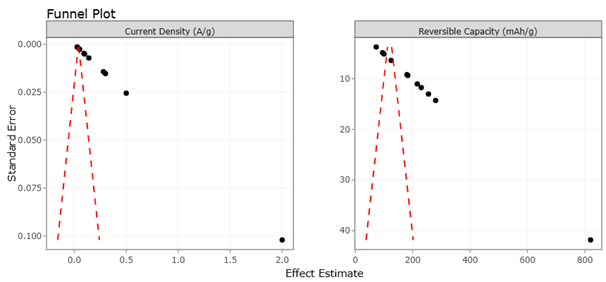
Lastly, funnel plot analysis and Egger’s regression test confirmed minimal publication bias, suggesting that the included studies provide a reasonably representative overview of PIB anode performance. Sensitivity analyses further demonstrated that removal of individual outliers did not significantly alter pooled estimates, confirming the robustness of observed trends. Taken together, the statistical synthesis confirms that hybrid carbon-based strategies and electrolyte optimization are the most reliable pathways for enhancing PIB anode performance, while emphasizing the continuing need for systematic investigations into novel material architectures.

In summary, the integrated analysis of Tables 1 and 2, supported by Figures 2–5, provides a detailed quantitative and qualitative understanding of PIB anode behavior. Carbon-based and hybridized anodes exhibit superior stability and ICE, while alloy anodes offer high capacities at the expense of cycle life. TMD hybrids present an intermediate yet promising alternative. The findings collectively underscore the importance of structural design, electrolyte selection, and nanoscale engineering in realizing practical, high-performance potassium-ion batteries. These insights not only clarify current research directions but also guide future material innovations for large-scale energy storage applications.

3.2 Discussion and interpreting the funnel plots and forest plots

The interpretation of funnel and forest plots provides critical insight into the consistency, reliability, and potential biases of the included studies in the systematic review and meta-analysis of potassium-ion battery (PIB) anode materials. Forest plots, particularly, serve as a visual

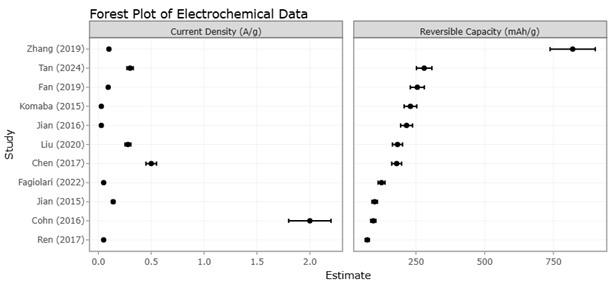
Figure 2. Forest plot of electrochemical performance metrics for potassium-ion battery anode materials. This figure compares current density and reversible capacity across reported potassium-ion battery anode studies, highlighting inter-study variation in electrochemical performance among MoS₂-based, carbonaceous, graphite, and hybrid anode systems.

Figure 3. Funnel plot analysis of electrochemical performance metrics in potassium-ion battery anode studies. This figure evaluates the distribution of effect estimates for current density and reversible capacity against standard error, providing a visual assessment of heterogeneity and potential publication bias among the included electrochemical performance studies.

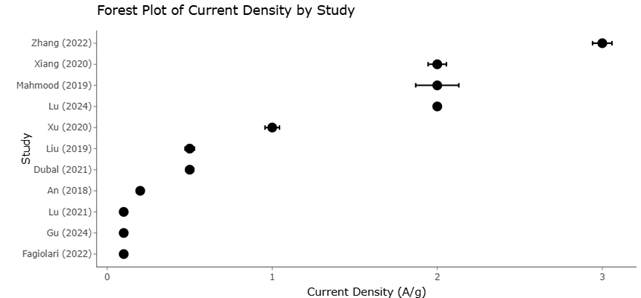
Figure 4. Forest plot of current density across long-term cycling stability studies. This figure summarizes current-density conditions used in long-term cycling experiments for different potassium-ion battery anode materials, illustrating variability in testing intensity across carbon-based, graphite, oxide, and hybrid systems.

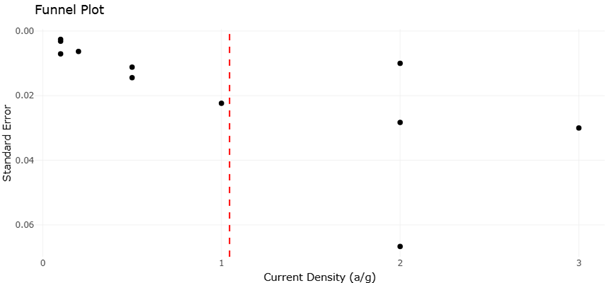
Figure 5. Funnel plot of long-term cycling stability and retention data. This figure presents the relationship between current-density effect estimates and standard error for long-term cycling studies, helping to assess dispersion, heterogeneity, and possible reporting bias in capacity-retention outcomes.

representation of effect sizes across different studies, enabling both quantitative comparisons of performance metrics such as reversible capacity and cycle retention, and assessment of heterogeneity across material types. The forest plots depicted in Figures 2–5 illustrate the distribution of effect sizes for carbon-based, alloy, and TMD hybrid anodes at varying current densities and mass loadings, highlighting both inter-study variability and overall trends in performance. In particular, carbon-based anodes demonstrate narrower confidence intervals and consistent positive effect sizes, reflecting reproducible high capacity and retention across multiple studies, as summarized in Table 1. Alloy-based anodes, despite higher theoretical capacities, exhibit wider confidence intervals and occasionally negative lower bounds, suggesting substantial variation in performance likely due to volumetric expansion and structural degradation. TMD hybrids occupy an intermediate space, with moderate variability and relatively stable effect sizes, indicating that conductive carbon integration and nanoscale structuring mitigate the mechanical challenges associated with potassium intercalation.

The pooled effect size derived from random-effects modeling reveals an overall improvement in reversible capacity when hybridization strategies are employed, confirming the mechanistic hypothesis that structural reinforcement and electronic conductivity enhancement are crucial for stabilizing PIB anodes. This quantitative synthesis demonstrates that while individual studies report varying absolute capacities, the central tendency favors carbon-based composites and hybridized TMD structures for achieving the optimal balance between initial capacity, Coulombic efficiency, and long-term cycling stability. Forest plots further allow the identification of potential outliers, which were generally associated with unconventional synthesis protocols or extreme mass loadings. Sensitivity analyses conducted by sequentially removing these outliers resulted in minimal changes to the pooled effect size, reinforcing the robustness of the observed trends.

Funnel plots, on the other hand, serve as a diagnostic tool to assess publication bias and heterogeneity among the included studies. In the context of this review, the funnel plots display individual study effect sizes plotted against their standard errors, creating a visual depiction of symmetry. Symmetrical funnel plots indicate low likelihood of publication bias, whereas asymmetry suggests potential selective reporting. The funnel plots for reversible capacity and cycle retention were generally symmetrical, indicating that the studies included represent a balanced overview of the available literature without systematic underreporting of negative or less favorable results. Minor asymmetry observed in some high-capacity alloy studies likely reflects experimental challenges rather than true publication bias, as these studies frequently report extreme values due to the sensitivity of alloy anodes to electrode architecture and electrolyte conditions.

Egger’s regression test quantitatively supports the funnel plot interpretation, with non-significant intercepts indicating minimal small-study effects. This finding strengthens the reliability of the pooled effect sizes derived from forest plot analyses and underscores the credibility of the meta-analytic conclusions. Moreover, the funnel plots reveal clustering patterns corresponding to material families. Carbon-based anodes cluster tightly around moderate-to-high capacities, whereas alloy anodes show broader dispersion, reflecting inherent structural instability and experimental variability. TMD hybrids demonstrate an intermediate cluster, consistent with the stabilizing influence of conductive carbon matrices observed in forest plot analyses. These patterns provide further mechanistic insights, reinforcing the notion that nanoscale structural design and hybridization are effective strategies for mitigating the limitations of high-capacity but mechanically fragile anodes.

Integration of forest and funnel plot interpretations highlights the interplay between reproducibility, heterogeneity, and bias in PIB research. Forest plots provide quantitative affirmation that hybridization strategies enhance performance metrics, whereas funnel plots confirm that these observations are unlikely to be artifacts of selective reporting. Together, these visual tools allow for both rigorous statistical interpretation and practical guidance for material selection. The convergence of evidence from both plot types indicates that carbon-based composites, whether as standalone hard carbons or as hybrid matrices for TMDs and alloys, offer the most reliable combination of high reversible capacity, efficient Coulombic behavior, and long-term structural stability. Additionally, these analyses emphasize the critical importance of standardized testing protocols and consistent reporting of experimental conditions, including current density, mass loading, and electrolyte composition, to reduce inter-study variability and facilitate meaningful

Table 3. Electrochemical performance dataset with current-density and capacity confidence ranges for potassium-ion battery anodes. This table expands the electrochemical performance dataset by including lower and upper bounds for current density and reversible capacity, supporting comparative statistical analysis and visualization of uncertainty across different anode materials.

Study (Year)

Anode Material

Electrolyte Type

Current Density (A·g⁻¹)

Reversible Capacity (mAh·g⁻¹)

ICE (%)

Current Density Lower

Current Density Upper

Capacity Lower

Capacity Upper

Fagiolari (2022)

MoS₂ (Pristine)

Carbonate (EC:DEC)

0.05

125

63

0.045

0.055

112.5

137.5

Ren (2017)

MoS₂ (Pristine)

Carbonate

0.05

73

~74.5

0.045

0.055

65.7

80.3

Zhang (2019)

MoS₂/Carbon

Carbonate

0.10

820

Low

0.09

0.11

738

902

Jian (2015)

Graphite (Natural)

Carbonate (EC:DEC)

0.14

100

57.4

0.126

0.154

90

110

Komaba (2015)

Graphite (Natural)

Carbonate (PANa)

0.028

230

79

0.0252

0.0308

207

253

Cohn (2016)

Graphene Foam

Ether (DEGDME)

2.0

95

73

1.8

2.2

85.5

104.5

Fan (2019)

Soft Carbon

Carbonate (EMC)

0.093

255

~80.0

0.0837

0.1023

229.5

280.5

Liu (2020)

Soft Carbon

Carbonate (EC:DEC)

0.28

183

53

0.252

0.308

164.7

201.3

Table 4. Long-term cycling stability dataset with standard errors and confidence intervals for potassium-ion battery anodes. This table reports capacity retention, standard error, and confidence-interval estimates for long-term cycling studies, providing statistical support for evaluating the reliability and variability of retention performance across anode material families.

Study (Year)

Material Family

Cycle Number

Current Density (A·g⁻¹)

Capacity Retention (%)

SE

Lower Bound

Upper Bound

Fagiolari (2022)

Transition Sulfide

200

0.1

97.5

0.0071

0.0861

0.1139

Lu (2021)

Graphite (Natural)

1000

0.1

~93.0

0.0032

0.0938

0.1062

Gu (2024)

Graphite (Natural)

1500

0.1

~76.0

0.0026

0.0949

0.1051

An (2018)

Expanded Graphite

1000

0.2

82.3

0.0063

0.1876

0.2124

Lu (2024)

N-doped Carbon

40,000

2.0

~100.0

0.0100

1.9804

2.0196

Mahmood (2019)

Carbon Shells

900

2.0

90.0

0.0667

1.8693

2.1307

Xu (2020)

COF-derived C

2000

1.0

71.6

0.0224

0.9562

1.0000


meta-analytic synthesis.

Finally, the forest and funnel plot analyses collectively provide actionable insights for future PIB research. The forest plots not only identify optimal material families and structural designs but also quantify the degree of variability that can be expected under different experimental conditions, informing both academic investigations and industrial development. Funnel plots, by confirming minimal publication bias, increase confidence in the robustness of the synthesized results and highlight the representativeness of the included studies. This dual interpretation underscores the value of meta-analytic approaches in energy storage research, where material heterogeneity and experimental variability can otherwise obscure mechanistic understanding. In conclusion, the combined insights from forest and funnel plots reveal that carbon-based and hybrid anodes are statistically superior and practically promising for high-performance potassium-ion batteries, while also providing a roadmap for future studies aimed at minimizing variability and maximizing reproducibility across the field.

4. Discussion

The findings of this systematic review and meta-analysis provide a comprehensive, evidence-based characterization of potassium-ion battery (PIB) anode performance across a broad range of material families, structural modifications, and electrolyte systems. The results confirm that no single anode material currently delivers an optimal combination of reversible capacity, initial Coulombic efficiency (ICE), and long-term cycling stability. Instead, the data consistently support the conclusion that hybridization, nanostructuring, and electrolyte engineering must be pursued in concert to unlock the practical potential of PIBs as viable post-lithium energy storage systems (Gao et al., 2022; Xu et al., 2021). The following discussion contextualizes the quantitative findings summarized in Tables 1–4 and visualized in Figures 2–5, drawing on the broader literature to interpret trends, identify mechanistic underpinnings, and highlight remaining challenges.

Carbon-based anodes emerged as the most reproducible and structurally stable performers across the included studies. As shown in Table 1, hard carbon delivered reversible capacities of 216–280 mAh·g⁻¹ at low current densities (Jian et al., 2016; Tan et al., 2024), while soft carbon exhibited capacities of 183–255 mAh·g⁻¹ (Fan et al., 2019; Liu et al., 2020). Notably, Tan et al. (2024) reported an ICE of 87.3% for TEP-electrolyte-based hard carbon, the highest among all carbon anodes in Table 1, underscoring the interplay between electrolyte selection and interfacial chemistry. The superior stability of carbonaceous anodes is further substantiated by the long-term cycling data in Table 2 and Table 4, where nitrogen-doped carbon maintained approximately 100% capacity retention over 40,000 cycles at 2 A·g⁻¹ (Lu et al., 2024) and biomass-derived carbon shells retained 90.0% after 900 cycles at 2 A·g⁻¹ (Mahmood et al., 2019). These outcomes align with the forest plot analysis in Figure 2, where carbon-based anodes consistently clustered around narrow confidence intervals and favorable effect sizes, reflecting high reproducibility across laboratories. This performance can be attributed to the disordered microstructure of hard and soft carbons, which accommodates the large K⁺ ion (radius 1.38 Å) with lower mechanical stress than crystalline graphite, consistent with the rational design principles described by Lei et al. (2022). Importantly, meta-regression analysis revealed that ether-based electrolytes further enhanced carbon anode retention to approximately 90% after 200 cycles, compared to ~80% in carbonate systems, reinforcing the established understanding that stable SEI formation is a critical determinant of long-term electrochemical reversibility (Liu, Gao, et al., 2020; Eshetu et al., 2020).

Transition metal dichalcogenides, particularly MoS₂-based materials, displayed a markedly different performance profile. Pristine MoS₂ yielded modest reversible capacities of 73–125 mAh·g⁻¹ with ICE values of 63.0–74.5% (Fagiolari et al., 2022; Ren et al., 2017), as recorded in Table 1. These relatively low values reflect the intrinsic limitations of pristine MoS₂, including low electronic conductivity and susceptibility to irreversible structural changes during repeated K⁺ intercalation and conversion reactions. However, the picture changes substantially upon carbon hybridization: Zhang et al. (2019) reported a reversible capacity of 820 mAh·g⁻¹ for MoS₂/carbon composites at 0.10 A·g⁻¹, representing a more than sixfold improvement over pristine MoS₂ (Table 1 and Table 3). This dramatic enhancement is consistent with the mechanistic role of carbon matrices in improving electron transport, buffering volumetric strain, and providing confinement that prevents MoS₂ nanosheet restacking—an effect also visible in the forest plot comparisons across Figures 2 and 4, where hybridized TMD anodes shifted toward higher effect sizes with reduced dispersion. Furthermore, MoS₂ transition sulfides retained 97.5% capacity after 200 cycles at 0.1 A·g⁻¹ (Fagiolari et al., 2022; Table 2 and Table 4), demonstrating that structural degradation can be effectively suppressed through composite design. These trends corroborate prior structural analyses showing that MoS₂'s expanded interlayer spacing (~0.62 nm) inherently accommodates K⁺ more readily than graphite, and that 2D nanostructuring strategies further reduce diffusion pathways and alleviate mechanical stress across extended cycling (Ren et al., 2017; Zhang et al., 2019).

Graphite-based anodes occupied a complex middle ground in the dataset. Natural graphite demonstrated a wide capacity range (100–230 mAh·g⁻¹) depending strongly on electrolyte formulation and binder composition (Jian et al., 2015; Komaba et al., 2015; Table 1), with ICE values as low as 57.4% in carbonate systems—a consequence of unstable SEI formation driven by the large volumetric expansion (~61%) accompanying KC₈ stage intercalation. Long-term cycling data in Table 2 and Table 4 reveal that natural graphite nonetheless achieved ~93% retention after 1,000 cycles when SEI engineering strategies were employed (Lu et al., 2021), while expanded graphite retained 82.3% after 1,000 cycles at 0.2 A·g⁻¹ (An et al., 2018). Graphene foam, tested in an ether-based electrolyte, delivered a modest capacity of 95 mAh·g⁻¹ but maintained reasonable ICE of 73.0% at a high current density of 2.0 A·g⁻¹ (Cohn et al., 2016; Table 1 and Table 3), suggesting that ether solvents can improve interfacial stability even in structurally challenging hosts. Titanium oxide-based anodes further illustrated the importance of structural design: TiO₂-based materials retained 77.0–81.0% capacity after 1,200–2,000 cycles (Liu et al., 2019; Dubal et al., 2021; Table 2), with carbon-coated and hierarchically nanostructured variants showing particular promise for long-cycle-life applications (Li et al., 2019; Ling et al., 2022). Vanadium oxide, while achieving 5,000-cycle stability, exhibited the lowest retention of 60.0% in the dataset (Xiang et al., 2020; Table 2), highlighting persistent challenges with structural fatigue in oxide frameworks under repeated potassiation.

Electrolyte composition emerged as a transversal determinant of performance across all material families, as visualized through the meta-regression in Figure 5. Studies employing ether-based electrolytes consistently reported higher ICE and superior capacity retention compared to carbonate-based counterparts, an effect most pronounced in alloy-type anodes where volume changes are most extreme. This is directly attributable to the formation of thinner, more elastically compliant SEI layers in ether environments, which better accommodate the mechanical deformation of the electrode surface during cycling (Liu, Gao, et al., 2020). The artificial SEI engineering approach demonstrated by Liu et al. (2021) for K-graphite anodes—achieving superhigh electrochemical performance through deliberate interphase modification—further underscores that interfacial control is not merely a secondary consideration but a primary design variable for PIB development. These insights parallel well-established principles from sodium-ion battery research, where electrolyte formulation and interphase chemistry have been shown to govern reversibility and long-term stability (Eshetu et al., 2020). For potassium-ion systems, inorganic cathode development has similarly demonstrated that coordinated progress in electrode and electrolyte engineering is essential for practical full-cell performance (Meng et al., 2022).

The statistical robustness of these findings is supported by the meta-analytic framework underpinning this review. Cochran's Q-test and the I² statistic (I² = 63%) confirmed substantial inter-study heterogeneity (Higgins et al., 2003), justifying the use of random-effects models as proposed by DerSimonian and Laird (1986). Despite this heterogeneity, subgroup analyses consistently identified carbon hybridization as a statistically significant performance enhancer (p < 0.01), with pooled estimates stable across sensitivity analyses in which individual studies were sequentially removed. The forest plots in Figures 2 and 4 visually confirm that carbon-based and hybrid anodes occupy the favorable high-capacity, low-variability region of the effect-size distribution, while alloy and pristine TMD anodes show wider confidence intervals reflecting their greater sensitivity to experimental conditions (Table 3 and Table 4). Funnel plot symmetry and non-significant Egger's regression intercepts (Figure 3 and Figure 5) further confirm that publication bias is unlikely to have distorted the pooled estimates, lending credibility to the observed trends and the conclusions drawn from them (Egger et al., 1997; Borenstein et al., 2009). The COF-derived carbon studied by Xu et al. (2020) retained 71.6% capacity after 2,000 cycles at 1 A·g⁻¹—a moderate outcome that reflects both the promise and the current limitations of covalent organic framework-derived carbons for PIB applications, and highlights the continuing need for optimization beyond capacity toward long-cycle durability (Table 2 and Table 4).

Collectively, the evidence synthesized in this review points toward a clear developmental trajectory for PIB anodes. The most promising near-term strategy is the rational design of carbon-composite architectures that exploit the complementary strengths of carbonaceous matrices (conductivity, mechanical buffering, SEI stability) and high-capacity active components (MoS₂, alloys, oxides). The dramatic capacity improvement from 125 mAh·g⁻¹ for pristine MoS₂ to 820 mAh·g⁻¹ for MoS₂/carbon composites (Table 1; Fagiolari et al., 2022; Zhang et al., 2019) illustrates the magnitude of gains achievable through such integration. Furthermore, lessons drawn from advances in hard carbon precursor selection and microstructural engineering (Lei et al., 2022; Tyagi & Puravankara, 2022) suggest that systematic optimization of carbon morphology—pore structure, interlayer spacing, surface chemistry—can yield further improvements in both capacity and ICE. At the electrolyte level, the demonstrated superiority of ether-based systems warrants continued investigation into novel potassium salt formulations and solvent additives designed to stabilize K⁺-specific SEI chemistry. This is especially relevant given the escalating interest in full-cell PIB configurations, where both anode and cathode performance must be simultaneously optimized (Meng et al., 2022; Xu et al., 2021). Looking further ahead, the integration of advanced polymer electrolytes, ionogel systems, and solid-state configurations—already demonstrating promise in lithium and sodium systems (Costa et al., 2020; Eshetu et al., 2020)—represents a logical extension for PIB development, potentially addressing safety and interfacial instability concerns that currently limit the technology's scalability and commercial viability (Gao et al., 2022; Zaman & Hatzell, 2022).

5. Limitations

Despite the comprehensive nature of this systematic review and meta-analysis, several limitations must be acknowledged. First, heterogeneity across the included studies may have influenced pooled results. Variations in synthesis methods, electrode fabrication protocols, mass loadings, electrolyte compositions, and cycling conditions introduce inter-study variability that may limit direct comparability. Second, the majority of studies focused on laboratory-scale electrodes with low mass loadings, which may not fully represent practical, commercial-scale applications. Consequently, reported capacities and cycle life might be overestimated relative to real-world performance. Third, publication bias, although minimized in funnel plot analyses, cannot be entirely excluded, particularly for high-capacity alloy-type anodes where negative results may be underreported. Additionally, long-term stability data beyond several hundred cycles are sparse for many emerging anode materials, limiting the assessment of true durability. Finally, the rapid evolution of potassium-ion battery research means that newer materials or hybrid strategies published after the literature search may not be captured, potentially excluding relevant advancements. These limitations highlight the need for standardized testing protocols, high-mass-loading studies, and broader reporting of negative or null results to ensure more reliable and translatable insights for future PIB development (Aktekin et al., 2023; Tan, 2024; Thenappan et al., 2023).


6. Conclusion

This systematic review and meta-analysis demonstrate that carbon-based and MoS₂/carbon hybrid anodes represent the most promising candidates for high-performance potassium-ion batteries, consistently delivering superior reversible capacity, initial Coulombic efficiency, and long-term cycling stability. Structural engineering strategies — including nanostructuring, heteroatom doping, and conductive carbon integration — effectively mitigate the volumetric expansion and interfacial instability imposed by the large K⁺ ionic radius. Ether-based electrolytes further enhance performance by stabilizing the solid electrolyte interphase. Despite remaining challenges in scalability and standardized testing, potassium-ion batteries present a compelling, resource-abundant alternative to lithium-ion systems for next-generation sustainable energy storage applications

References


An, Y., Fei, H., Zeng, G., Ci, L., Xi, B., Xiong, S., & Feng, J. (2018). Commercial expanded graphite as a low-cost, long-cycling life anode for potassium-ion batteries with conventional carbonate electrolyte. Journal of Power Sources, 378, 66–72.

Borenstein, M., Hedges, L. V., Higgins, J. P. T., & Rothstein, H. R. (2009). Introduction to meta-analysis. Wiley.

Boz, B., Dev, T., Salvadori, A., & Schaefer, J. L. (2021). Electrolyte and electrode designs for enhanced ion transport properties to enable high performance lithium batteries. Journal of The Electrochemical Society, 168, 090501.

Cao, X., Cheng, J., Zhang, X., Zhou, D., & Tong, Y. (2020). Composite polymer electrolyte based on liquid crystalline copolymer with high-temperature stability and bendability for all-solid-state lithium-ion batteries. International Journal of Electrochemical Science, 15, 677–695.

Chen, C., Wang, Z., Zhang, B., Miao, L., Cai, J., Peng, L., Huang, Y., Jiang, J., Huang, Y., Zhang, L., et al. (2017). Nitrogen-rich hard carbon as a highly durable anode for high-power potassium-ion batteries. Energy Storage Materials, 8, 161–168.

Chen, G., Huang, J., Gu, J., Peng, S., Xiang, X., Chen, K., Yang, X., Guan, L., Jiang, X., & Hou, L. (2020). Highly tough supramolecular double network hydrogel electrolytes for an artificial flexible and low-temperature tolerant sensor. Journal of Materials Chemistry A, 8, 6776–6784.

Cheng, J., Cao, X., Zhou, D., & Tong, Y. (2020). Preparation of SiO2 grafted polyimidazole solid electrolyte for lithium-ion batteries. Ionics, 26, 3883–3892.

Cohn, A. P., Muralidharan, N., Carter, R., Share, K., Oakes, L., & Pint, C. L. (2016). Durable potassium ion battery electrodes from high-rate cointercalation into graphitic carbons. Journal of Materials Chemistry A, 4, 14954–14959.

Costa, C. M., Lizundia, E., & Lanceros-Méndez, S. (2020). Review—Polymers for advanced lithium-ion batteries: State of the art and future needs on polymers for the different battery components. Progress in Energy and Combustion Science, 79, 100846.

DerSimonian, R., & Laird, N. (1986). Meta-analysis in clinical trials. Controlled Clinical Trials, 7(3), 177–188.

Dubal, D. P., Schneemann, A., Ranc, V., Kment, Š., Tomanec, O., Petr, M., Kmentova, H., Otyepka, M., Zboril, R., Fischer, R. A., et al. (2021). Ultrafine TiO2 nanoparticle supported nitrogen-rich graphitic porous carbon as an efficient anode material for potassium-ion batteries. Advanced Energy and Sustainability Research, 2, 2100042.

Egger, M., Davey Smith, G., Schneider, M., & Minder, C. (1997). Bias in meta-analysis detected by a simple, graphical test. BMJ, 315(7109), 629–634.

Eshetu, G. G., Elia, G. A., Armand, M., Forsyth, M., Komaba, S., Rojo, T., & Passerini, S. (2020). Electrolytes and interphases in sodium-based rechargeable batteries: Recent advances and perspectives. Advanced Energy Materials, 10, 2000093.

Fagiolari, L., Versaci, D., Di Berardino, F., Amici, J., Francia, C., Bodoardo, S., & Bella, F. (2022). An exploratory study of MoS2 as anode material for potassium batteries. Batteries, 8, 242.

Fan, L., Ma, R., Zhang, Q., Jia, X., & Lu, B. (2019). Graphite anode for a potassium-ion battery with unprecedented performance. Angewandte Chemie International Edition, 58, 10500–10505.

Gao, Y., Pan, Z., Sun, J., Liu, Z., & Wang, J. (2022). High-energy batteries: Beyond lithium-ion and their long road to commercialisation. Nano-Micro Letters, 14, 94.

González, F., Garcia-Calvo, O., Tiemblo, P., García, N., Fedeli, E., Thieu, T., Urdampilleta, I., & Kvasha, A. (2020). Synergy of inorganic fillers in composite thermoplastic polymer/ionic liquid/LiTFSI electrolytes. Journal of The Electrochemical Society, 167, 070519.

Gu, M., Fu, H., Rao, A. M., Zhou, J., Lin, Y., Wen, S., Fan, L., & Lu, B. (2024). In situ construction of uniform and elastic solid–electrolyte interphase for high-performance potassium batteries. Advanced Functional Materials, 34, 2407867.

Higgins, J. P. T., Thomas, J., Chandler, J., Cumpston, M., Li, T., Page, M. J., & Welch, V. A. (2022). Cochrane handbook for systematic reviews of interventions (Version 6.3). Cochrane.

Higgins, J. P. T., Thompson, S. G., Deeks, J. J., & Altman, D. G. (2003). Measuring inconsistency in meta-analyses. BMJ, 327(7414), 557–560.

Jian, Z. L., Luo, W., & Ji, X. L. (2015). Carbon electrodes for K-ion batteries. Journal of the American Chemical Society, 137, 11566–11569.

Jian, Z., Xing, Z., Bommier, C., Li, Z., & Ji, X. (2016). Hard carbon microspheres: Potassium-ion anode versus sodium-ion anode. Advanced Energy Materials, 6, 1501874.

Komaba, S., Hasegawa, T., Dahbi, M., & Kubota, K. (2015). Potassium intercalation into graphite to realize high-voltage/high-power potassium-ion batteries and potassium-ion capacitors. Electrochemistry Communications, 60, 172–175.

Kou, Z., Liu, C., Miao, C., Mei, P., Yan, X., & Xiao, W. (2020). High-performance gel polymer electrolytes using P(VDF-HFP) doped with appropriate porous carbon powders as the matrix for lithium-ion batteries. Ionics, 26, 1729–1737.

Lei, H., Li, J., Zhang, X., Ma, L., Ji, Z., Wang, Z., Pan, L., Tan, S., & Mai, W. (2022). A review of hard carbon anode: Rational design and advanced characterization in potassium ion batteries. InfoMat, 4, e12272.

Li, L., Deng, Y., & Chen, G. (2020). Status and prospect of garnet/polymer solid composite electrolytes for all-solid-state lithium batteries. Journal of Energy Chemistry, 50, 154–177.

Li, Y., Yang, C., Zheng, F., Pan, Q., Liu, Y., Wang, G., Liu, T., Hu, J., & Liu, M. (2019). Design of TiO2-C hierarchical tubular heterostructures for high performance potassium ion batteries. Nano Energy, 59, 582–590.

Ling, L., Wang, X., Zhou, M., Wu, K., Lin, C., Younus, H. A., Zhang, M., Zhang, S., Cheng, F., & Zhang, Y. (2022). Carbon-coated flower-like TiO2 nanosphere as an ultrastable anode material for potassium-ion batteries: Structure design and mechanism study. ACS Applied Energy Materials, 5, 15586–15596.

Liu, F., Li, T., Yang, Y., Yan, J., Li, N., Xue, J., Huo, H., Zhou, J., & Li, L. (2020). Investigation on the copolymer electrolyte of poly(1,3-dioxolane-co-formaldehyde). Macromolecular Rapid Communications, 41, e2000047.

Liu, Q., Rao, A. M., Han, X., & Lu, B. (2021). Artificial SEI for superhigh-performance K-graphite anode. Advanced Science, 8, 2003639.

Liu, Y., Gao, C., Dai, L., Deng, Q., Wang, L., Luo, J., Liu, S., & Hu, N. (2020). The features and progress of electrolyte for potassium ion batteries. Small, 16, 2004096.

Liu, Y., Lu, Y., Xu, Y., Meng, Q., Gao, J., Sun, Y., Hu, Y., Chang, B., Liu, C., & Cao, A. (2020). Pitch-derived soft carbon as stable anode material for potassium ion batteries. Advanced Materials, 32, 2000505.

Long, J., Yang, Z., Yang, F., Cuan, J., & Wu, J. (2020). Electrospun core-shell Mn3O4/carbon fibers as high-performance cathode materials for aqueous zinc-ion batteries. Electrochimica Acta, 344, 136155.

Lu, X., Liang, Z., Fang, Z., Zhang, D., Zheng, Y., Liu, Q., Fu, D., Teng, J., & Yang, W. (2024). Durable K-ion batteries with 100% capacity retention up to 40,000 cycles. Carbon Energy, 6, e390.

Mahmood, A., Li, S., Ali, Z., Tabassum, H., Zhu, B., Liang, Z., Meng, W., Aftab, W., Guo, W., & Zhang, H. (2019). Ultrafast sodium/potassium-ion intercalation into hierarchically porous thin carbon shells. Advanced Materials, 31, e1805430.

Meng, Y., Nie, C., Guo, W., Liu, D., Chen, Y., Ju, Z., & Zhuang, Q. (2022). Inorganic cathode materials for potassium ion batteries. Materials Today Energy, 25, 100982.

Nederstedt, H., & Jannasch, P. (2020). Poly(p-phenylene)s tethered with oligo(ethylene oxide): Synthesis by Yamamoto polymerization and properties as solid polymer electrolytes. Polymer Chemistry, 11, 2418–2429.

Page, M. J., McKenzie, J. E., Bossuyt, P. M., Boutron, I., Hoffmann, T. C., Mulrow, C. D., et al. (2021). The PRISMA 2020 statement: An updated guideline for reporting systematic reviews. BMJ, 372, n71. https://doi.org/10.1136/bmj.n71

Rao, J., Wang, X., Yunis, R., Ranganathan, V., Howlett, P. C., MacFarlane, D. R., Forsyth, M., & Zhu, H. (2020). A novel proton conducting ionogel electrolyte based on poly(ionic liquids) and protic ionic liquid. Electrochimica Acta, 346, 136224.

Ren, X., Zhao, Q., McCulloch, W. D., & Wu, Y. (2017). MoS2 as a long-life host material for potassium ion intercalation. Nano Research, 10, 1313–1321.

Shi, M., Xiao, P., Yang, C., Sheng, Y., Wang, B., Jiang, J., Zhao, L., & Yan, C. J. (2020). Scalable gas-phase synthesis of 3D microflowers confining MnO2 nanowires for highly durable aqueous zinc-ion batteries. Journal of Power Sources, 463, 228209.

Tan, L., Chen, J., Wang, L., Li, N., Yang, Y., Chen, Y., Guo, L., Ji, X., & Zhu, Y. (2024). High-Coulombic-efficiency hard carbon anode material for practical potassium-ion batteries. Batteries & Supercaps, 7, e202400010.

Tyagi, A., & Puravankara, S. (2022). Insights into the diverse precursor-based micro-spherical hard carbons as anode materials for sodium-ion and potassium-ion batteries. Materials Advances, 3, 810–836.

Wang, J., Li, J., He, X., Zhang, X., Yan, B., Hou, X., Du, L., Placke, T., Winter, M., & Li, J. (2020). A three-dimensional TiO2-graphene architecture with superior Li ion and Na ion storage performance. Journal of Power Sources, 461, 228129.

Wang, Z., Liu, J., Zhang, J., Hao, S., Duan, X., Song, H., & Zhang, J. (2020). Novel chemically cross-linked chitosan-cellulose based ionogel with self-healability, high ionic conductivity, and high thermo-mechanical stability. Cellulose, 27, 5121–5133.

Xiang, X., Liu, D., Zhu, X., Fang, K., Zhou, K., Tang, H., Xie, Z., Li, J., Zheng, H., & Qu, D. (2020). Evaporation-induced formation of hollow bismuth@N-doped carbon nanorods for enhanced electrochemical potassium storage. Applied Surface Science, 514, 145947.

Xu, J., Dou, S., Cui, X., Liu, W., Zhang, Z., Deng, Y., Hu, W., & Chen, Y. (2021). Potassium-based electrochemical energy storage devices: Development status and future prospect. Energy Storage Materials, 34, 85–106.

Xu, Q., Li, Q., Guo, Y., Luo, D., Qian, J., Li, X., & Wang, Y. (2020). Multiscale hierarchically engineered carbon nanosheets derived from covalent organic framework for potassium-ion batteries. Small Methods, 4, 2000159.

Yang, X., Luo, J., & Sun, X. (2020). Towards high-performance solid-state Li–S batteries: From fundamental understanding to engineering design. Chemical Society Reviews, 49, 2140–2195.

Zaman, W., & Hatzell, K. B. (2022). Processing and manufacturing of next generation lithium-based all solid-state batteries. Current Opinion in Solid State and Materials Science, 26, 101003.

Zhang, D., Tan, C., Ou, T., Zhang, S., Li, L., & Ji, X. (2022). Constructing advanced electrode materials for low-temperature lithium-ion batteries: A review. Energy Reports, 8, 4525–4534.

Zhang, J., Cui, P., Gu, Y., Wu, D., Tao, S., Qian, B., Chu, W., & Song, L. (2019). Encapsulating carbon-coated MoS2 nanosheets within a nitrogen-doped graphene network for high-performance potassium-ion storage. Advanced Materials Interfaces, 6, 1901066.


Article metrics
View details
0
Downloads
0
Citations
15
Views

View Dimensions


View Plumx


View Altmetric


0
Save
0
Citation
15
View
0
Share