Biosensors and Nanotheranostics

Bionanotechnology, Drug Delivery, Therapeutics | online ISSN 3064-7789
175
Citations
121.4k
Views
93
Articles
Your new experience awaits. Try the new design now and help us make it even better
Switch to the new experience
Figures and Tables
REVIEWS   (Open Access)

CRISPR-Cas13 Paper Biosensors for Point-of-Care Genotyping of Thalassemia Mutations: Mechanisms, Isothermal Coupling, and Translational Readiness

Mohammad Lutfor Rahman 1*, Md Shamsuddin Sultan Khan 2*

+ Author Affiliations

Biosensors and Nanotheranostics 5 (1) 1-8 https://doi.org/10.25163/biosensors.5110998

Submitted: 03 October 2026 Revised: 20 November 2026  Published: 01 December 2026 


Abstract

Thalassemia is among the most common inherited monogenic disorders worldwide, and its heaviest burden falls on regions where centralized molecular testing is hardest to sustain. Accurate carrier screening and allelic discrimination remain the backbone of prevention, yet the reference methods that deliver them, polymerase chain reaction, reverse dot-blot, multiplex ligation-dependent probe amplification, and sequencing, depend on instruments, cold chains, and trained staff that many endemic settings cannot guarantee. This review examines how CRISPR-Cas13 paper biosensors might close that gap. We trace the enzymology of the Type VI effector, whose crRNA-guided recognition of single-stranded RNA unleashes a high-turnover collateral trans-cleavage that converts one binding event into thousands of cleaved reporters, and we show how a single engineered mismatch in the guide can sharpen that activity into single-nucleotide allelic resolution for mutations such as CD41/42, IVS-1-110, and codon 39. We then follow the full assay cascade, from rapid whole-blood lysis through isothermal recombinase polymerase amplification and T7 in vitro transcription to a lateral-flow dipstick on which a severed reporter is read as a visible band by the naked eye. Reagent lyophilization with disaccharide lyoprotectants is considered as the step that frees the platform from refrigeration. Across hematologic, oncologic, and infectious-disease applications, reported concordance with laboratory standards is high, though most thalassemia work remains preclinical. We argue that simplified extraction, one-pot contamination control, and robust multiplexing are the decisive hurdles between a promising chemistry and a deployable, REASSURED-aligned diagnostic. On current evidence the chemistry is mature, whereas thalassemia-specific clinical validation across endemic populations remains the critical unfinished step.

Keywords: CRISPR-Cas13; SHERLOCK; thalassemia; point-of-care testing; lateral-flow assay; recombinase polymerase amplification; single-nucleotide discrimination; collateral cleavage

1. Introduction

Thalassemia ranks among the most widespread inherited hemoglobinopathies, and its geography is unusually concentrated: the Mediterranean basin, the Middle East, South and Southeast Asia, and parts of sub-Saharan Africa carry the greatest share of cases (Taher et al., 2018). The disorder arises from pathogenic variation in the alpha-globin cluster (HBA1/HBA2) on chromosome 16 and the beta-globin gene (HBB) on chromosome 11, and because inheritance is autosomal recessive, affected individuals synthesize little or no functional globin chain (Bhattacharjee et al., 2022; Taher et al., 2018). In beta-thalassemia, the shortfall of beta-globin leaves unpaired alpha-globin chains to accumulate in erythroid precursors (Taher et al., 2018). Those free chains precipitate, and the downstream consequences, premature hemolysis, ineffective erythropoiesis, chronic anemia, hepatosplenomegaly, and the iron overload that follows a lifetime of transfusion in transfusion-dependent disease, define the clinical picture (Frangoul et al., 2021; Taher et al., 2018).

At the molecular level the disease is strikingly heterogeneous (Shahid et al., 2025; Taher et al., 2018). More than two hundred variants have been catalogued in HBB alone, spanning single-nucleotide substitutions, nonsense and missense changes, splice-altering intronic lesions, and small frameshift insertions or deletions such as CD41/42 (-CTTT) and IVS-1-110 (G>A) (Bhattacharjee et al., 2022; Gabr et al., 2020; Li et al., 2022; Taher et al., 2018). Alpha-thalassemia, by contrast, more often reflects large deletions, including the Southeast Asian deletion, or non-deletional point mutations such as Hb Westmead in HBA2 (Li et al., 2022). This diversity is not an academic detail; it is precisely why carrier identification, prenatal diagnosis, and reliable allelic discrimination matter so much for community-level prevention and timely clinical care (Chen et al., 2020; Shahid et al., 2025; Zhou et al., 2026).

The diagnostic reference standards for thalassemia are centralized by design. Genotyping today leans on polymerase chain reaction (PCR), reverse dot-blot (RDB) hybridization, multiplex ligation-dependent probe amplification (MLPA), Sanger sequencing, and next-generation sequencing (NGS) (Chen et al., 2020; Garibyan & Avashia, 2013; Nemeth et al., 2016). These assays are accurate and analytically sensitive, but their strengths are inseparable from a heavy operational footprint (Kumaran et al., 2023; Schwarze et al., 2020; Zhou et al., 2026). They call for thermocyclers, optical readers, cold-chain storage for fragile reagents, and skilled personnel to run multi-step workflows and interpret the output (Bonini et al., 2021; Schwarze et al., 2020).

The practical result is slow turnaround and a per-sample cost that is difficult to absorb in the low- and middle-income regions where carrier prevalence peaks (Bonini et al., 2021; Kumaran et al., 2023; Price, 2001). That mismatch between where the disease is common and where the testing capacity sits has driven a sustained push toward decentralized point-of-care testing (POCT) (Louie et al., 2000; Price, 2001). The World Health Organization's REASSURED framework captures the target specification: real-time connectivity, ease of specimen collection, affordability, sensitivity, specificity, user-friendliness, rapid and robust performance, equipment-free operation, and delivery to end-users (Bhardwaj et al., 2022; Kumaran et al., 2023).

CRISPR-Cas systems offer a route around those physical and economic constraints. Originally characterized as microbial adaptive immune machinery, Class 2 Cas effectors have been repurposed as programmable biosensors that pair sequence-specific recognition with enzymatic signal amplification (Bonini et al., 2021; Gootenberg et al., 2017; Shahid et al., 2025). The same property that made them powerful genome editors, programmable nucleic-acid targeting, makes them attractive detectors (East-Seletsky et al., 2016; Makarova et al., 2020; Zhou et al., 2026).

Cas13, which encompasses the Cas13a, Cas13b, and Cas13d subtypes, is the Type VI effector family devoted exclusively to single-stranded RNA (ssRNA) (East-Seletsky et al., 2016; Gootenberg et al., 2017; Zhou et al., 2026). Unlike the DNA-targeting Cas9 and Cas12a, which depend on a protospacer adjacent motif (PAM), Cas13 is guided by a short CRISPR RNA (crRNA) without a strict PAM requirement, which broadens the set of targetable sites (Gootenberg et al., 2017; Rasool et al., 2024; Zhou et al., 2026). Its defining feature is a dual-ribonuclease architecture built on two Higher Eukaryotes and Prokaryotes Nucleotide-binding (HEPN) domains (East-Seletsky et al., 2016; Zhou et al., 2026). When the crRNA spacer hybridizes to its complementary target, the enzyme undergoes an allosteric rearrangement that exposes the HEPN active site (Sinha et al., 2024; Zhou et al., 2026). Beyond cleaving the matched transcript in cis, the activated complex also carries out indiscriminate trans-cleavage of bystander ssRNA reporters (East-Seletsky et al., 2016; Gootenberg et al., 2017; Kellner et al., 2019).

This collateral activity is the source of the signal. A single recognition event drives the turnover of thousands of reporter molecules at a constant physiological temperature, amplifying the readout without thermal cycling (Gootenberg et al., 2017; Kellner et al., 2019; Nalefski et al., 2021). Just as important for genotyping, the chemistry is exacting: a single mismatch between spacer and target can destabilize the ternary complex enough to shut down collateral activation, which is the basis for discriminating pathogenic single-nucleotide variants (Gootenberg et al., 2017; Vargas et al., 2024; Zhou et al., 2026).

Direct Cas13 detection alone does not reach the sensitivity that clinical specimens demand, so collateral cleavage is typically coupled to isothermal pre-amplification (Gootenberg et al., 2017; Kellner et al., 2019). The Specific High-Sensitivity Enzymatic Reporter UnLOCKing (SHERLOCK) platform is the archetype, joining recombinase polymerase amplification (RPA) with T7 in vitro transcription and LwaCas13a collateral detection (Gootenberg et al., 2017; Kellner et al., 2019; Rasool et al., 2024). Appending a T7 promoter to the amplification primers lets the double-stranded DNA produced by RPA at 37-42 C be transcribed into the RNA targets that activate Cas13a (Gootenberg et al., 2017; Rasool et al., 2024; Zhou et al., 2026).

To make the assay genuinely equipment-free, this cascade is moved onto paper lateral-flow strips (Gootenberg et al., 2018; Kellner et al., 2019; Kumaran et al., 2023). A dual-labeled reporter, commonly fluorescein (FAM) and biotin bridged by a short ssRNA spacer, provides the readout (Gootenberg et al., 2018; Kellner et al., 2019; Rasool et al., 2024). When no target is present, the intact reporter tethers streptavidin-bound gold nanoparticles (AuNPs) at the control line (Gootenberg et al., 2018; Kellner et al., 2019; Rasool et al., 2024); when a mutation activates collateral cleavage, the bridge is severed and liberated label migrates to produce a visible test-line band (Gootenberg et al., 2018; Rasool et al., 2024; Zhou et al., 2026). Combined with trehalose-assisted lyophilization for ambient-temperature stability, the result is a portable, naked-eye genotyping format suited to field use (Gootenberg et al., 2017; Pardee et al., 2016; Rasool et al., 2024).

Engineering progress has been considerable, yet routine clinical deployment of CRISPR-Cas13 paper biosensors for thalassemia still faces real obstacles, among them the DNA-to-RNA conversion step, the design of mismatch-tolerant crRNAs, aerosol cross-contamination in field workflows, and dependable multiplexed discrimination of heterozygous from homozygous states. Against that backdrop, this review synthesizes the field with five aims: (i) to set out the molecular mechanics and collateral trans-cleavage kinetics of Type VI Cas13 effectors, including their activation and cleavage-site preferences (Zhou et al., 2026); (ii) to evaluate the biochemical coupling architectures, particularly RPA pre-amplification and T7 transcription, that make low-copy HBA and HBB targets detectable (Gootenberg et al., 2017; Rasool et al., 2024); (iii) to analyze crRNA engineering and synthetic-mismatch strategies for prominent point mutations (Vargas et al., 2024; Zhou et al., 2026); (iv) to appraise the design and performance of paper-based lateral-flow strips, from reporter chemistry to shelf-life (Gootenberg et al., 2018; Pardee et al., 2016; Rasool et al., 2024); and (v) to assess the translational barriers that stand between the chemistry and REASSURED-aligned decentralized diagnostics (Bhardwaj et al., 2022; Kumaran et al., 2023; Zhou et al., 2026).

2. Paper-Based CRISPR-Cas13 Diagnostics for Point-of-Care Detection of Thalassemia Mutations

Decentralized nucleic-acid testing rests on two requirements held together: high-fidelity sequence recognition and a signal that can be read without mains power. For an inherited hemoglobinopathy such as thalassemia, moving a laboratory-bound assay onto a cellulose strip is what makes community-level point-of-care testing (POCT) plausible. The integrated workflow that links a whole-blood specimen to a naked-eye result is summarized in Figure 1, and the comparative properties of the relevant enzymes, amplification chemistries, readout formats, and clinical applications are organized in Tables 1 through 4.

2.1 Molecular pathophysiology and mutational diversity of thalassemia

Thalassemia is a family of recessive monogenic anemias defined by disrupted globin-chain synthesis (Shahid et al., 2025; Taher et al., 2018). Variants in HBA1 and HBA2 on chromosome 16 impair alpha-chain assembly, while lesions in HBB on chromosome 11 suppress beta-chain output (Bhattacharjee et al., 2022; Taher et al., 2018). In beta-thalassemia major the beta-globin deficit leaves alpha-globin monomers unpaired and in excess (Taher et al., 2018); these precipitate within erythroid precursors, inflicting membrane injury, oxidative stress, and the erythroblast destruction that defines ineffective erythropoiesis (Frangoul et al., 2021; Taher et al., 2018). Clinically this manifests as chronic anemia, skeletal change from marrow expansion, and the iron overload that accompanies chronic transfusion (Frangoul et al., 2021; Musallam et al., 2012; Taher et al., 2018). The allelic landscape is broad, with more than two hundred confirmed disease-associated alleles in HBB, ranging from nonsense changes (codon 39, C>T) through frameshifts such as CD41/42 (-CTTT) to splice-disrupting intronic variants like IVS-1-110 (G>A) (Gabr et al., 2020; Li et al., 2022; Taher et al., 2018). Because heterozygous carriers are usually asymptomatic, premarital and prenatal screening is the pragmatic lever for reducing incidence (Chen et al., 2020; Shahid et al., 2025).

2.2 Conventional diagnostics and the point-of-care gap

Standard hemoglobinopathy workups open with red-cell indices and electrophoretic or HPLC separation of hemoglobin fractions, but definitive carrier identification still depends on nucleic-acid testing (Taher et al., 2018; Chen et al., 2020; Garibyan & Avashia, 2013). The established molecular toolkit, gap-PCR, reverse dot-blot hybridization, MLPA, Sanger sequencing, and NGS, resolves complex genotypes with high analytical sensitivity (Garibyan & Avashia, 2013; Chen et al., 2020; Nemeth et al., 2016; Schwarze et al., 2020). What it does not do is travel well. Cleanroom conditions, precise thermocyclers, optical detection, uninterrupted power, and refrigerated reagents are prerequisites rather than conveniences (Bonini et al., 2021; Schwarze et al., 2020; Kumaran et al., 2023; Zhou et al., 2026), and turnaround measured in days to weeks blunts the value of genetic counseling (Kumaran et al., 2023). The comparative effector properties in Table 1 make the appeal of a Cas-based alternative concrete, and the amplification options in Table 2 show how the sensitivity shortfall of a reagent-light assay can be recovered without a thermocycler. The unmet need is a field-deployable platform that meets the REASSURED benchmarks (Bhardwaj et al., 2022; Kumaran et al., 2023).

2.3 Programmable CRISPR effectors in diagnostic sensing

CRISPR-associated nucleases began as bacterial adaptive immunity and have since expanded well beyond genome editing into molecular detection (Bonini et al., 2021; Makarova et al., 2020; Shahid et al., 2025). Where Class 2 Type II enzymes such as SpCas9 cut double-stranded DNA (Bhattacharjee et al., 2022), the Type V (Cas12, Cas14) and Type VI (Cas13) effectors add a second, diagnostically decisive behavior (East-Seletsky et al., 2016; Gootenberg et al., 2017; Harrington et al., 2018; Zhou et al., 2026). On crRNA-directed binding to a complementary target, both Cas12 and Cas13 reorganize to expose a catalytic center that then cleaves surrounding reporter oligonucleotides non-specifically, in trans (Chen et al., 2018; East-Seletsky et al., 2016; Gootenberg et al., 2017; Zhou et al., 2026). That turnover is what converts a single binding event into the degradation of thousands of reporters, delivering catalytic signal amplification at a fixed temperature (Gootenberg et al., 2017; Nalefski et al., 2021; Zhou et al., 2026). The full roster of Class 2 effectors and their cleavage characteristics is compared in Table 1.

2.4 Catalytic activation and collateral mechanics of the Cas13 effector

The Type VI effectors, Cas13a, Cas13b, and Cas13d, act on ssRNA exclusively (Abudayyeh et al., 2016; East-Seletsky et al., 2016; Zhou et al., 2026). Architecturally, Cas13 pairs a recognition (REC) lobe with a nuclease (NUC) lobe that houses the twin HEPN motifs (East-Seletsky et al., 2016; Sinha et al., 2024; Zhou et al., 2026). The activation sequence, from the apo-enzyme through crRNA loading, target hybridization, and the allosteric shift that converges the HEPN domains into cis- and trans-cleavage, is depicted in Figure 2. Cas13 does not require a rigid PAM on an ssRNA target, although some orthologs show mild protospacer flanking site (PFS) preferences (Abudayyeh et al., 2016; Gootenberg et al., 2017; Rasool et al., 2024). Once the mature spacer pairs with its complement, the two HEPN domains coalesce into a solvent-exposed ribonuclease center that executes both targeted cis-cleavage and indiscriminate trans-cleavage (Sinha et al., 2024; East-Seletsky et al., 2016; Gootenberg et al., 2017; Zhou et al., 2026). Orthologs differ in their dinucleotide preferences, a detail that matters for reporter design: LwaCas13a favors AU and UU linkages, which lets the reporter be tuned to the enzyme (Gootenberg et al., 2018; Zhou et al., 2026).

2.5 Single-nucleotide discrimination and synthetic-mismatch design

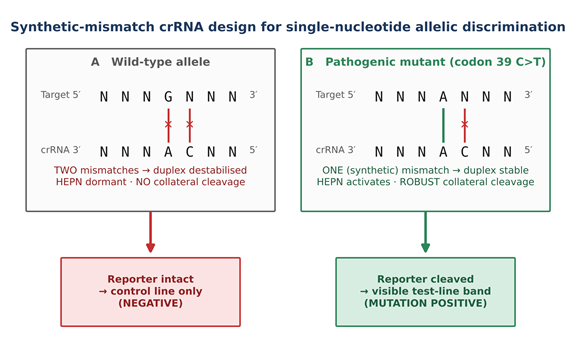
Because hemoglobinopathies turn on point mutations, the assay has to resolve a single base (Bhattacharjee et al., 2022; Taher et al., 2018). Cas13 is specific, but a fully complementary crRNA can still cross-react weakly with wild-type transcripts and generate background collateral cleavage (Gootenberg et al., 2017; Vargas et al., 2024). The engineering answer is counterintuitive but elegant: a deliberate synthetic mismatch is built into the spacer (Gootenberg et al., 2017; Vargas et al., 2024). Figure 3 lays out the logic. Against a pathogenic variant the guide

Table 1. Comparative molecular architecture, target specificity, and enzymatic cleavage properties of Class 2 CRISPR-Cas diagnostic effectors. The table contrasts Cas9 (Type II), Cas12a and Cas12b (Type V), Cas13a/Cas13b (Type VI), and the miniature Cas14/Cas12f effectors by nucleic-acid substrate, guide and flanking-motif requirement, catalytic domains, cis- versus trans-cleavage behavior, representative diagnostic platforms, analytical sensitivity and specificity, and the principal operational strengths and bottlenecks relevant to point-of-care genotyping.

CRISPR-Cas Effector & Subtype

Target Substrate

Guide RNA & Flanking Motif Specificity

Catalytic Nuclease Domains

Cis- vs. Trans-Cleavage Characteristics

Representative Diagnostic Platforms

Analytical Sensitivity (LOD) & Specificity

Operational Strengths & Technical Bottlenecks

Key References (APA Style)

Cas9 (Class 2, Type II; e.g., SpCas9, SaCas9, FnCas9)

Double-stranded DNA (dsDNA); RNA via specialized PAMmers

sgRNA (or crRNA + tracrRNA duplex); requires canonical 5'-NGG-3' PAM (SpCas9) or 5'-NNGRRT-3' (SaCas9)

RuvC-like domain (cleaves non-target strand); HNH domain (cleaves target strand)

Cis: Generates blunt-ended double-strand breaks (DSBs) 3 bp upstream of PAM. Trans: Absent or negligible under standard conditions; no promiscuous collateral digestion.

FELUDA, CRISDA, CAS-EXPAR, CASLFA, CRISPR-Chip, Bio-SCAN

LOD: ~100 copies/mL to 1.4×10⁵ copies/mL; down to 5 aM when integrated with cascade circuits. Specificity: High sequence fidelity; single-nucleotide discrimination via engineered high-fidelity variants (SpCas9-HF1, FnCas9).

Strengths: Highly characterized; ideal for direct DNA target capture, CRISPR-Chip electrical biosensing, and paired dCas9 ELISAs. Bottlenecks: Requires strict PAM; lacks catalytic turnover from collateral cleavage; requires external isothermal amplification or fluorescent/electronic transducers for readout.

Balderston et al. (2021); Bhardwaj et al. (2022); Bonini et al. (2021); Hassan et al. (2025); Huang et al. (2018); Li et al. (2022); Marsic et al. (2021); Zhang et al. (2025); Zhou et al. (2026)

Cas12a (Class 2, Type V-A; formerly Cpf1; e.g., LbCas12a, AsCas12a)

dsDNA and single-stranded DNA (ssDNA)

Mature crRNA (40–44 nt, 19–24 nt spacer); requires 5'-TTTV-3' (or 5'-TTTN-3') PAM on dsDNA; PAM-independent on ssDNA

Single RuvC-like endonuclease domain (Nuc domain assists coordination)

Cis: Staggered 5-nt 5'-overhang cut on dsDNA distal to PAM. Trans: Robust, non-specific collateral degradation of surrounding non-target ssDNA (preference: poly-C > poly-T > poly-A).

DETECTR, HOLMES, E-CRISPR, CRISPR-MTB, AIOD-CRISPR

LOD: Attomolar (1–10 aM; ~1–10 copies/μL) when coupled with RPA/LAMP; pM range without amplification. Specificity: Single-base mismatch sensitivity in spacer seed region (positions 1–8).

Strengths: Dual cis/trans activity enables continuous signal amplification; processes own pre-crRNA; minimal crRNA requirement (no tracrRNA). Bottlenecks: Constrained by T-rich PAM motifs in GC-rich exons; vulnerable to false-positive background from non-specific trans-cleavage if amplification is unoptimized.

Chen et al. (2018); Hassan et al. (2025); Kumaran et al. (2023); Li et al. (2018); Nalefski et al. (2021); Rasool et al. (2024); Zhang et al. (2025); Zhou et al. (2026)

Cas12b (Class 2, Type V-B; e.g., AacCas12b, AaCas12b)

dsDNA and ssDNA

Dual-guide or chimeric sgRNA; recognizes 5'-TTN-3' or 5'-ATTN-3' PAM

Single RuvC domain; requires homodimeric or structural coordination

Cis: Staggered cleavage of target dsDNA. Trans: Thermostable, non-specific collateral degradation of bystander ssDNA reporters across broad thermal profiles.

CDetection, HOLMESv2, STOPCovid

LOD: Sub-attomolar (down to 1 aM; ~0.1–1 copy/μL). Specificity: High single-nucleotide discrimination; resolves single-base SNPs.

Strengths: Extreme thermostability (operates efficiently between 50 °C and 65 °C); directly compatible with LAMP in a homogeneous one-pot system. Bottlenecks: Requires sgRNA; primer and guide design constrained by temperature compatibility and PAM availability.

Joung et al. (2020); Kumaran et al. (2023); Rasool et al. (2024); Teng et al. (2019); Zhang et al. (2025); Zhou et al. (2026)

Cas13a / Cas13b (Class 2, Type VI-A/B; e.g., LwaCas13a, PsmCas13b)

Single-stranded RNA (ssRNA)

Single mature crRNA (28-nt direct repeat + 20–28-nt spacer); PAM-free; loose protospacer flanking site (PFS; 3' non-G for LshCas13a; largely PFS-independent for LwaCas13a)

Twin Higher Eukaryotes and Prokaryotes Nucleotide-binding (HEPN) ribonuclease domains

Cis: Target-specific ssRNA cleavage inside target protospacer. Trans: High-turnover, non-specific trans-cleavage of bystander ssRNA reporters (LwaCas13a: AU/UU dinucleotides; PsmCas13b: GA motifs).

SHERLOCK, SHERLOCKv2, CARMEN, DISCoVER, SHINE

LOD: Attomolar to zeptomolar (10⁻¹⁸ to 10⁻²¹ M; <1 copy/μL) with RPA-T7 cascades. Specificity: Exceptional single-nucleotide variant (SNV) and SNP sensitivity with synthetic mismatch guides.

Strengths: PAM-independent targeting across transcriptomes; high catalytic turnover; autonomous crRNA processing allows orthogonal multiplexing. Bottlenecks: Requires in vitro T7 transcription when interrogating genomic DNA; fragile RNA reporter chemistry demands RNase-free workflows.

Abudayyeh et al. (2016); Ackerman et al. (2020); East-Seletsky et al. (2016); Gootenberg et al. (2017, 2018); Kellner et al. (2019); Sinha et al. (2024); Vargas et al. (2024); Zhou et al. (2026)

Cas14 / Cas12f (Class 2, Type V-F / Type V-U; miniature effectors)

ssDNA (and dsDNA under specific modified architectures)

Single crRNA or crRNA-tracrRNA duplex depending on subclass; completely PAM-independent on ssDNA targets

Conserved single RuvC nuclease catalytic core

Cis: Precise cleavage of target single-stranded DNA. Trans: High-turnover, indiscriminate degradation of bystander ssDNA (prefers longer >15-nt homopolymer reporters).

Cas14-DETECTR, Cas14VIDet, PER-Cas14a

LOD: 1 aM to 50 fM within 60 min. Specificity: High sensitivity to single-base mismatches across the entire protospacer.

Strengths: Ultra-compact protein footprint (400–700 amino acids); PAM-independent ssDNA target range; high fidelity for SNP discrimination. Bottlenecks: Cannot target double-stranded genomic DNA directly without thermal/enzymatic denaturation or conversion to ssDNA; complex production kinetics.

Harrington et al. (2018); Karvelis et al. (2020); Lai et al. (2025); Rasool et al. (2024); Zhang et al. (2025); Zhou et al. (2026)

Table 2. Isothermal and enzymatic amplification strategies coupled with CRISPR biosensing architectures. For recombinase polymerase amplification, loop-mediated isothermal amplification, rolling-circle amplification, nucleic acid sequence-based amplification, and strand-displacement amplification, the table lists the core enzymes and accessory proteins, thermal regime and reaction time, operating mechanism, compatible Cas effectors, analytical limit of detection and dynamic range, representative targets including HBB alleles, and the field-readiness trade-offs of each approach.

Amplification Strategy

Core Catalytic Enzymes & Accessory Proteins

Thermal Regime & Kinetic Duration

Operating Mechanism & Molecular Intermediate

CRISPR Detection Compatibility

Analytical LOD & Dynamic Range

Target Pathogens & Clinical Genotypes

Field Readiness & Operational Trade-offs

Key References (APA Style)

Recombinase Polymerase Amplification (RPA / RT-RPA)

T4 UvsX recombinase, UvsY mediator, T4 gp32 single-stranded binding protein (SSB), Bsu or Sau DNA polymerase; AMV/M-MLV RT for RNA

37 °C to 42 °C (ambient body-heat compatible); 10 to 30 min

Recombinase-primer nucleoprotein filaments invade dsDNA, forming a D-loop; gp32 stabilizes the displaced strand; strand-displacement polymerase extends from 3'-OH.

Excellent with Cas12a, Cas12b, and Cas13a (requires 5'-T7 promoter tag for Cas13 IVT). One-pot systems enabled via buffer balancing or physical phase separation.

1 to 10 copies/μL (attomolar sensitivity, ~1–10 aM); linear over 6–8 orders of magnitude.

SARS-CoV-2, HBB mutations (CD41/42, IVS-1-110, codon 39), Vibrio parahaemolyticus, African swine fever virus (ASFV), HPV16/18.

Pros: Low constant operating temperature; rapid kinetics; tolerant to biological inhibitors; lyophilization-compatible. Cons: Proprietary enzyme formulation; potential non-specific amplification at lower temperatures; primer dimer risks.

Feng et al. (2023); Gootenberg et al. (2017); Kellner et al. (2019); Lobato & O’Sullivan (2018); Rasool et al. (2024); Zhang et al. (2025); Zhou et al. (2026)

Loop-Mediated Isothermal Amplification (LAMP / RT-LAMP)

Bst 2.0 / Bst 3.0 DNA Polymerase (large fragment with 5'→3' polymerase and strand-displacement; lacks 5'→3' exonuclease)

60 °C to 65 °C; 30 to 60 min

4 to 6 sequence-specific primers target 6 to 8 genomic regions; forms self-hybridizing loop structures yielding cauliflower-like concatemer amplicons.

Requires thermostable Cas effectors (e.g., AacCas12b, TccCas13) for homogeneous one-pot assays; mesophilic Cas12a requires two-step tube transfers or temperature-staged wax barriers.

1 to 30 copies/reaction (~10 aM to 1 fM); wide dynamic detection threshold.

SARS-CoV-2 RNA, Mycobacterium tuberculosis, HBV DNA, ATP7B (Wilson's disease mutations), ctDNA oncogenic variants.

Pros: High yield (>10 μg DNA); low cost; high thermal specificity suppresses non-specific primer binding. Cons: Requires high operational temperature; complex primer design (FIP, BIP, F3, B3, Loop-F/B); prone to aerosol contamination.

Bhardwaj et al. (2022); Notomi et al. (2000); Teng et al. (2019); Zhou et al. (2026)

Rolling Circle Amplification (RCA)

Phi29 DNA Polymerase (high processivity, strong strand displacement, 3'→5' proofreading exonuclease)

30 °C to 37 °C; 30 to 90 min

Phi29 continuously extends a primer hybridized to a circularized single-stranded DNA padlock probe, generating tandem-repeat concatemers.

Highly compatible with Cas12a and Cas9; generated ssDNA tandem repeats provide multiple binding sites for crRNAs, multiplying downstream collateral activation.

10 to 35 fM (down to 1 zeptomole when combined with secondary enzymatic circuits).

MicroRNAs (miR-21, miR-141), human papillomavirus (HPV) genotypes, Leishmania genomic targets, circulating tumor cells.

Pros: Operates at low ambient temperature; high replication fidelity; linear or exponential (hyperbranched) kinetics. Cons: Requires pre-circularized padlock probes and ligase pre-treatment; amplicons form large structural networks that can retard lateral flow migration.

Blanco et al. (1989); Lizardi et al. (1998); Zhou et al. (2026)

Nucleic Acid Sequence-Based Amplification (NASBA)

Avian Myeloblastosis Virus (AMV) Reverse Transcriptase, T7 RNA Polymerase, RNase H

41 °C; 60 to 120 min

Forward primer with T7 promoter initiates cDNA synthesis; RNase H hydrolyzes original RNA template; reverse primer directs second-strand DNA synthesis; T7 RNAP transcribes antisense ssRNA amplicons.

Directly yields single-stranded RNA targets; integrates with Cas13a (SHERLOCK) or Cas9-toehold riboregulators (NASBACC) without requiring separate transcription steps.

Attomolar (~10–100 aM; down to 10²–10³ copies/mL).

Zika virus strains, Dengue virus serotypes, HIV-1 viral load, Chlamydia pneumoniae, mRNA tumor markers.

Pros: Direct transcription of ssRNA products eliminates DNA denaturation; enables direct viral RNA screening at constant 41 °C. Cons: Multi-enzyme cocktail (three enzymes) increases batch variability; less robust on double-stranded DNA targets without denaturation.

Compton (1991); Gootenberg et al. (2017); Pardee et al. (2016); Zhang et al. (2025)

Strand Displacement Amplification (SDA / EXPAR)

Klenow fragment (3'→5' exo⁻) or Bsu DNA Polymerase, paired with nicking endonucleases (e.g., Nt.BstNBI, Nb.BbvCI)

37 °C to 50 °C; 15 to 45 min

Polymerase synthesizes double-stranded recognition site containing a hemiphosphorothioate or nicking sequence; nicking enzyme creates a single-strand nick; polymerase initiates synthesis from the nick, displacing the downstream strand.

Displaced single-stranded oligonucleotides serve directly as target triggers or crRNA-binding substrates for Cas12a, Cas14a, or Cas9-directed biosensing.

Sub-femtomolar to zeptomolar (aM to zM levels); rapid exponential signal progression.

Circulating cell-free DNA (cfDNA), KRAS/EGFR point mutations, DNA methylation patterns, foodborne bacterial toxins.

Pros: Rapid reaction kinetics (signal generation within minutes); generates short ssDNA triggers without thermal cycling. Cons: Prone to non-specific background synthesis from non-templated extension; requires precise buffer coordination between nicking enzymes and polymerases.

Huang et al. (2018); Walker et al. (1992); Zhou et al. (2026)

carries only that one engineered mismatch, which leaves the duplex stable enough to drive HEPN activation; against a wild-type template the complex now faces two mismatches, the natural base difference plus the synthetic one, and the combined penalty keeps the enzyme dormant (Gootenberg et al., 2017; Vargas et al., 2024). Positioning the synthetic mismatch at spacer position 3, 5, or 9 relative to the variant nucleotide maximizes the kinetic separation and cleanly distinguishes wild-type, heterozygous, and homozygous states (Gootenberg et al., 2017; Vargas et al., 2024). The single-nucleotide performance this affords underlies the hemoglobinopathy entries in Tables 3 and 4.

2.6 Isothermal amplification coupling: the RPA-T7-Cas13 cascade

Unamplified Cas13 assays tend to bottom out in the picomolar range, whereas clinical specimens demand attomolar sensitivity (Gootenberg et al., 2017; Kumaran et al., 2023; Zhou et al., 2026). RPA closes that gap without thermal cycling (Gootenberg et al., 2017; Kellner et al., 2019; Rasool et al., 2024). Operating at a steady 37-42 C for roughly 15-30 minutes, RPA uses T4 UvsX recombinase and the UvsY mediator to drive primer invasion into homologous double-stranded DNA, with T4 gp32 single-stranded binding protein stabilizing the displaced strand and Bacillus subtilis (Bsu) polymerase carrying out synthesis (Kellner et al., 2019; Rasool et al., 2024). Because Cas13 reads RNA, a T7 promoter is appended to the 5' end of the forward primer so that T7 RNA polymerase can transcribe the amplicons into the ssRNA targets that feed the Cas13-crRNA reaction, yielding dual enzymatic amplification down to attomolar limits (Gootenberg et al., 2017; Kellner et al., 2019). This cascade sits at the heart of the SHERLOCK workflow, and the amplification chemistries that can substitute for or complement RPA are compared in Table 2.

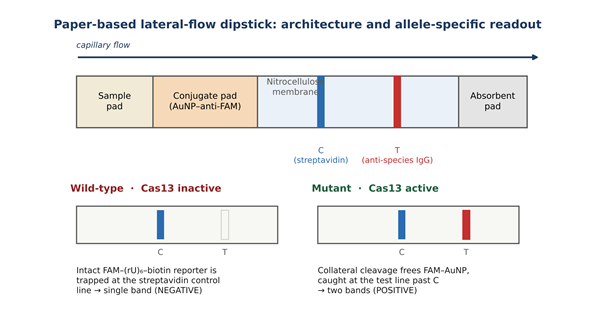
Replacing a fluorimeter with a strip of paper is what makes the assay equipment-free (Gootenberg et al., 2018; Kellner et al., 2019; Kumaran et al., 2023). A conventional dipstick comprises a sample pad that buffers the specimen, a conjugate pad that stores dried AuNPs linked to anti-FAM antibodies, a nitrocellulose membrane bearing an immobilized streptavidin control line and a secondary anti-species IgG test line, and an absorbent pad that drives capillary flow (Kumaran et al., 2023; Gootenberg et al., 2018; Kellner et al., 2019). The dual-labeled reporter, a short ssRNA tagged with 5'-FAM and 3'-biotin (for example 5'-FAM-rUrUrUrUrUrU-biotin-3'), ties the chemistry together (Gootenberg et al., 2018; Kellner et al., 2019; Rasool et al., 2024). The architecture and its two readout states are drawn in Figure 4: in a negative reaction the intact probe binds both the anti-FAM AuNP and immobilized streptavidin, trapping the gold at the control line; when a target mutation activates collateral cleavage, the bridge is digested and freed FAM-AuNP conjugates migrate past the control line to accumulate at the test line, producing a visible band through localized surface plasmon resonance (Gootenberg et al., 2018; Kellner et al., 2019; Kumaran et al., 2023). The reporter and capture chemistries that distinguish competing strip formats are compared in Table 3.

2.8 Reagent lyophilization and room-temperature stability

Enzymes are the fragile element of any field assay, and nucleases and polymerases do not tolerate tropical ambient conditions well (Gootenberg et al., 2017; Pardee et al., 2016; Zhou et al., 2026). Lyophilization with non-reducing disaccharide lyoprotectants such as trehalose or sucrose addresses this by two complementary routes: the sugars replace the water of hydration through direct hydrogen bonding to surface residues, and they vitrify into an amorphous glassy matrix that restricts the molecular motion underlying denaturation and aggregation (Pardee et al., 2016; Zhou et al., 2026). Single-tube lyophilized master mixes that bundle the Cas13 ribonucleoprotein, crRNA, reporter, and RPA reagents retain the bulk of their activity under ambient storage and are reactivated simply by adding a lysed specimen, which is what makes field use realistic (Gootenberg et al., 2017; Pardee et al., 2016). The environmental robustness of lyophilized strip assays is documented in Table 3, and the hemoglobinopathy use cases that depend on it appear in Table 4.

2.9 Translational bottlenecks and future directions

Three obstacles recur across the literature (Bhardwaj et al., 2022; Kumaran et al., 2023; Zhou et al., 2026). The first is extraction: standard purification relies on centrifuges and silica columns, so a genuine point-of-care format needs rapid thermal or chemical lysis that releases genomic DNA directly from fingerstick blood (Garibyan & Avashia, 2013; Kumaran et al., 2023; Zhou et al., 2026). The second is contamination: shuttling amplicons from the RPA tube into the Cas13 reaction invites aerosol carryover, which closed one-pot designs using wax or

Table 3. Paper-based lateral-flow and point-of-care biosensing readouts engineered with CRISPR-Cas systems. The table compares gold-nanoparticle dipstick, triple-line lateral-flow, enzyme-linked colorimetric, electrochemical, and fluorescence-assisted microfluidic formats by the integrated Cas effector and pre-amplification, transduction principle and nanomaterial, reporter-probe chemistry, test- and control-line capture mechanism, assay time and limit of detection, reagent stabilization and environmental robustness, and the clinical genotyping targets addressed, including thalassemia alleles.

Biosensing Platform & Architecture

Integrated Cas Effector & Preamplification

Transduction Principle & Nanomaterial Architecture

Reporter Probe Design & Functional Chemistry

Test-Line (T-Line) & Control-Line (C-Line) Capture Mechanism

Assay Time & Limit of Detection (LOD)

Reagent Stabilization & Environmental Robustness

Clinical Application & Genotyping Targets

Key References (APA Style)

Gold Nanoparticle Dipstick Assay (AuNP-LFA)

Cas12a or Cas13a; coupled with isothermal RPA or RT-RPA

Localized Surface Plasmon Resonance (LSPR) of colloidal gold nanoparticles (20–40 nm AuNPs); visible red/purple band formation.

Bi-functionalized ssDNA/ssRNA reporter tagged with terminal dual affinities: 5'-FAM and 3'-Biotin (e.g., 5'-FAM-rU₆-Biotin-3').

Negative (Wild-Type): Intact probe bridges anti-FAM-AuNP to immobilized Streptavidin at C-Line; T-Line remains clear. Positive (Mutant): Collateral cleavage severs reporter; liberated anti-FAM-AuNPs bypass C-Line and bind secondary anti-species IgG at T-Line.

45–75 min total (15 min lateral flow development); 1–10 copies/μL (attomolar sensitivity).

Compatible with trehalose-assisted vacuum lyophilization; maintains >85% enzymatic activity for up to 6 months at 25 °C–37 °C.

Thalassemia single-nucleotide mutations (HBB CD41/42, IVS-1-110), SARS-CoV-2, HPV16/18 genotyping, Mycobacterium tuberculosis.

Ferrari (2023); Gootenberg et al. (2018); Kellner et al. (2019); Kumaran et al. (2023); Pardee et al. (2016); Rasool et al. (2024); Zhang et al. (2025); Zhou et al. (2026)

Triple-Line Lateral Flow Assay (TL-LFA)

Cas9 (catalytically active) or multiplexed Cas12a/Cas13a; coupled with multiplex RT-RPA

Dual-target spatial separation via orthogonal hapten-antibody recognition on a single nitrocellulose membrane.

Multiplexed probes functionalized with differential haptens (e.g., Digoxigenin-dsDNA-Biotin and FAM-dsDNA-Biotin).

C-Line: Streptavidin captures excess unbound biotinylated components. T-Line 1: Anti-Digoxigenin antibody captures Target 1. T-Line 2: Anti-FAM antibody captures Target 2.

30–60 min; 10 to 100 copies/reaction.

Strip cassettes housed with silica desiccant; stable across relative humidity fluctuations (20–75%).

Simultaneous dual-gene discrimination (e.g., SARS-CoV-2 Orf1ab and N genes; concurrent HBA and HBB globin gene variants).

Xiong et al. (2020); Zhang et al. (2025); Zhou et al. (2026)

Enzyme-Linked Colorimetric Immuno-Strip

dCas9 (nuclease-dead Cas9) or Cas12a; unamplified or RPA-assisted

Chromogenic enzymatic conversion: Horseradish peroxidase (HRP) oxidizes 3,3',5,5'-tetramethylbenzidine (TMB) to produce a visual blue/yellow signal.

Biotinylated target-sgRNA/dCas9 complex functionalized with Streptavidin-conjugated HRP enzymes.

Biotinylated target amplicons are captured at the test zone by immobilized anti-dCas9 antibodies; localized HRP accumulation catalyzes substrate color transition.

30–60 min; 100 CFU/mL to 10 fM.

Liquid reagents require cold chain unless lyophilized with sucrose matrices; colorimetric substrate is photosensitive.

Visual screening of human papillomavirus (HPV), drug-resistant pH1N1, and foodborne bacterial contamination.

Bonini et al. (2021); Kumaran et al. (2023); Moon et al. (2020); Zhang et al. (2025)

Electrochemical CRISPR Strip (E-CRISPR)

Cas12a, Cas13a, or dCas9; paired with RPA or unamplified ctDNA capture

Amperometric, potentiometric, or impedimetric current transduction on printed carbon/gold electrodes (screen-printed electrodes, SPE).

Methylene blue (MB) or ferrocene redox tags conjugated to hairpin or linear ssDNA linkers immobilized on the electrode surface.

Intact redox probes maintain close proximity to the gold electrode, facilitating electron transfer. Target-induced collateral cleavage digests the linker, releasing the redox tag and causing a drop in signal (signal-off) or rise in signal (signal-on).

20–45 min; down to 0.34 fM to 50 pM (amplification-free); attomolar with RPA.

Reagent-free solid-phase electrodes stable at ambient conditions; requires portable micro-potentiostat or glucometer interface.

Genotyping of oncogenic EGFR L858R and BRAF V600E mutations, cell-free tumor DNA (ctDNA), HIV/HBV viral load.

Dai et al. (2019); Ding et al. (2021); Hassan et al. (2025); Kumaran et al. (2023); Zhou et al. (2026)

Fluorescence-Assisted Portable Microfluidic Strip

Cas13a (SHERLOCK) or Cas12a (DETECTR); integrated with microfluidic capillary flow channels

Optical fluorescence excitation via integrated blue LEDs; emission read via filtered smartphone cameras or handheld fluorimeters.

Fluorophore-quencher (FQ) functionalized reporters (e.g., 5'-FAM-rU₅-IABkFQ-3' or HEX-ssDNA-BHQ1).

Collateral trans-cleavage physically separates the fluorophore from its quencher in the detection chamber, generating an isotropic fluorescence signal along the paper channel.

15–30 min; attomolar (0.1–1 aM).

Microfluidic cartridges contain pre-aliquoted, vacuum-sealed lyophilized enzyme pellets; reconstitution occurs upon sample loading.

Rapid screening of SARS-CoV-2 variants, Wilson's disease ATP7B single-nucleotide variants, Dengue and Zika virus serotypes.

Ackerman et al. (2020); Gootenberg et al. (2017); Joung et al. (2020); Zhou et al. (2026)

Table 4. Translational and clinical applications of CRISPR diagnostics across hematology, oncology, and infectious diseases. Organized by clinical domain and molecular target, the table reports the Cas effector and diagnostic architecture, biological matrix and specimen pretreatment, diagnostic performance (sensitivity, specificity, and concordance with reference methods), development and regulatory stage, and the key operational obstacles to implementation, with transfusion-dependent beta-thalassemia and sickle cell disease highlighting the hemoglobinopathy use case.

Clinical Domain & Pathological Target

Target Gene, Mutation, or Molecular Biomarker

CRISPR Effector & Diagnostic Architecture

Biological Matrix & Specimen Pretreatment

Diagnostic Performance (Sensitivity, Specificity, Concordance)

Development Stage & Regulatory Status

Operational Obstacles & Implementation Challenges

Key References (APA Style)

Hemoglobinopathies: Transfusion-Dependent $\beta$-Thalassemia (TDT)

HBB gene variants: CD41/42 (–CTTT frameshift), IVS-1-110 (G>A splicing), Codon 39 (C>T nonsense), IVS-2-654 (C>T)

Cas13a (SHERLOCK with T7 transcription) or Cas12a/Cas12b (CDetection) paired with RPA; synthetic mismatch crRNA designs

Peripheral whole blood; fingerstick capillary blood via rapid thermal-chemical lysis (Chelex-100/NaOH)

98.5% to 100% concordance with Sanger sequencing and gap-PCR; attomolar sensitivity; resolves homozygous vs. heterozygous carriers.

Preclinical validation; multi-center academic cohort validations; proof-of-concept for community screening.

Multi-step T7 transcription required for Cas13a; aerosol contamination risk during manual liquid handling; precise quantification needed for micro-chimerism monitoring.

Bhattacharjee et al. (2022); Frangoul et al. (2021); Gabr et al. (2020); Li et al. (2022); Shahid et al. (2025); Taher et al. (2018); Teng et al. (2019); Wattanapanitch et al. (2018); Zhou et al. (2026)

Hemoglobinopathies: Sickle Cell Disease (SCD)

HBB point mutation: c.20A>T (p.Glu6Val, HbS allele)

Cas9-mediated CRISPR-SNP-Chip; Cas12a-DETECTR; Cas14a-DETECTR with high-fidelity discrimination

Whole blood, isolated genomic DNA, amniotic fluid for prenatal diagnosis

100% analytical sensitivity; discriminates single-base A-to-T transversion; detects <0.1% variant allele frequency (VAF).

Preclinical and observational clinical trials; research-use-only (RUO) and laboratory-developed tests (LDT).

Electro-chemical chips require microfabrication; distinguishing sickle cell trait (HbAS) from homozygous sickle disease (HbSS) on paper strips requires multiplexing.

Demirci et al. (2020); Frangoul et al. (2021); Hajian et al. (2019); Shahid et al. (2025); Taher et al. (2018)

Inherited Metabolic Disorders: Wilson's Disease

ATP7B gene pathogenic variants (e.g., c.3207C>A [p.His1069Gln], c.2333G>T [p.Arg778Leu])

Cas12a (DETECTR), Cas13a (SHERLOCK), or Cas12b (CDetection) coupled with RT-RPA or LAMP

Whole blood, dried blood spots (DBS), liver biopsy homogenates

>99% specificity against wild-type alleles; limits of detection down to 1–10 copies/μL; 100% concordance with NGS panels.

Academic preclinical development; targeted diagnostic assay validation.

High allelic heterogeneity (>500 distinct ATP7B mutations) complicates universal crRNA design; requires multi-plex crRNA arrays for clinical coverage.

Fang et al. (2024); Gromadzka et al. (2023); Nemeth et al. (2016)

Precision Oncology: Liquid Biopsy & Circulating Tumor DNA (ctDNA)

Oncogenic driver mutations: EGFR L858R, EGFR T790M, KRAS G12D, BRAF V600E, TP53 point mutations

Cas12a, Cas14a, or split-crRNA Cas12a systems; coupled with magnetic bead enrichment (MSPE) or digital droplet partitioning (DropCRISPR)

Peripheral blood plasma (cell-free DNA); pleural effusions; urine supernatants

0.01% to 0.1% variant allele frequency (VAF); analytical LOD down to 0.34 fM to 3.3 aM in high wild-type backgrounds.

Translational validation; early-phase clinical evaluations for treatment monitoring; CE-IVD / FDA breakthrough tracks under exploration.

High background of unmutated wild-type cfDNA requires synthetic mismatches or split-crRNA to avoid false positives; requires high-yield cfDNA isolation methods.

Chen et al. (2021); Hassan et al. (2025); Jing et al. (2018); Zhou et al. (2026)

Infectious Diseases: Viral Respiratory Pathogens

SARS-CoV-2 (Orf1ab, N, S genes; Omicron/Delta single-nucleotide variants), Influenza A/B, RSV

Cas12a (DETECTR), Cas13a (SHERLOCK, SHINE), Cas12b (STOPCovid) coupled with RT-RPA or RT-LAMP

Nasopharyngeal swabs, anterior nasal swabs, unextracted raw saliva (HUDSON or chemical lysis)

95% to 98.8% clinical sensitivity, 100% specificity relative to RT-qPCR; LOD of 10 to 100 viral copies/mL; time-to-result: 20–45 min.

FDA Emergency Use Authorization (EUA) granted to Sherlock Biosciences and Mammoth Biosciences; commercialized IVD field kits.

Reagent cold chains (unless lyophilized); cross-contamination risks when opening multi-step tubes; cost competition from mass-manufactured lateral flow antigen tests.

Ackerman et al. (2020); Joung et al. (2020); Kellner et al. (2019)

Infectious Diseases: Chronic & Neglected Tropical Pathogens

Hepatitis B Virus (HBV DNA genotypes B/C), Human Papillomavirus (HPV16/18), Mycobacterium tuberculosis (MTB)

Cas12a (CRISPR-MTB), Cas12b (CRISPR-HBV with MCDA), Cas9-CARP

Serum, plasma, cervical brush scrapings, sputum, processed stool samples

1 to 10 copies/reaction; >98% sensitivity in paucibacillary pediatric/extrapulmonary clinical samples; 100% analytical genotyping accuracy.

Clinical validation in endemic regional hospitals; ongoing field surveillance deployments.

DNA extraction from sputum or stool remains technically demanding; distinguishing live from dead bacilli in post-treatment tuberculosis monitoring.

Chen et al. (2021); Kumaran et al. (2023); Zhou et al. (2026)

other phase barriers are meant to prevent (Kellner et al., 2019; Rasool et al., 2024; Zhou et al., 2026). The third is multiplexing: clinical management needs heterozygous carriers separated from homozygous patients across several targets at once, which argues for orthogonal Cas enzymes or multi-band strips (Li et al., 2022; Taher et al., 2018; Gootenberg et al., 2018; Zhou et al., 2026). The clinical-translation status of these approaches across disease domains is laid out in Table 4.

3. Methods

This section specifies the assay as a reproducible protocol so that an independent laboratory could rebuild it. It consolidates the design and operating parameters reported for RPA-T7-Cas13a lateral-flow systems (Gootenberg et al., 2017, 2018; Kellner et al., 2019; Rasool et al., 2024) and adapts them to HBB and HBA genotyping. Being a narrative review, the article reports no new primary data; the workflow below is a synthesis of published procedures, and the overall cascade is shown in Figure 1.

3.1 Literature search and source selection

Primary and review literature was identified in PubMed, Scopus, and Web of Science using combinations of the terms CRISPR, Cas13, SHERLOCK, recombinase polymerase amplification, lateral flow, paper biosensor, point-of-care, thalassemia, HBB, and HBA. Records were screened for direct relevance to Cas13 enzymology, isothermal amplification coupling, lateral-flow readout chemistry, reagent stabilization, or clinical genotyping of hemoglobinopathies, and the reference lists of retrieved articles were examined for additional sources. The protocol parameters summarized here reflect the consensus conditions reported across these studies (Gootenberg et al., 2017, 2018; Kellner et al., 2019; Kumaran et al., 2023; Rasool et al., 2024).

3.2 Specimen collection and rapid nucleic-acid release

The intended input is capillary whole blood from a fingerstick, 10-20 microliters collected into a buffered sample tube. To keep the format equipment-free, genomic DNA is released by rapid thermal-chemical lysis rather than column purification: specimens are mixed with a Chelex-100 suspension or a dilute NaOH solution and heated briefly (for example 95 C for 5 minutes), then neutralized, a strategy consistent with point-of-care extraction reported for CRISPR assays (Kumaran et al., 2023; Zhou et al., 2026). The crude lysate is used directly as amplification input, which removes the centrifugation step that would otherwise tie the assay to a laboratory (Garibyan & Avashia, 2013; Kumaran et al., 2023).

3.3 crRNA design and synthetic-mismatch engineering

For each target allele, a crRNA is designed with a direct repeat matched to the Cas13a ortholog (for LwaCas13a, a 28-nucleotide repeat) and a 20-28-nucleotide spacer complementary to the mutant transcript (East-Seletsky et al., 2016; Abudayyeh et al., 2016). To secure single-base discrimination, a single synthetic mismatch is introduced into the spacer at position 3, 5, or 9 relative to the variant nucleotide, so that a wild-type template presents two mismatches and fails to activate the enzyme while the mutant presents one and does (Gootenberg et al., 2017; Vargas et al., 2024). Candidate guides for CD41/42 (-CTTT), IVS-1-110 (G>A), and codon 39 (C>T) are evaluated in silico for predicted duplex thermodynamics and off-target potential before synthesis, and the discrimination logic follows Figure 3 (Vargas et al., 2024; Zhou et al., 2026).

3.4 Isothermal RPA with a T7-tagged primer

Target loci are pre-amplified by RPA in a 50-microliter reaction containing T4 UvsX recombinase, the UvsY mediator, T4 gp32 single-stranded binding protein, and Bsu DNA polymerase, with magnesium acetate initiating the reaction (Kellner et al., 2019; Rasool et al., 2024). The forward primer carries a 5' T7 promoter extension (5'-TAATACGACTCACTATAGGG-3') so that the resulting amplicons are transcribable; forward and reverse primers are designed to flank the mutation of interest and to avoid primer-dimer formation (Gootenberg et al., 2017; Kellner et al., 2019). Amplification proceeds at a constant 37-42 C for 15-30 minutes, which obviates thermal cycling (Rasool et al., 2024).

3.5 Coupled T7 transcription and Cas13a collateral detection

The RPA output feeds a combined transcription-detection step. T7 RNA polymerase transcribes the double-stranded amplicons into ssRNA targets, which the LwaCas13a-crRNA ribonucleoprotein then recognizes (Gootenberg et al., 2017; Kellner et al., 2019). The detection mix contains the Cas13a-crRNA complex, T7 polymerase and ribonucleotides, and the dual-labeled lateral-flow reporter, a short ssRNA bearing 5'-FAM and 3'-biotin, typically 5'-

Figure 1. Integrated equipment-free workflow of a CRISPR-Cas13 paper biosensor for point-of-care thalassemia genotyping. A fingerstick whole-blood specimen undergoes rapid thermal-chemical lysis to expose the genomic HBA/HBB target, which is pre-amplified by isothermal recombinase polymerase amplification (RPA) with a T7-tagged forward primer, transcribed to single-stranded RNA by T7 polymerase, recognized with single-base precision by the Cas13a-crRNA complex, and amplified through collateral trans-cleavage of FAM-biotin reporters; the severed reporter is read by the naked eye on a lateral-flow dipstick within 10-15 minutes, with lyophilized reagents removing the cold chain.

Figure 2. RNA-guided catalytic activation of the Type VI Cas13 effector. The apo-Cas13 monomer, with its twin HEPN motifs buried, loads a crRNA (28-nt direct repeat plus 20-28-nt spacer) to form a binary surveillance complex. Hybridization of the spacer to a complementary target ssRNA creates an RNA:RNA duplex within the recognition lobe and triggers an allosteric rearrangement that converges the HEPN domains into a composite ribonuclease site, enabling sequence-specific cis-cleavage of the target and high-turnover, non-specific trans-cleavage of bystander reporters that generates the diagnostic signal.

FAM-rUrUrUrUrUrU-biotin-3' to match the AU/UU preference of LwaCas13a (Gootenberg et al., 2018; Kellner et al., 2019). Recognition of a mutant target activates HEPN-mediated collateral cleavage of the reporter; the reaction is held at 37 C for 20-30 minutes (Gootenberg et al., 2017; Kellner et al., 2019). To minimize aerosol carryover between amplification and detection, a closed one-pot configuration with a physical phase barrier is preferred where feasible (Kellner et al., 2019; Rasool et al., 2024).

3.6 Lateral-flow strip assembly and readout

Commercial or custom dipsticks are assembled from a sample pad, a conjugate pad bearing dried anti-FAM antibody-conjugated gold nanoparticles, a nitrocellulose membrane printed with a streptavidin control line and a secondary anti-species IgG test line, and an absorbent wicking pad (Kumaran et al., 2023; Gootenberg et al., 2018; Kellner et al., 2019). After detection, the reaction is diluted in running buffer and the strip is dipped; capillary flow develops the result in 10-15 minutes (Kumaran et al., 2023). An intact reporter yields a single control-line band (wild-type), whereas collateral cleavage frees FAM-AuNP conjugates to accumulate at the test line, producing a second visible band through localized surface plasmon resonance (mutant), as shown in Figure 4 (Gootenberg et al., 2018; Kellner et al., 2019; Kumaran et al., 2023). The control line must be visible for a result to be valid.

3.7 Reagent lyophilization and stability testing

For field readiness, the amplification and detection reagents are freeze-dried as single-tube master mixes in the presence of a disaccharide lyoprotectant (5-10% trehalose or sucrose), which preserves enzyme conformation through water replacement and matrix vitrification (Pardee et al., 2016; Zhou et al., 2026). Lyophilized reactions are reconstituted at the point of care by adding the diluted lysate, and residual activity is confirmed against freshly prepared controls after defined storage intervals and temperatures (Gootenberg et al., 2017; Pardee et al., 2016).

3.8 Controls, validation, and performance metrics

Every run includes a no-template control, a wild-type genomic control, and a confirmed homozygous mutant control, with heterozygous controls where allele dosage must be resolved. Analytical sensitivity is established as the limit of detection against a dilution series of quantified target, and specificity is assessed against wild-type and off-target alleles (Nalefski et al., 2021). Clinical performance is reported as sensitivity, specificity, and concordance with an accepted reference method such as Sanger sequencing or gap-PCR, following the benchmarking approach summarized in Table 4 (Chen et al., 2020; Nemeth et al., 2016). Reporting the enzyme ortholog, crRNA and primer sequences, reagent concentrations, incubation times and temperatures, and lot information is recommended so that the protocol can be reproduced.

4. Comparative Performance of CRISPR-Cas13 Paper Biosensors

4.1 Collateral trans-cleavage kinetics distinguish the Class 2 effectors.

Read side by side, the Class 2 effectors do not behave alike, and the differences are the whole point. Cas9, a Type II enzyme, works largely through target-constrained cis-cleavage and produces blunt double-strand breaks without catalytic turnover (Table 1). The Type V effectors (Cas12a, Cas12b, Cas14) and the Type VI Cas13 enzymes behave differently: once they engage an on-target sequence, they switch on a vigorous, indiscriminate trans-cleavage that keeps going (Table 1; Figure 2). For RNA sensing in particular, the twin HEPN domains of Cas13 assemble into a ribonuclease site on the protein's outer surface (Abudayyeh et al., 2016; East-Seletsky et al., 2016), and the turnover is high enough that a single recognized target drives the cleavage of thousands of bystander reporters (Gootenberg et al., 2017; Nalefski et al., 2021). The orthologs are not interchangeable, which is easy to forget. LwaCas13a leans toward uracil-rich dinucleotides (AU and UU), a preference that other orthologs do not share to the same degree, and that single fact constrains how a reporter should be designed (Gootenberg et al., 2018; Zhou et al., 2026). One more property matters for genomic targets: Cas13 does not insist on a PAM, unlike Cas12a with its 5'-TTTV requirement (Table 1), which frees crRNA placement across the GC-rich stretches of HBA and HBB that a PAM constraint would otherwise put out of reach (Gootenberg et al., 2017; Zhou et al., 2026).

4.2 A single synthetic mismatch converts specificity into allelic resolution.

High specificity is not quite the same thing as single-base discrimination, and the gap between the two is where background collateral cleavage lives. A fully complementary crRNA can still react, weakly, with a wild-type transcript (Gootenberg et al., 2017; Vargas et al., 2024). The fix, adding a second, deliberately engineered mismatch to the spacer, is almost counterintuitive, because it works by making the guide a worse match on purpose (Figure 3). Against a pathogenic variant the complex retains only that one engineered mismatch and stays stable enough to trip the allosteric change that activates HEPN (Gootenberg et al., 2017; Vargas et al., 2024). Against a wild-type template it now carries two mismatches, the natural base difference plus the synthetic one, and the combined penalty is enough to keep the ribonuclease dormant (Gootenberg et al., 2017; Vargas et al., 2024). Where the synthetic mismatch sits turns out to matter more than one might expect: positions 3, 5, and 9 relative to the variant give the widest separation between wild-type and mutant, which is what lets the assay call homozygous and heterozygous genotypes apart rather than merely flagging that a mutation is present somewhere (Gootenberg et al., 2017; Vargas et al., 2024).

4.3 Isothermal coupling recovers the sensitivity a reagent-light assay gives up.

On its own, Cas13 detection tends to stall around picomolar concentrations, which is simply not enough for a clinical blood sample (Gootenberg et al., 2017; Kumaran et al., 2023). Coupling the enzyme to RPA pulls the limit of detection down into the attomolar range, and in some reports lower still (Table 2). The appeal of RPA is that it does its work at a near-body temperature of 37-42 C in about 10-30 minutes, so no thermocycler is needed (Kellner et al., 2019; Rasool et al., 2024). Three enzymes carry the reaction, T4 UvsX recombinase and the UvsY mediator to drive primer invasion, gp32 to hold the displaced strand, and Bsu polymerase to extend (Kellner et al., 2019; Rasool et al., 2024). Because Cas13 reads RNA rather than DNA, a T7 promoter (5'-TAATACGACTCACTATAGGG-3') is appended to the forward primer, and T7 RNA polymerase then transcribes the amplicons into the ssRNA that the Cas13a-crRNA complex recognizes (Gootenberg et al., 2017). The combined RPA-T7-Cas13 cascade, the engine of SHERLOCK, reaches roughly 1-10 copies per microliter across a wide dynamic range (Table 2). It is worth saying plainly that this gain is not free: each added enzyme is another reagent to stabilize and another opportunity for a false positive if amplification is not well controlled (Table 2).

4.4 The paper readout turns cleavage into a band the eye can read.

The strip is where the chemistry becomes a result anyone can interpret (Figure 4). The reporter is a short ssRNA carrying 5'-FAM and 3'-biotin (Gootenberg et al., 2018; Kellner et al., 2019). When Cas13 stays inactive, as it does against wild-type, the intact reporter binds anti-FAM gold nanoparticles and is caught by streptavidin at the control line, so all the gold ends up there and the test line stays blank (Kellner et al., 2019). When a mutation activates collateral cleavage, the RNA bridge is cut, the FAM and biotin ends are separated, and the freed FAM-AuNP conjugates travel past the control line to be captured at the test line, where localized surface plasmon resonance produces a visible band, usually within 10-15 minutes and without any instrument (Gootenberg et al., 2018; Kellner et al., 2019; Kumaran et al., 2023). The reporter and capture formats that different groups have used, and their reported detection limits, are compiled in Table 3; the gold-nanoparticle dipstick is the one most directly suited to naked-eye thalassemia genotyping.

4.5 Lyophilization buys ambient shelf life.

None of this travels unless the enzymes survive the trip. Cas nucleases and polymerases are thermally fragile, which is a real problem in exactly the tropical, low-resource settings where thalassemia is common (Pardee et al., 2016). Freeze-drying the reaction with a non-reducing disaccharide, trehalose or sucrose, stabilizes the proteins two ways at once: the sugar hydroxyls hydrogen-bond to surface residues in place of the departing water, and the excipient sets into a high-viscosity glassy matrix (glass transition above about 60 C) that physically restrains unfolding (Pardee et al., 2016; Zhou et al., 2026). Single-tube lyophilized master mixes, bundling the Cas13a ribonucleoprotein, crRNA, FAM-biotin reporter, and RPA reagents, have been reported to keep the better part of their activity after weeks at ambient temperature, and they restart simply on addition of a diluted lysate (Table 3; Pardee et al., 2016). It is a modest-sounding step that, in practice, decides whether a strip assay is deployable at all.

4.6 Clinical concordance is high, but most thalassemia work is still preclinical.

Across pathological domains, the reported agreement with

Figure 3. Synthetic-mismatch crRNA design for single-nucleotide allelic discrimination. (A) Against a wild-type allele the guide presents two mismatches, the natural base difference and the engineered synthetic mismatch, which destabilizes the duplex, leaves HEPN dormant, and yields no collateral cleavage (control line only, negative). (B) Against a pathogenic mutant (for example codon 39 C>T) only the single synthetic mismatch remains, the duplex is stable, HEPN activates, and robust collateral cleavage produces a visible test-line band (mutation positive). Placing the synthetic mismatch at spacer positions 3, 5, or 9 maximizes wild-type/mutant separation.

Figure 4. Architecture and allele-specific readout of the paper-based lateral-flow dipstick. Capillary flow carries the reaction from the sample pad through a conjugate pad bearing dried anti-FAM gold nanoparticles across a nitrocellulose membrane printed with a streptavidin control (C) line and an anti-species IgG test (T) line to an absorbent pad. In wild-type samples the intact FAM-(rU)6-biotin reporter is trapped at the control line (single band, negative); in mutant samples collateral cleavage frees FAM-gold conjugates that are captured at the test line (two bands, positive), the visible band arising from localized surface plasmon resonance of the gold nanoparticles within 10-15 minutes without instrumentation.

laboratory standards is, frankly, better than one might expect from so young a technology (Table 4). For hemoglobinopathies specifically, Cas13a and Cas12b platforms coupled with RPA have been reported to separate heterozygous beta-thalassemia carriers from homozygous patients across common alleles, including CD41/42 (-CTTT) and IVS-1-110 (G>A), with concordance on the order of 98.5-100% against Sanger sequencing and gap-PCR (Table 4). The same chemistry generalizes: in oncology, Cas12a and Cas13a assays have resolved circulating tumor DNA mutations down to roughly 0.01% variant allele frequency where droplet digital PCR was ambiguous (Table 4), and in outbreak settings SHERLOCK and DETECTR lateral-flow tests have reached 95-98.8% clinical sensitivity with 100% specificity for SARS-CoV-2 and flaviviruses within 30-45 minutes (Ackerman et al., 2020; Joung et al., 2020; Table 4). Two caveats temper the enthusiasm. First, the thalassemia-specific evidence remains largely preclinical or single-center rather than multi-site and regulated (Table 4). Second, when rapid chemical-thermal lysis and lyophilized reagents are combined on a strip, the platform does appear to satisfy the WHO REASSURED criteria, which is the benchmark that matters for community deployment (Bhardwaj et al., 2022; Kumaran et al., 2023).

5. Closing the Gap Between CRISPR-Cas13 Paper Biosensors and Community Thalassemia Screening

5.1 Why Cas13 fits thalassemia genotyping

Put together, the evidence points to a reasonably coherent conclusion: the properties that make Cas13 attractive in the abstract line up unusually well with what thalassemia screening actually needs. The disease is defined by point mutations, and the synthetic-mismatch strategy gives the single-base resolution to call them (Vargas et al., 2024; Figure 3). The targets sit in GC-rich globin genes, and the absence of a PAM requirement means crRNAs can be placed where a Cas12a assay could not reach (Gootenberg et al., 2017; Table 1). And the setting is resource-limited, which is precisely the niche an isothermal, paper-based, lyophilized assay was built for (Kumaran et al., 2023; Pardee et al., 2016; Table 3). None of these is individually novel, but their alignment is what makes the application compelling rather than merely possible.

5.2 The extraction and contamination problems are not yet solved

That said, it would be a mistake to treat the remaining hurdles as incidental. The first is sample preparation. Elegant detection chemistry does not help if getting usable template out of whole blood still needs a centrifuge and a column (Garibyan & Avashia, 2013). Rapid Chelex or alkaline lysis is the usual proposed answer (Kumaran et al., 2023; Zhou et al., 2026), but crude lysates carry inhibitors and variable yields, and how robustly they feed an RPA reaction from fingerstick volumes is, honestly, still being worked out. The second is contamination. RPA generates enormous amplicon copy numbers, and any open transfer into the Cas13 step risks aerosol carryover and false positives (Kellner et al., 2019; Rasool et al., 2024). Closed one-pot formats with wax or other phase barriers are the obvious mitigation (Table 2), yet integrating amplification and detection into a single sealed reaction without sacrificing sensitivity remains a genuine engineering problem rather than a solved one.

5.3 Multiplexing and genotype calling

Clinical usefulness raises the bar further. A screening test that reports only presence or absence of one mutation is of limited value when management hinges on distinguishing a heterozygous carrier from a homozygous or compound-heterozygous patient across several alleles (Li et al., 2022; Taher et al., 2018). Two routes toward multiplexing appear in the literature: deploying orthogonal effectors with distinct dinucleotide preferences, for instance pairing Cas13 with Cas12, or printing multiple test lines on a single strip (Gootenberg et al., 2018; Table 3). Both are plausible, and triple-line formats have been demonstrated for dual-gene discrimination (Table 3). Whether either scales cleanly to the panel of alleles that matters for a given population, while preserving the clean wild-type/heterozygous/homozygous separation that the synthetic-mismatch design provides, is not yet established.

5.4 Evidence maturity and regulatory distance

It is worth being candid about where the field sits. Much of the headline performance, the attomolar limits, the near-perfect concordance, comes from infectious-disease and oncology applications that have simply had more development attention and, in a few cases, regulatory authorization (Ackerman et al., 2020; Joung et al., 2020; Table 4). The thalassemia-specific results are encouraging but mostly preclinical or single-center (Table 4). Translating them will require validation on clinically representative cohorts across the relevant endemic populations and their characteristic allele spectra, ideally against the reference methods the assay hopes to displace (Chen et al., 2020; Nemeth et al., 2016). The distance from a 98.5-100% concordance in a research report to a deployable, quality-controlled field kit should not be underestimated.

5.5 Shifting Thalassemia Carrier Screening From Laboratory to Community Clinic With CRISPR-Cas13 Paper Biosensors

On balance, the trajectory looks favorable rather than certain. The enzymology is well understood, the amplification coupling is mature, the readout is genuinely instrument-free, and reagent stabilization is tractable (Gootenberg et al., 2017; Kellner et al., 2019; Pardee et al., 2016; Zhou et al., 2026). What the field still owes is integration: a closed, lyophilized, one-pot device that accepts a fingerstick, tolerates a crude lysate, resolves the common alpha- and beta-globin alleles in a multiplexed format, and does so reproducibly enough to satisfy the REASSURED criteria (Bhardwaj et al., 2022; Kumaran et al., 2023). If those pieces come together, CRISPR-Cas13 paper biosensors could plausibly shift thalassemia carrier screening from the central laboratory to the community clinic, which is, after all, where most of the at-risk couples actually are (Shahid et al., 2025; Zhou et al., 2026).

6. Conclusion

CRISPR-Cas13 paper biosensors bring together three capabilities that thalassemia screening has long needed in one place: single-nucleotide allelic discrimination through synthetic-mismatch crRNA design, attomolar sensitivity through isothermal RPA-T7 coupling, and an equipment-free, naked-eye readout on lyophilized lateral-flow strips. Reported concordance with laboratory standards for common HBB alleles is high, and the platform's alignment with the WHO REASSURED criteria makes it a credible candidate for decentralized carrier screening. The decisive work now lies not in the chemistry but in integration, simplified extraction from whole blood, closed one-pot contamination control, robust multiplexing, and validation in endemic clinical cohorts. Clearing those hurdles would move thalassemia genotyping from the central laboratory to the point of care, where prevention is most needed.

References


Abudayyeh, O. O., Gootenberg, J. S., Konermann, S., Joung, J., Slaymaker, I. M., Cox, D. B. T., Shmakov, S., Makarova, K. S., Semenova, E., Minakhin, L., & Zhang, F. (2016). C2c2 is a single-component programmable RNA-guided RNA-targeting CRISPR effector. Science, 353(6299), aaf5573.

Ackerman, C. M., Myhrvold, C., Thakku, S. G., Freije, C. A., Metsky, H. C., Yang, D. K., Ye, S. H., Boehm, C. K., Kosoko-Thoroddsen, T. S., Kehe, J., Nguyen, T. G., & Sabeti, P. C. (2020). Massively multiplexed nucleic acid detection with Cas13. Nature, 582(7811), 277-282.

Balderston, S., Taulbee, J. J., Celaya, E., Fung, K., Jiao, A., Smith, K., Hajian, R., Gasiunas, G., Kutanovas, S., Kim, D., & Collins, J. J. (2021). Discrimination of single-point mutations in unamplified genomic DNA via Cas9 immobilized on a graphene field-effect transistor. Nature Biomedical Engineering, 5(7), 713-725.

Bhardwaj, P., Kant, R., Behera, S. P., Dwivedi, G. R., & Singh, R. (2022). Next-generation diagnostic with CRISPR/Cas: Beyond nucleic acid detection. International Journal of Molecular Sciences, 23(11), 6052.

Bhattacharjee, G., Gohil, N., Khambhati, K., Mani, I., Maurya, R., Karapurkar, J. K., Gohil, J., Chu, D.-T., Vu-Thi, H., Alzahrani, K. J., Show, P.-L., Rawal, R. M., Ramakrishna, S., & Singh, V. (2022). Current approaches in CRISPR-Cas9 mediated gene editing for biomedical and therapeutic applications. Journal of Controlled Release, 343, 703-723.

Blanco, L., Bernad, A., Lazaro, J. M., Martin, G., Garmendia, C., & Salas, M. (1989). Highly efficient DNA synthesis by the phage phi 29 DNA polymerase. Journal of Biological Chemistry, 264(15), 8935-8940.

Bonini, A., Poma, N., Vivaldi, F., Kirchhain, A., Salvo, P., Bottai, D., Tavanti, A., & Di Francesco, F. (2021). Advances in biosensing: The CRISPR/Cas system as a new powerful tool for the detection of nucleic acids. Journal of Pharmaceutical and Biomedical Analysis, 192, 113645.

Chen, J. S., Ma, E., Harrington, L. B., Da Costa, M., Tian, X., Palefsky, J. M., & Doudna, J. A. (2018). CRISPR-Cas12a target binding unleashes indiscriminate single-stranded DNase activity. Science, 360(6387), 436-439.

Chen, X., Wang, L., Li, C., Zhang, Y., & Wang, Q. (2021). A CRISPR-Cas12b-based platform for ultrasensitive, rapid, and highly specific detection of hepatitis B virus genotypes B and C in clinical application. Frontiers in Bioengineering and Biotechnology, 9, 743322.

Chen, Y., Mei, Y., & Jiang, X. (2021). Universal and high-fidelity DNA single nucleotide polymorphism detection based on a CRISPR/Cas12a biochip. Chemical Science, 12(12), 4455-4462.

Chen, Y., Wen, R., Yang, Z., & Chen, Z. (2020). Genome editing using CRISPR/Cas9 to treat hereditary hematological disorders. Gene Therapy, 29(5), 207-216.

Compton, J. (1991). Nucleic acid sequence-based amplification. Nature, 350(6313), 91-92.

Dai, Y., Somoza, R. A., Wang, L., Welter, J. F., Li, Y., Caplan, A. I., & Liu, C. C. (2019). Exploring the trans-cleavage activity of CRISPR-Cas12a for the development of a universal electrochemical biosensor. Angewandte Chemie International Edition, 58(48), 17399-17405.

Demirci, S., Leonard, A., Essawi, K., & Tisdale, J. F. (2020). Genome editing strategies for fetal hemoglobin induction in beta-hemoglobinopathies. Human Molecular Genetics, 29(R1), R100-R107.

Ding, S., Chen, G., Wei, Y., Dong, J., Du, F., Cui, X., Huang, X., & Tang, Z. (2021). CRISPR/Cas12a-mediated interfacial cleaving of hairpin DNA reporter for electrochemical nucleic acid sensing. ACS Sensors, 6(3), 1086-1093.

East-Seletsky, A., O'Connell, M. R., Knight, S. C., Burstein, D., Cate, J. H., Tjian, R., & Doudna, J. A. (2016). Two distinct RNase activities of CRISPR-C2c2 enable guide-RNA processing and RNA detection. Nature, 538(7624), 270-273.

Fang, Y., Liu, H., Wang, Y., Su, X., & Jin, L. (2024). Application of the CRISPR/Cas system in the diagnosis and management of genetic disorders. Cells, 13(14), 1214.

Feng, H., Zhao, C., & Xia, W. (2023). Recombinase polymerase amplification-based biosensors: Principles, applications and challenges. International Journal of Nanomedicine, 18, 6315-6335.

Ferrari, E. (2023). Gold nanoparticle-based plasmonic biosensors. Biosensors, 13(3), 411.

Frangoul, H., Altshuler, D., Cappellini, M. D., Chen, Y.-S., Domm, J., Eustace, B. K., Foell, J., de la Fuente, J., Grupp, S., Handgretinger, R., Ho, T. W., & Corbacioglu, S. (2021). CRISPR-Cas9 gene editing for sickle cell disease and beta-thalassemia. The New England Journal of Medicine, 384(3), 252-260. https://doi.org/10.1056/NEJMoa2031054

Gabr, H., El Ghamrawy, M. K., Almaeen, A. H., Abdelhafiz, A. S., Hassan, A. O. S., & El Sissy, M. H. (2020). CRISPR-mediated gene modification of hematopoietic stem cells with beta-thalassemia IVS-1-110 mutation. Stem Cell Research & Therapy, 11(1), 187. https://doi.org/10.1186/s13287-020-01876-4

Garibyan, L., & Avashia, N. (2013). Polymerase chain reaction. Journal of Investigative Dermatology, 133(3), 1-4.

Gootenberg, J. S., Abudayyeh, O. O., Kellner, M. J., Joung, J., Collins, J. J., & Zhang, F. (2018). Multiplexed and portable nucleic acid detection platform with Cas13, Cas12a, and Csm6. Science, 360(6387), 439-444.

Gootenberg, J. S., Abudayyeh, O. O., Lee, J. W., Essletzbichler, P., Dy, A. J., Joung, J., Verdine, V., Donghia, N., Daringer, N. M., Freije, C. A., Myhrvold, C., Bhattacharyya, R. P., Livny, J., Regev, A., Koonin, E. V., Hung, D. T., Sabeti, P. C., Collins, J. J., & Zhang, F. (2017). Nucleic acid detection with CRISPR-Cas13a/C2c2. Science, 356(6336), 438-442. https://doi.org/10.1126/science.aam9321

Gromadzka, G., Wierzbicka, D., Litwin, T., & Przybylkowski, A. (2023). Monitoring of copper in Wilson disease: Diagnostic challenges and molecular perspectives. Diagnostics, 13(10), 1830.

Hajian, R., Balderston, S., Tran, T., deBoer, T., Etienne, J., Sandhu, M., Wauford, N. A., Chung, J.-Y., Nokes, J., Athaiya, M., Paredes, J., Peytavi, R., Goldsmith, B., Murthy, N., Conboy, I. M., & Aran, K. (2019). Detection of unamplified target genes via CRISPR-Cas9 immobilized on a graphene field-effect transistor. Nature Biomedical Engineering, 3(6), 427-437.

Harrington, L. B., Burstein, D., Chen, J. S., Paez-Espino, D., Ma, E., Witte, I. P., Cofsky, J. C., Kyrpides, N. C., Banfield, J. F., & Doudna, J. A. (2018). Programmed DNA destruction by miniature CRISPR-Cas14 enzymes. Science, 362(6416), 839-842.

Hassan, Y. M., Mohamed, A. S., Hassan, Y. M., & El-Sayed, W. M. (2025). Recent developments and future directions in point-of-care next-generation CRISPR-based rapid diagnosis. Clinical and Experimental Medicine, 25(1), 33. https://doi.org/10.1007/s10238-024-01540-8

Huang, M., Zhou, X., Wang, H., & Xing, D. (2018). Clustered regularly interspaced short palindromic repeats/Cas9 triggered isothermal amplification for site-specific nucleic acid detection. Analytical Chemistry, 90(3), 2193-2200.

Jing, C., Mao, X., Wang, Z., Sun, K., Ma, R., Wu, J., & Cao, H. (2018). Next-generation sequencing-based detection of EGFR, KRAS, BRAF, NRAS, PIK3CA, Her-2 and TP53 mutations in patients with non-small cell lung cancer. Molecular Medicine Reports, 18(2), 2191-2197.

Joung, J., Ladha, A., Saito, M., Kim, N. G., Woolley, A. E., Segel, M., Barretto, P. R., Ranu, A., Macrae, R. K., Faure, G., Ioannidi, E. I., Krajeski, R. N., Bruneau, R., Huang, M. L.-W., Yu, X. G., Li, J. Z., Blainey, P. C., Hung, D. T., & Zhang, F. (2020). Detection of SARS-CoV-2 with SHERLOCK one-pot testing. The New England Journal of Medicine, 383(15), 1492-1494.

Karvelis, T., Bigelyte, G., Young, J. K., Hou, Z., Zedaveinyte, R., Budre, K., Paulraj, S., Djukanovic, V., Gasior, S., Silanskas, A., Venclovas, C., & Siksnys, V. (2020). PAM recognition by miniature CRISPR-Cas12f nucleases triggers programmable double-stranded DNA target cleavage. Nucleic Acids Research, 48(9), 5016-5023.

Kellner, M. J., Koob, J. G., Gootenberg, J. S., Abudayyeh, O. O., & Zhang, F. (2019). SHERLOCK: Nucleic acid detection with CRISPR nucleases. Nature Protocols, 14(10), 2986-3012.

Kumaran, A., Jude Serpes, N., Gupta, T., Swaminathan, S., & Poddar, K. (2023). Advancements in CRISPR-based biosensing for next-gen point of care diagnostic application. Biosensors, 13(2), 202.

Lai, Y., Zhou, H., Zhang, J., & Xu, Y. (2025). Cas14VIDet: A visual instant method free from PAM restriction for antibiotic resistance detection. Biosensors and Bioelectronics, 268, 116884.

Li, L., Yi, H., Liu, Z., Long, P., Pan, T., Huang, Y., Li, Y., Li, Q., & Ma, Y. (2022). Genetic correction of concurrent alpha- and beta-thalassemia patient-derived pluripotent stem cells by the CRISPR-Cas9 technology. Stem Cell Research & Therapy, 13(1), 102.

Li, R., Wang, Y., She, S., & Zhang, Y. (2022). CRISPR/Cas systems usher in a new era of disease treatment and diagnosis. Molecular Biomedicine, 3(1), 31.

Li, S. Y., Cheng, Q. X., Wang, J. M., Li, X. Y., Zhang, Z. L., Gao, S., Cao, R. B., Zhao, G. P., & Wang, J. (2018). CRISPR-Cas12a-assisted nucleic acid detection. Cell Discovery, 4, 20.

Lizardi, P. M., Huang, X., Zhu, Z., Bray-Ward, P., Thomas, D. C., & Ward, D. C. (1998). Mutation detection and single-molecule counting using isothermal rolling-circle amplification. Nature Genetics, 19(3), 225-232.

Lobato, I. M., & O'Sullivan, C. K. (2018). Recombinase polymerase amplification: Basics, applications and recent advances. TrAC Trends in Analytical Chemistry, 98, 19-35.

Louie, R. F., Tang, Z., Shelby, M. D. G., & Kost, G. J. (2000). Point-of-care testing: Millennium technology for critical care. Laboratory Medicine, 31(7), 402-408.

Makarova, K. S., Wolf, Y. I., Iranzo, J., Shmakov, S. A., Alkhnbashi, O. S., Brouns, S. J. J., Charpentier, E., Cheng, D., Haft, D. H., Horvath, P., Moineau, S., Mojica, F. J. M., Shah, S. A., Sicheritz-Ponten, T., Terns, M. P., Terns, R. M., Venclovas, C., White, M. F., Yakunin, A. F., ... Koonin, E. V. (2020). Evolutionary classification of CRISPR-Cas systems: A burst of class 2 and derived variants. Nature Reviews Microbiology, 18(2), 67-83.

Marsic, T., Ali, Z., Tehseen, M., Mahas, A., Hamdan, S., & Mahfouz, M. (2021). Vigilant: An engineered VirD2-Cas9 complex for lateral flow assay-based detection of SARS-CoV-2. Nano Letters, 21(8), 3596-3603.

Moon, J., Kwon, H.-J., Yong, D., Lee, I.-C., Kim, H., Kang, H., Lim, E.-K., Lee, K.-S., Jung, J., Park, H. G., & Kang, T. (2020). Colorimetric detection of SARS-CoV-2 and drug-resistant pH1N1 using CRISPR/dCas9. ACS Sensors, 5(12), 4017-4026.

Musallam, K. M., Sankaran, V. G., Cappellini, M. D., Duca, L., Nathan, D. G., & Taher, A. T. (2012). Fetal hemoglobin levels and morbidity in untransfused patients with beta-thalassemia intermedia. Blood, 119(2), 364-367.

Nalefski, E. A., Patel, N., Leung, P. J., Islam, Z., Kooistra, R. M., Parikh, I., Marion, E., Knott, G. J., Doudna, J. A., Le Ny, A.-L. M., & Henderson, J. M. (2021). Kinetic analysis of Cas12a and Cas13a RNA-guided nucleases for development of improved CRISPR-based diagnostics. iScience, 24(9), 102996.

Nemeth, D., Arvai, K., Horvath, P., Kosa, J. P., Tobias, B., Balla, B., Folhoffer, A., Krolopp, A., Lakatos, P. A., & Szalay, F. (2016). Clinical use of next-generation sequencing in the diagnosis of Wilson's disease. Gastroenterology Research and Practice, 2016, 4548039.

Notomi, T., Okayama, H., Masubuchi, H., Yonekawa, T., Watanabe, K., Amino, N., & Hase, T. (2000). Loop-mediated isothermal amplification of DNA. Nucleic Acids Research, 28(12), e63.

Pardee, K., Green, A. A., Takahashi, M. K., Braff, D., Lambert, G., Lee, J. W., Ferrante, T., Ma, D., Donghia, N., Fan, M., Daringer, N. M., & Collins, J. J. (2016). Rapid, low-cost detection of Zika virus using programmable biomolecular components. Cell, 165(5), 1255-1266.

Price, C. P. (2001). Regular review: Point of care testing. BMJ, 322(7297), 1285-1288.

Rasool, A., Rasheed, M. A., Wang, C., Li, K., & Ding, X. (2024). Recombinase polymerase amplification coupled with CRISPR/Cas systems for the diagnosis of infectious animal and zoonotic diseases: A comprehensive review. FASEB Journal, 38(14), e70252.

Schwarze, K., Buchanan, J., Fermont, J. M., Dreau, H., Tilley, M. W., Taylor, J. M., Antoniou, P., Knight, S. J. L., Camps, C., Pentony, M. M., & Taylor, J. C. (2020). The complete costs of genome sequencing: A microcosting study in cancer and rare diseases from a single center in the United Kingdom. Genetics in Medicine, 22(1), 85-94.

Shahid, A., Zahra, A., Aslam, S., Shamim, A., Ali, W. R., Aslam, B., Khan, S. H., & Arshad, M. I. (2025). Appraisal of CRISPR technology as an innovative screening to therapeutic toolkit for genetic disorders. Molecular Biotechnology, 67(3), 1374-1392. https://doi.org/10.1007/s12033-025-01374-z

Sinha, S., Molina Vargas, A. M., Arantes, P. R., Patel, A., O'Connell, M. R., & Palermo, G. (2024). Unveiling the RNA-mediated allosteric activation discloses functional hotspots in CRISPR-Cas13a. Nucleic Acids Research, 52(2), 906-920.

Taher, A. T., Weatherall, D. J., & Cappellini, M. D. (2018). Thalassaemia. The Lancet, 391(10116), 155-167.

Teng, F., Guo, L., Cui, T., Wang, X.-G., Xu, K., Gao, Q., Zhou, Q., & Li, W. (2019). CDetection: CRISPR-Cas12b-based DNA detection with sub-attomolar sensitivity and single-base specificity. Genome Biology, 20(1), 132.

Vargas, A. M. M., Sinha, S., Osborn, R., Arantes, P. R., Patel, A., Dewhurst, S., Hardy, D. J., Cameron, A., Palermo, G., & O'Connell, M. R. (2024). New design strategies for ultra-specific CRISPR-Cas13a-based RNA detection with single-nucleotide mismatch sensitivity. Nucleic Acids Research, 52(2), 921-939.

Walker, G. T., Fraiser, M. S., Schram, J. L., Little, M. C., Nadeau, J. G., & Malinowski, D. P. (1992). Isothermal in vitro amplification of DNA by a restriction enzyme/DNA polymerase system. Proceedings of the National Academy of Sciences, 89(1), 392-396.

Wattanapanitch, M., Damkham, N., Potirat, P., Trakarnsanga, K., Janan, M., U-pratya, Y., & Kheolamai, P. (2018). One-step genetic correction of hemoglobin E/beta-thalassemia patient-derived iPSCs by the CRISPR/Cas9 system. Stem Cell Research & Therapy, 9(1), 46. https://doi.org/10.1186/s13287-018-0779-3

Xiong, E., Jiang, L., Tian, T., Hu, M., Yue, H., Huang, M., Lin, W., Jiang, Y., Zhu, D., & Zhou, X. (2020). Simultaneous dual-gene diagnosis of SARS-CoV-2 based on CRISPR/Cas9-mediated lateral flow assay. ACS Nano, 14(2), 2497-2508.

Zhang, D., Yan, X., & Xu, Z. (2025). CRISPR-artificial intelligence theranostics: Next-generation biosensors and point-of-care diagnostics. Biotechnology Advances, 7(1), 106.

Zhou, J., Li, Z., Olajide, J. S., & Wang, G. (2026). Advances and applications of CRISPR-Cas molecular detection systems in precision medicine: A review. Sensors and Actuators Reports, 11, 100437.
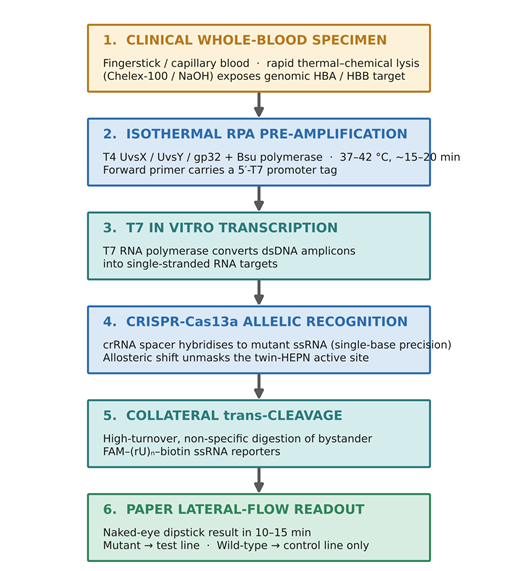
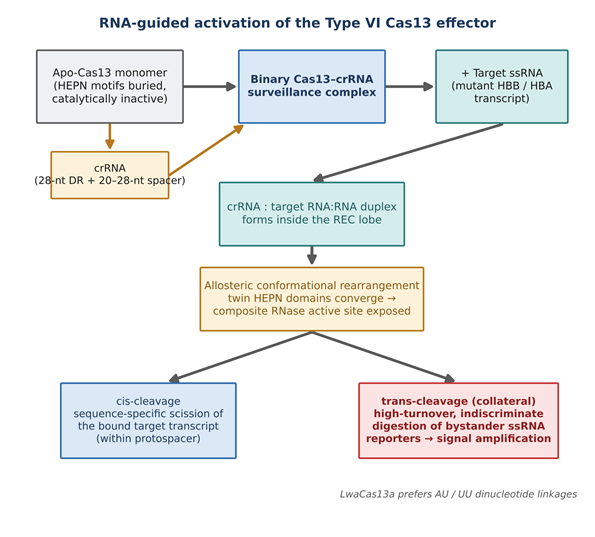
Article metrics
View details
0
Downloads
0
Citations
28
Views

View Dimensions


View Plumx


View Altmetric


0
Save
0
Citation
28
View
0
Share