1. Introduction
Global agriculture—if one pauses to consider its current trajectory—appears to be under a kind of quiet but intensifying pressure. The demand for food continues to rise, driven not only by population growth but also by shifting consumption patterns and resource constraints. Yet, this expansion unfolds alongside a less visible, though arguably more insidious challenge: the accumulation of toxic elements in agroecosystems. Among these, cadmium (Cd) has emerged as a particularly troubling contaminant. It is not required for plant metabolism, and still, it enters plant systems with unsettling ease, often via pathways intended for essential nutrients (Clemens et al., 2013; Chen et al., 2018). One begins to see, then, how the problem is not merely environmental—it is physiological, biochemical, and ultimately systemic.
Cadmium contamination is largely anthropogenic in origin. Industrial emissions, mining activities, and the prolonged use of phosphate fertilizers have all contributed to its persistence in soils (Guo et al., 2018). Once present, Cd does not simply remain inert; it interacts dynamically with plant systems. It disrupts ion homeostasis, interferes with nutrient uptake, and triggers oxidative stress by elevating reactive oxygen species (ROS) levels (Gill & Tuteja, 2010; He et al., 2020). These ROS, while part of normal cellular signaling, become harmful in excess, damaging membranes, proteins, and nucleic acids. It is perhaps here that the subtlety of Cd toxicity becomes most evident—not in immediate plant death, but in gradual physiological decline, reduced productivity, and compromised food quality.
Plants, of course, are not passive recipients of stress. Over evolutionary time, they have developed a repertoire of defense strategies. These include exclusion mechanisms that limit Cd entry, sequestration processes that confine it to vacuoles, and detoxification pathways involving chelating molecules such as phytochelatins (Clemens et al., 2013). Still, these intrinsic systems are not always sufficient, especially under high contamination scenarios. Their effectiveness depends—sometimes quite delicately—on the plant’s nutritional status and surrounding soil environment. It is here that the conversation begins to shift, from intrinsic tolerance to externally mediated resilience.
Nutrient-mediated strategies, though perhaps initially considered supplementary, have gained increasing attention as practical tools for mitigating Cd stress. Essential elements such as zinc (Zn), calcium (Ca), and nitrogen (N) do not merely support plant growth; they actively modulate Cd uptake and toxicity. Zinc, for instance, competes with Cd for transporters, thereby reducing its accumulation in plant tissues (Cai et al., 2019). Calcium, through its role in membrane stability and signaling, can limit Cd-induced cellular damage and regulate stress responses (Dong et al., 2022; Huang et al., 2017). Nitrogen, somewhat more complex in its effects, can either alleviate or exacerbate Cd toxicity depending on its form, influencing rhizosphere pH and metal mobility (Huang et al., 2019). These interactions suggest that nutrient management is not merely about supply—it is about balance, timing, and biochemical context.
Yet, even this perspective may be incomplete without considering another, perhaps more dynamic, component of the plant system: its associated microbiota. Increasingly, plants are being understood not as solitary organisms but as holobionts—integrated systems composed of the host and its microbial partners. The plant microbiome, particularly in the rhizosphere, plays a central role in shaping nutrient availability, stress responses, and overall plant health (Afridi et al., 2022). One might even argue that these microbial communities function as an extension of the plant’s own genome, offering adaptive capabilities that the plant alone may not possess.
Plant growth-promoting bacteria (PGPB) are among the most studied components of this microbiome. Their functions are diverse and, at times, surprisingly sophisticated. They produce phytohormones, solubilize nutrients, and synthesize siderophores that enhance iron acquisition (Glick, 2012). Some species, such as Bacillus subtilis, exhibit multicellular behaviors and produce bioactive compounds that suppress pathogens and improve plant resilience (Nagórska et al., 2007). These microbial activities can indirectly mitigate Cd stress by improving nutrient uptake and strengthening antioxidant defenses, thereby reducing the physiological burden imposed by heavy metals.
Fungal partners, too, contribute significantly to this dynamic. Species of Trichoderma have been widely recognized for their biocontrol and stress-alleviating properties, often enhancing root growth and nutrient acquisition under adverse conditions (Manzar et al., 2022). Arbuscular mycorrhizal fungi (AMF), in particular, form intimate associations with plant roots, extending their functional reach into the soil. These symbioses facilitate phosphorus uptake and can immobilize heavy metals within root structures, effectively limiting their translocation to edible plant parts (Cornejo et al., 2017). The implication here is subtle but important: microbial interactions do not merely buffer stress—they reshape how plants interact with their environment.
The interplay between microbiota and nutrient dynamics introduces an additional layer of complexity. Microbial activity influences soil chemistry, altering pH, redox conditions, and the availability of both nutrients and contaminants. In some cases, bacteria may enhance phosphorus availability, leading to the precipitation of Cd as insoluble complexes (Ma et al., 2024). In others, microbial communities may shift nutrient-use efficiencies, as seen in paddy soils where bacterial composition correlates with nutrient cycling processes (Guo et al., 2018). These interactions are not linear; they are context-dependent, shaped by soil type, plant genotype, and environmental conditions.
And perhaps this is where a degree of caution—or at least humility—is warranted. While the potential of microbiome engineering and nutrient optimization is compelling, it is not without uncertainty. The field itself has oscillated between optimism and skepticism, with some questioning whether current approaches can be reliably translated from controlled environments to field conditions (Afridi et al., 2022). Moreover, methodological challenges, including biases in data interpretation and experimental design, remain a concern, particularly in meta-analytical syntheses (Egger et al., 1997). These limitations do not negate the promise of the field, but they do suggest that progress may be incremental rather than immediate.
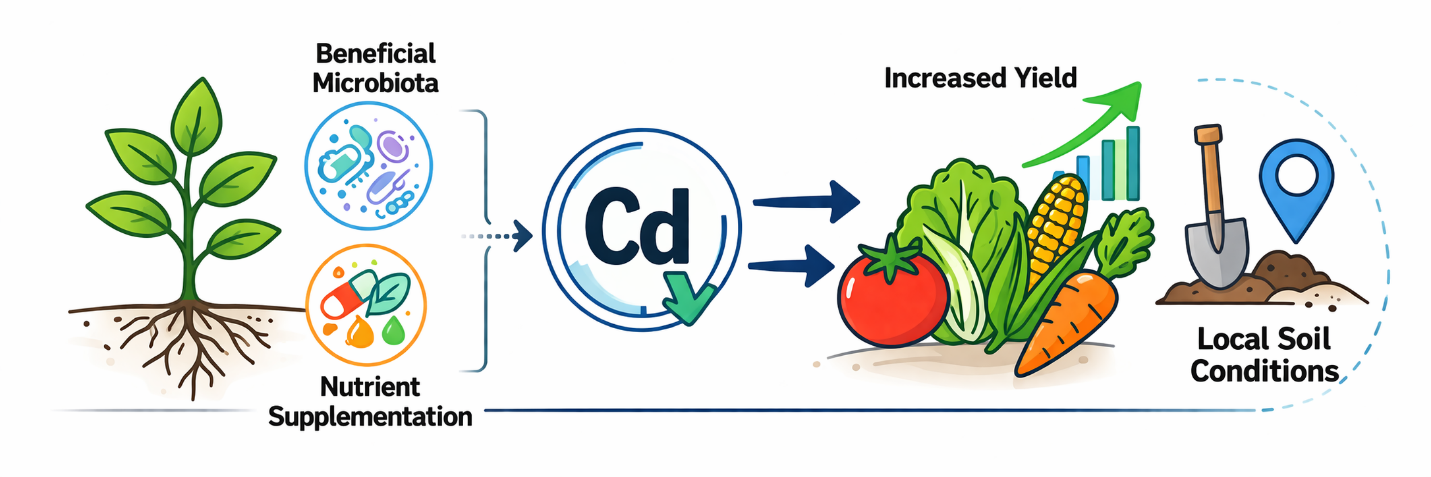
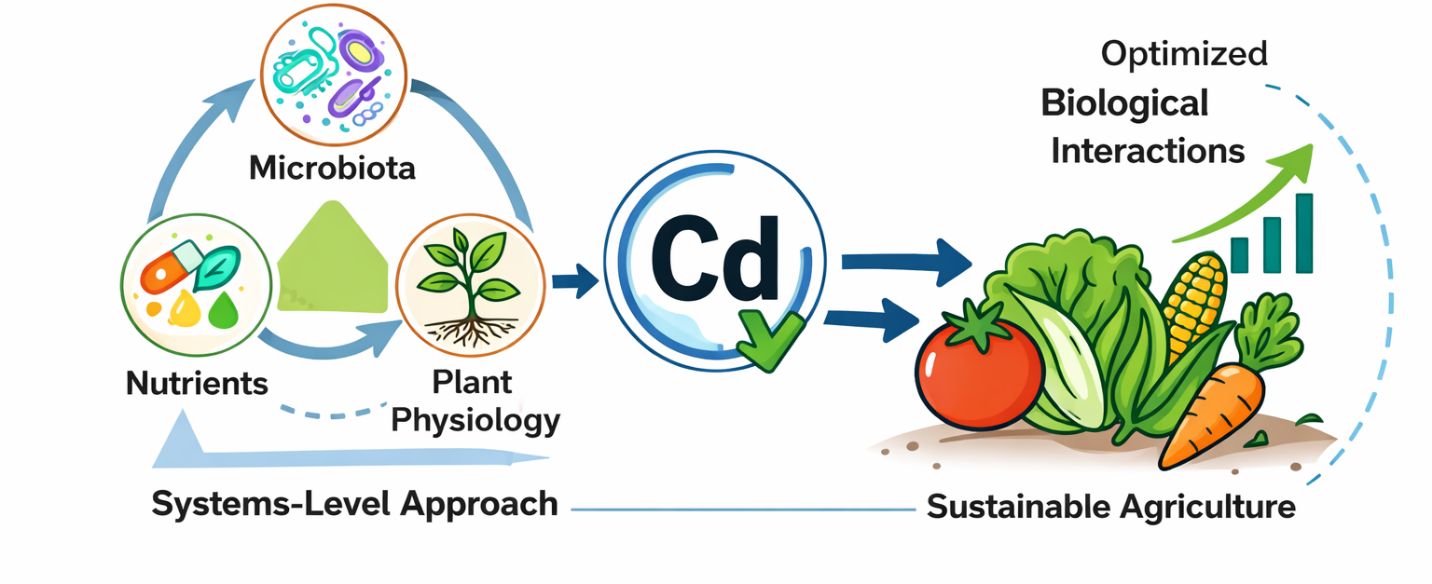
Still, taken together, the evidence points toward a convergence of strategies. Nutrient management and beneficial microbiota are not independent solutions; rather, they operate synergistically. Nutrients shape microbial communities, and microbes, in turn, regulate nutrient availability and plant uptake. Within this feedback loop lies the potential for more sustainable, biologically informed approaches to Cd mitigation.
In this review, we explore these interconnected mechanisms with a focus that is, admittedly, both integrative and cautious. We examine how beneficial microbiota and nutrient-mediated interventions interact to influence Cd dynamics in crop plants, considering both mechanistic insights and practical applications. By situating these strategies within a broader ecological and physiological framework, we aim to contribute—perhaps modestly—to the evolving conversation on sustainable agriculture and environmental resilience.