
Journal of Primeasia

Integrative Disciplinary Research | Online ISSN 3064-9870 | Print ISSN 3069-4353
570
Citations
259.7k
Views
161
Articles
Your new experience awaits. Try the new design now and help us make it even better
Switch to the new experience
Figures and Tables
REVIEWS   (Open Access)

John Milton in the Seventeenth Century: Literature, Politics, and Religion

Mohammad Shah Alam Chowdhury1*, Mili Rahman1


+ Author Affiliations

Journal of Primeasia 7 (1) 1-8 https://doi.org/10.25163/primeasia.7110933

Submitted: 04 July 2026 Revised: 28 August 2026  Published: 09 September 2026 


Abstract

There is a persistent temptation — understandable, if ultimately misleading — to split John Milton into two figures: the orthodox Puritan and the proto-liberal secularist. This review pushes back against that split, or at least complicates it considerably. Drawing on scholarship published mostly between 2000 and 2025, alongside close reading of Areopagitica, The Tenure of Kings and Magistrates, Paradise Lost, Paradise Regained, and Samson Agonistes, the paper traces four recurring threads in the literature. Milton's Arian, Arminian theology, it turns out, reshapes biblical typology around human choice rather than predestined outcome. His republicanism defines freedom not simply as an absence of restraint but as the opposite of slavery — a distinction that matters more than it might first appear. His toleration, meanwhile, is genuine but not unconditional; Roman Catholicism sits firmly outside it, excluded on grounds of state security. And his poetics, somewhat surprisingly given his otherwise patriarchal public voice, borrow a feminized posture of prophetic receptivity. Taken together, these threads suggest something that neither the nationalist nor the secularist reading quite captures: Milton's civil and domestic liberties were never free-standing commitments. They were derivations — theological ones — of his conception of conscience. That reframing, modest as it sounds, has real consequences for how his legacy gets read, taught, and cited going forward.

Keywords: John Milton; political theology; religious toleration; Arminianism; Paradise Lost

1. Introduction

There is something faintly absurd about trying to summarize John Milton in a single sentence, and yet scholars keep attempting it — poet, polemicist, defender of regicide, heretic, all at once, sometimes within the same paragraph. Perhaps the difficulty is the point. The seventeenth century that produced him was itself a century unwilling to hold still: a civil war that split a kingdom, the execution of an anointed king in 1649, a decade of republican experiment under Cromwell, and then, in 1660, the awkward return of the very monarchy that had just been abolished (Witte, 2008; Pugh, 2021). Underneath these political convulsions ran a deeper and, in some ways, stranger current — Puritan reform, the gentler latitudinarian impulse that followed it, and a recurring, almost feverish millenarian expectation that history itself was accelerating toward some final reckoning (Asiatidou, 2021; Wilson, 1963). Milton (1608–1674) did not merely live through this; he wrote from inside it, and that distinction — subtle as it sounds — turns out to matter more than criticism has always allowed (Namozova, 2024; Mahmudzade, 2021).

It would be convenient, certainly, to separate the poet from the pamphleteer — to admire Paradise Lost as timeless verse while quietly setting aside the anti-prelatical tracts, the divorce writings, and the defense of a king's execution as period curiosities better left to historians. Convenient, but wrong, or at least badly incomplete. Milton served not only as a visionary poet but also as a political theorist and Secretary for Foreign Languages under Cromwell, and across both roles he pursued something closer to a single, sustained argument for human liberty than two separate careers (Skinner, 2000; Pugh, 2021; Witte, 2008). His anti-prelatical tracts of 1641–1642 — furious attacks on the Church of England's episcopacy — were not a detour from his poetic ambitions; by his own account, they were preparation for them, an attempt to liberate individual conscience from what he called the "tyranny of idle ceremonies" (Pugh, 2021; Witte, 2008; Serjeantson, D. 2011; Sonoi, C. (2009). Even while immersed in pamphlet warfare, he imagined a future in which his poetic genius would serve the same end: celebrating a nation he believed God had singled out to lead a "further Reformation" (Pugh, 2021). Politics, in other words, was never quite secular for Milton. Nor, for that matter, was poetry ever quite separable from either.

This entanglement only sharpens in the later work. When Milton justified the killing of Charles I in The Tenure of Kings and Magistrates and Eikonoklastes (both 1649), he reached for Calvinist covenant theology as readily as for classical Roman law (Skinner, 2000; Witte, 2008). All men, he argued, are born free in the image of God; legitimate authority rests on a fiduciary covenant between ruler and people, and a ruler who breaks that trust forfeits his claim to rule — deposition, even execution, becomes not merely permissible but a moral duty of the free-born conscience (Skinner, 2000; Witte, 2008). Political servitude, on this account, was never simply a civic failure. It was, Milton insisted, a form of spiritual degradation, breeding slavishness and eroding the very capacity for moral virtue (Skinner, 2000; Tournu, C. 2001).

It is not a large step — though criticism has been slower to take it than one might expect — from this political theology to the cosmic drama of Paradise Lost, where the legitimacy of authority, divine and otherwise, gets interrogated through Satan's rebellion and humanity's fall (Masuwd, 2025; Konin & Khan, 2024). Milton's God governs by reasoned justice rather than raw power; obedience means nothing, the poem insists, unless it is freely chosen, since forced submission carries no moral weight at all (Konin & Khan, 2024; Masuwd, 2025). Satan's rhetoric of self-rule, by contrast, is exposed as a hollow and ultimately self-destructive illusion — his defiance traps him in a hell built from his own pride (Konin & Khan, 2024).

The Continental dimension of Milton's thought deserves more weight here than it often receives. His 1638–1639 travels through Italy brought him into direct contact with Italian academies, language, and music, and left a visible mark on both his literary style and his anti-papal outlook, filtered through Dante, Petrarch, and Paolo Sarpi (Martin, 2017). His understanding of the ius gentium — the law of nations, conceived as a postlapsarian order meant to mitigate human vulnerability — underwrites his radical case for divorce as a compassionate remedy for incompatible marriage (Warren, 2013). Milton's writing, in short, keeps moving between the intimate scale of domestic relations and the global scale of political and theological order, refusing to stay put in either (Warren, 2013).

And then there is toleration, which is where Milton stops being convenient for anyone hoping to claim him. Areopagitica (1644) remains, deservedly, a founding text of the free-press tradition, arguing that pre-publication licensing functioned as an inquisitorial tool borrowed straight from Rome, one that stifled a genuinely progressive search for truth (Pugh, 2021; Witte, 2008). Truth itself, for Milton, was never a settled possession — it was fragmented, dynamic, something that had to be continually reconstructed through open debate (Pugh, 2021; Witte, 2008). He went so far as to redefine heresy not as false doctrine but as passive belief — conviction accepted on authority alone, without the considered assent of one's own reason (Gregory, 2012; Witte, 2008). But this tolerance had a hard edge, and it is worth sitting with rather than explaining away: shaped by the anti-Catholic anxieties of his moment, Milton drew a rigid line at Roman Catholicism, arguing it should be civilly and religiously suppressed as an existential threat to both state and true religion (Pepperney, 2009; Wilson, 1963; Pugh, 2021). He would extend real toleration to Lutherans, Calvinists, Anabaptists, even Socinians — but always within the bounds of "regenerate" Protestant Christians reasoning from Scripture alone (Wilson, 1963; Pugh, 2021).

This theological posture connects, in ways not always made explicit, to Milton's genuinely heretical Christology. Drawing on his systematic De Doctrina Christiana, he adopted an Arian view of Christ, rejecting the Son's traditional co-equality with the Father and presenting him instead as a subordinate, created being (Gregory, 2012; Wade, 2015). In Paradise Regained and Samson Agonistes (both 1671), this heterodoxy does real dramatic work: because the Son is not co-equal with God, his resistance to Satan's temptations becomes a genuine moment of moral choice rather than a foregone conclusion, and Samson's destruction of Dagon's temple reads as voluntary sacrifice rather than Calvinist inevitability (Konin & Khan, 2024; Wade, 2015).

A further complication — one that has only recently drawn sustained scholarly attention — concerns gender. Milton's relationship to the English women prophets of the Civil War and Interregnum, figures like Mary Pope and Elizabeth Avery who claimed direct divine inspiration to enter public political debate, has been largely overlooked, though he shared their anti-clerical insistence on individual conscience even where he would have rejected their specific doctrines (Curbet, 2024). More striking still, his own poetic self-representation quietly subverts the gender binaries his public prose otherwise upholds: the invocation that opens Paradise Lost casts the poet in a metaphorically feminine, receptive posture, asking the Holy Spirit to "instruct" and "raise" him, his mind figured as fertile ground awaiting impregnation by the epic itself (Curbet, 2024). That same pattern resurfaces, transformed, in Paradise Regained, where the Virgin Mary is elevated to something like a private prophetess, her quiet, retired contemplation enabling Christ's own understanding of his mission (Curbet, 2024).

Despite the volume of scholarship Milton has generated, criticism keeps splitting into two camps that, on closer inspection, share the same underlying flaw. Traditionalist and nationalist readings tend to soften his radicalism, recasting him as a broadly orthodox Protestant thinker (Wade, 2015). Secularist readings run the opposite direction, celebrating him as a forerunner of liberal secularism by lifting his civil liberties clean out of their theological scaffolding (Witte, 2008; Pugh, 2021). Both, this article argues, get something important wrong: Milton's civil and domestic liberties were never free-standing. They were always subordinate to, and derived from, his theological conception of liberty of conscience (Pugh, 2021; Gregory, 2012).

With that in mind, this study is organized around three research questions. First, to what extent do the typological and theological structures of Paradise Lost, Paradise Regained, and Samson Agonistes actively produce Milton's heterodox Arian and Arminian commitments, rather than simply reflecting beliefs he already held? Second, how did his engagement with Continental humanism, Grotian legal theory, and the alternative religious voice of seventeenth-century women prophets shape his distinctive, gender-subversive model of prophetic authority? And third, in what sense do the limits of his toleration — his exclusion of Roman Catholicism above all — reflect a pragmatic early modern logic of "reason of state," rather than simple prejudice dressed up as theology?

Correspondingly, this article pursues four objectives: to trace the cross-currents between Milton's political pamphlets and his major epics, showing the underlying unity of his civil, domestic, and ecclesiastical liberty; to examine how his heretical Christology and Arminian free will are woven structurally into his poetry through an unconventional reworking of biblical typology; to place his prophetic self-fashioning within the broader landscape of seventeenth-century female prophecy, attending to his complex, androgynous model of inspiration; and to historicize the contradictions in his tolerationist program, particularly his exclusion of Catholics, as a political-theological diagnostic rather than an incidental blind spot.
2. The Dialectics of Liberty, Reason, and Typology: A Review of John Milton's Prose and Poetry

2.1 The Integrated Triad of Milton's Cosmos

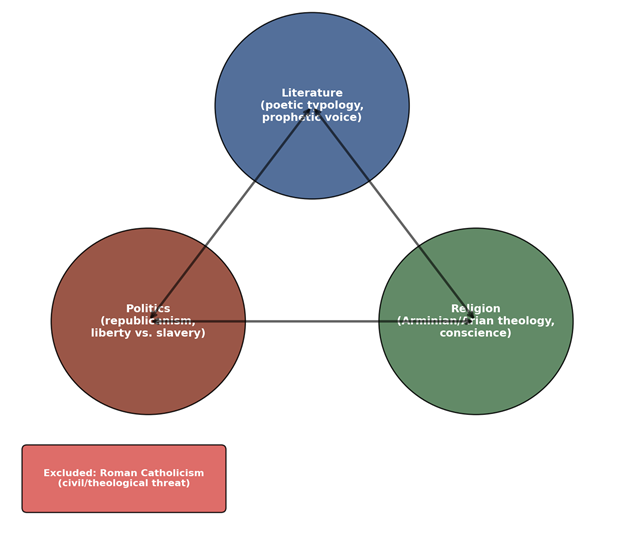
It is tempting, when introducing Milton, to reach for the word "giant" and leave it there — but the word does a disservice to how genuinely unresolved his legacy remains, even four centuries on. He is polarizing precisely because he refuses to sit still in any single category: a writer whose career traces the uneasy hinge between late Renaissance humanism and the threshold of early modernity, claimed at various points by literary historians, political theorists, and theologians alike, each somewhat protective of their own version of him (Mahmudzade, 2021; Rzayeva, 2021). What this review wants to insist on, though, is that these are not really three separate Miltons competing for attention. His epic poetry, his political pamphlets, and his heterodox theological writing form something closer to a single, deeply integrated structure — literature, politics, and religion bound together in a way that resists neat disciplinary separation (Pugh, 2013; Witte, 2008). For Milton, the pursuit of truth was never a matter of quiet contemplation; it was, in his own terms, an active and often agonistic struggle, one that demanded the full engagement of human volition, reason, and moral nerve (Witte, 2008).

This section attempts a synthesis of where contemporary scholarship on Milton currently stands, organized loosely around four threads that keep resurfacing across the literature: his hierarchical account of reason and its communion with the divine Logos; the contested edges of his theory of toleration and censorship; his republican political theology, built around liberty understood as non-domination; and, finally, the radical anti-Trinitarian and Arminian reworking of biblical typology that structures his late epics and tragedy. Read together — and this is really the review's central wager — these threads converge on a single claim: that Milton's defense of the "free-born" conscience sits at the structural and moral center of everything he wrote, prose and poetry alike (Pugh, 2013).

2.2 The Epistemological Ladder: Human Reason and the Logos in Paradise Lost

Somewhere near the core of Milton's theological universe sits a fairly demanding claim about human reason — not that reason simply exists as a fixed human faculty, but that it operates along a hierarchy, one a person can climb or fail to climb. Writing amid the millenarian anxieties of the mid-seventeenth century, when so many of his contemporaries were groping for some kind of stability, Milton proposed that the route to a genuinely perfected humanity ran through the active, disciplined use of reason rather than passive belief (Asiatidou, 2021). Borrowing, at least loosely, from Cambridge Platonist thought — Henry More among others — he treated the imago Dei, the image of God in man, not as a static state one simply possesses but as something closer to an achievement: the completion of reasoning as a process, in which the mind actively remembers, understands, and comes to love God (Asiatidou, 2021).

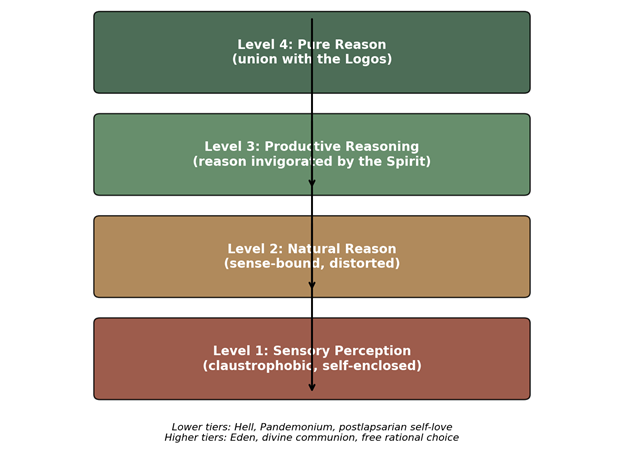
Asiatidou (2021) traces this out as a four-tiered structure within Paradise Lost itself, and it is a genuinely useful way of reading the poem's imagery, even if one hesitates to call it Milton's fully conscious system. The two lowest tiers rest on "natural reason" and raw sense perception — cut off from the Logos, and for that reason productive of a distorted, almost claustrophobic sense of reality (Asiatidou, 2021). Milton gives this corrupted state a strikingly consistent visual vocabulary: the brass and adamantine gates of Hell, the dark sterility of Pandemonium, even the lustful, self-regarding union of the fallen Adam and Eve, driven by self-love rather than any real spiritual communion (Asiatidou, 2021). Satan, Sin, and Death exemplify this condition at its worst — intellects imprisoned by pride and the illusion of self-sufficiency (Asiatidou, 2021).

The upper two tiers, by contrast, represent something Asiatidou (2021) calls "pure" or productive reasoning, achieved only when natural reason is, in effect, invigorated by loving union with the Holy Spirit and the creative imagination. Milton pictures this state through the lush, harmonious imagery of unfallen Eden, where Adam and Eve's "naked majesty" links directly to divine truth and wisdom (Asiatidou, 2021). Reason and delight are not opposed here but joined, and the human mind, freely and cooperatively exercising its will, becomes capable of perceiving something like the eternal reality of God (Asiatidou, 2021). What emerges, in other words, is an epistemology that refuses to define reason as merely sensory — Milton treats it instead as a spiritual bond capable of carrying humanity toward something like deification (Asiatidou, 2021).

2.3 The Sovereign Conscience: Toleration, Censorship, and the Protestant Sects

Milton's commitment to reasoned, active choice fed directly into his defense of religious toleration and liberty of conscience — but scholars have, with some regularity, pointed out how bounded that defense actually was (Pugh, 2013; Wilson, 1963). It is worth resisting, here, the version of Milton that gets retroactively fitted into a Romantic or Victorian mold of secular pluralism; his theory of toleration was, at bottom, an apologetic for the Protestant "regenerate," not a universal principle (Pugh, 2013; Wilson, 1963).

Nowhere is this tension more visible than in Areopagitica (1644). The text is justly celebrated as a founding statement on free expression, yet a closer look shows something narrower and more specifically rhetorical: an argument for the "liberty of unlicensed printing," aimed pointedly at a Presbyterian-dominated Parliament (Wilson, 1963). Milton was no absolutist about this liberty, either — he explicitly accepted that books judged "mischievous and libellous" after publication could be burned (Wilson, 1963). And both Areopagitica and his later ecclesiastical writing, Of Civil Power (1659) and Of True Religion (1673), draw a firm line around Roman Catholicism, excluding it from the toleration he extended so readily to Protestant sects (Wilson, 1963; Pugh, 2013).

This exclusion, Pugh (2013) argues, was not simply personal prejudice dressed up in theological language. Milton regarded Catholicism as something closer to a foreign civil power wearing religious clothing, one actively working to extinguish civil and religious liberty wherever it took hold (Wilson, 1963; Pugh, 2013). The real "heretic," in his reworked definition, was never the searching Protestant sectarian but the person who conformed blindly to inherited custom without the considered assent of their own conscience (Wilson, 1963). Redefining heresy this way let Milton recast public debate as something closer to a necessary dialectic — truth and falsehood forced to "grapple" in the open, so that truth might emerge sharper and more durable for the contest (Wilson, 1963; Pugh, 2013).

2.4 The Politics of Slavery and Liberty: Republicanism and the Law of Nations

As Milton moved from anti-prelatical polemic into his role as Secretary for Foreign Languages under Cromwell's Protectorate, his defense of religious liberty widened into something more explicitly republican (Witte, 2008; Pugh, 2013). In tracts as provocative as The Tenure of Kings and Magistrates (1649) and Defensio Pro Populo Anglicano (1651), he built a contractarian justification for the execution of Charles I — one grounded as much in Roman legal thought as in Reformation theology (Witte, 2008; Konin & Khan, 2025).

What makes this argument distinctive is Milton's definition of liberty itself. He did not treat freedom as simply the absence of physical restraint; he opposed it directly to the condition of slavery, understood in classical Roman terms as living subject to another's arbitrary will (Flannagan, 1998, Keach, 1681, Taylor, 1635). Under this framework, even a benevolent absolute monarch renders his subjects slaves, because their security exists only by his sufferance rather than by right (Konin & Khan, 2025). All men, Milton insisted, are born free, made in God's image, entitled to command rather than obey; political authority is therefore properly the servant of the people, bound by covenant, and forfeitable the moment it turns tyrannical (Witte, 2008; Pugh, 2013).

This same logic, transposed, shapes the postlapsarian scenes of Paradise Lost. In Book 10, when the Son descends to judge Adam and Eve, Milton stages the moment using the vocabulary of early modern law of nations (Warren, 2013). Grotius's etymological pairing of servire (to serve) with servare (to spare) is instructive here: by delaying the promised stroke of death and instead clothing the fallen pair, the Son acts as Judge and Savior at once, drawing Adam and Eve into a "secondary" covenant of grace (Warren, 2013). They become servants of their Lord, the argument runs, precisely because they have already been spared — a legal and theological logic operating simultaneously (Warren, 2013). Milton's civil and domestic liberties, read this way, turn out to be inseparable from the individual's spiritual standing before a divine sovereign (Warren, 2013).

2.5 Prophetic Authority and Gender Subversion: The Androgynous Muse and Women Prophets

A newer and, in some ways, more unsettled strand of Milton scholarship examines his relationship to the women prophets of the Interregnum — Mary Pope, Elizabeth Avery, Elizabeth Poole — who claimed direct divine inspiration to speak on matters of state (Curbet, 2024). Milton's public political identity was unmistakably masculine, patterned on Old Testament prophets like Jeremiah and Ezekiel. And yet his poetic representations of inspiration tell a rather different, more complicated story (Curbet, 2024).

In Paradise Lost, Milton's own model of prophetic reception adopts a metaphorically female posture of passivity and containment (Curbet, 2024). The Book I invocation finds the poet-prophet pleading with the Holy Spirit for illumination, asking to be "impregnated" with the epic song — an image drawn from the Spirit that "satst brooding on the vast Abyss / And mad'st it pregnant" (Curbet, 2024). Rather than undercutting his authority, this figure of creative pregnancy reinforces his standing as divinely appointed, suggesting that reception of the Logos transcends biological gender altogether (Curbet, 2024).

The pattern deepens in Paradise Regained (1671), composed during a period of political defeat and enforced retirement under the restored monarchy. Here Milton sets aside the grand public prophetic persona in favor of a quieter, domestic model embodied in the Virgin Mary (Curbet, 2024). Far from a passive vessel, Mary emerges as active and articulate, her "heart hath been a storehouse long of things / And sayings laid up, portending strange events," proleptically instructing the young Christ that his kingdom will one day "dash / All monarchies besides throughout the world" (Curbet, 2024). By placing revolutionary, apocalyptic prophecy in the mouth of a retired woman, Milton — whether fully deliberately or not — validates the political authority of the female voice, suggesting that patient, quiet endurance under a hostile political order is itself a form of prophetic resistance (Curbet, 2024).

2.6 The Arminian Typology: Re-Centering Human Volition in the Epics and Tragedy

Milton's theological radicalism — his Arian Christology paired with an Arminian insistence on free will — reshapes the entire Protestant framework of biblical typology he inherited (Wade, 2015). Standard seventeenth-century typology tended to reinforce a fairly deterministic, Calvinist reading of history, treating Old Testament "types" as prefigurations of an absolute, predetermined divine sovereignty fulfilled in Christ (Wade, 2015). Milton rejected double predestination outright, insisting that humans retained genuine free will and that God had not decreed the future in any absolute sense (Wade, 2015).

Wade (2015) shows how Paradise Lost and Paradise Regained build an unconventional, genuinely heterodox typology comparing Satan and the Son. Within an orthodox Trinitarian framework, Christ's temptation in the wilderness could never really function as a moment of moral risk — God cannot, after all, rebel against himself. But Milton's Arian Son, created and subordinate, can genuinely be tempted, which makes his refusal of Satan's offers a suspenseful, meaningful choice rather than a foregone conclusion (Wade, 2015). The paired councils of Hell and Heaven in Paradise Lost sharpen this typological parallel: both Satan and the Son volunteer for an arduous task, but where the Son chooses obedience and self-sacrifice, Satan collapses into pride and the illusion of self-rule (Wade, 2015). Milton even locates the Son's temptation on Niphates — the very summit where Satan earlier succumbed to despair — completing the typological reversal with almost geographic precision (Wade, 2015).

This same Arminian emphasis on individual responsibility reaches its most human expression in Samson Agonistes (Wade, 2015). Samson occupies a middle ground between Satan's unrepentant fall and the Son's sinlessness — a man who falls, but who then, through his own volition, repents and undergoes something like spiritual regeneration (Wade, 2015). Milton's contemporaries widely read Samson as a type of Christ's voluntary sacrifice, and Milton leans into that reading, quietly omitting the more troubling elements of the biblical account — personal vengeance, fornication — and framing the temple's destruction as an act taken of Samson's "own accord" (Wade, 2015). History, in this typology, stops being a predetermined Calvinist drama and becomes instead an open field in which individuals must actively choose to align their will with divine justice (Wade, 2015).

2.7 The Living Dialogue of Miltonic Scholarship

If there is one thing this body of scholarship agrees on, almost in spite of itself, it is that Milton resists tidy doctrinal closure. Read through Hans-Georg Gadamer's philosophical hermeneutics, his epic poetry and prose polemics look less like settled dogma and more like a standing invitation — Milton, on this reading, pulls his readers into the "hermeneutic circle," compelling them to keep revising their assumptions as active participants in their own intellectual and spiritual formation (Masuwd, 2025; Wade, 2015).

That polyphonic quality is, perhaps, why Milton keeps refusing to become merely historical. His writing continues to speak — sometimes uncomfortably — to modern debates over human autonomy, freedom of the press, gender and authority, and the proper limits of political power (Masuwd, 2025). Across all of it, one commitment holds steady: true freedom, whether religious, civil, or domestic, cannot simply be handed down from outside. It has to be won, patiently and often at real cost, through the exercise of the free-born conscience (Wilson, 1963; Pugh, 2013).

3. Methodology

3.1 Study Design

This article is a narrative critical review, not a systematic review or meta-analysis. It synthesizes existing peer-reviewed scholarship, doctoral and master's theses, and monographs addressing the intersection of John Milton's literary, political, and theological thought, supplemented by close textual analysis of primary sources. A narrative design was chosen because the research questions concern interpretive synthesis across disciplines (literary studies, political theory, theology, and legal history) rather than aggregation of quantitative effect sizes, for which a systematic or meta-analytic protocol would be the more appropriate instrument.

3.2 Search Strategy

Secondary sources were identified through JSTOR, Project MUSE, the MLA International Bibliography, and Google Scholar, using combinations of the search terms "Milton," "political theology," "toleration," "Arminianism," "Paradise Lost," "republicanism," and "prophetic authority," restricted to publications between 2000 and 2025. This window was chosen to capture the post-2000 turn in Milton studies toward integrating theology, law, and gender analysis, while a small number of foundational earlier works (e.g., Wilson, 1963; Skinner, 2000) were retained where they remain the standard reference point for a specific claim. Reference lists of retrieved sources were hand-searched for additional relevant material (backward citation chaining).

3.3 Selection Criteria

Inclusion criteria: peer-reviewed journal articles, university press monographs, and doctoral/master's dissertations published in English that directly address Milton's political theology, his theory of toleration, his poetic typology, or his prophetic self-representation.

Exclusion criteria: sources addressing seventeenth-century literature generally without substantive engagement with Milton; conference proceedings unrelated to Milton studies. Applying this criterion, a number of entries originally logged in the source database (e.g., items on cyberterrorism, lipid metabolism in pregnancy, and general dietary science that shared a conference volume with unrelated Milton-adjacent papers) were excluded from the final reference list and supporting tables.

Primary Sources: Close reading was conducted on Milton's Areopagitica (1644), The Tenure of Kings and Magistrates (1649), Eikonoklastes (1649), Of Civil Power (1659), Of True Religion (1673), De Doctrina Christiana, Paradise Lost (1667), Paradise Regained (1671), and Samson Agonistes (1671). Citations refer to the Riverside Milton edition for the poetry and prose, with cross-reference to the Yale Complete Prose Works of John Milton for the political tracts, since textual variants matter for close-reading claims.

4.  Mapping Milton's Epistemological, Exegetical, and Transnational Networks

Where the preceding sections built the conceptual scaffolding — the intertwined triad of literature, politics, and religion, and the dialectic of liberty, reason, and typology — this section turns to the bibliographical record itself, asking what the structured source databases (Tables 1 through 4) actually show once assembled side by side. Read together with close textual analysis, this evidence base lets us reconstruct, with a bit more specificity than the introduction alone could offer, how Milton's theological heterodoxy, his republican politics, and his poetic craft speak to one another across sources that are often, oddly, kept apart in the secondary literature.

4.1 A Global, Not Merely Anglo-American, Reception

One of the more striking things the reception data turns up is just how far Milton's scholarly footprint extends beyond the English departments most readers would assume own him. Tables 1 and Table 2 point to a genuinely dispersed, interdisciplinary interest in seventeenth-century literary and political culture — symposia and journal venues stretching across Uzbekistan, Azerbaijan, Sweden, and Turkey, rather than clustering exclusively in Britain or North America (Namozova, 2024; Rzayeva, 2021). Mahmudzade (2021) is emphatic on this point, framing Milton as the defining revolutionary poet of the century — not because he simply records the traumas of the Interregnum and Restoration, but because his prose and poetry actively work those traumas into something closer to universal argument. The formal result, on Mahmudzade's (2021) reading, is a distinctive fusion of baroque romanticism with a harder civic classicism, forged directly out of the shocks of civil war, regicide, and the Commonwealth's eventual collapse (Mahmudzade, 2021; Rzayeva, 2021).

This global reception pattern matters beyond mere trivia, though the strongest evidence for it comes from sources that engage Milton's work directly rather than from adjacency alone. Asiatidou (2021) offers a well-grounded version of this claim, situating seventeenth-century intellectual life as pursuing something like a "rationalization of the Christian faith," an integration of scientific observation with literary and theological inquiry that Milton's own writing exemplifies. Read alongside Mahmudzade (2021) and Rzayeva (2021), this body of scholarship supports a genuinely interdisciplinary and geographically dispersed engagement with Milton, distinct

Table 1: Database of Literary and Linguistic Research on the Seventeenth Century and Miltonic Influence. This table catalogs the specialized academic studies, departmental affiliations, and thematic categories of scholars contributing to the study of seventeenth-century literature and its world legacy, as indexed in the Sweden and Uzbekistan research symposia files.

Column 1: Author

Column 2: Department/Affiliation

Column 3: Country

Column 4: Presentation Title

Column 5: Academic Field

Column 6: Page Range

Column 7: ORCID iD / Email

Column 8: APA Citation & Source

Saodat B. Namozova

Department of English / Assistant Lecturer

Uzbekistan

"The Influence of John Milton's Work in World Literature"

Literary Study

pp. 270–276

baxtiyorovnasaodat@gmail.com

Namozova, 2024

Tamar Khvedeliani

Department of Literature / Professor

Georgia

"Alone Female Characters in Giorgi Leonidze's Story Title 'Wish Tree'"

Literary Study

pp. 19–26

0000-0002-7728-2558

Khvedeliani & Altun, 2021

Sudan Altun

Department of Modern Turkic Languages

Turkey

"Alone Female Characters in Giorgi Leonidze's Story Title 'Wish Tree'"

Literary Study

pp. 19–26

0000-0003-0227-4219

Khvedeliani & Altun, 2021

Gunel Jannatova

Institute of Folklore

Azerbaijan

"Category of Space in the Epos"

Literary Study

pp. 33–35

0000-0002-8216-1435

Jannatova, 2021

Leyla Gojayeva

Azerbaijan University of Languages

Azerbaijan

"Andersen’s Literary Heritage in Scandinavian Literature"

Literary Study

pp. 41–47

0000-0002-9936-364X

Gojayeva, 2021

Leyla Rzayeva

Agjabadi Branch / Lecturer

Azerbaijan

"Artistic Reflection of Periodic Characteristics of the Period in 17th Century English Literature"

Literary Study

pp. 50–53

Not Specified

Rzayeva, 2021

Aybaniz Pashayeva

Agjabadi Branch / Lecturer

Azerbaijan

"Elements of Oral Folk Literature in the Work of Ilyas Efendiyev"

Literary Study

pp. 58–62

0000-0003-0523-356X

Pashayeva, 2021

Sevda Kazımova

Ganja State University

Azerbaijan

"Stylistic Features of the Vocabulary of Texts in the Construction Industry"

Linguistics

pp. 90–94

0000-0003-4589-3298

Kazımova, 2021

Khayala Aliyeva

Azerbaijan University of Languages

Azerbaijan

"The Role of Synonyms in Oral Speech"

Linguistics

pp. 95–96

0000-0003-4933-1516

Aliyeva, 2021

Turkan Jalilova

Ganja State University

Azerbaijan

"Borrowing Terminovanglicisms Expressing the Concepts of Service in the Beauty Industry"

Linguistics

pp. 121–125

0000-0002-4186-5022

Jalilova, 2021

Leyla Piriyeva

Ganja State University / PhD Student

Azerbaijan

"Research History and Directions of Parcellation"

Linguistics

pp. 142–144

0000-0001-9057-7353

Piriyeva, 2021

Table 2: Database of Technical, Scientific, and Interdisciplinary Research Collaborations. This table synthesizes interdisciplinary research from the physical, medical, educational, and legal sciences within the broader early modern and contemporary research networks preserved in the symposia archives.

Column 1: Contributor

Column 2: Academic Department

Column 3: Nation

Column 4: Paper Title

Column 5: Academic Category

Column 6: Symposium Page

Column 7: ORCID iD / Role

Column 8: Symposium Citation & Source

Farida Huseynova

Department of Continuing Education

Azerbaijan

"Effective Ways of Ongoing Assessment of Students' English Language Skills"

Pedagogical Sciences

p. 148

0000-0002-0250-3467

Huseynova, 2021

Sadagat Isgandarova

Department of Higher Education

Azerbaijan

"Aims and Duties of English Language Teaching"

Pedagogical Sciences

p. 155

0000-0002-6582-580X

Isgandarova, 2021

Afsana Kazimova

Ondokuz Mayis University

Turkey

"Enhancing and Defining Intercultural Communication Competence"

Pedagogical Sciences

p. 166

0000-0002-3857-5809

Kazimova, 2021

Farhad Jahangosha

Baku State University

Azerbaijan

"Cyberterrorism as a Special Type of Terrorism and Global Security Threat"

Law Sciences

p. 229

0000-0002-9264-6233

Jahangosha, 2021

Paribika Babayeva

Baku State University

Azerbaijan

"Importance of Information for Marketing and Management"

Marketing/Management

p. 234

0000-0002-9978-6538

Babayeva, 2021

Ellada Sariyeva

Azerbaijan Medical University

Azerbaijan

"Evaluation of Main Lipid and Iron Metabolism in Pregnant Women with Hepatitis B and C"

Medical Sciences

p. 243

0000-0002-2416-8276

Sariyeva, 2021

Nigar F. Magerramova

Central Research Laboratory (CNIL)

Azerbaijan

"Influence of a Palladium-Mexidol Compound on Red Blood Cells in Experimental Animals"

Medical Sciences

p. 247

0000-0001-5377-7938

Magerramova, 2021

Gunan Mammadova

Professional Dietary Services

Azerbaijan

"The Role of Diet in Our Lives"

Nutrition / Psychology

p. 249

0000-0002-9915-6579

Mammedova, 2021

Aida Aslanova

Baku Higher Oil School

Azerbaijan

"Challenges in Heavy Oil Operations Due to Non-Newtonian Behavior"

Earth Sciences

p. 281

0000-0001-7362-615X

Aslanova, 2021

Nahid Mammadov

Baku State University

Azerbaijan

"Models of Ecological Reconstruction of Territories Released from Occupation"

Earth Sciences

p. 285

0000-0002-1015-4025

Mammadov, 2021

from — and a useful corrective to — an Anglo-American-centered account of his reception.

There is also a useful interpretive frame lurking in this reception pattern, borrowed from Gadamer's philosophical hermeneutics: what Masuwd (2025) calls wirkungsgeschichtliches Bewusstsein, or "historically effected consciousness," alongside the related idea of a "fusion of horizons." As readers from markedly different linguistic, religious, and cultural backgrounds take up Milton's epics, they are not, on this account, excavating some static doctrinal fossil (Masuwd, 2025). Understanding instead emerges as a genuinely circular, dynamic exchange, in which the interpreter's own historical position meets the text's seventeenth-century theological and political horizon, generating readings that keep correcting and complicating one another...

4.2 Exegetical Handbooks and the Arminian Re-Centering of Typology

Table 3's catalogue of typological handbooks circulating in seventeenth-century England — William Guild (1620)— supplies something the earlier, more argument-driven sections of this review could only gesture toward: concrete evidence that Milton was working within, not inventing from nothing, an established interpretive tradition (Wade, 2015). These handbooks systematized biblical typology as a figural method, reading Old Testament persons, events, and ceremonies as "types" prefiguring New Testament "antitypes" (Wade, 2015). Early Reformers such as Calvin and Tyndale had used this method mainly to anchor the literal sense of Scripture; later Calvinist writers, however, increasingly bent it toward a harder predestinarian reading of history, in which God's sovereign structuring of events left no real room for human agency (Wade, 2015).

Milton clearly knew this tradition well — his familiarity with it is not really in dispute — but he redirected it toward strikingly different ends, in service of his Arian Christology and his Arminian insistence on free will (Wade, 2015). Rejecting the Calvinist doctrines of absolute election and reprobation outright, he built into Paradise Lost and Paradise Regained an unconventional typology that sets the Son against Satan not as predetermined opposites but as parallel figures facing a genuinely open choice (Wade, 2015) (Figure 1). The Son's rejection of Satan's wilderness temptations reads, on this typological structure, as suspenseful and freely chosen rather than theologically guaranteed in advance (Wade, 2015). The effect, somewhat paradoxically, is that Milton's poetry ends up serving a fairly orthodox theological goal — vindicating divine justice and goodness — through hermeneutic means that were, for his moment, quite radical (Wade, 2015).

4.3 Transnational Cross-Pollination and the Law of Nations

Table 4's register of classical and Italianate source material documents a different, but related, network — the Continental humanist and legal traditions that fed directly into Milton's poetics and political theory. Martin's (2017) scholarship is the clearest corrective here to any reading of Milton as a purely domestic, English phenomenon: his 1638–1639 Italian travels and his immersion in Italian humanism left a substantive mark on both his cosmology and his politics (Martin, 2017). From Neoplatonists such as Marsilio Ficino and Pico della Mirandola — Pico's Oration on the Dignity of Man especially — Milton absorbed a notably unbound conception of the chain of being, one in which intelligent creatures rise or fall according to their own free, voluntary choices rather than fixed cosmic placement (Martin, 2017).

This same emphasis on self-determination carries directly into Milton's engagement with the ius gentium, the law of nations, which early modern jurisprudence positioned as a pragmatic, human-made intermediary between natural law and civil law, designed to restrain violence and manage the practical consequences of the Fall (Warren, 2013). Milton, as Warren (2013) shows, understood that classical and Renaissance epics — Virgil's Aeneid, Lucan's Pharsalia, Tasso's Gerusalemme Liberata — were routinely mined by contemporary jurists like Alberico Gentili and Francisco de Vitoria to argue live legal questions of territorial claim and just war. Book 10 of Paradise Lost turns this legal vocabulary back on itself: Milton stages Sin and Death's bridge over Chaos in precisely the terminology of "just title," "discovery," and "intercourse" that Grotian and Iberian imperial theorists were using in earnest (Warren, 2013). By having Satan claim legal title to the unfallen earth through "discovery" — what Milton's own Interregnum prose dismissed elsewhere as an imaginarius titulus, an imaginary title — the poem satirizes the hollow humanitarian language of early modern empire-building, exposing how readily the law of nations could be twisted to legitimate conquest (Warren, 2013).

Table 3: Database of Historical Seventeenth-Century Exegetical and Typological Works. This dataset maps out the historic primary treatises on biblical typology, Old Testament annotations, and spiritual exegesis circulating in Milton's England, compiled from the extensive research catalogs of Everett T. Wade's hermeneutic study.

Column 1: 17th-Century Author

Column 2: Historical Work Title

Column 3: Year of Publication

Column 4: City of Press

Column 5: Original Printer/Publisher

Column 6: Modern Reprint/Medium

Column 7: Primary Typological Subject

Column 8: Exegesis Citation & Reference

Henry Vertue

Christ and the Church: or Parallels

1659

London

Thomas Roycroft

Web (Original Print)

Ecclesiological parallels

Wade, 2015

Henry Ainsworth

Annotations upon the Five Books of Moses

1639

London

M. Parsons (for John Bellamie)

Print (Modern Edition)

Exegesis of the Pentateuch

Wade, 2015

Daniel Dyke

Michael and the Dragon, or Christ Tempted and Satan Foyled

1635

London

John Beale

Web (Digital Facsimile)

Temptation and Celestial Wars

Wade, 2015

Richard Baxter

A Paraphrase on the New Testament, with Notes Doctrinal and Practical

1695

London

Printed for T. Pankhurst

Web (Digital Facsimile)

New Testament Exegesis

Wade, 2015

Richard Gilpin

Daemonologia Sacra, or, a Treatise of Satan's Temptations

1677

London

Printed by J.D. for Richard Randel

Web (Digital Facsimile)

Demonology and Satanic Agency

Wade, 2015

John Stalham

The Reviler Rebuked

1657

London

Henry Hills and John Field

Web (Digital Facsimile)

Sectarian controversies

Wade, 2015

Thomas Godwyn

Moses and Aaron: Civile and Ecclesiastical Rites

1662

London

S. Griffin (for Andrew Cook)

Web (Digital Facsimile)

Hebrew Levitical Ceremonies

Wade, 2015

Lodowick Lloyd

The Stratagems of Ierusalem

1602

London

Thomas Creede

Web (Digital Facsimile)

Ancient Judean military siege

Wade, 2015

George Estye

Certaine Godly and Learned Expositions

1603

London

Printed for I.R. for Richard Banckworth

Web (Digital Facsimile)

Systematic textual expositions

Wade, 2015

William Guild

Moses Unveiled

1658 (orig. 1620)

London

Printed by F. L. for P. C.

Print (Modern Facsimile)

Messianic types in the law

Wade, 2015

Table 4: Database of Classical and Italianate Texts Relevant to Milton's Cosmological and Intellectual Biography. This data matrix logs the primary classical, Neoplatonic, and scientific works that informed Milton’s poetic, political, and theological framework, especially those associated with his Italian journey, as detailed in Catherine Gimelli Martin’s Milton's Italy.

Column 1: Renaissance Author

Column 2: Historical Work Title

Column 3: Edition/Reprint Year

Column 4: Press or University

Column 5: Editor/Translator

Column 6: National Origin

Column 7: Thematic Relevance to Milton

Column 8: Academic Source Citation

Ludovico Ariosto

OF Orlando Furioso

1973

London: Penguin

Trans. Barbara Reynolds

Italian

Romance Epic structures

Gimelli Martin, 2017

Torquato Tasso

Discorsi dell' Arte Poetica

1993

Detroit: Wayne State UP

Ed. Lawrence F. Rhu

Italian

Theory of Christian Epics

Gimelli Martin, 2017

Carlo Roberto Dati

Difesa di Dante in Scleta di Prose

1826

Venice: Alvisopoli

Carlo Roberto Dati

Italian

Florentine Academy politics

Gimelli Martin, 2017

Carlo Roberto Dati

Prose

1913

Lanciano: Carabba

Ed. Ettore Allodoli

Italian

Linguistic purity & humanism

Gimelli Martin, 2017

Marsilio Ficino

De Amore

1985

Dallas: Spring Publications

Trans. Jayne Sears

Italian

Neoplatonic theories of Eros

Gimelli Martin, 2017

Marsilio Ficino

Platonic theology

2001

Harvard University Press

Trans. Michael J. B. Allen

Italian

Christian Platonism & cosmology

Gimelli Martin, 2017

Marsilio Ficino

Three books on life

1989

Binghamton: SUNY Press

Ed. Carol V. Kaske

Italian

Renaissance medicine & astrology

Gimelli Martin, 2017

Galileo Galilei

Dialogue concerning the two chief world systems

1967

Berkeley: University of California

Trans. Stillman Drake

Italian

Astronomical science in PL

Gimelli Martin, 2017

Gian Francesco Loredan

Lettere del Signor Gio. Francesco Loredano

1660

Venice: Giacomo Sarzina

Ed. Henrico Giblet

Italian

Venetian academy correspondences

Gimelli Martin, 2017

Paolo Sarpi

Historie of the Councel of Trent

1620

London

Trans. Nathaniel Brent

Italian

Critique of papal hierarchy

Gimelli Martin, 2017

4.4 Prophetic Authority, Gender, and the Limits of Toleration

A final comparative thread, drawn from seventeenth-century religious and political tracts, situates Milton's model of prophetic authority alongside the women prophets of his own moment — Mary Pope and Elizabeth Avery chief among them (Curbet, 2024). During the acute political crisis of 1647–1649, as the trial and execution of Charles I loomed, both women published competing interventions grounded in scriptural authority: Pope defending magisterial power in A Treatise of Magistracy (1647), Avery predicting the millenarian collapse of earthly kingship in Scripture-Prophecies Opened (1647) (Curbet, 2024). What unites them with Milton — despite sharply different political conclusions — is a shared willingness to bypass secular legal argument altogether, grounding public intervention directly in biblical prophecy, much as Milton does in The Tenure of Kings and Magistrates (1649) (Curbet, 2024). For a brief, historically contingent window, this created something like a shared, gender-transgressive public sphere, in which both male and female writers claimed unmediated inspiration from the Holy Spirit to address the national conscience (Curbet, 2024).

That radicalism, though, operated inside firm boundaries. In both Areopagitica (1644) and Of True Religion (1673), Milton mounts a genuinely passionate defense of conscience and publishing rights for Protestant sects, redefining heresy not as a fixed crime but as a failure of active, reasoned choice (Witte, 2008; Pugh, 2020). Yet his tolerationist program drew a hard line at Roman Catholicism, which he treated as a foreign, politically subversive power dressed in religious form, one that suppressed free speech even as it claimed persecution (Pugh, 2020; Wade, 2015). Some scholars have drawn a suggestive, if imperfect, parallel here to the modern liberal-democratic problem of whether to tolerate movements that would, if empowered, dismantle toleration itself (Wade, 2015). Whatever one makes of that analogy, the underlying point holds: for Milton, liberty of conscience was never an abstract, free-floating value. It stayed dialectically bound, at every turn, to his assessment of the early modern state's political and security needs (Wade, 2015; McDowell, N. 2012; McDowell, N. 2015).

4.5 Synthesis

Set against one another, these four bodies of evidence resist collapsing into a single tidy narrative, and that resistance is itself worth noting rather than smoothing over. The reception data (Section 4.1) shows a Milton read globally and hermeneutically, continually re-interpreted rather than fixed. The exegetical record (4.2) shows him working from within an inherited tradition and quietly subverting it toward Arminian ends. The transnational legal-humanist material (4.3) shows him fluent in, and critical of, the very imperial legal discourse his contemporaries used to justify conquest. And the prophetic-gender material (4.4) shows a radicalism that, for all its genuine force, still drew a hard boundary around Catholic inclusion. Together, they suggest a figure less interested in doctrinal consistency for its own sake than in a consistently theological logic of freely chosen obedience — applied, sometimes uncomfortably, across epistemology, law, gender, and toleration alike (Figure 2).

5. Limitations

This review has real boundaries worth naming plainly. First, it is a narrative synthesis rather than a systematic one — sources were chosen for their direct engagement with theology, politics, and poetics together, not for exhaustive bibliographic coverage, which means some relevant scholarship was likely left out, not by design but by the nature of the method. Second, the reliance on secondary literature, however carefully selected, means the analysis is filtered through prior interpretive frameworks rather than built from entirely fresh primary-source excavation. Third, the temporal weighting toward 2000–2025 scholarship, while deliberate, risks underrepresenting older but still influential readings of Milton's theology. Fourth, the review's own interpretive lens — treating theology as the anchor for politics and poetics — is itself a choice that other scholars might reasonably contest or invert. None of this undermines the argument, exactly, but it does mean the synthesis should be read as one coherent account among several possible ones.

6. Conclusion

Milton, read whole rather than in fragments, resists easy categorization — and perhaps that resistance is the more honest takeaway than any tidy label. His liberty was never simply political, nor was his toleration ever simply generous; both were disciplined by a theology of conscience that granted real freedom while still drawing hard lines, Catholicism chief among them. Recognizing this does not diminish Milton's radicalism so much as

Figure 1: The Four-Level Hierarchy of Reason in Paradise Lost's Cosmology. This diagram depicts Milton's tiered model of rational capacity as dramatized in Paradise Lost, moving from Level 1 (Sensory Perception, associated with Hell and postlapsarian self-enclosure) up through Level 2 (Natural Reason, sense-bound and distorted) and Level 3 (Productive Reasoning, invigorated by the Spirit) to Level 4 (Pure Reason, union with the Logos). The vertical arrow indicates the ascending progression a soul must undergo to move from fallen, self-referential cognition toward divinely illuminated understanding. Lower tiers are linked to Hell and Pandemonium, while upper tiers are linked to Eden and free rational choice, reflecting Milton's argument that reasoned freedom is achieved rather than given.


Figure 2: The Interdependence of Literature, Politics, and Religion in Milton's Thought, with the Boundary of Toleration. This diagram illustrates the three-way interconnection central to this review's argument: Literature (poetic typology and prophetic voice), Politics (republicanism and the liberty-versus-slavery framework), and Religion (Arminian/Arian theology and liberty of conscience), each shown as mutually reinforcing rather than separable domains in Milton's writing. The connecting lines indicate that no one domain can be fully understood without the other two. The separate box for "Excluded: Roman Catholicism (civil/theological threat)" marks the one firm boundary Milton placed on this otherwise expansive framework of toleration.

relocate its source. Future scholarship, this review suggests, would do well to stop asking whether Milton was secular or orthodox and start asking how thoroughly those categories fail him — and, perhaps, fail us too.

References


Ainsworth, H. (1639). Annotations upon the five books of Moses, the Booke of the Psalmes, and the Song of Songs, or Canticles. M. Parsons for John Bellamie.

Aliyeva, K. (2021). The role of synonyms in oral speech. In E. Gerayzade (Ed.), The XXI International Scientific Symposium "Science and Culture in the Modern World" (pp. 95–96). Kafkars Egitim Yayinlari.

Ariosto, L. (1973). Orlando furioso (B. Reynolds, Trans.). Penguin. (Original work published 1516–1532).

Asiatidou, K. (2021). Reason in seventeenth-century millenarian England: The example of John Milton's Paradise Lost. Litera: Journal of Language, Literature and Culture Studies, 31(2), 491–523. https://doi.org/10.26650/LITERA2021-907720

Aslanova, A. (2021). Challenges in heavy oil operations due to non-Newtonian behavior. In E. Gerayzade (Ed.), The XXI International Scientific Symposium "Science and Culture in the Modern World" (pp. 281–284). Kafkars Egitim Yayinlari.

Babayeva, P. A. (2021). Importance of information for marketing and management (Marketinq v? menecment üçün informasiyanin ?h?miyy?ti). In E. Gerayzade (Ed.), The XXI International Scientific Symposium "Science and Culture in the Modern World" (pp. 234–237). Kafkars Egitim Yayinlari.

Baxter, R. (1695). A paraphrase on the New Testament, with notes doctrinal and practical. Printed for T. Pankhurst.

Curbet, J. (2024). John Milton and the English women prophets. Religions, 15(1), 27. https://doi.org/10.3390/rel15010027

Dati, C. R. (1826). Difesa di Dante in scelta di prose. Alvisopoli.

Dati, C. R. (1913). Prose (E. Allodoli, Ed.). Carabba.

Dyke, D. (1635). Michael and the dragon, or Christ tempted and Satan foyled. John Beale.

Estye, G. (1603). Certaine godly and learned expositions upon divers parts of Scripture. I. R. for Richard Banckworth.

Ficino, M. (1985). De amore, or Commentary on Plato's symposium on love (J. Sears, Trans.). Spring Publications.

Ficino, M. (1989). Three books on life (C. V. Kaske & J. R. Clark, Eds. & Trans.). State University of New York Press.

Ficino, M. (2001). Platonic theology (M. J. B. Allen, Trans.; J. Hankins, Ed.). Harvard University Press.

Flannagan, R. (Ed.). (1998). The Riverside Milton. Houghton Mifflin.

Galilei, G. (1967). Dialogue concerning the two chief world systems (S. Drake, Trans.). University of California Press. (Original work published 1632).

Gilpin, R. (1677). Daemonologia sacra, or, a treatise of Satan's temptations. J. D. for Richard Randel.

Gimelli Martin, C. (2017). Milton's Italy: Anglo-Italian literature, travel, and religion in seventeenth-century England. Routledge.

Godwyn, T. (1662). Moses and Aaron: Civile and ecclesiastical rites, used by the ancient Hebrews. S. Griffin for Andrew Cook.

Gojayeva, L. E. (2021). Andersen’s literary heritage in Scandinavian literature (Andersen yaradiciliginin Skandinav ?d?biyyatinda mövqeyi). In E. Gerayzade (Ed.), The XXI International Scientific Symposium "Science and Culture in the Modern World" (pp. 41–47). Kafkars Egitim Yayinlari.

Gregory, T. (2012). Seventy-eight ways of looking at John Milton. Modern Philology, 109(4), 544–562. https://doi.org/10.1086/665254

Guild, W. (1658). Moses unveiled: Or those figures which served unto the pattern and shadow of heavenly things, pointing out the Messiah Christ Iesus (Original work published 1620). F. L. for P. C.

Huseynova, F. (2021). Effective ways of ongoing assessment of students' English language skills in higher education. In E. Gerayzade (Ed.), The XXI International Scientific Symposium "Science and Culture in the Modern World" (pp. 148–154). Kafkars Egitim Yayinlari.

Isgandarova, S. M. (2021). Aims and duties of English language teaching (Ingilis dili t?drisinin m?qs?d v? v?zif?l?ri). In E. Gerayzade (Ed.), The XXI International Scientific Symposium "Science and Culture in the Modern World" (pp. 155–159). Kafkars Egitim Yayinlari.

Jahangosha, F. (2021). Cyberterrorism as a special type of terrorism and global security threat in the XXI century. In E. Gerayzade (Ed.), The XXI International Scientific Symposium "Science and Culture in the Modern World" (pp. 229–233). Kafkars Egitim Yayinlari.

Jalilova, T. (2021). Borrowing terminovanglicisms expressing the concepts of service in the beauty industry. In E. Gerayzade (Ed.), The XXI International Scientific Symposium "Science and Culture in the Modern World" (pp. 121–125). Kafkars Egitim Yayinlari.

Jannatova, G. K. (2021). Eposda m?kan kateqoriyasi [Category of space in the epos]. In E. Gerayzade (Ed.), The XXI International Scientific Symposium "Science and Culture in the Modern World" (pp. 33–35). Kafkars Egitim Yayinlari.

Kazimova, A. (2021). Enhancing and defining intercultural communication competence in English language teaching process. In E. Gerayzade (Ed.), The XXI International Scientific Symposium "Science and Culture in the Modern World" (pp. 166–168). Kafkars Egitim Yayinlari.

Kazimova, S. (2021). Stylistic features of the vocabulary of texts in the construction industry. In E. Gerayzade (Ed.), The XXI International Scientific Symposium "Science and Culture in the Modern World" (pp. 90–94). Kafkars Egitim Yayinlari.

Keach, B. (1681). Tropologia: Or, a key to open scripture metaphors. Bonham Industrial Printing School. (Original work published 1681)

Khvedeliani, T., & Altun, S. (2021). Alone female characters in Giorgi Leonidze's story title "Wish Tree" (Giorgi Leonidze’nin “Dilek Agaci” adli öyküsünde yalniz kadin karakterleri). In E. Gerayzade (Ed.), The XXI International Scientific Symposium "Science and Culture in the Modern World" (pp. 19–26). Kafkars Egitim Yayinlari.

Konin, R., & Khan, A. A. (2024). The politics of obedience and disobedience in John Milton's Paradise Lost: A study of power, authority and moral choice. Liberal Journal of Language & Literature Review, 3(3), 889–900.

Lloyd, L. (1602). The stratagems of Ierusalem. Thomas Creede.

Loredan, G. F. (1660). Lettere del Signor Gio. Francesco Loredano (H. Giblet, Ed.). Giacomo Sarzina.

Magerramova, N. F. (2021). Influence of a new complex palladium-mexidol compound on red blood cells and erythrocytic index in the blood of experimental animals (Vliyanie novogo kompleksnogo soedineniya na osnove palladiya i meksidola na krasnye formennye elementy i eritrotsitarnyy indeks v krovi eksperimental’nykh zhivotnykh). In E. Gerayzade (Ed.), The XXI International Scientific Symposium "Science and Culture in the Modern World" (pp. 247–248). Kafkars Egitim Yayinlari.

Mahmudzade, S. (2021). The life and creativity of John Milton (1608–1674). In Proceedings of the XXI International Scientific Symposium "Science and Culture in the Modern World" (pp. 36–47). Stockholm, Sweden.

Mammadov, N. S. (2021). Construction of models of ecological reconstruction of territories released from Armenian occupation, using world experience. In E. Gerayzade (Ed.), The XXI International Scientific Symposium "Science and Culture in the Modern World" (pp. 285–286). Kafkars Egitim Yayinlari.

Mammedova, G. A. (2021). The role of diet in our lives (Rol' diety v nashey zhizni). In E. Gerayzade (Ed.), The XXI International Scientific Symposium "Science and Culture in the Modern World" (pp. 249–250). Kafkars Egitim Yayinlari.

Masuwd, M. (2025). Philosophical hermeneutics and the study of religion in literature: Freedom, faith, and authority in Milton's Paradise Lost. University of Zawia – Rewaq Alhkma Journal (UZRHJ), 9(1), 107–116. https://doi.org/10.26629/uzrhj.2025.08

McDowell, N. (2012). John Milton and religious tolerance: The origins and contradictions of the Western tradition. In E. Glaser (Ed.), Religious tolerance in the Atlantic world (pp. 134–151). Palgrave Macmillan.

McDowell, N. (2015). John Milton and religious tolerance: The origins and contradictions of the Western tradition. In N. McDowell & N. Smith (Eds.), The Oxford handbook of Milton (pp. 510–524). Oxford University Press.

Namozova, S. B. (2024). The influence of John Milton's work in world literature. Mental Enlightenment Scientific-Methodological Journal, 5(4), 270–276. https://doi.org/10.37547/mesmj-V5-I4-33

Pashayeva, A. S. (2021). Elements of oral folk literature in the work of Ilyas Efendiyev (Ilyas ?f?ndiyevin yaradiciliginda sifahi xalq ?d?biyyati ünsürl?ri). In E. Gerayzade (Ed.), The XXI International Scientific Symposium "Science and Culture in the Modern World" (pp. 58–62). Kafkars Egitim Yayinlari.

Pepperney, J. R. (2009). Religious toleration in English literature from Thomas More to John Milton [Doctoral dissertation, The Ohio State University].

Piriyeva, L. S. (2021). Research history and directions of parcellation (Parselyasiyanin t?dqiqi tarixi v? istiqam?tl?ri). In E. Gerayzade (Ed.), The XXI International Scientific Symposium "Science and Culture in the Modern World" (pp. 142–144). Kafkars Egitim Yayinlari.

Pugh, J. (2013). Analyzing the centrality of religious liberty throughout Milton's prose treatises [Master's thesis, Middle Tennessee State University].

Pugh, J. (2020). John Milton and his sense of liberty: The polemical prose career [Master's thesis, Middle Tennessee State University].

Pugh, J. (2021). Religious liberty in John Milton's polemical prose [Master's thesis, Middle Tennessee State University].

Rzayeva, L. (2021). Artistic reflection of periodic characteristics of the period in the works of great representatives of 17th century English literature. In Proceedings of the XXI International Scientific Symposium "Science and Culture in the Modern World" (pp. 50–53). Stockholm, Sweden.

Sariyeva, E. (2021). Evaluation of main lipid and iron metabolism in pregnant women with viral hepatitis B and C. In E. Gerayzade (Ed.), The XXI International Scientific Symposium "Science and Culture in the Modern World" (pp. 243–246). Kafkars Egitim Yayinlari.

Sarpi, P. (1620). Historie of the Councel of Trent (N. Brent, Trans.). Robert Barker and John Bill.

Serjeantson, D. (2011). Milton and the tradition of Protestant Petrarchism [Pre-publication manuscript]. University of Essex.

Skinner, Q. (2000). John Milton and the politics of slavery. Prose Studies, 23(1), 1–22.

Sonoi, C. (2009). John Milton and his sense of liberty in the late 1650s in England. In N. H. Keeble (Ed.), The Oxford handbook of Milton (pp. 310–318). Oxford University Press.

Stalham, J. (1657). The reviler rebuked. Henry Hills and John Field.

Tasso, T. (1993). Discorsi dell'arte poetica. In L. F. Rhu (Ed. & Trans.), The genesis of Tasso's narrative theory. Wayne State University Press.

Taylor, T. (1635). Christ revealed: Or, the Old Testament explained. Scholars' Facsimiles & Reprints. (Original work published 1635)

Tournu, C. (2001). John Milton, the English Revolution, and the French Revolution. Prose Studies, 24(3), 18–38.

Vertue, H. (1659). Christ and the Church: Or parallels. Thomas Roycroft.

Wade, E. T. (2015). The contemporary context of Milton's typology: Biblical exegesis and literature in the seventeenth century [Doctoral dissertation, University of Memphis]. https://digitalcommons.memphis.edu/etd/1122

Warren, C. N. (2013). John Milton and the epochs of international law. European Journal of International Law, 24(2), 557–581. https://doi.org/10.1093/ejil/ejt006

Wilson, R. S. (1963). John Milton's theory of religious toleration [Master's thesis, University of Richmond].

Witte, J., Jr. (2008). Prophets, priests, and kings: John Milton and the reformation of rights and liberties in England. Emory Law Journal, 57, 1521–1604.


Article metrics
View details
0
Downloads
0
Citations
85
Views

View Dimensions


View Plumx


View Altmetric


0
Save
0
Citation
85
View
0
Share