Journal of Primeasia

Integrative Disciplinary Research | Online ISSN 3064-9870 | Print ISSN 3069-4353
570
Citations
253.6k
Views
158
Articles
Your new experience awaits. Try the new design now and help us make it even better
Switch to the new experience
Figures and Tables
REVIEWS   (Open Access)

When Prediction Isn't Enough: Causal Machine Learning for Personalized Treatment Selection and Clinical Outcome Prediction

Sanjida Alam Eshra1*, Md. Fatin2

+ Author Affiliations

Journal of Primeasia 3 (1) 1-14 https://doi.org/10.25163/primeasia.3110913

Submitted: 30 May 2022 Revised: 04 August 2022  Published: 12 August 2022 


Abstract

Machine learning has become part of the everyday vocabulary of clinical research, and for good reason — it is good at finding patterns. What it is not naturally built to do, though, is tell us what would have happened if a patient had received a different treatment, and that gap matters a great deal once the goal shifts from prediction to decision-making. Causal machine learning tries to close that gap by pairing causal inference with modern ML, so that treatment effects, not just correlations, become something we can estimate at the level of a single patient. In this narrative review, we trace the conceptual foundations of this approach — counterfactual reasoning and the potential-outcomes framework — through to the estimation methods built on top of them: meta-learners, causal forests, and deep learning-based causal models, among others. Across all of these, the same story repeats itself in different technical dialects: these methods can recover individualized and subgroup-level treatment effects reasonably well when data are rich and confounding is at least partially measured, and considerably less well when either condition fails. Applications in oncology, cardiovascular care, and critical care illustrate the promise; unmeasured confounding, patchy data quality, and limited interpretability illustrate the ceiling. We also try to be honest about the boundaries of the exercise itself: this is a narrative synthesis of the literature, not a systematic one, and we have not attempted a formal risk-of-bias assessment of the sources it draws on. What emerges, on balance, is a field with real conceptual promise for personalized medicine — but one whose clinical value will hinge on validation discipline, external cohorts, sensitivity analyses, and honest uncertainty reporting, rather than on ever more elaborate architectures.

Keywords: Causal Machine Learning; Causal Inference; Personalized Medicine; Treatment Effect Estimation; Clinical Decision Support

1. Introduction

It has become almost a cliché to say that artificial intelligence and machine learning are transforming healthcare, and yet, cliché or not, the underlying shift is real. Electronic health records, medical imaging, genomic panels, and wearable sensor streams have, between them, generated the raw material for predictive models that are now woven into everyday clinical workflows (Ahmad et al., 2021; Iqbal et al., 2021). These models are genuinely good at spotting patterns across large datasets — disease risk, patient subgroups, likely trajectories — but there is a catch that is easy to gloss over: most of them are built to detect statistical association, not cause and effect. That distinction sounds academic until you ask the question a clinician actually needs answered, which is not “what usually happens to patients like this” but “what would happen to this patient, specifically, under option A versus option B” (Golas et al., 2018; Miotto et al., 2016).

Personalized medicine exists precisely because that second question so often has different answers for different people. Two patients can walk in with the same diagnosis, similar age, similar labs, and still respond quite differently to the same drug — a fact clinicians have always known intuitively and that causal inference tries to formalize. Predicting an outcome under the treatment a patient already received tells you something, but not the thing you most need: how that same patient might have fared otherwise. Answering that requires counterfactual reasoning, which is really just a rigorous way of asking “what if” (Prosperi et al., 2018; Strianese et al., 2020).

Causal machine learning sits at the intersection of these two traditions, borrowing the rigor of causal inference and the flexibility of modern ML to estimate treatment effects and, ideally, to reveal how much those effects vary from person to person. The distinction from predictive ML is subtle but consequential: predictive models estimate an outcome given the data at hand, while causal models compare an observed outcome against a counterfactual one to isolate what the intervention itself contributed. Rubin's potential-outcomes framework gives this comparison mathematical footing, and from it follow the now-familiar quantities — the Average Treatment Effect (ATE), the Conditional Average Treatment Effect (CATE), and the Individual Treatment Effect (ITE) — each useful for a slightly different clinical question (Bica et al., 2021; Kawashima et al., 2017).

A fair number of estimation strategies have emerged to operationalize this idea. Meta-learners — S-, T-, X-, and R-Learner among them — repurpose ordinary ML models as building blocks for treatment-effect estimation. Causal forests extend the familiar logic of random forests, but optimize for treatment-effect heterogeneity rather than predictive accuracy, effectively hunting for subgroups that respond differently. Deep learning-based causal models go a step further, folding causal structure into neural architectures capable of digesting messy, high-dimensional, multimodal data — genomics sitting alongside imaging sitting alongside years of longitudinal records (Alber et al., 2019; Jacob, 2021).

Where has this actually been tried? Oncology, cardiovascular medicine, critical care, and chronic disease management come up again and again. In oncology, causal models have been used to estimate the probability of response and the risk that a given therapy will fail, conditioned on molecular and clinical features. In intensive care, the appeal is slightly different — conditions change quickly, and causal approaches offer a way to reason about how an intervention might alter a trajectory that is still unfolding. Chronic disease management raises yet another wrinkle, since treatment effects there often play out over months or years rather than days (Bica et al., 2021; Prosperi et al., 2020).

None of this comes for free, though. Confounding, missing data, measurement error, and selection bias are not exotic problems — they are the ordinary texture of observational healthcare data, and they can quietly bias causal estimates in ways that are hard to detect after the fact. Unlike a randomized controlled trial (RCT), where assignment is at least nominally under the investigator's control, observational data may hide variables that shape both who gets treated and how they fare, and a model has no way of knowing what it was never shown. Complex causal architectures, deep learning ones especially, compound the problem by being difficult to interpret, which in turn makes clinicians understandably reluctant to act on their output. None of these issues are fatal, but they do demand a certain humility — stronger causal assumptions where they can be justified, ethical frameworks for deployment, transparent modeling choices, and, perhaps most importantly, external validation before anyone starts trusting the numbers too much (Cammarota et al., 2020; Subramanian et al., 2020).

With that groundwork laid, this review sets out to examine causal machine learning as a tool for personalized treatment selection and clinical outcome prediction in genuinely complex healthcare settings. Section 2 explains, in some detail, how we went about finding and selecting the literature discussed here. Sections 3 and 4 lay out the conceptual foundations and the major causal ML methods, respectively. Section 5 turns to healthcare applications, Section 6 takes a harder, more critical look at where the field still struggles, and Section 7 looks ahead — before Section 8 tries to bring it all together.

2. Review Methodology

We want to be upfront: this is a narrative review, not a systematic one, and we think it is more useful to say that plainly than to dress it up as something it isn't. We searched PubMed, Google Scholar, and IEEE Xplore for peer-reviewed, English-language articles, using combinations of terms such as “causal machine learning,” “causal inference,” “treatment effect estimation,” “heterogeneous treatment effects,” “personalized medicine,” and “clinical decision support.” From there, we followed reference lists of the papers we found — a fairly old-fashioned but still effective way of surfacing work that keyword searches miss.

Articles were kept if they described a causal ML method, a healthcare application of causal inference, or a methodological challenge bearing on clinical deployment; purely theoretical statistics papers with no healthcare angle, along with non-peer-reviewed sources, were set aside. We did not use a second, independent reviewer, we did not register a protocol in advance, and we did not attempt a formal risk-of-bias assessment — all of which means this review should be read as a conceptual map of the field, useful for orientation, rather than as a systematic or quantitative synthesis of the evidence (of the kind a PRISMA-compliant review would offer). Readers who need a rigorous, reproducible accounting of the evidence in any one application area — oncology, say, or critical care — should look to systematic reviews focused specifically on that area.

3. Fundamentals of Causal Machine Learning

3.1 Causal Inference and Counterfactual Reasoning

Causal inference is, at its core, an attempt to learn what an intervention actually does, rather than merely what tends to co-occur with it. In a clinical setting, that distinction becomes the question of whether one treatment truly outperforms another, as opposed to simply being associated with better outcomes in the data we happen to have. What sets causal inference apart from most ML modeling is its insistence on explicitly accounting for patient characteristics and plausible confounders when trying to estimate what would happen across different treatment arms (Badgeley et al., 2019; Keele & Small, 2021; Prosperi et al., 2020).

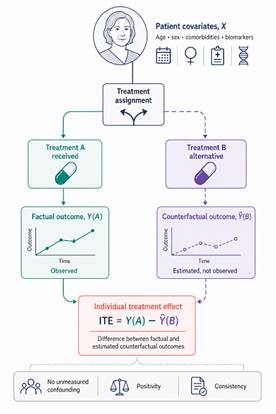
Counterfactual reasoning sits at the center of all this: it means comparing the outcome a patient actually experienced under their treatment with the outcome they would have experienced under some other treatment — a comparison that, notably, can never be directly observed for any single patient. The Individual Treatment Effect (ITE), shown conceptually in Figure 1, is simply the difference between these observed and potential outcomes. Causal ML methods lean on this framework to estimate patient-level effects, though how much confidence one should place in any given estimate depends heavily on data quality and on whether the causal assumptions the method requires are even remotely plausible in that setting.

3.2 Treatment Effect Estimation

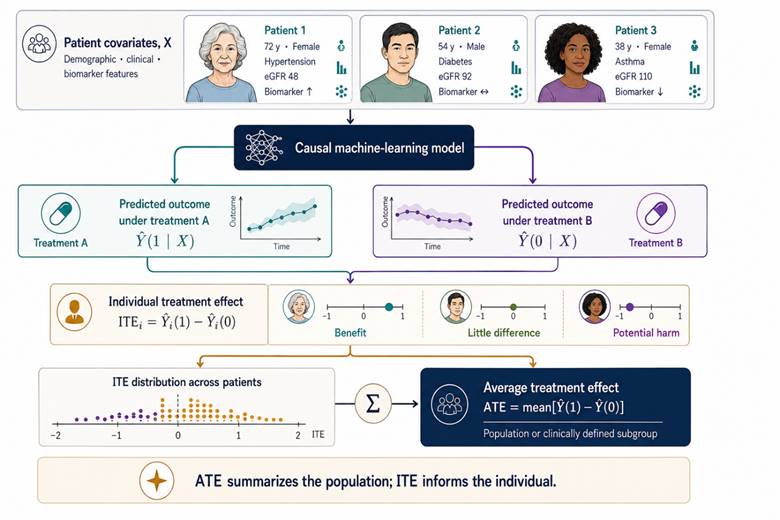
Treatment effect estimation is really just the machinery that turns counterfactual reasoning into a number. It measures the impact of a treatment on patient outcomes by comparing what is predicted to happen under one option against what is predicted to happen under another. Figure 2 sketches this out: a causal ML model estimates outcomes under treatment, Y(1), and under control, Y(0), conditional on patient characteristics, and the difference between them is the treatment effect — not a single fixed number, but one that in principle can vary from patient to patient.

The Individual Treatment Effect (ITE) captures the expected benefit for one specific patient, while the Average Treatment Effect (ATE) captures the expected benefit across an entire population — and the gap between these two, when it is large, is exactly where personalized medicine has room to add value. These estimates can reveal meaningful variation in treatment response across patients, provided (and this proviso matters) that data quality is adequate and the causal assumptions underlying the estimate are reasonable rather than merely convenient (Boevé et al., 2019; Clarke et al., 2019).

3.3 Causal Models and Algorithms

Causal ML, in practice, is really a marriage of statistical causal inference and machine learning, brought together to estimate treatment effects from data that is rarely clean or simple. Confounding, treatment heterogeneity, and high dimensionality have each, in their own way, pushed researchers toward different tools, summarized in Table 1. Directed Acyclic Graphs (DAGs) force causal assumptions into the open, making it easier to spot potential confounding pathways before they cause trouble;

Figure 1 | Counterfactual reasoning underlies individual treatment effect estimation in causal machine learning. For a given patient described by covariates X (e.g., age, sex, comorbidities, biomarker profile), only one treatment arm is ever observed in practice — the arm the patient actually received. Causal inference formalizes the unobserved alternative as a counterfactual outcome: the outcome that would have been observed had the same patient, at the same point in time, received a different treatment. The individual treatment effect (ITE) is defined as the difference between the factual outcome (observed under the treatment received) and the counterfactual outcome (the outcome the model estimates would have occurred under the alternative treatment). Because the counterfactual outcome is never directly observed for any single patient — the so-called “fundamental problem of causal inference” — causal machine learning models must estimate it from patterns learned across many similar patients who received each treatment arm, under explicit assumptions (e.g., no unmeasured confounding, positivity, and consistency) that determine whether the resulting ITE estimate is valid. This schematic illustrates the logical structure of that estimation problem rather than a specific fitted model or dataset.

Figure 2 | Treatment effect estimation combines predicted potential outcomes into patient-level and population-level effect measures. Patient characteristics X (demographic, clinical, and biomarker covariates) are passed into a causal machine learning model, which produces two potential-outcome predictions: Y(1), the expected outcome under treatment A, and Y(0), the expected outcome under treatment B (or no treatment). The individual treatment effect is calculated as ITE = Y(1) − Y(0) for each patient, capturing the model's estimate of that patient's personal benefit (or harm) from treatment A relative to treatment B. Averaging the ITE across a patient population, or a clinically defined subgroup, yields the average treatment effect (ATE = mean[Y(1) − Y(0)]), which corresponds to the quantity typically reported in randomized controlled trials. The distinction is central to personalized medicine: two patients with the same ATE-eligible diagnosis can have materially different ITEs, and it is the ITE — not the ATE — that should, in principle, guide an individual patient's treatment choice, provided the underlying causal assumptions hold for that patient.

propensity score methods, meanwhile, adjust for observed patient characteristics so that treatment groups look more comparable in observational data (Linden & Yarnold, 2016; Meid et al., 2020).

Building on those foundations, causal forests, meta-learners, Bayesian causal models, and deep causal models make it possible to estimate individualized effects and to capture relationships that are anything but linear. It is worth saying, though, that across all of these approaches, performance still comes down to the same three things: how good the data is, how believable the causal assumptions are, and how carefully the model has been validated in a real clinical setting. A cleverer architecture, on its own, guarantees nothing.

4. Causal Machine Learning Approaches

4.1 Meta-Learning Methods

Meta-learning techniques take a fairly pragmatic approach to estimating heterogeneous treatment effects (HTEs): rather than inventing an entirely new algorithm, they repurpose ordinary ML models as building blocks (Table 2). Instead of predicting the outcome under one treatment, a meta-learner predicts outcomes under each possible treatment and compares them, arriving at the individual treatment effect almost as a byproduct of routine prediction.

The S-Learner is the simplest of the bunch — one model, with treatment status folded in as just another feature. The T-Learner splits the difference by fitting separate models for treated and control patients, which works well enough when both groups are reasonably large. The X-Learner tries to be cleverer about it, borrowing treatment-effect estimates from one group to sharpen estimation in the other, which turns out to matter a great deal when treatment groups are imbalanced — as they very often are in observational data. The R-Learner and the Doubly Robust (DR)-Learner go further still, separating outcome modeling from treatment-assignment modeling entirely; the DR-Learner, in particular, has the reassuring property of staying roughly unbiased even if one of its two component models turns out to be wrong (Imhof et al., 2020; Schneeweiss, 2018; Verboven & Martin, 2022). Collectively, these methods have found their way into personalized treatment selection, response-pattern identification, and precision medicine more broadly.

4.2 Causal Forests and Tree-Based Models

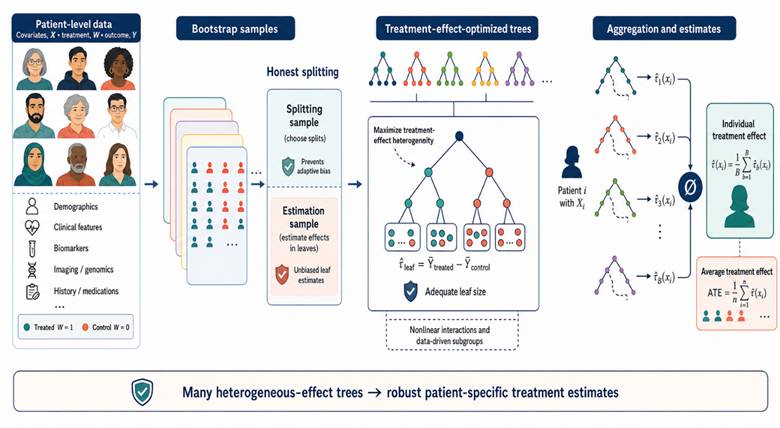
Causal forests, and tree-based models more generally, try to estimate heterogeneous treatment effects by hunting for differences in how individuals or subgroups respond to treatment. They extend the familiar logic of decision trees and random forests, but with a twist: rather than optimizing for predictive accuracy, they optimize for causal contrast. Patient-level inputs — demographics, clinical parameters, biomarkers, and whatever else the healthcare system happens to record — feed into these tree-based models, which estimate what would happen under alternative treatments (Figure 3).

A causal forest is, essentially, many decision trees grown on bootstrapped samples, each estimating treatment effects by comparing outcomes among similar patients within its own branching structure. Aggregate enough of these trees and you get estimates of both the ATE and the ITE. The appeal here is real — these methods can pick up on nonlinear relationships and interactions that simpler models would miss entirely, which matters for personalized treatment selection and precision medicine. But (and there is always a but) their performance still rests on plausible model assumptions, an adequate sample size, and validation against genuinely credible clinical data, not just internal cross-validation (Wager & Athey, 2018; Wendling et al., 2018).

4.3 Deep Learning-Based Causal Models

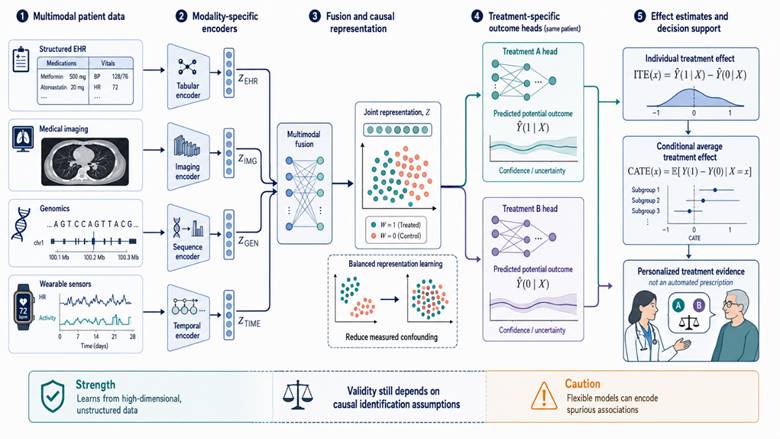
For the messiest, highest-dimensional healthcare data — the kind that spans electronic health records, medical imaging, genomics, and wearable sensor streams all at once — deep learning causal models offer a way to fold causal inference into neural network architectures capable of actually handling that volume and heterogeneity (Liu et al., 2021; Sushil et al., 2018).

The pipeline (Figure 4) starts with multimodal patient-level data being processed to extract modality-specific features through deep representation learning. Those learned representations then feed into deep causal neural networks, which predict potential outcomes for different therapies — Y(1) and Y(0) — along with some measure of how confident the model actually is. The gap between these predicted outcomes gives an estimate of the individual treatment effect (ITE) and the conditional average treatment effect (CATE), both of which, in principle, could help tailor treatment to a specific patient. Whether that promise is realized, though, depends a great deal on data quality, on how transparent the model

Table 1 | Causal models and machine learning algorithms commonly used to estimate treatment effects in healthcare. Each row summarizes one modeling family in terms of its core statistical or algorithmic concept, the principal methodological advantage it offers relative to alternative approaches, and the healthcare application domains in which it has been most widely applied. Directed Acyclic Graphs (DAGs) and propensity score methods are foundational tools used to make causal assumptions explicit and to adjust for observed confounding, respectively, and are frequently combined with the effect-estimation methods listed below rather than used as stand-alone estimators. Causal forests, meta-learners, Bayesian causal models, and deep causal models are effect-estimation frameworks capable of producing patient-level (individual treatment effect, ITE) or subgroup-level (conditional average treatment effect, CATE) estimates; reinforcement-learning-based causal models extend this logic to sequential, multi-timepoint treatment decisions. Abbreviations: DAG, directed acyclic graph; EHR, electronic health record; ICU, intensive care unit; ML, machine learning.

Causal Model / Algorithm

Core Concept

Key Advantages

Healthcare Applications

Directed Acyclic Graphs (DAGs)

Represents causal relationships among variables and identifies potential confounding pathways

Helps define causal assumptions and guide model development

Disease mechanism analysis, identifying confounders, treatment pathway modeling

Propensity Score Methods

Estimates the probability of receiving a treatment based on observed patient characteristics

Reduces imbalance between treatment groups in observational studies

Treatment effectiveness analysis using EHRs

Causal Forests

Tree-based ensemble methods designed to estimate heterogeneous treatment effects

Identifies differences in treatment response among patient subgroups

Personalized treatment selection, precision medicine, risk stratification

Meta-Learners (S-, T-, X-, R-Learner)

Uses ML models to estimate individual and subgroup-level treatment effects

Flexible framework compatible with various ML algorithms

Individualized therapy recommendation and treatment response prediction

Bayesian Causal Models

Combines causal inference with probabilistic modeling to quantify uncertainty

Provides uncertainty estimation and interpretable causal conclusions

Clinical decision-making under uncertainty, disease prognosis modeling

Deep Causal Models

Integrates deep learning with causal inference for high-dimensional, complex data

Handles nonlinear relationships and multimodal healthcare data

Genomics, medical imaging, longitudinal health records, multimodal AI systems

Reinforcement-Learning-Based Causal Models

Learns optimal treatment strategies through sequential decision-making

Supports dynamic treatment planning over time

ICU management, medication optimization, chronic disease monitoring

Table 2 | Meta-learning methods for heterogeneous treatment effect estimation. Meta-learners decompose heterogeneous treatment effect estimation into one or more standard supervised-learning subproblems, allowing any base machine learning algorithm (e.g., gradient-boosted trees, random forests, or neural networks) to be substituted as the underlying estimator. The five methods listed differ principally in how many models they fit and how they handle imbalance between treatment and control group sizes: the S-Learner fits a single model with treatment status as a covariate; the T-Learner fits two fully separate models; the X-Learner and R-Learner explicitly reweight or cross-use information between the treated and control estimators to improve performance under imbalance and to isolate the treatment-effect signal from outcome-level variation, respectively; and the Doubly Robust (DR)-Learner combines an outcome model with a propensity score model such that the resulting effect estimate remains consistent if only one of the two component models is correctly specified. No single meta-learner is uniformly superior; the appropriate choice depends on treatment-group balance, sample size, and the anticipated complexity of treatment-effect heterogeneity in the target population. Abbreviations: DR, doubly robust; EHR, electronic health record; ML, machine learning.

Meta-Learning Method

Core Principle

Advantages

Healthcare Applications

S-Learner (Single Learner)

Uses a single ML model with treatment assignment included as an additional feature

Simple implementation; flexible across ML algorithms

General treatment outcome prediction

T-Learner (Two Learner)

Builds separate models for treated and control groups, then compares predicted outcomes

Effective when treatment groups have sufficient data

Comparing effectiveness of different therapies

X-Learner

Uses treatment-effect estimates from one group to improve estimation in another

Performs well with imbalanced treatment groups

Personalized treatment selection in observational studies

R-Learner

Separates outcome prediction from treatment-assignment modeling

Flexible, robust heterogeneous treatment-effect estimation

Precision medicine and individualized therapy planning

DR-Learner (Doubly Robust Learner)

Combines outcome modeling and propensity score estimation

Reduces bias when one component model is misspecified

Reliable treatment-effect estimation using EHR data

Figure 3 | Causal forests aggregate many treatment-effect-optimized decision trees to estimate heterogeneous treatment effects. Patient-level inputs — demographic factors, clinical parameters, biomarkers, and other routinely collected healthcare variables — are used to grow an ensemble of decision trees on bootstrapped (resampled with replacement) subsets of the training cohort. Unlike conventional random forests, which split nodes to maximize predictive accuracy for an outcome, each tree in a causal forest splits patients into subgroups that maximize the difference in treatment effect between the resulting groups, so that patients within a leaf node are as similar as possible in their expected response to treatment. Within each leaf, the treatment effect is estimated by contrasting outcomes between treated and control patients who share similar covariate profiles; averaging these leaf-level estimates across all trees in the ensemble yields the final individual treatment effect (ITE) or, aggregated across the full sample, the average treatment effect (ATE). This ensemble structure allows the model to capture nonlinear covariate interactions and identify patient subgroups with divergent treatment responses without requiring the subgroups to be specified in advance, but honest-splitting and adequate leaf sample size are required to keep the resulting effect estimates statistically valid.

Figure 4 | Deep causal models learn joint representations across data modalities before estimating treatment-specific potential outcomes. Raw multimodal patient data — structured electronic health record (EHR) variables, medical imaging, genomic sequencing data, and longitudinal wearable-sensor streams — are each passed through modality-specific representation-learning components (e.g., convolutional or transformer-based encoders for imaging, sequence models for longitudinal data) that compress each modality into a lower-dimensional feature embedding. These embeddings are then fused and fed into a deep causal neural network head, which is trained to predict the potential outcomes under each treatment option, Y(1) and Y(0), typically together with a calibrated measure of predictive confidence or uncertainty. As in the meta-learner and causal-forest approaches, the difference between the predicted potential outcomes yields the individual treatment effect (ITE) and, when computed conditional on a specified covariate subset, the conditional average treatment effect (CATE). The principal advantage of this architecture is its capacity to exploit high-dimensional, unstructured data sources that are inaccessible to tree-based or linear causal models; its principal limitation is that the added flexibility increases the risk of encoding spurious, non-causal associations unless the network architecture explicitly enforces the causal assumptions (e.g., balanced representation learning to address confounding) that the estimate depends on.

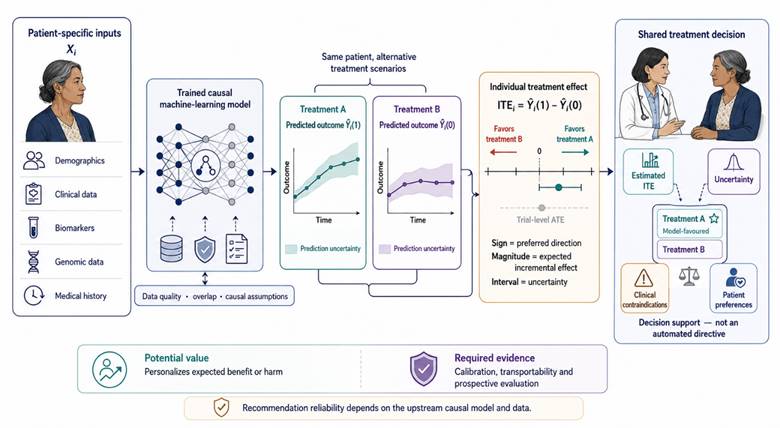
Figure 5 | Individual treatment effect estimates translate causal model output into an actionable, patient-specific treatment recommendation. Patient-specific inputs — demographic data, clinical data, biomarker measurements, genomic data, and prior medical history — are supplied to a trained causal machine learning model, which simulates the outcome the patient would be expected to experience under treatment A, denoted Y(1), and under treatment B, denoted Y(0). Subtracting these two model outputs yields the patient's estimated individual treatment effect (ITE), which quantifies the expected incremental benefit (or harm) of treatment A relative to treatment B for that specific patient, as distinct from the population-average effect reported by a conventional clinical trial. In principle, a clinician (or a decision-support system built on this framework) can use the sign and magnitude of the ITE, alongside its associated uncertainty, to select the treatment predicted to be more beneficial for the individual patient; in practice, this recommendation is only as reliable as the causal assumptions and data quality underlying the upstream model, and should be interpreted as decision support rather than as a validated clinical directive absent prospective evaluation.

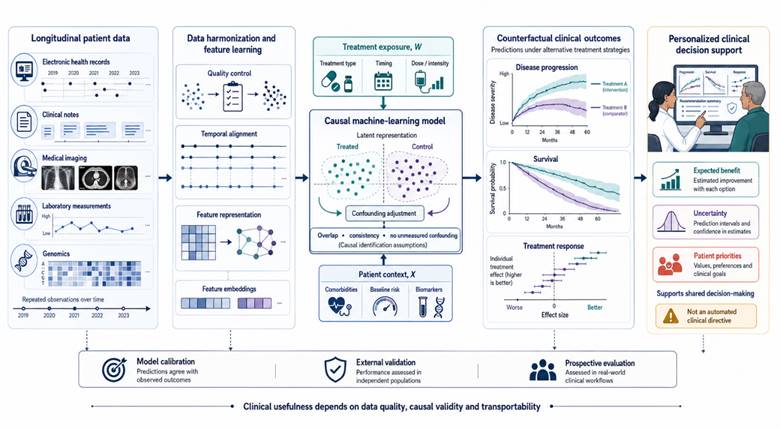
Figure 6 | Causal outcome prediction integrates multi-source clinical data with treatment information to forecast patient-specific clinical trajectories. Heterogeneous patient data sources — electronic health records (EHRs), structured medical records, medical imaging, laboratory test results, genomic data, and longitudinal clinical history — are collected and preprocessed (e.g., normalization, missing-data handling, feature extraction) to yield a harmonized feature set for each patient. A causal machine learning model combines these extracted features with explicit treatment/intervention information, rather than treating treatment as just another correlated input variable, to estimate downstream clinical outcomes such as disease progression, survival probability, or treatment response. Because the model conditions its outcome estimate on a specified (or counterfactual) treatment assignment, its output can be re-queried under alternative treatment scenarios for the same patient, distinguishing this approach from standard prognostic models that produce a single outcome forecast tied only to the treatment the patient is already receiving. The resulting patient-specific outcome estimates are intended to support — not replace — clinician judgement when selecting care for patients with similar clinical presentations.

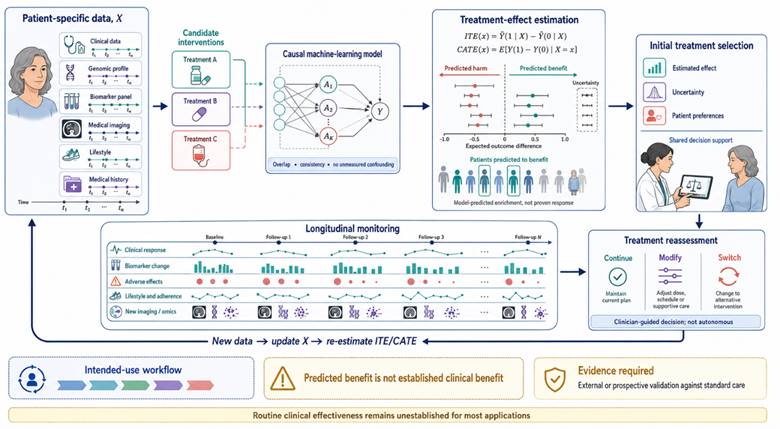
Figure 7 | Causal machine learning links individualized effect estimation to longitudinal precision-medicine decision-making. Multimodal precision-medicine data — clinical data, genomic profiles, biomarker panels, imaging data, lifestyle information, and medical history — feed into a causal machine learning model that estimates the individual treatment effect (ITE) or conditional average treatment effect (CATE) for candidate therapeutic interventions. These effect estimates are used to identify the subset of patients for whom a targeted intervention is predicted to be beneficial, informing both the initial treatment choice and subsequent longitudinal monitoring as the patient's condition evolves and new data become available for re-estimation. This figure represents an intended-use workflow rather than a validated clinical pathway: as discussed in Section 6, deploying this workflow in routine practice requires prospective or externally validated evidence that the recommended interventions improve outcomes relative to standard care, which remains largely unestablished for most of the applications summarized here.

actually is, on computational cost, and — as always — on whether the causal assumptions baked into the architecture hold up.

5. Healthcare Applications

5.1 Personalized Treatment Selection

The goal here is deceptively simple to state: find the therapeutic regimen that best suits a given patient, based on their clinical profile, biological characteristics, and how they've responded to treatment before. Traditional approaches, by contrast, usually lean on aggregate historical evidence — useful, but blind to individual variation. Causal ML tries to get around this by analyzing observed and potential outcomes for a specific patient, rather than for “patients like them” in the abstract (Kantae et al., 2017; Schmidt et al., 2016).

Figure 5 shows roughly how this works in practice: demographic data, clinical data, biomarkers, genomic information, and medical history all feed into a causal ML model, which simulates what would happen under treatment A, Y(1), versus treatment B, Y(0). The resulting Individual Treatment Effect (ITE) gives clinicians something concrete to compare — not a guarantee, but a reasoned estimate to inform an individualized choice.

5.2 Clinical Outcome Prediction

Predicting how a patient's health will unfold, as a function of both treatment choice and their own individual characteristics, is arguably where causal ML has the most obvious payoff. By explicitly incorporating treatment information and causal structure — rather than treating treatment as just one more correlated variable — causal ML algorithms can, at least in principle, produce more genuinely useful predictions than conventional models that mostly detect patterns after the fact. This matters most in complicated clinical settings, where outcomes are shaped simultaneously by history, biomarkers, lifestyle, and whatever therapeutic interventions have already been tried (Jacoba et al., 2021; Prosperi et al., 2020; Yurkovich et al., 2020).

Figure 6 lays out a fairly typical workflow: EHRs, medical records, imaging, laboratory tests, genomics, and clinical history are gathered and processed to extract the features that matter. A causal ML model then combines those features with treatment information to estimate outcomes — disease progression, survival probability, treatment response, and so on. Ideally, these predictions help practitioners choose more fitting care for patients whose presentations look similar on paper but may not respond similarly in practice (Geeslin & Gaskin, 2016; Huang et al., 2020; Wong et al., 2018).

5.3 Precision Medicine and Disease Management

Precision medicine is built on the premise that patient-specific information — clinical data, genomics, biomarkers, imaging, lifestyle, medical history — should shape care rather than be an afterthought. Causal ML can, in theory, analyze these complex and heterogeneous sources and estimate the impact of different treatments on a per-patient basis; ITE and CATE estimates, in particular, can inform a more nuanced selection among therapeutic interventions than a one-size-fits-all guideline would allow (Currie & Delles, 2018; Goetz & Schork, 2018; Traversi et al., 2021).

Figure 7 illustrates how causal ML frameworks connect patient-specific information to treatment choice and to ongoing disease management — identifying patients most likely to benefit from a targeted intervention and, ideally, supporting monitoring over time as circumstances change. Before any of this becomes routine clinical practice, though, it needs to clear a fairly high bar: reliable data, defensible causal assumptions, and rigorous, ideally externally validated, evidence — a bar that, candidly, most causal ML applications in this space have not yet cleared.

6. Challenges and Limitations

6.1 Data Quality and Bias

Causal ML models are, in the end, only as good as the data feeding them, and healthcare data has a well-earned reputation for being messy. Missing values, inconsistent measurement, incomplete histories, and variation in how different institutions record things all chip away at model performance and, more insidiously, at the accuracy of treatment-effect estimates specifically. Add to that the fact that EHR systems differ substantially across institutions, and generalizing a causal model across clinical or demographic populations becomes genuinely difficult, not just a technical footnote (Derakhshan et al., 2021; Sun et al., 2018).

There is a related, arguably more troubling issue: bias that is already baked into the data before any model ever touches it. Disparities tied to age, sex, ethnicity, socioeconomic status, or simple access to care show up in observational records whether we like it or not, and if left unexamined, they risk being reproduced — even amplified — in causal model outputs as inequitable treatment recommendations. Making causal ML fair and generalizable is not a one-time fix; it requires careful data curation, explicit and ongoing bias evaluation, use of multiple independent datasets, and external validation, rather than confidence built on a single institution's records (Markus et al., 2021; Vollmer et al., 2020).

6.2 Confounding Factors

Confounders — variables that shape both which treatment a patient receives and how they fare — remain, arguably, the single biggest obstacle to valid causal estimation in this field. Clinical decisions routinely hinge on things like disease severity, age, comorbidities, and treatment history, and when a model fails to account for these adequately, it can mistake correlation for causation — producing treatment-effect estimates that look confident but are, in fact, wrong (Burhenn et al., 2016).

Existing methods try to address this through causal graphical models, propensity score adjustment, and representation learning, among other techniques, and these approaches do help. But substantial limitations remain, particularly around unmeasured or “hidden” confounders — the ones no adjustment can fix simply because they were never recorded in the first place. Improving the reliability of causal estimates, then, means combining sensible adjustment strategies with sensitivity analyses that at least quantify how robust an estimate is to unmeasured confounding, plus validation across genuinely independent datasets and causal assumptions stated explicitly enough to be scrutinized (Coulter et al., 2015; Johnson et al., 2021).

6.3 Interpretability and Clinical Adoption

Interpretability is, perhaps, the most stubborn barrier of all, because clinicians reasonably want to understand how a model arrived at a treatment recommendation before they act on it — and who could blame them. Advanced causal ML methods, deep learning approaches especially, tend to produce relationships that are genuinely hard to unpack, and that opacity does real damage to clinician trust, making it difficult to verify whether the model's output actually squares with clinical knowledge and the needs of the patient in front of them (Baubeta Fridh et al., 2017; Majnarić et al., 2021).

Beyond interpretability itself, adoption also depends on things that have little to do with the algorithm — integration with existing workflows, regulatory clearance, and closer collaboration between clinicians and data scientists so that each side understands what the other is assuming. For routine use across diverse healthcare settings, causal ML systems need to be reliable, safe, and generalizable, not just accurate on a benchmark. Building genuinely interpretable causal models, generating insights clinicians can actually act on, and using causal ML responsibly remain the central hurdles standing between where the field is now and broader acceptance (Weissler et al., 2021).

7. Future Perspectives

7.1 Integration with Advanced AI Models

The convergence of causal ML with foundation models, large language models (LLMs), and multimodal AI systems opens up a genuinely promising, if still somewhat speculative, path toward richer healthcare decision support. These more capable models can already digest diverse data — clinical notes, images, genomics, EHRs — and, paired with explicit causal structure, could plausibly support treatment-effect estimation and individualized recommendations that go beyond pattern recognition alone.

Combining causal ML with these more sophisticated systems could improve interpretability, adaptability, and decision support by capturing complex relationships and causal structure across modalities at once. Multimodal causal AI systems, for instance, could integrate information from several healthcare sources to better characterize how a disease is likely to progress and how a patient is likely to respond. Getting there, though, will mean clearing real hurdles — data privacy, computational cost, model transparency, and rigorous clinical validation — before any of this moves from promising idea to deployed tool.

7.2 Real-Time Clinical Decision Support

Real-time clinical decision support is probably the most near-term, tangible application of causal ML on the horizon. Continuous analysis of EHR data, monitoring devices, laboratory results, and other clinical streams could, in theory, offer real-time insight into treatment options and their likely consequences. Conventional decision-support systems tend to lean on prediction-based risk scores; causal approaches instead try to estimate the actual consequence of a specific intervention, which gives clinicians something more directly comparable across treatment options.

Adopting causal ML here could enable treatment planning that adjusts dynamically, earlier warning of patient deterioration, and interventions tailored to a patient's evolving status — particularly valuable in intensive care, where the calculus changes almost by the hour. Realizing this vision will require solving data-availability constraints, ensuring computational efficiency and reliable workflow integration, and, not least, completing the regulatory validation that safe clinical use demands.

7.3 Ethical and Responsible AI Development

Because causal ML models can directly shape clinical decisions and treatment recommendations, their development has to be held to a genuinely high ethical standard — this is not a box-ticking exercise. Healthcare data can encode demographic or socioeconomic bias that, left unaddressed, will simply propagate into model recommendations and affect care unevenly across patient populations. Stakeholders need to prioritize equitable access, active mitigation of algorithmic bias, and protection of patient confidentiality throughout development, not just at the end.

Future causal ML systems will need to be more explainable, more thoroughly validated, and deployed alongside meaningful human oversight if they are to be used safely in the clinic. Transparent reporting of model assumptions, limitations, and uncertainty helps clinicians interpret AI-generated recommendations appropriately, rather than treating them as unquestionable output. None of this happens automatically — it will take sustained collaboration among clinicians, AI researchers, policymakers, and regulators to establish guidelines that keep causal AI development safe, fair, and genuinely patient-centered.

8. Conclusion

Causal machine learning, when we step back from the technical details, offers something genuinely valuable: a way of asking not just what tends to happen, but what would happen to this particular patient under this particular choice. That distinction, small as it sounds, is what separates personalized medicine from population-level guesswork. We have tried, throughout this review, not to oversell the field — data bias, confounding, limited interpretability, and thin clinical validation are real constraints, not footnotes, and they will not be solved by a cleverer neural network alone. Multimodal data integration, foundation-model-based analysis, and ethical governance frameworks can help close some of this gap, but perhaps not all of it, at least not soon. On balance, we think causal machine learning deserves cautious optimism: promising enough to keep investing in, uncertain enough that its adoption should be paced by evidence, not by enthusiasm.

Acknowledgements

The authors S.A.E. et al., thank colleagues at their respective institutions for helpful comments on earlier drafts of this manuscript. No dedicated funding was received for this work, and no external parties had any role in the writing or the decision to submit it for publication.

Author Contributions

S.A.E. conceived the review, designed and conducted the literature search, and drafted the manuscript. M.F. contributed to the conceptual framing of the clinical applications discussed, critically revised the manuscript for intellectual content, and helped verify the accuracy of the technical descriptions. Both authors read and approved the final version of the manuscript.

Competing Financial Interests

The authors S.A.E. et al., declare that they have no competing financial interests related to this work.

References


Ahmad, Z., Rahim, S., Zubair, M., & Abdul-Ghafar, J. (2021). Artificial intelligence (AI) in medicine, current applications and future role with special emphasis on its potential and promise in pathology: present and future impact, obstacles including costs and acceptance among pathologists, practical and philosophical considerations. A comprehensive review. Diagnostic Pathology, 16(1), 24. https://doi.org/10.1186/s13000-021-01085-4

Alber, M., Buganza Tepole, A., Cannon, W. R., De, S., Dura-Bernal, S., Garikipati, K., Karniadakis, G., Lytton, W. W., Perdikaris, P., Petzold, L., & Kuhl, E. (2019). Integrating machine learning and multiscale modeling—perspectives, challenges, and opportunities in the biological, biomedical, and behavioral sciences. Npj Digital Medicine, 2(1), 115. https://doi.org/10.1038/s41746-019-0193-y

Badgeley, M. A., Zech, J. R., Oakden-Rayner, L., Glicksberg, B. S., Liu, M., Gale, W., McConnell, M. V., Percha, B., Snyder, T. M., & Dudley, J. T. (2019). Deep learning predicts hip fracture using confounding patient and healthcare variables. Npj Digital Medicine, 2(1), 31. https://doi.org/10.1038/s41746-019-0105-1

Baubeta Fridh, E., Andersson, M., Thuresson, M., Sigvant, B., Kragsterman, B., Johansson, S., Hasvold, P., Falkenberg, M., & Nordanstig, J. (2017). Amputation Rates, Mortality, and Pre-operative Comorbidities in Patients Revascularised for Intermittent Claudication or Critical Limb Ischaemia: A Population Based Study. European Journal of Vascular and Endovascular Surgery, 54(4), 480–486. https://doi.org/10.1016/j.ejvs.2017.07.005

Bica, I., Alaa, A. M., Lambert, C., & van der Schaar, M. (2021). From Real-World Patient Data to Individualized Treatment Effects Using Machine Learning: Current and Future Methods to Address Underlying Challenges. Clinical Pharmacology & Therapeutics, 109(1), 87–100. https://doi.org/10.1002/cpt.1907

Boevé, L. M. S., Hulshof, M. C. C. M., Vis, A. N., Zwinderman, A. H., Twisk, J. W. R., Witjes, W. P. J., Delaere, K. P. J., Moorselaar, R. J. A. van, Verhagen, P. C. M. S., & van Andel, G. (2019). Effect on Survival of Androgen Deprivation Therapy Alone Compared to Androgen Deprivation Therapy Combined with Concurrent Radiation Therapy to the Prostate in Patients with Primary Bone Metastatic Prostate Cancer in a Prospective Randomised Clinical Trial: Data from the HORRAD Trial. European Urology, 75(3), 410–418. https://doi.org/10.1016/j.eururo.2018.09.008

Burhenn, P. S., McCarthy, A. L., Begue, A., Nightingale, G., Cheng, K., & Kenis, C. (2016). Geriatric assessment in daily oncology practice for nurses and allied health care professionals: Opinion paper of the Nursing and Allied Health Interest Group of the International Society of Geriatric Oncology (SIOG). Journal of Geriatric Oncology, 7(5), 315–324. https://doi.org/10.1016/j.jgo.2016.02.006

Cammarota, G., Ianiro, G., Ahern, A., Carbone, C., Temko, A., Claesson, M. J., Gasbarrini, A., & Tortora, G. (2020). Gut microbiome, big data and machine learning to promote precision medicine for cancer. Nature Reviews Gastroenterology & Hepatology, 17(10), 635–648. https://doi.org/10.1038/s41575-020-0327-3

Clarke, N. W., Ali, A., Ingleby, F. C., Hoyle, A., Amos, C. L., Attard, G., Brawley, C. D., Calvert, J., Chowdhury, S., Cook, A., Cross, W., Dearnaley, D. P., Douis, H., Gilbert, D., Gillessen, S., Jones, R. J., Langley, R. E., MacNair, A., Malik, Z., … James, N. D. (2019). Addition of docetaxel to hormonal therapy in low- and high-burden metastatic hormone sensitive prostate cancer: long-term survival results from the STAMPEDE trial. Annals of Oncology, 30(12), 1992–2003. https://doi.org/10.1093/annonc/mdz396

Coulter, A., Entwistle, V. A., Eccles, A., Ryan, S., Shepperd, S., & Perera, R. (2015). Personalised care planning for adults with chronic or long-term health conditions. Cochrane Database of Systematic Reviews, 2015(3). https://doi.org/10.1002/14651858.CD010523.pub2

Currie, G., & Delles, C. (2018). Precision Medicine and Personalized Medicine in Cardiovascular Disease (pp. 589–605). https://doi.org/10.1007/978-3-319-77932-4_36

Derakhshan, P., Azadmanjir, Z., Naghdi, K., Habibi Arejan, R., Safdarian, M., Zarei, M. R., Jazayeri, S. B., Sharif-Alhoseini, M., Arab Kheradmand, J., Amirjamshidi, A., Ghodsi, Z., Faghih Jooybari, M., Mohammadzadeh, M., Khazaeipour, Z., Abdollah Zadegan, S., Abedi, A., Oreilly, G., Noonan, V., Benzel, E. C., … Rahimi-Movaghar, V. (2021). The impact of data quality assurance and control solutions on the completeness, accuracy, and consistency of data in a national spinal cord injury registry of Iran (NSCIR-IR). Spinal Cord Series and Cases, 7(1), 51. https://doi.org/10.1038/s41394-020-00358-2

Geeslin, M. G., & Gaskin, C. M. (2016). Electronic Health Record–Driven Workflow for Diagnostic Radiologists. Journal of the American College of Radiology, 13(1), 45–53. https://doi.org/10.1016/j.jacr.2015.08.008

Goetz, L. H., & Schork, N. J. (2018). Personalized medicine: motivation, challenges, and progress. Fertility and Sterility, 109(6), 952–963. https://doi.org/10.1016/j.fertnstert.2018.05.006

Golas, S. B., Shibahara, T., Agboola, S., Otaki, H., Sato, J., Nakae, T., Hisamitsu, T., Kojima, G., Felsted, J., Kakarmath, S., Kvedar, J., & Jethwani, K. (2018). A machine learning model to predict the risk of 30-day readmissions in patients with heart failure: a retrospective analysis of electronic medical records data. BMC Medical Informatics and Decision Making, 18(1), 44. https://doi.org/10.1186/s12911-018-0620-z

Huang, S.-C., Pareek, A., Seyyedi, S., Banerjee, I., & Lungren, M. P. (2020). Fusion of medical imaging and electronic health records using deep learning: a systematic review and implementation guidelines. Npj Digital Medicine, 3(1), 136. https://doi.org/10.1038/s41746-020-00341-z

Imhof, C., Bergamin, P., & McGarrity, S. (2020). Implementation of Adaptive Learning Systems: Current State and Potential (pp. 93–115). https://doi.org/10.1007/978-3-030-48190-2_6

Iqbal, M. J., Javed, Z., Sadia, H., Qureshi, I. A., Irshad, A., Ahmed, R., Malik, K., Raza, S., Abbas, A., Pezzani, R., & Sharifi-Rad, J. (2021). Clinical applications of artificial intelligence and machine learning in cancer diagnosis: looking into the future. Cancer Cell International, 21(1), 270. https://doi.org/10.1186/s12935-021-01981-1

Jacob, D. (2021). CATE meets ML. Digital Finance, 3(2), 99–148. https://doi.org/10.1007/s42521-021-00033-7

Jacoba, C. M. P., Celi, L. A., & Silva, P. S. (2021). Biomarkers for Progression in Diabetic Retinopathy: Expanding Personalized Medicine through Integration of AI with Electronic Health Records. Seminars in Ophthalmology, 36(4), 250–257. https://doi.org/10.1080/08820538.2021.1893351

Johnson, K. B., Wei, W., Weeraratne, D., Frisse, M. E., Misulis, K., Rhee, K., Zhao, J., & Snowdon, J. L. (2021). Precision Medicine, AI, and the Future of Personalized Health Care. Clinical and Translational Science, 14(1), 86–93. https://doi.org/10.1111/cts.12884

Kantae, V., Krekels, E. H. J., Esdonk, M. J. Van, Lindenburg, P., Harms, A. C., Knibbe, C. A. J., Van der Graaf, P. H., & Hankemeier, T. (2017). Integration of pharmacometabolomics with pharmacokinetics and pharmacodynamics: towards personalized drug therapy. Metabolomics, 13(1), 9. https://doi.org/10.1007/s11306-016-1143-1

Kawashima, M., Nagare, T., & Doi, M. (2017). Clinical efficacy and safety of benzoyl peroxide for acne vulgaris: Comparison between Japanese and Western patients. The Journal of Dermatology, 44(11), 1212–1218. https://doi.org/10.1111/1346-8138.13996

Keele, L., & Small, D. S. (2021). Comparing Covariate Prioritization via Matching to Machine Learning Methods for Causal Inference Using Five Empirical Applications. The American Statistician, 75(4), 355–363. https://doi.org/10.1080/00031305.2020.1867638

Linden, A., & Yarnold, P. R. (2016). Combining machine learning and propensity score weighting to estimate causal effects in multivalued treatments. Journal of Evaluation in Clinical Practice, 22(6), 875–885. https://doi.org/10.1111/jep.12610

Liu, R., Wei, L., & Zhang, P. (2021). A deep learning framework for drug repurposing via emulating clinical trials on real-world patient data. Nature Machine Intelligence, 3(1), 68–75. https://doi.org/10.1038/s42256-020-00276-w

Majnaric, L. T., Babic, F., O'Sullivan, S., & Holzinger, A. (2021). AI and Big Data in Healthcare: Towards a More Comprehensive Research Framework for Multimorbidity. Journal of Clinical Medicine, 10(4), 766. https://doi.org/10.3390/jcm10040766

Markus, A. F., Kors, J. A., & Rijnbeek, P. R. (2021). The role of explainability in creating trustworthy artificial intelligence for health care: A comprehensive survey of the terminology, design choices, and evaluation strategies. Journal of Biomedical Informatics, 113, 103655. https://doi.org/10.1016/j.jbi.2020.103655

Meid, A. D., Ruff, C., Wirbka, L., Stoll, F., Seidling, H. M., Groll, A., & Haefeli, W. E. (2020). Using the Causal Inference Framework to Support Individualized Drug Treatment Decisions Based on Observational Healthcare Data. Clinical Epidemiology, Volume 12, 1223–1234. https://doi.org/10.2147/CLEP.S274466

Miotto, R., Li, L., Kidd, B. A., & Dudley, J. T. (2016). Deep Patient: An Unsupervised Representation to Predict the Future of Patients from the Electronic Health Records. Scientific Reports, 6(1), 26094. https://doi.org/10.1038/srep26094

Prosperi, M., Guo, Y., Sperrin, M., Koopman, J. S., Min, J. S., He, X., Rich, S., Wang, M., Buchan, I. E., & Bian, J. (2020). Causal inference and counterfactual prediction in machine learning for actionable healthcare. Nature Machine Intelligence, 2(7), 369–375. https://doi.org/10.1038/s42256-020-0197-y

Prosperi, M., Min, J. S., Bian, J., & Modave, F. (2018). Big data hurdles in precision medicine and precision public health. BMC Medical Informatics and Decision Making, 18(1), 139. https://doi.org/10.1186/s12911-018-0719-2

Schmidt, K. T., Chau, C. H., Price, D. K., & Figg, W. D. (2016). Precision Oncology Medicine: The Clinical Relevance of Patient-Specific Biomarkers Used to Optimize Cancer Treatment. The Journal of Clinical Pharmacology, 56(12), 1484–1499. https://doi.org/10.1002/jcph.765

Schneeweiss, S. (2018). Automated data-adaptive analytics for electronic healthcare data to study causal treatment effects. Clinical Epidemiology, Volume 10, 771–788. https://doi.org/10.2147/CLEP.S166545

Strianese, O., Rizzo, F., Ciccarelli, M., Galasso, G., D'Agostino, Y., Salvati, A., Del Giudice, C., Tesorio, P., & Rusciano, M. R. (2020). Precision and Personalized Medicine: How Genomic Approach Improves the Management of Cardiovascular and Neurodegenerative Disease. Genes, 11(7), 747. https://doi.org/10.3390/genes11070747

Subramanian, M., Wojtusciszyn, A., Favre, L., Boughorbel, S., Shan, J., Letaief, K. B., Pitteloud, N., & Chouchane, L. (2020). Precision medicine in the era of artificial intelligence: implications in chronic disease management. Journal of Translational Medicine, 18(1), 472. https://doi.org/10.1186/s12967-020-02658-5

Sun, W., Cai, Z., Li, Y., Liu, F., Fang, S., & Wang, G. (2018). Data Processing and Text Mining Technologies on Electronic Medical Records: A Review. Journal of Healthcare Engineering, 2018, 1–9. https://doi.org/10.1155/2018/4302425

Sushil, M., Šuster, S., Luyckx, K., & Daelemans, W. (2018). Patient representation learning and interpretable evaluation using clinical notes. Journal of Biomedical Informatics, 84, 103–113. https://doi.org/10.1016/j.jbi.2018.06.016

Traversi, D., Pulliero, A., Izzotti, A., Franchitti, E., Iacoviello, L., Gianfagna, F., Gialluisi, A., Izzi, B., Agodi, A., Barchitta, M., Calabrò, G. E., Hoxhaj, I., Sassano, M., Sbrogiò, L. G., Del Sole, A., Marchiori, F., Pitini, E., Migliara, G., Marzuillo, C., … Boccia, S. (2021). Precision Medicine and Public Health: New Challenges for Effective and Sustainable Health. Journal of Personalized Medicine, 11(2), 135. https://doi.org/10.3390/jpm11020135

Verboven, S., & Martin, N. (2022). Combining the Clinical and Operational Perspectives in Heterogeneous Treatment Effect Inference in Healthcare Processes (pp. 327–339). https://doi.org/10.1007/978-3-030-98581-3_24

Vollmer, S., Mateen, B. A., Bohner, G., Király, F. J., Ghani, R., Jonsson, P., Cumbers, S., Jonas, A., McAllister, K. S. L., Myles, P., Grainger, D., Birse, M., Branson, R., Moons, K. G. M., Collins, G. S., Ioannidis, J. P. A., Holmes, C., & Hemingway, H. (2020). Machine learning and artificial intelligence research for patient benefit: 20 critical questions on transparency, replicability, ethics, and effectiveness. BMJ, l6927. https://doi.org/10.1136/bmj.l6927

Wager, S., & Athey, S. (2018). Estimation and Inference of Heterogeneous Treatment Effects using Random Forests. Journal of the American Statistical Association, 113(523), 1228–1242. https://doi.org/10.1080/01621459.2017.1319839

Weissler, E. H., Naumann, T., Andersson, T., Ranganath, R., Elemento, O., Luo, Y., Freitag, D. F., Benoit, J., Hughes, M. C., Khan, F., Slater, P., Shameer, K., Roe, M., Hutchison, E., Kollins, S. H., Broedl, U., Meng, Z., Wong, J. L., Curtis, L., … Ghassemi, M. (2021). The role of machine learning in clinical research: transforming the future of evidence generation. Trials, 22(1), 537. https://doi.org/10.1186/s13063-021-05489-x

Wendling, T., Jung, K., Callahan, A., Schuler, A., Shah, N. H., & Gallego, B. (2018). Comparing methods for estimation of heterogeneous treatment effects using observational data from health care databases. Statistics in Medicine, 37(23), 3309–3324. https://doi.org/10.1002/sim.7820

Wong, J., Murray Horwitz, M., Zhou, L., & Toh, S. (2018). Using Machine Learning to Identify Health Outcomes from Electronic Health Record Data. Current Epidemiology Reports, 5(4), 331–342. https://doi.org/10.1007/s40471-018-0165-9

Yurkovich, J. T., Tian, Q., Price, N. D., & Hood, L. (2020). A systems approach to clinical oncology uses deep phenotyping to deliver personalized care. Nature Reviews Clinical Oncology, 17(3), 183–194. https://doi.org/10.1038/s41571-019-0273-6

Article metrics
View details
0
Downloads
0
Citations
104
Views
📖 Cite article

View Dimensions


View Plumx


View Altmetric


0
Save
0
Citation
104
View
0
Share