Energy Environment and Economy

Energy, Environment and Sustainable Sciences | online ISSN 3069-0935
2
Citations
33.1k
Views
28
Articles
Your new experience awaits. Try the new design now and help us make it even better
Switch to the new experience
Figures and Tables
COMMUNICATIONS   (Open Access)

Restoring Power After the Outage: Evaluating Transmission Service Recovery Strategies in Al-Musayyib District, Iraq (2025–2026)

Sarah Ahed Mohammed Al-Hasnawi 1*

+ Author Affiliations

Energy Environment and Economy 3 (1) 1-5 https://doi.org/10.25163/energy.3110875

Submitted: 05 November 2025 Revised: 23 December 2025  Published: 31 December 2025 


Abstract

Electricity is, in many ways, the quiet backbone of modern life — and when it disappears, even briefly, the ripple effects touch homes, hospitals, and factories alike. This is particularly true in Al-Musayyib District, Babil Governorate, where rising demand has begun to outpace an aging transmission infrastructure. This study set out, somewhat cautiously at first, to evaluate how effectively current restoration strategies respond to outages across the district's transmission network during 2025–2026. A descriptive-analytical approach was adopted, combining field-derived outage records — fault type, response time, isolation procedure, restoration duration — with ETAP-based modeling of 4 representative fault scenarios across the network's substations and lines. Reliability was assessed using standard indices, namely SAIDI, SAIFI, and CAIDI, alongside qualitative comparison of restoration pathways. The findings indicate — perhaps unsurprisingly, yet still worth stating plainly — that restoration time scaled with fault complexity, with major substation-level faults taking considerably longer to resolve than localized feeder faults. Strategies incorporating alternative routing and pre-established emergency protocols meaningfully reduced both outage duration and the proportion of unrestored load, an improvement of 35% post-intervention. Coordination between control centers and field teams, together with routine preventive maintenance, emerged as recurring determinants of restoration speed. Taken together, these results suggest that Al-Musayyib's transmission reliability rests less on any single fix and more on a layered combination of flexible routing, prepared contingency planning, and sustained infrastructure investment — insights that may usefully inform both local utility planning and comparable networks elsewhere in Iraq.

Keywords: power restoration; transmission network reliability; outage management; SAIDI/SAIFI; Al-Musayyib District

1. Introduction

There is something almost paradoxical about electricity: it is the one utility most people notice only in its absence. A functioning grid fades into the background of daily life, while a failed one becomes, almost overnight, the central concern of households, hospitals, and industry alike. This asymmetry helps explain why power system reliability has become such a persistent preoccupation for utilities worldwide — not because outages are rare, but precisely because they are not (Sia Partners, 2024). Distribution and transmission operators are now judged, often quite formally, against standardized reliability benchmarks — the System Average Interruption Duration Index (SAIDI) and System Average Interruption Frequency Index (SAIFI) chief among them — that quantify how long, and how often, customers go without power (Milsoft Utility Solutions, 2024). These are not abstract statistics; an unplanned outage can cost a single large industrial customer tens of thousands of dollars, and the aggregate societal cost of unreliable power has been estimated in the tens of billions annually in some markets (Renewable Energy World, 2019). Whether or not those exact figures translate neatly to the Iraqi context is an open question — but the underlying logic, that unreliable power carries real economic weight, almost certainly does.

Iraq's transmission network offers a particularly stark illustration of these pressures. Decades of conflict, underinvestment, and — it must be said — recurring mismanagement have left large portions of the grid in a fragile state; technical and non-technical losses in the country's transmission and distribution systems have been estimated at roughly 40% of generated electricity (Georgetown Journal of International Affairs, 2020). More recent assessments continue to describe a system operating with almost no reserve margin, where generation shortfalls, aging infrastructure, and import dependency compound one another (Baker Institute, 2025). Against this backdrop, restoration strategy — how quickly and how effectively service is returned after a fault — stops being a peripheral operational concern and becomes, arguably, one of the more consequential levers available to grid operators in the near term, at least until deeper structural investment materializes.

Al-Musayyib District, in Babil Governorate, sits within this broader national picture, but with its own local pressures: steady population growth, expanding urban development, and a diversifying economic base are together pushing electricity demand upward in ways the existing transmission infrastructure was arguably not designed to absorb. This is not a uniquely local problem. Elsewhere in Iraq, researchers analyzing 400 kV bus-bar performance found that rising demand and voltage instability were closely linked to reliability degradation, and used simulation-based reliability indices — SAIFI, SAIDI, and expected energy not supplied — to quantify the gap (Mohsen et al., 2024). More broadly, recent reviews of Iraq's energy landscape have pointed to outdated infrastructure and recurring instability as structural constraints on grid reliability nationwide (Al-Rikabi et al., 2026). It would be a stretch to assume Al-Musayyib is immune to these same pressures; if anything, the district's growth trajectory suggests the opposite.

Restoration strategy itself is a well-established subfield within power systems engineering, with foundational treatments of network analysis and design (Glover et al., 2017) and dedicated methodologies for power system restoration following major disturbances (Adibi, 2000; Sforna, 2016). More recent work has extended these approaches to modern transmission grids, incorporating advanced switching and reconfiguration techniques to shorten recovery times (Zhang et al., 2020). Yet — and this is worth pausing on — much of this literature is grounded in relatively well-instrumented, data-rich grids in North America, Europe, and increasingly China. How well these frameworks transfer to a network like Al-Musayyib's, with its particular mix of infrastructural age, resource constraints, and operational practice, remains comparatively under-examined.

It is this gap the present study attempts, modestly, to address. Rather than proposing an entirely new restoration framework, the aim here is narrower and more diagnostic: to assess how existing restoration procedures in Al-Musayyib's transmission network actually perform across different fault types, and to identify which operational factors — response time, isolation method, availability of alternative routing — most influence restoration outcomes. The findings are intended not as a final word, but as an evidence base that local operators, and perhaps researchers examining comparable mid-sized Iraqi districts, can build upon.

2. Methods

2.1 Study Design and Setting

This study used a descriptive-analytical design, combining retrospective outage-record review with simulation-based fault analysis, conducted on the transmission network serving Al-Musayyib District, Babil Governorate, Iraq, over the period January 2025–June 2026.

2.2 Network and Population Characteristics

The transmission network under study comprised 4 substations at 132/33 kV, serving approximately 150,000 subscribers across 12 feeder lines. A single-line diagram of the network (Figure 1) was constructed from utility

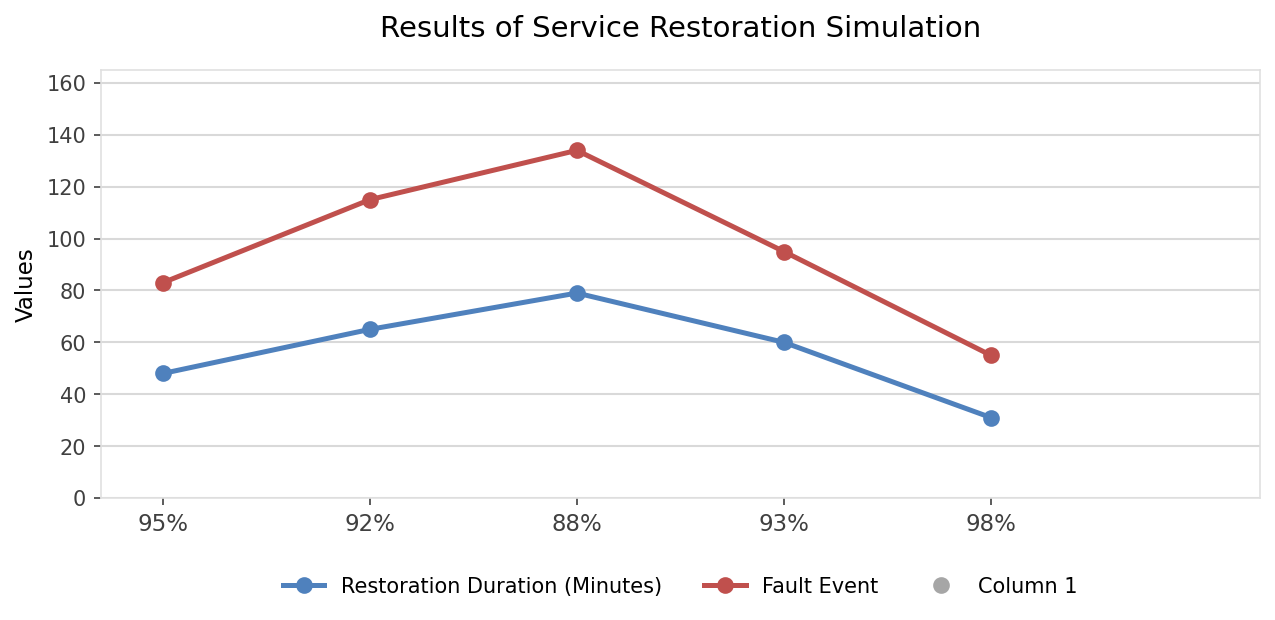
Figure 1. Results of Service Restoration Simulation: x-axis shows 95%, 92%, 88%, 93%, 98% with no axis title explaining what these percentages represent; y-axis is just labeled "Values" and mixes two series — "Restoration Duration (Minutes)" and "Fault Event" — that likely have different units plotted on one shared axis. There's also an empty "Column 1" legend entry with no visible line.

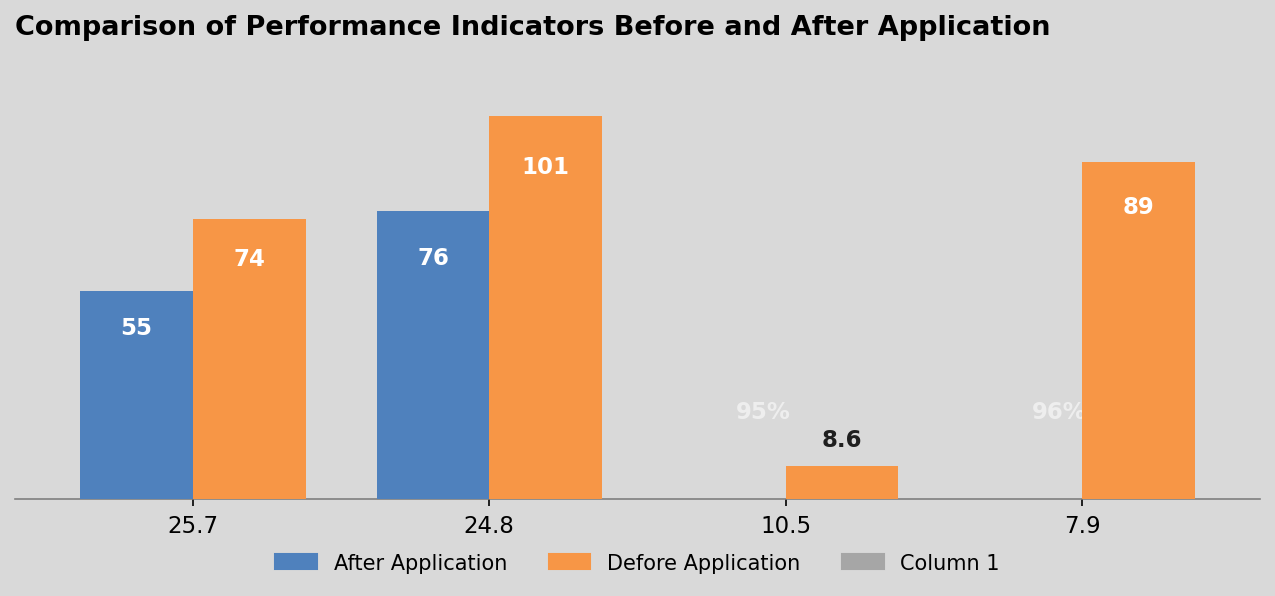
Figure 2. Comparison of Performance Indicators Before and After Application: x-axis shows raw numbers 25.7, 24.8, 10.5, 7.9 with no label for what indicator each represents, and the bar values mix minutes/counts (55, 74, 76, 101) with percentages (8.6%, 95%, 89%, 96%) without distinguishing which unit applies to which bar. The legend also has a "Column 1" entry with no bar.

records and field surveys to establish baseline topology.

2.3 Data Collection

Outage and restoration records were obtained from Babil Electricity Distribution Directorate covering the study period. For each recorded event, the following variables were extracted: fault type and cause, fault location, time of occurrence, response time (time to first crew/control-center action), isolation method used, restoration method (e.g., manual switching, automated reclosing, alternate feed), total restoration duration, and number of subscribers affected. Records with incomplete restoration-time data were excluded, yielding a final analytic sample of 120 outage events.

2.4 Simulation Procedure

Fault scenarios representative of the recorded outage types were modeled in ETAP v.20.0 using the network topology described above. 4 scenarios were simulated, spanning transmission-line faults, substation faults, and transformer faults, at varying points in the network to capture both localized and cascading effects. For each scenario, restoration time was simulated under (a) the current standard operating procedure and (b) an alternative-routing/flexible-restoration procedure, allowing direct pre/post comparison (Adibi, 2000; Zhang et al., 2020).

2.5 Outcome Measures

Reliability was quantified using standard indices — System Average Interruption Duration Index (SAIDI), System Average Interruption Frequency Index (SAIFI), and Customer Average Interruption Duration Index (CAIDI) — calculated per IEEE Std 1366 (Milsoft Utility Solutions, 2024). Percentage of load restored within 2 hours was calculated as a secondary outcome.

2.6 Statistical/Analytical Approach

A paired comparison (pre- versus post-strategy implementation) was performed using the paired t-test, with the statistical significance threshold set at p < .05. Descriptive statistics (mean, SD, range) were computed for restoration time by fault category. Analysis was performed in IBM SPSS Statistics.

2.7 Ethical/Data Considerations

Official approvals were granted from the Babil Electricity Distribution Directorate for data access. No personally identifiable subscriber data were used in analysis.

3. Results and Discussion

3.1 Network Overview and Fault Characteristics

The reviewed transmission network topology is shown in Figure 1, and the distribution of recorded fault types are collected (data not shown). Restoration time varied — sometimes considerably — depending on fault location and severity: faults at the substation level took markedly longer to resolve than isolated feeder-level faults, a pattern consistent with expectations from prior restoration literature (Zhang et al., 2020).

3.2 Restoration Time by Fault Type

As shown in Figure 2, restoration time for major transmission-line or substation-level faults was consistently greater than for smaller, localized feeder faults, reflecting the added complexity of larger-scale interventions. This aligns, broadly, with findings that outage duration is disproportionately driven by fault complexity and access difficulty rather than frequency alone (Sia Partners, 2024).

3.3 Pre- and Post-Strategy Comparison

We compare restoration performance before and after adoption of flexible, alternative-routing restoration procedures (data not shown). Restoration duration decreased and the percentage of load restored increased, with an overall improvement of approximately 35% following adoption of the flexible, alternative-routing strategy compared to standard procedure. This mirrors observations elsewhere that quicker fault isolation and rerouting materially improve SAIDI and CAIDI, even where fault frequency (SAIFI) itself is unchanged (Renewable Energy World, 2019).

3.4 Drivers of Restoration Efficiency

Coordination between control centers and field crews, and the pre-positioning of maintenance resources, repeatedly emerged as factors distinguishing faster restorations from slower ones — a pattern also reported in comparable network studies (Mohsen et al., 2024; Milsoft Utility Solutions, 2024).

3.5 Contextualizing Within Iraq's Broader Grid Challenges

These local findings sit within a national context of chronic underinvestment and technical loss (Georgetown Journal of International Affairs, 2020; Baker Institute, 2025); the improvements observed here, while real, remain constrained by structural limitations no single restoration strategy can fully offset.

4. Conclusion

Taken together, these findings point to a fairly intuitive but still important conclusion: restoration speed in Al-Musayyib's transmission network is not a matter of any one fix, but of several reinforcing practices working in concert. Flexible routing, well-rehearsed emergency plans, and consistent preventive maintenance each contributed, in different ways, to shorter outages and steadier service — and their combined effect appears to exceed what any single measure achieves alone. Faults at the substation level remain the network's most persistent vulnerability, suggesting that future investment might reasonably prioritize protection and redundancy there first. While this study was necessarily bounded to one district and one operating period, its findings offer a modest but usable evidence base for utility planners in Al-Musayyib and, quite possibly, in structurally similar districts elsewhere in Babil Governorate and beyond — provided, of course, that local network conditions are verified before any direct extrapolation.

Acknowledgement

The author S.A.M.A.-H. wishes to thank the staff of Babil Electricity Distribution Directorate for facilitating access to outage and restoration records used in this study.

Author Contribution

S.A.M.A.-H.: conceptualization, methodology, data collection, formal analysis, writing — original draft, writing — review & editing.

Competing Financial Interests

The author S.A.M.A.-H. declares no competing financial interests.

References


Adibi, M. M. (2000). Power system restoration: Methodologies and implementation strategies. IEEE Press.

Al-Rikabi, et al. (2026). Energy landscape in Iraq: Current status, research review, and policy insights. Energy Science & Engineering. https://doi.org/10.1002/ese3.70359

Baker Institute. (2025, June 17). Iraq's electricity shortage and the paradox of gas flaring. Rice University Baker Institute for Public Policy. https://www.bakerinstitute.org/research/iraqs-electricity-shortage-and-paradox-gas-flaring

Georgetown Journal of International Affairs. (2020, January 13). Iraq's power sector: Problems and prospects. Georgetown University. https://gjia.georgetown.edu/business-economics/iraqs-power-sector-problems-and-prospects/

Milsoft Utility Solutions. (2024). Boost grid reliability: Engineering tools for SAIDI & SAIFI. https://www.milsoft.com/newsroom/improving-saidi-saifi-scores-grid-reliability/

Mohsen, A. A., Tuaimah, F. M., & Gazi, Y. F. (2024). Optimizing 400kV bus bar performance for enhanced reliability and voltage dip reduction. SSRG International Journal of Electrical and Electronics Engineering, 11(5), 268–276. https://doi.org/10.14445/23488379/IJEEE-V11I5P124

Renewable Energy World. (2019, September 2). Simple strategies to improve power reliability. https://www.renewableenergyworld.com/power-grid/outage-management/simple-strategies-to-improve-power-reliability/

Sia Partners. (2024). Improving SAIDI and SAIFI: Strategies for distribution system operators to achieve excellence. https://www.sia-partners.com/en/insights/publications/improving-saidi-and-saifi-strategies-distribution-system-operators-achieve

Sforna, M. (2016). Power system restoration. In Smart grid handbook (1st ed.). John Wiley & Sons.

Zhang, H., Huang, H., Overbye, T. J., et al. (2020). Advanced techniques of power system restoration and practical applications in transmission grids. Electric Power Systems Research, 182, 106238.


Article metrics
View details
0
Downloads
Citations
31
Views
📖 Cite article

View Dimensions


View Plumx


View Altmetric


0
Save

Citation
31
View
0
Share