1. Introduction
Software testing occupies an odd position in the software industry — or so it has seemed for most of the field's history. It is, in principle, indispensable; nobody sets out to ship broken code, and Black's (2007) now-standard treatment of the discipline frames testing as the practice that stands between a working system and one that merely looks like it works. And yet, for decades, testers were treated as something closer to an afterthought: a checkpoint bolted onto the tail end of "real" development rather than a discipline with its own intellectual demands. That perception has been shifting, gradually and unevenly, as organisations have come to recognise — sometimes the hard way — that quality assurance shapes whether a product survives contact with the market. The rise of continuous delivery pipelines, in which testing is woven into every build rather than reserved for a final gate (Humble & Farley, 2010), and of agile methods that pull testers into design conversations earlier than before (Bordin & De Angeli, 2016), has arguably done more to change this image than any amount of advocacy could. Still, the change has been partial, and it plays out differently depending on where in the world one happens to look.
A typical software development life cycle moves through planning, requirements analysis, design, development, testing, deployment, and maintenance — and testing sits at the point where mistakes made earlier become visible, or, ideally, are caught before they become anyone else's problem. Requirements themselves rarely hold still long enough to make that job easy; Nurmuliani et al. (2004) documented just how much requirements volatility complicates downstream verification, which is one reason testing is harder in practice than the tidy life-cycle diagram suggests. Given the position testing occupies, it is a little strange that testers were long regarded as second-class members of development teams — Kassab et al. (2021) note that many engineers actively avoid testing as a career entry point, treating it instead as a stepping stone toward analyst, programmer, or architect roles. Part of this may be a visibility problem: Storey et al. (2005) argued, in a related context, that awareness of who is doing what on a development team depends heavily on how that work is represented and surfaced, and testing work has traditionally been represented poorly. Part of it may also be pedagogical. Mayer et al. (1986) and, later, Halpern (1998) both suggested that the kind of structured, transfer-oriented critical thinking testing actually requires is not something most curricula teach deliberately — it is assumed to emerge on its own, which it does not always do.
Where the literature is more encouraging — or at least more detailed — is on what testing work actually demands once someone is doing it. Florea and Stray (2018, 2019), examining postings from more than thirty countries, found employers expecting testers to bring not only test-planning and automation competence but a fairly demanding set of soft skills: communication, analytical reasoning, the capacity to hold up under pressure. That finding echoes a broader strand of research on soft competencies in technical roles. Holtkamp et al. (2015) traced soft-skill expectations across requirements engineering, design, implementation, and testing alike; Joseph et al. (2010) made a related case for "practical intelligence" as an underrated asset among IT professionals; and Sukhoo et al. (2005) argued that technical competence without interpersonal competence tends to break down under real project pressure. Cohen et al. (2004) put a finer point on this, showing that much of the day-to-day friction in testing work is conflict management wearing a technical disguise. Kumar and Hsiao (2007) went so far as to suggest engineers mostly learn such skills "the hard way," through experience rather than instruction — a claim with obvious implications for how testing careers get built. Rivera-Ibarra et al. (2010) tried to formalise some of this into a competency framework for software engineers generally, while Kuusinen et al. (2016) connected developer motivation and flow states to the sustained attentiveness testing seems to require. Garousi and Mäntylä (2016), reviewing the testing literature at a meta level, found the empirical base on tester roles thinner and more geographically lopsided than one might expect — a gap this study is, in its small way, trying to narrow.
That geographic lopsidedness is worth dwelling on. Masuda (2017), writing from a Japanese context shaped by a string of high-profile software failures in financial and airline systems, argued that the gap is not only about workplace practice but about education — only about half of IT and engineering curricula there meaningfully address testing at all. Capretz et al. (2020), surveying senior software students in Malaysia, found the students themselves ambivalent about the field, aware of both its merits and its drawbacks, which hints that whatever image problem testing has starts early, well before graduates ever reach a job posting. What has been studied far less, though — hardly at all, really — is how any of this plays out in South Asia, and in Bangladesh specifically. This matters for reasons beyond completeness. Bangladesh's IT and IT-enabled services sector has grown considerably over the past decade, and software testing there, as Javed (2012) observed in a broader discussion of quality assurance in developing economies, tends to face a distinct set of constraints — tight budgets, compressed timelines, inconsistent standards — that may or may not resemble those reported in more heavily studied markets. Whether they do is, frankly, an open question this study cannot fully settle, but it is one worth raising. Ocholla and Shongwe (2013), in an unrelated but methodologically instructive study of the library and information science job market in South Africa, showed that job-advertisement analysis can meaningfully characterise an emerging profession's requirements even with a modest sample, provided the approach stays transparent about its limits. That precedent, together with Kassab et al.'s (2021) tester-specific methodology in the United States, offers a reasonable template for adapting the same kind of analysis to Bangladesh.
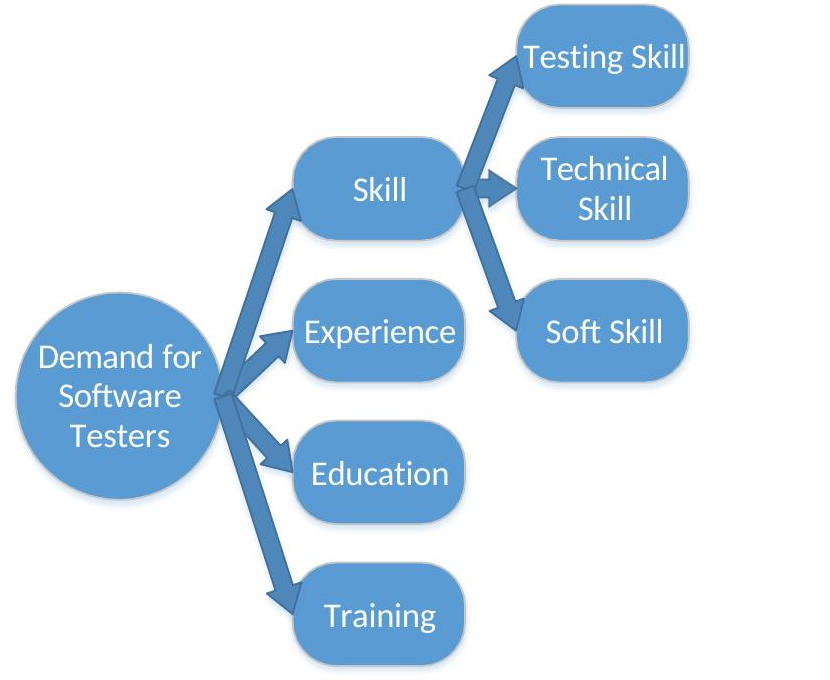
This study, then, asks a fairly narrow but practically useful question: what do employers in Bangladesh actually say they want when they advertise for software testers? Drawing on job postings collected from BDJobs — the country's leading online job portal — over November and December 2022, we examine the education, training, experience, and skill requirements attached to testing roles, organised around the research questions detailed in the following section. The intent is not to offer a definitive account of the Bangladeshi testing labour market; two months of data from a single portal cannot support that, and we would be overstating our case to claim otherwise. What we hope to provide instead is an initial, evidence-based sketch — one that newcomers to the field, career counsellors, and curriculum designers might reasonably use as a starting point, and that future researchers, working with richer and longer-running data, can build upon or, just as usefully, revise.