Oxidative stress is a major contributor to numerous chronic diseases, including neurodegenerative disorders, cardiovascular diseases, and aging-related conditions (Halliwell & Gutteridge, 2015). It results from an imbalance between the production of reactive oxygen species (ROS) and the body's ability to neutralize them through antioxidant defenses. Rutin, a naturally occurring flavonoid glycoside, plays a crucial role in combating oxidative stress by scavenging free radicals, enhancing antioxidant enzyme activity, and modulating inflammatory pathways (Rahmani et al., 2023) (Table 2). This section explores the antioxidant properties of rutin, emphasizing its role in mitigating oxidative damage at the cellular level.
2.1 Understanding Free Radicals and Oxidative Stress
Free radicals are highly reactive molecules with unpaired electrons, making them unstable and prone to interacting with biological macromolecules such as lipids, proteins, and DNA (Valko et al., 2007). These interactions can lead to cellular damage, inflammation, and the progression of various diseases. Free radicals are generated both endogenously — through normal metabolic processes such as mitochondrial respiration — and exogenously, as a result of environmental factors like pollution, radiation, and cigarette smoke (Halliwell & Gutteridge, 2015). The most common free radicals involved in oxidative stress include: superoxide anion (O₂⁻·) — a byproduct of mitochondrial electron transport, and hydroxyl radical (·OH) — one of the most damaging ROS, capable of attacking DNA, proteins, and lipids.
Nitric oxide (NO·) and peroxynitrite (ONOO⁻) — involved in inflammation and neurodegenerative disorders. The body has evolved several mechanisms to neutralize these harmful radicals, primarily through enzymatic antioxidants like superoxide dismutase (SOD), catalase (CAT), and glutathione peroxidase (GPx) (Valko et al., 2007). However, excessive ROS production can overwhelm these defense systems, leading to oxidative stress and cellular damage.
2.2 Rutin as a Potent Free Radical Scavenger
Rutin exhibits strong antioxidant properties due to its ability to directly scavenge free radicals and enhance the activity of endogenous antioxidant enzymes. The presence of hydroxyl (-OH) groups in its molecular structure allows rutin to donate electrons, thereby stabilizing free radicals and preventing them from initiating chain reactions that cause oxidative damage (Satari et al., 2021). Reviews synthesizing the neuroprotective literature report that rutin reduces lipid peroxidation and oxidative injury across several models of neurological disease, consistent with a role in preventing neurodegenerative processes (Zhang & Wang, 2025). Rutin's radical-
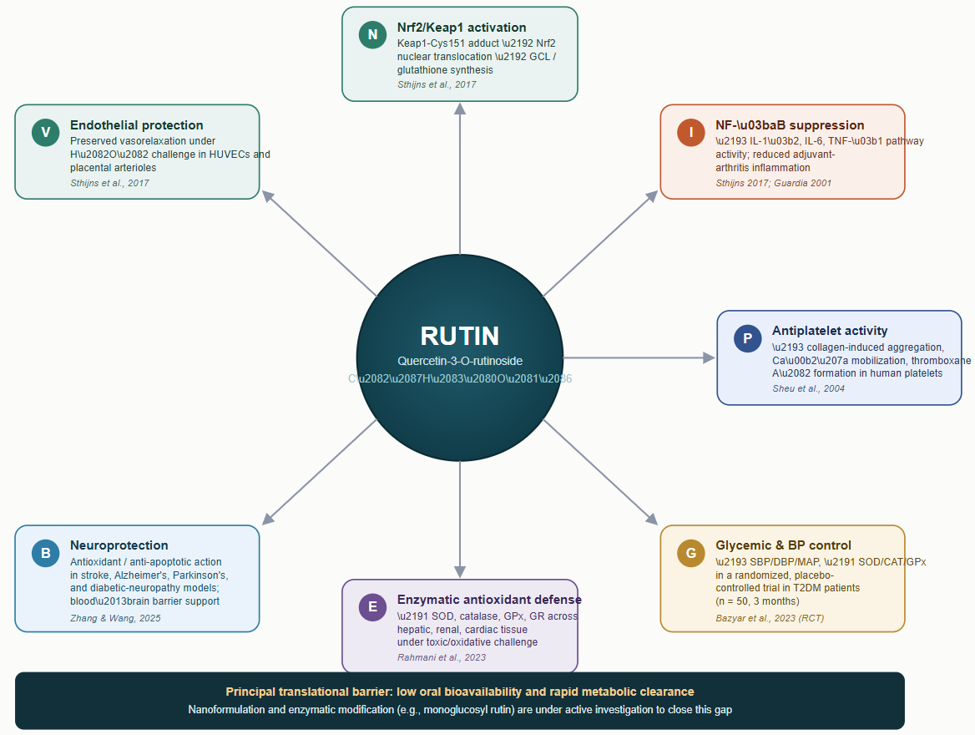
Figure 1. Graphical summary of rutin's principal, evidence-verified mechanisms of action across oxidative, inflammatory, vascular, and metabolic pathways. Each node cites the specific verified source supporting it (see References).
Table 1: Mechanisms of free radical neutralization.
|
Mechanisms
|
Description
|
|
Direct free radical scavenging
|
Rutin donates electrons or hydrogen atoms to neutralize reactive oxygen species (ROS) such as superoxide anions.
|
|
Metal chelation and prevention of Fenton reactions
|
Rutin is proposed to bind transition metals like iron and copper, limiting their participation in Fenton reactions (mechanism plausible for flavonoids generally; not independently confirmed for rutin in this review).
|
|
Modulation of antioxidant enzyme activity
|
Rutin enhances the activity of antioxidant enzymes including superoxide dismutase, catalase, and glutathione peroxidase, which neutralize ROS (Rahmani et al., 2023).
|
|
Inhibition of lipid peroxidation
|
Rutin scavenges lipid peroxyl radicals, limiting oxidative damage to polyunsaturated fatty acids (Rahmani et al., 2023).
|
Table 2: Antioxidant and pharmacological properties of rutin — aspect, mechanism, study type, and clinical relevance
|
Aspect
|
Mechanism of benefit
|
Study type / model
|
Clinical relevance
|
|
Free radical scavenging
|
Donates electrons/hydrogen atoms via HAT and SET mechanisms to neutralize ROS such as superoxide, hydroxyl, and peroxyl radicals (Satari et al., 2021).
|
In vitro chemical assays; mechanistic review
|
Proposed protective role against oxidative-stress-related disease; foundational mechanism underlying downstream effects.
|
|
General redox biology context
|
ROS/RNS imbalance drives lipid, protein, and DNA damage underlying aging and chronic disease; rutin's scavenging activity is relevant against this backdrop (Valko et al., 2007; Halliwell & Gutteridge, 2015).
|
Foundational reviews / textbook
|
Establishes disease rationale rather than a rutin-specific clinical finding.
|
|
Antioxidant enzyme enhancement
|
Upregulates SOD, catalase, GPx, and glutathione reductase activity across hepatic, renal, and cardiac tissue (Rahmani et al., 2023).
|
Rodent organ-toxicity models (review synthesis)
|
Mechanistically consistent with clinical enzyme increases reported below.
|
|
Antioxidant enzyme enhancement (clinical)
|
Significantly increased serum SOD, CAT, and GPx activity versus placebo after 1 g/day rutin for 3 months.
|
Double-blind RCT, n = 50, type 2 diabetes mellitus (Bazyar et al., 2023)
|
Direct human evidence; one of the few adequately controlled clinical trials in this literature.
|
|
Blood pressure regulation
|
Reduced systolic BP, diastolic BP, mean arterial pressure, and heart rate relative to placebo.
|
Double-blind RCT, n = 50, type 2 diabetes mellitus (Bazyar et al., 2023)
|
Clinically meaningful, though based on a single, modestly sized trial.
|
|
Endothelial / vascular protection
|
Nrf2/Keap1 activation and NF-κB suppression; preserved vasorelaxation under H₂O₂ challenge (Sthijns et al., 2017).
|
Human umbilical vein endothelial cells; placental arterioles (ex vivo)
|
Direct mechanistic human-cell/tissue evidence linking redox chemistry to a functional vascular readout.
|
|
Antiplatelet activity
|
Inhibits collagen-stimulated platelet aggregation, Ca²⁺ mobilization, and thromboxane A2 formation (Sheu et al., 2004).
|
Human platelets, in vitro
|
Direct human-platelet evidence; potential antithrombotic relevance, not yet tested as a clinical endpoint.
|
|
Lipid / cholesterol modulation
|
Reduced total cholesterol and LDL-C (Ziaee et al., 2009); a more bioavailable modified form (monoglucosyl rutin) reduced LDL-C, total cholesterol, and LDL/HDL ratio in humans (Hashizume & Tandia, 2024).
|
Hypercholesterolaemic rats; human RCT (modified rutin)
|
Evidence is real but mixed — at least one comparative animal study found no lipid effect for native rutin versus atorvastatin; effect may depend on formulation.
|
|
Anti-inflammatory activity
|
Reduced inflammatory markers in joint tissue, comparable to quercetin and hesperidin (Guardia et al., 2001); NF-κB suppression in endothelial cells (Sthijns et al., 2017).
|
Adjuvant-arthritis rat model; HUVECs
|
Supports a genuine anti-inflammatory role, though rutin-specific human inflammatory-marker data are still lacking.
|
|
Neuroprotection
|
Antioxidant, anti-inflammatory, and anti-apoptotic action across stroke, Alzheimer's, Parkinson's, and diabetic-neuropathy models; blood–brain barrier support (Zhang & Wang, 2025).
|
Preclinical review synthesis (2025)
|
Mechanistically broad, but the review itself flags low bioavailability as the main limiter of clinical translation.
|
|
Bioavailability / delivery
|
Native rutin has poor oral bioavailability and rapid clearance; enzymatic modification (monoglucosyl rutin) improves solubility and shows measurable clinical effects on visceral fat and LDL-C.
|
Human RCTs, modified rutin (Hashizume & Tandia, 2024)
|
Identifies the field's principal translational bottleneck and one validated strategy for addressing it.
|
scavenging chemistry — acting through hydrogen-atom-transfer and single-electron-transfer mechanisms — has similarly been described as neutralizing hydroxyl radicals, superoxide anions, and peroxyl radicals, protecting cellular components from oxidative damage (Satari et al., 2021).
Rutin's antioxidant action also appears to work alongside the body's broader enzymatic antioxidant defenses — including SOD, catalase, and glutathione peroxidase — rather than acting in isolation, amplifying its overall protective effect on cellular health (Rahmani et al., 2023).
2.3 Enhancing Antioxidant Enzyme Activity
Beyond its direct free radical scavenging ability, rutin also enhances the activity of key antioxidant enzymes, strengthening the body's natural defense mechanisms. A synthesis of organ-toxicity studies reports that rutin administration increases the activity of superoxide dismutase (SOD), catalase (CAT), glutathione peroxidase (GPx), and glutathione reductase (GR) across hepatic, renal, and cardiac tissue exposed to oxidative or toxic challenge (Rahmani et al., 2023). Consistent with this, a randomized controlled clinical trial in patients with type 2 diabetes mellitus found that daily rutin supplementation significantly increased serum SOD, CAT, and GPx activity relative to placebo over three months (Bazyar et al., 2023). Reviews of rutin's neuroprotective mechanisms similarly report upregulated antioxidant enzyme activity and reduced lipid peroxidation across models of neurological injury (Zhang & Wang, 2025).
2.4 Protection Against Oxidative Stress-Related Diseases
Cardiovascular Protection
Oxidative stress is a major factor in the development of cardiovascular diseases, including hypertension, atherosclerosis, and heart failure. Rutin has been shown to protect against cardiovascular damage by reducing oxidative stress and improving endothelial function; working in human umbilical vein endothelial cells, Sthijns et al. (2017) demonstrated that rutin activates the Nrf2 antioxidant pathway and protects placental arterioles from oxidative impairment of vasorelaxation. In a clinical setting, a double-blind, placebo-controlled trial in patients with type 2 diabetes mellitus found that three months of rutin supplementation significantly reduced systolic and diastolic blood pressure alongside increases in antioxidant enzyme activity, suggesting a genuine cardioprotective effect in humans, not only in preclinical models (Bazyar et al., 2023).
Neuroprotection and Cognitive Health
Neurodegenerative diseases such as Alzheimer's and Parkinson's are strongly linked to oxidative stress and neuroinflammation. A 2025 review synthesizing the neuroprotective literature on rutin describes antioxidant, anti-inflammatory, and anti-apoptotic actions across models of stroke, Alzheimer's disease, Parkinson's disease, and diabetic neuropathy, along with a role in protecting the blood–brain barrier (Zhang & Wang, 2025). The same review is careful to note that, despite this broad preclinical evidence, rutin's clinical application in neurological disease remains limited chiefly by its low oral bioavailability.
Anti-Aging and Skin Protection
Aging is largely driven by cumulative oxidative damage to cells and tissues. Rutin's antioxidant chemistry provides a plausible basis for benefit in skin health — for example, in limiting UV- and pollution-driven oxidative damage — but direct, well-controlled human evidence specific to rutin's anti-aging or dermatological effects is still limited, and this remains an area better described as promising than established.
2.5 Future Perspectives and Therapeutic Potential
As interest in natural antioxidants grows, rutin is emerging as a promising candidate for therapeutic applications. Its ability to mitigate oxidative stress-related diseases makes it a valuable component in nutraceuticals, functional foods, and pharmaceuticals. Future research should focus on optimizing its bioavailability and exploring novel delivery methods, since poor oral bioavailability is repeatedly identified as the principal barrier limiting rutin's translation from preclinical promise into confirmed clinical benefit (Zhang & Wang, 2025). Rutin's antioxidant properties make it a compound worth continued study for combating oxidative stress and preventing related diseases. As research progresses, and as more adequately powered human trials of the kind reported by Bazyar et al. (2023) accumulate, rutin's role in natural antioxidant therapy should become considerably clearer.